Who Leads the Mushoku Tensei Sequel? Decoding the Eight Figures in Rudeus’s Last Dream
A great-granddaughter with a Dragon God’s bracelet, a savior playing fifty-year chess against a god, and an ordinary Japanese boy with zero…
Who Leads the Mushoku Tensei Sequel? Decoding the Eight Figures in Rudeus’s Last Dream
A great-granddaughter with a Dragon God’s bracelet, a savior playing fifty-year chess against a god, and an ordinary Japanese boy with zero mana. The final chapter reads like a casting sheet — here’s how Japanese fans decode it.
⚠️ Maximum spoiler warning: This piece covers the very last chapter of the complete Mushoku Tensei novels — Rudeus’s death included — plus untranslated Japanese web-only epilogues and heavy sequel speculation. Anime viewers: Season 3 is airing right now (summer 2026), and this discusses the end of everything. You’ve been warned twice now.
The last chapter of Mushoku Tensei contains one of the strangest scenes in the series, and almost nobody talks about it in English.
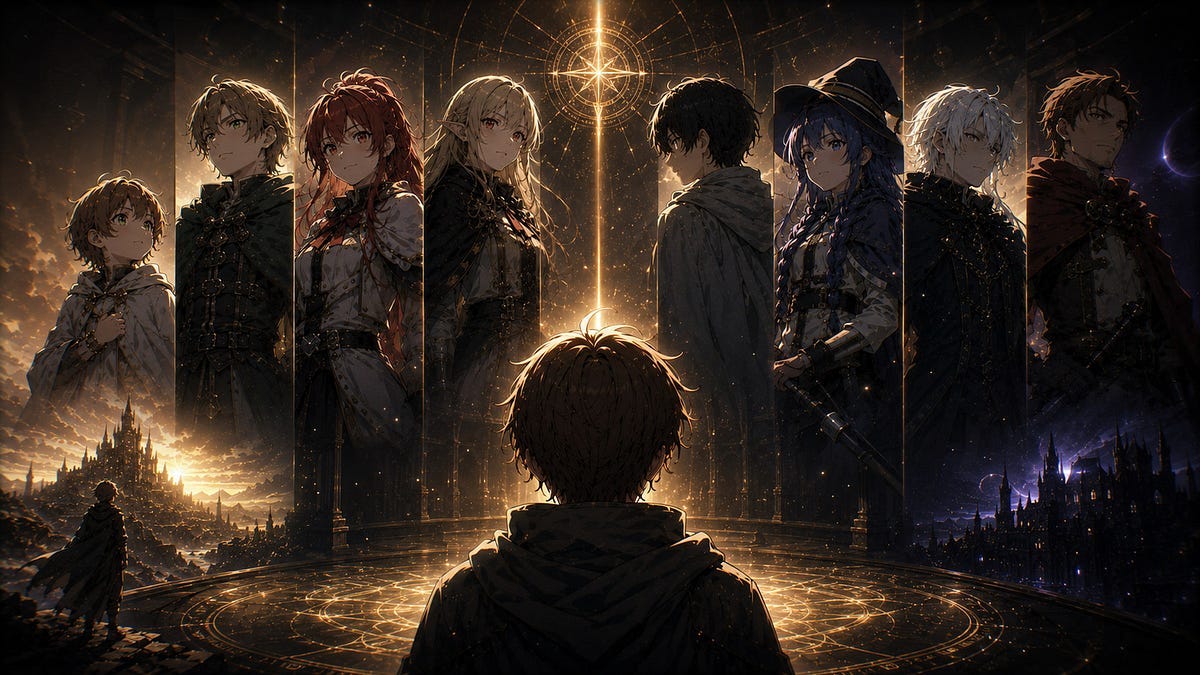
As Rudeus dies in year 481, he dreams of a white place where a group of people — about eight of them — sit talking. He recognizes exactly one: Orsted. The rest are strangers, described only in fragments: a boy of seventeen or eighteen with East Asian features doing most of the talking; a blue-haired girl half-hiding in the group who makes Rudeus wonder, could that be Lara?; a man in his twenties, also East Asian-looking, who turns and bows to Rudeus in a distinctly Japanese way. (We’re summarizing, not quoting — the scene is in the final translated volume, web ch. 260, and deserves your own read.)
Japanese fans have long treated this dream as exactly what it looks like: the author showing us the sequel’s cast a decade before writing it. This is Part 8, the finale of our series on Mushoku Tensei’s untranslated sequel lore — and the fun one. Who’s actually going to lead “The Story of the Six-Faced World” (the sequel’s tentative title)? Here’s how one Japanese essayist we follow breaks down the candidates, with all their caveats intact.
Candidate 1: Feris, the girl with the bracelet
Feris (no official English spelling exists) is Rudeus’s great-granddaughter through the line we mapped in Part 5: Ars and Aisha’s son Leroy is her father. Two things make her the classic-protagonist pick.
First, the bracelet. Before dying, Rudeus passes her the Dragon God’s bracelet — an object people around him treat as the mark of the Dragon God’s right hand. In a series this deliberate, a dying protagonist handing a named child a symbol of office in his final chapter is about as subtle as a trumpet fanfare. She also appears in the white-place dream.
Second — and this is the elegant part — Orsted cannot predict her. In every other loop, Eris married Luke; the entire Ars line, and therefore Feris, exists in no timeline Orsted has ever lived. She’s a blank spot on the answer key, just like the war itself (see Part 7). A protagonist the in-world god of foreknowledge can’t foresee is a lovely thematic engine.
The essayist adds a numerology garnish they openly admit is wishful: Feris is about five when Rudeus dies, which makes her 24 in K500 and 34 around K510 — and 34 is a loaded number for anyone who remembers where Rudeus’s first life ended. The honest counterweight: in a war whose players include gods, immortals, and title-holders, it’s genuinely unclear how a talented human girl becomes relevant — unless her inheritance includes hardware, whether Lily’s mass-production Magic Armor or something sharper.
Candidate 2: Lara, the fifty-year chess game
Lara Greyrat is canonically prophesied as a savior, and the untranslated epilogues show what that looks like in practice: half a century of travel, quietly plucking “slightly off futures” before they bloom — which the material all but states means countering Hitogami. Her style, as the essayist reads it, is beautifully anti-dramatic: moves that look pointless in the moment, until the god realizes a local battle he thought won has become unwinnable. A patient, indirect player against an opponent who only knows straight lines. (The world’s chess-like game, Karkatranga, is likely named after India’s chaturanga — ancestor of chess and shogi — which feels like the author leaving his metaphor on the table.)
But that’s precisely why the essayist doubts she’s the lead: she’s the fixer who makes the finale possible, not the one who swings the sword in it. Expect her everywhere in the sequel’s first half — including one very odd errand: the epilogues have her telling her family, in effect, that she’s been running experiments in high-mana-density places and will eventually bring a man home. Rudeus assumed she meant a husband. Everything else Lara says suggests she means a weapon in the war against Hitogami.
Candidate 3: the boy with zero mana
Which brings us to Akito Shinohara — an ordinary Japanese high schooler whose name has been hiding in the series since the prologue, resurfacing when Rudeus and Nanahoshi compare notes on who else was on that street in Japan. The untranslated “Epilogue: Prologue Zero” puts him at the center of the sequel’s premise: summoned into a war-torn K500 by Lilia’s unconscious interference with Orsted’s loop, fated to die at Roa — unless the rewritten timeline saves him.
He is, by every indication, a normal kid: no combat skills, and — if he’s like Nanahoshi — zero mana. So what is he for?
Here the essayist offers their boldest theory, with a disclaimer we’re contractually obligated by honesty to repeat: they themselves call it full of holes and “for reference only.” The theory: Akito is the one who ends up inside the Fighting God Armor — the sentient golden armor that turns an amateur into someone who can kill the strongest beings alive (the books are explicit about this in part 23). The armor devours its wearer’s mana and will; a boy with no mana shouldn’t be able to wear it at all — unless his mana is borrowed. The essayist sketches two mechanisms: maybe the fifty years of displaced mana from Rudeus’s teleport catastrophe found its way to K500 through Akito’s stay in the rift between times; or maybe Lilia — hollowed out by her bargain — is his external battery, meaning every minute Akito fights, someone he’s never met pays for it. Shaky? Absolutely. But “the most ordinary person in the story wearing the most monstrous weapon in it” is exactly the kind of irony this author feasts on.
The dream isn’t a goodbye. It’s a cast list — and the loudest voice in it belongs to a boy with no magic at all.
The essayist’s actual answer: everyone
Asked to pick one protagonist, the essayist refuses the premise. The sequel’s likely span — 481 to 500 to roughly 510 and then the Hitogami war — is thirty-plus years, with Lara’s campaign running longer still. No single human lifetime of stardom covers it. Their prediction: a braided ensemble. Lara carries the years up to 481; Feris and the Ars line carry the aftermath; Akito and Nanahoshi enter at 500; Orsted and Alexander, and Sieghart on his collision course, run in parallel — all converging on Laplace’s birth, the war, and the god at the end. If forced to name the spine of it: Akito Shinohara, the one person in the cast with no power, no lineage, and no debts to the old story.
And the dream supports the ensemble reading. Count the identifications: Orsted (the scarred forehead gives him away), the teen boy (Akito), the blue-haired girl (Lara, probably), Feris, and the bowing twenty-something — whom fans debate endlessly. Consensus pick: Seiji Kuroki, the man Rudeus died saving in Japan, bowing his gratitude across two worlds — though the essayist notes he shouldn’t look that young, and floats Alexander as an alternative. Three figures remain unidentified. And the absences are as loud as the presences: no Nanahoshi, despite Akito being there. No one from Sylphiette’s line, despite the material’s obsession with Sieghart. No Laplace — which either means nothing, or means everything about how the war ends.
The other duel
One last thread, because it’s too good to leave out. In web ch. 259, the sealed Badigadi leaves Alexander — North God Kalman III — a parting challenge, roughly: find your true enemy, the one your father never found, and surpassing your father means defeating it. The essayist builds a whole speculative arc on that: the Technique God — Laplace’s gentler half — living as a hermit in the mountains; Orsted (who has reason to know where) introducing Alexander for training; and eventually Alexander-plus-Technique-God meeting Sieghart-plus-Demon-God, master against master, as the two halves of the original second-generation Dragon God Laplace circle back toward one body. Pure speculation. But if the sequel gives us that fight, remember you heard the theory from the Japanese web first.
That’s the series, folks: eight silhouettes in a white room, and a fandom on the other side of the language barrier that’s spent years giving them names.
This closes our eight-part series on Mushoku Tensei’s sequel lore — the untranslated epilogues, side stories, spinoffs, and author comments English fans rarely get to see. Follow Manga Deep Dive for whatever the sequel actually confirms or demolishes — and tell us in the responses: who’s your protagonist, Feris, Lara, or Akito?
A note on sourcing: The following are canon or public record — the last-dream scene with its roughly eight figures (final chapter, web ch. 260; we summarize rather than quote); Feris receiving the Dragon God’s bracelet; Lara’s savior prophecy; Akito Shinohara’s prior mentions in the main story; Badigadi’s parting words to Alexander (web ch. 259, paraphrased); the Fighting God Armor’s amateur-to-godslayer effect and mana cost (book part 23); Eris marrying Luke in other loops; the author’s publicly floated sequel plans. Lara’s epilogue activities and “bringing a man home,” the Ars–Aisha–Leroy–Feris line, and Lilia’s timeline rewrite come from untranslated web-only material, described secondhand. The protagonist rankings, the Akito-in-the-armor theory (which its own author flags as shaky), the dream identifications, and the Technique God arc are one Japanese fan’s speculation, relayed with every caveat intact. Names follow official English releases where they exist; Feris, Leroy, Akito Shinohara, and Seiji Kuroki have no official English forms, so renderings may vary.
Originally published at https://mangadeepdivejp.substack.com on July 27, 2026.
메타데이터
- post_id
- c76f1ca7409f
- slug
- who-leads-the-mushoku-tensei-sequel-decoding-the-eight-figures-in-rudeuss-last-dream-c76f1ca7409f
- url
- https://medium.com/@mangadeepdivejp/who-leads-the-mushoku-tensei-sequel-decoding-the-eight-figures-in-rudeuss-last-dream-c76f1ca7409f
- canonical_url
- https://medium.com/@mangadeepdivejp/who-leads-the-mushoku-tensei-sequel-decoding-the-eight-figures-in-rudeuss-last-dream-c76f1ca7409f
- author_url
- https://medium.com/@mangadeepdivejp
- status
- ok
- fetched_at
- 2026-08-12 23:53:48