Denali National Park: North America’s Great Wonder
Denali, the “great one,” is the tallest peak in North America and one of the country’s biggest national parks. The peak is actually taller…
Denali National Park: North America’s Great Wonder
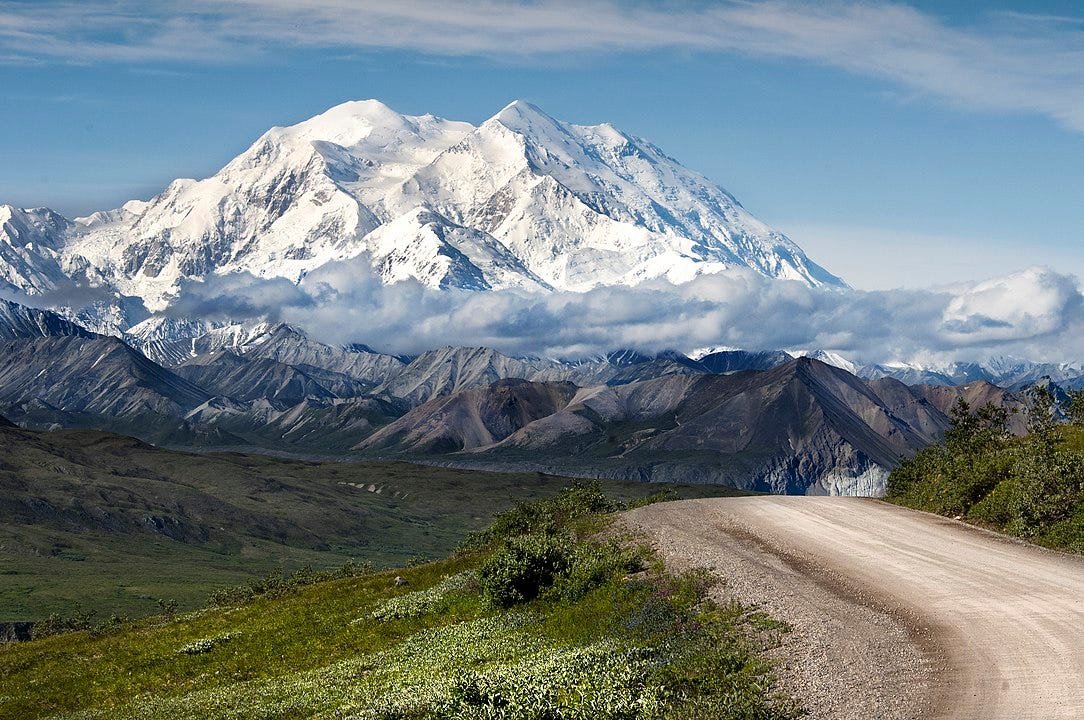
At 20,310 feet, Denali is the highest peak in North America
Denali, the “great one,” is the tallest peak in North America and one of the country’s biggest national parks. The peak is actually taller than Everest. If measured from sea level to peak, Everest is the tallest mountain on Earth. Yet its land base is on the Tibetan plateau at 17,000 feet, while Denali’s land base is much lower at 2,000 feet. So, this means that if measured from its land base, Denali stands at 18,000 feet while Everest stands lower at 12,000. So, while Everest’s altitude is the highest, Denali is the tallest from base to peak. And at nearly 10,000 square miles (9,446 sq miles), the park and preserve is larger than the state of New Hampshire.
The landscape is a mix of forests at the lowest elevations, including deciduous taiga, tundra in the middle, and glaciers, snow, and bare rock at the highest. The park includes the longest glacier in the Alaska Range, the Kahiltna. On average, the park attracts more than 600,000 visitors annually.
History
Early History
Human habitation in the park dates back more than 11,000 years. There are few archeological sites due to the high elevations, harsh winter conditions, and scarce resources. The oldest site, the Teklanika River site, dates back to 7130 BC. Most of the sites are hunting camps as opposed to settlements. The principal groups in the park include the Koyukon, Tanana, and Dena’ina peoples.
Establishment of the Park

Conrad Alexander Sheldon, the Father of Denali National Park
In 1906, conservationist Conrad Alexander Sheldon (1867–1928) conceived the idea of preserving Denali as a national park; Mount Sheldon in the park is named after him. After presenting his idea to the Boone and Crockett Club (founded by Theodore Roosevelt, it is North America’s oldest wildlife and habitat conservation group), it was decided that the political climate wasn’t favorable at the time and that the first step was to gain the support of the Alaskans themselves. After years of discussion with various groups and lobbying, a bill was finally put before Congress in April 1916. The following February, the bill passed. On February 26, 1917, eleven years after its first conception, President Wilson signed the bill creating Mount McKinley National Park, the nation’s twelfth park.

On Thanksgiving 1921, the McKinley Park Hotel opened. In 1923, President Harding visited the hotel on a tour of the Alaska Railroad, during which he drove a golden spike signaling its completion. The hotel was the first thing visitors saw stepping down from the train. The flat-roofed two-story log building featured exposed balconies, glass windows, and electric lights. There were two dozen guest rooms, a shop, a kitchen, a lunch counter, and a storeroom. By the 1930s, due to poor conditions, including drafty rooms and dirty linen, the hotel eventually closed. In 1972, it was destroyed by fire.
Fourteen log cabins were built in the 1920s and 30s as a network of shelters for patrolling park rangers. They are listed on the National Register of Historic Places. The 93-mile Park Road was completed in 1938 after seventeen years of construction.
There was no road access to the park entrance until 1957, when the Denali Highway opened. Park attendance greatly expanded. In 1971, the George Parks Highway opened, providing direct highway connections to Anchorage and Fairbanks.

Denali Highway as seen in summer
In 1967, the park was the site of one of the deadliest mountaineering accidents in U.S. history and is known as the Mount McKinley Disaster. Seven climbers died while attempting to descend from the summit in a severe blizzard, which was estimated to be the worst on Denali in 100 years. The park service debated closing the peak to climbing but ultimately it remained open.
The park was designated an international biosphere reserve. A surrounding Denali National Monument was proclaimed by President Carter in 1978 which was combined with the park in 1980. Also that year a Denali Wilderness was designated within the park.
Name Dispute

Wonder Lake and Denali
The name of this majestic peak has been in dispute since the beginning. The Alaskan natives refer to the mountain as Denali, which means “the high one.” Local prospector William Dickey named the peak after newly elected President William McKinley in 1897. The federal government formally adopted the name when the park was created. In 1980, Mount McKinley National Park was combined with the Denali National Monument, and the new unit was named Denali National Park and Preserve. At that time, the Alaska State Board on Geographic Names changed the name of the mountain to Denali. Yet the U.S. Board on Geographic Names refused the change and continued to denote the name as McKinley. The situation did not resolve until 2015 when President Obama directed the Secretary of the Interior to rename the mountain Denali. In January 2025, President Trump signed an executive order reverting the name to McKinley while keeping the name of the park and preserve unchanged.
Recent Decades
In 1992, Christopher McCandless ventured into the Alaskan wilderness and settled into an abandoned bus in the park on the Stampede Trail, near Lake Wentitika. He carried little food and equipment and was ill-prepared for the harsh Alaskan wilderness. He hoped to live simply off the land in solitude. A little over two months (July) in the wilderness, he decided to head back to civilization, but his route was blocked by the impassable Teklanika River, swollen from summer run-off. He did not have any maps and was unaware of an abandoned hand-operated cable car that crossed the river a mere half-mile down from where he had previously crossed in April. At that point, he headed back to the bus and re-established camp. Sometime in August, McCandless died of starvation. On September 6, a passing hiker found his remains, weighing only 67 pounds. His story has been widely publicized via books, articles, and film. The bus became a pilgrimage site, attracting people from around the world.

On June 18, 2020, various government agencies coordinated with the Alaska Army National Guard to remove the bus, deemed a public safety concern after fifteen people had to be rescued and two people died crossing the Teklanika River attempting to reach the bus. On September 24, 2020, the Museum of the North at the University of Alaska Fairbanks announced it was the new home of McCandless’ “Magic Bus 142,” where it will be restored, and a new outdoor exhibit will be created.
In November 2012, the U.S. Mint released the 15th coin of its America the Beautiful series honoring Denali National Park. The coin features a Dall sheep with Denali in the background.
Geography

Denali National Park and Preserve encompasses the central highest portion of the Alaska Range, along with the glaciers and glacial valleys running southward out of the range. The George Parks Highway runs along the eastern edge of the park. The entrance is eleven miles south of Healy. The visitor center and headquarters are located just inside the entrance.
The size and isolation of Denali lead to it generating its own weather. As a result, the mountain is often surrounded by clouds. Locals often say “the mountain is out” whenever it makes an appearance. It is commonly believed that only thirty percent of visitors to the park actually see Denali, and that only ten percent get to see the mountain unobscured from top to bottom. Due to weather patterns, the mountain is more often visible during the winter months. The visitor center has an etched outline of the peaks of Denali on the windows facing the mountain, showing where it would be if it were visible.
Wilderness
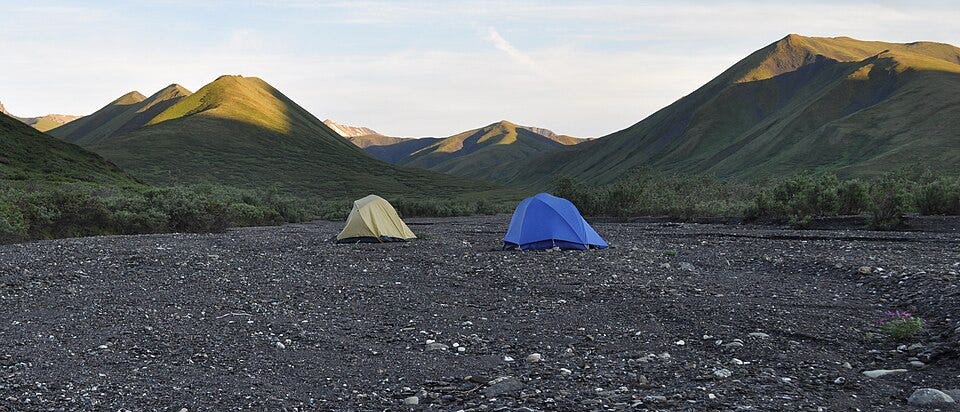
Camping on the Savage River drainage
The Denali Wilderness is an area in the park that protects the higher elevations of the central Alaska Range, including Denali. It comprises one-third of the park and preserve.
Visiting the Park

White Spruce taiga along the Denali Highway with the Alaska Range in the background
The park is serviced by the 93-mile-long Denali Park Road and is the sole vehicle access to the park. Only fifteen miles of it is paved due to permafrost and the freeze-thaw cycle. Private vehicles are restricted beyond this point. Access to the interior is only by tour/shuttle buses. All shuttle buses, along with some tours, depart from the Denali Bus Depot located a mile within the park. The visitor center is 1.5 miles within the park and features exhibits and ranger-led programs. It is also close to the park airport and railroad depot, which offers service for the Alaska Railroad’s Denali Star route between mid-May and mid-September.

The park’s only road

The world-famous Denali Star
Three campgrounds near the entrance are accessible by private vehicles (Riley Creek, Savage River, and Teklanika River), and camper buses provide access to campgrounds in the interior (Sanctuary River, Igloo Creek, and Wonder Lake). Snow closes the Park Road past the park headquarters for the winter between October to April, though the park remains open for cross-country skiing, snowshoeing, and dogsledding.
Kantishna features backcountry lodges accessible by chartered air taxi flight to the Kantishna Airport. Lodging, restaurants, and other services are in the community of Denali Park, one mile north of the park entrance on the George Parks Highway.
The far north of the park, characterized by hills and rivers, is accessed from the east by the Stampede Trail, a dirt road that effectively stops at the park boundary near the former location of the McCandless bus. The rugged south portion of the park, characterized by large glacier-filled canyons, is accessed by Petersville Road, a dirt road that stops about five miles outside the park. The mountains can be accessed most easily by air taxis that land on the glaciers.
Those wanting to climb Denali must first obtain a permit and go through orientation.
There are a few maintained hiking trails at Savage River, Eielson Visitor Center, Wonder Lake, and Riley Creek. The park also encourages off-trail hiking. But you don’t want to be caught in the backcountry without a map.
Things to Do

Caribou and a tour bus on the Park Road
Sled Dog Kennels
Denali has the only sled dog kennel owned by the federal government, where sled dogs are raised and trained. Sled dogs were first used in the park in 1922 to patrol the area to prevent poaching and assist in park development. These beautiful dogs are an important part of the cultural and historic significance of Denali. Park rangers continue to breed Alaskan Huskies for mushing and working at the park, particularly during the snowy winter months. Rangers use them to reach remote areas, and they are the only sled dogs used in a national park. In summer, the kennel has dog sledding demonstrations for visitors. Rangers provide three demonstrations daily during the summer. You can pet the dogs and take pictures. And if interested, you can apply to adopt a retired Denali sled dog.
Savage River Loop Trail
This peaceful trail features a charming footbridge that spans the river and is a great spot to take a pic, take in the views, and watch for wildlife. The trailhead is about as far as you can go on the park road before it closes. There is a small parking area but it’s recommended to use the park shuttle.
The area is usually very windy, and the weather can change in an instant. So be prepared, as you can experience several weather conditions in just one short hike. The hike is two miles round trip with minimal elevation change. Pets are not permitted.
Horseshoe Lake Trail
This pristine and gorgeous lake is tucked within the trees, where you can spot moose along the shoreline. The trail is popular, so you don’t expect to have it to yourself. The elevation drops greatly as you approach the lake, so expect to hike a slightly steep hill on your way out. The trail circles the lake, so you can circle it if you want. It’s a two-mile round trip. No pets. The easiest way to get here is by the Riley Creek Loop shuttle.
Wonder Lake

If you can make it out there, you will be in for a real treat. This breathtaking lake is 2.6 miles long and 280 feet deep. The only way to get here is by bus, and it is a lengthy eleven-hour day trip. Bring plenty of snacks and water. Stay overnight if you can. There is a great campground or the Camp Denali Lodge. The area is notorious for mosquitoes. Bring plenty of bug spray and a head net (available at stores near the park).
The Triple Lakes Trail

Alpine lakes and forest in Denali
This is the longest established trail in Denali and travels through the wilderness to three beautiful lakes. Look for blueberries (which means bears) and enjoy watching for waterfowl and beavers. Hike in a group and carry bear spray. Read up on bear safety before you go. The elevation change makes this more strenuous than many of the other hikes in the park system. So be prepared for a workout.
The trail is 9.5 miles if you start at the visitor center and end at the highway; you will need to use the shuttle to get back to your starting point. It’s a four-mile round trip if you begin at the trailhead along the highway, go to the lakes, and then turn around and go back. No pets.
Mount Healy Overlook

The 5,716 foot tall Mount Healy in the spring
It’s the perfect trail for those who don’t want to climb but want a stunning vantage point. It provides an amazing view of the valley below, and if you are lucky enough, Denali itself.
The hike is considered strenuous as it climbs the mountainside quickly. Expect some steep but manageable areas of the trail. Plan and prepare for the weather. As you gain elevation, you’ll lose tree cover and be more exposed to the elements. The trail ends at the overlook, but you can continue if you want to go to the top of the mountain. The trail is 5.4 miles round trip and gains 1700 feet in elevation. No pets. The easiest way to get here is the Riley Creek Loop shuttle.
McKinley Station Trail
There are many great trails to take at the visitor center, but this is one of the most fascinating. Over a hundred years ago, this area was once an energetic community of trappers and miners, and was typical of the Alaska towns of that era. It boasted a schoolhouse, a trading post, a fox-farming enterprise, a hotel, and a railroad depot. In 1932, less than twenty years after it came into existence, the town effectively came to an end when the park boundaries expanded. Little is left today, but the trail provides a small glimpse into a former way of life. Be sure to take the hiking guide with you as you walk the trail and learn about the area’s history. It’s a great little stroll to take a stroll on.
Mountain Vista Trail
This is a peaceful hike through a boreal forest and has great views of the Alaska Range. The trail is 0.6-mile loop and gains fifty feet in elevation. It travels through the site of an old tourist camp and there are interpretative panels explaining what used to be here. It also provides a great opportunity to see Denali.
You can drive here, and there is ample parking, clean restrooms, and picnic tables. You can also take the Savage River Shuttle.
Conclusion

Kichatna Range in the southwest preserve
A trip to Denali is richly rewarding. To see the continent’s highest peak in all of its splendor is simply breathtaking. This park is majestic and well worth the effort to visit.
메타데이터
- post_id
- c76feb32580d
- slug
- denali-national-park-north-americas-great-wonder-c76feb32580d
- url
- https://medium.com/@swgorham/denali-national-park-north-americas-great-wonder-c76feb32580d
- canonical_url
- https://medium.com/@swgorham/denali-national-park-north-americas-great-wonder-c76feb32580d
- author_url
- https://medium.com/@swgorham
- status
- ok
- fetched_at
- 2026-07-19 10:20:16