Curve Pitching at Princeton
Mac Mann, Ham Avery, and Candy Cummings square off at the nexus of legend and fact
Curve Pitching at Princeton
Mac Mann, Ham Avery, and Candy Cummings square off at the nexus of legend and fact

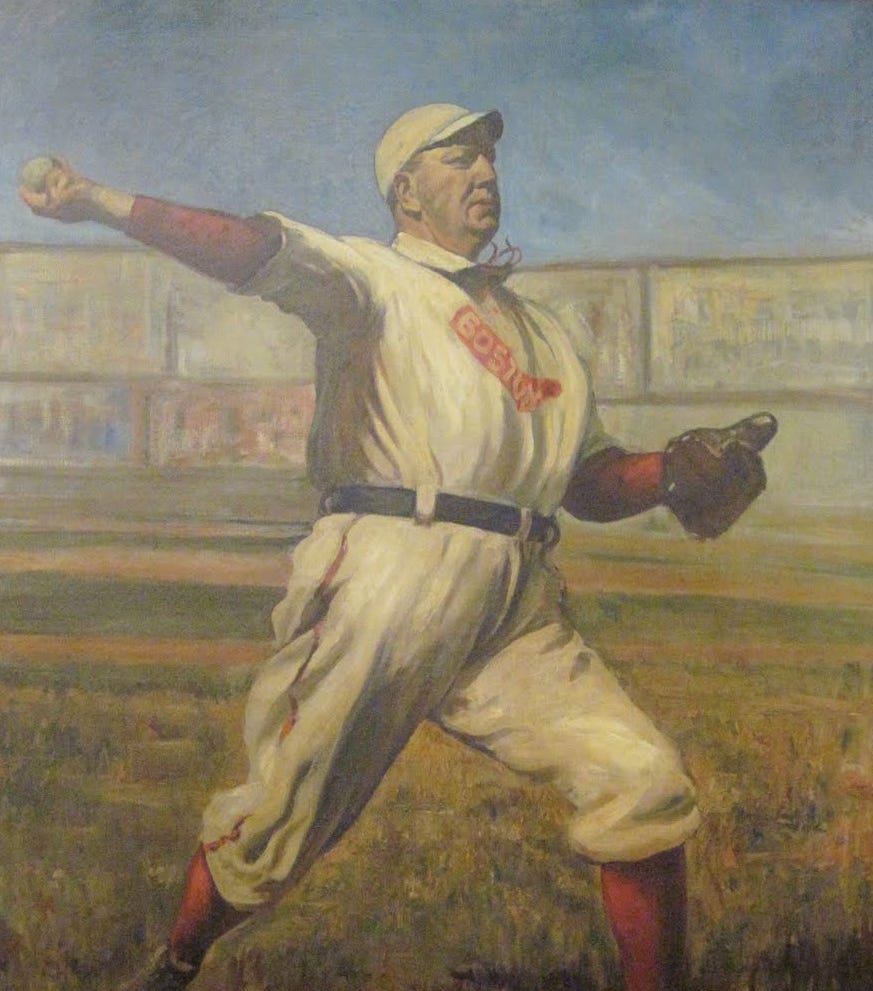
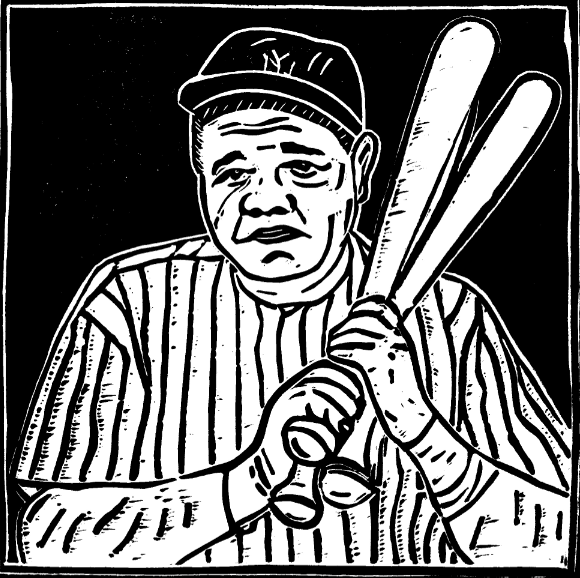
Curve King cigar box label, 1909
Who threw the first curve? The first no-hitter? This story challenges the conventional answer to the first, Candy Cummings, and the second — George Bradley, on July 15, 1876 if you count from MLB’s founding in 1876, or Joe Borden’s on July 28, 1875 in the National Association. Complicating the no-hitter question is Pud Galvin’s no-hitter in an exhibition game against the Philadelphia Athletics of the NL on July 4, 1876, when he was with the St. Louis Red Stockings, an NA participant in 1875 that was not admitted to the NL for 1876. Among the challengers to Cummings’ primacy with the curve, names tossed about have included Fred Goldsmith, Hamilton Avery, Bobby Mathews, Phonney Martin, and even Jim Creighton.
All the pitchers mentioned above, however, may have to stand aside for Joseph McElroy (“Mac”) Mann of Princeton (1856–1919). In 1876, the year of his graduation from Princeton, he set the first official world record in the shot-put at 9.44 metres (31 feet). Setting baseball aside — he had thrown too many curves, he believed — he joined the staff of the New York World. From 1886 until his death he was with Charles Scribner’s Sons, employed in the publication of Scribner’s Magazine.
Here is his baseball story, excerpted from Athletics at Princeton: A History, 1901.
1874–75 PRINCETON UNIVERSITY BASEBALL CLUB. J.M. Woods, ’76, Captain.
THE NINE. J.O. Denny, ’77, c; J.M. [Joseph McElroy] Mann, ’76, p.; J.A. Campbell, ’77, 1st.; J.M. Woods, ’76, 2nd.; M.W. Jacobus, ’77, 3rd.; D. Laughlin, ’77, ss.; J.F. Duffield, ’76, lf.; L.M. Walker, ’76, cf.; S.W. Bradford, ’75, rf. Substitutes: W.R. Bruyere, ’74; R.F. Karge, ’78; H.B. Kaufman, ’77; G.W. Mann, ’72; H. Moffat, ’75 ; T. Sheldon, ’75.
The ball season of the autumn closed with the Philadelphia game, in which Princeton was defeated by the strong pitcher, Cummings.

In this game, the Philadelphia catcher missed a good many balls and to excuse himself after one very costly passed ball, he said, “That ball went zigzag.” Probably he meant that the ball curved, for the pitcher was Cummings, whom the professionals call the “inventor of curves.” Undoubtedly Cummings did pitch curves in this game, and even earlier, and he says he learned the trick from curving clam shells on the beach. But, as this history shows, E. Davis, ’70 had been pitching curves much earlier than Cummings. In this Philadelphia game, Cummings would stand at the home base when the ball was not in play and pitch (he did not throw underhand), the ball down to second base and it curved to the left just before it was caught. Another player, York, would throw the ball in from left field and it looked as if it would go away off into right field, but suddenly the ball seemed to drop right down to the base. These peculiar balls puzzled the college players, especially Mann; they saw that the balls curved, but did not realize how it was done.

Hartford club, 1876; Candy Cummings at top right
The excitement of the fall elections had divided the college into two political parties, and the baseball season was closed by a grand game of baseball between the Democrats and Republicans. “Mac” Mann had been pitching more than usual in the previous week and had a very sore second finger, where the ball, on leaving his hand, had worn off the skin. Mann played third base until the game was well advanced, when the opponents sized up the pitcher and were batting him all over the field. Then Mann was coaxed into the box to save the game. In order to save his sore finger, he let the ball go out of his hand in a different manner than usual. The first striker up missed the ball. The second ball was also missed, and Mann noticed that it was peculiar, but could not determine in what respect. He turned to M.W. Jacobus, ’77, who was playing shortstop, and said: “Here goes for three strikes.” Sure enough the batter struck out. Then Mann said, “Those balls curved.” Not content with knowing how to pitch curves he set to work to find why they curved. Finally he worked out the following demonstration:

“B is the ball going toward home plate H, at the rate of 50 feet per second; at the same time revolving on its axis at the rate of 50 feet per second. Hence the portion of the ball at A, as far as the atmosphere is concerned, will be going 100 feet per second. The portion of the ball at C will be going toward H, but as it is also revolving in the opposite direction at the same rate, as far as the atmosphere is concerned, there is no advance. Hence we have an atmospheric pressure on one side of 100 and of 0 on the other. Therefore the ball will be forced out of its course toward E. In order to get the opposite curve, the ball must be twisted so as to revolve in the opposite direction.”
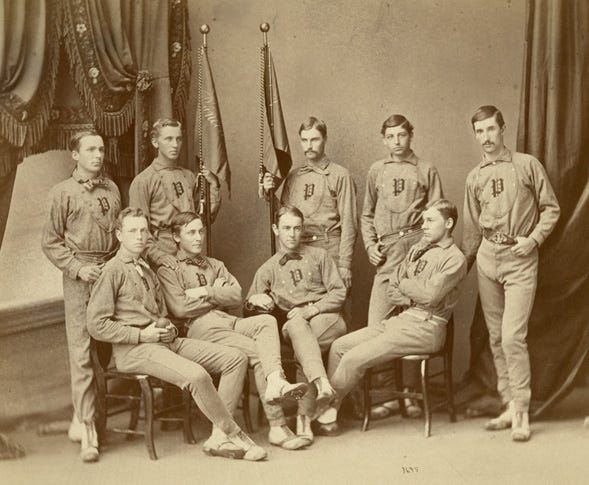
Princeton Baseball Nine, 1874–75; “Mac” Mann seated at left
All winter long Mann practised in the Gymnasium and in the spring, he had the pleasure of facing many surprised batters. His greatest curve was the outshoot, but he was able to pitch the inshoot and the drop also. This latter, however, had a very small deflection for the rule of that year forbade a pitcher to raise his arm in throwing above his waist. Two years later, when Mann had strained his arm, this rule was changed, and with a full arm motion W.M. Smith, ’77, developed the drop, which he used with so much effectiveness that he has the credit for its invention. As “Mac”Mann himself says, he did not invent the curving of a ball for “as long as baseball has been played and baseballs have had seams with which to catch the air, curve balls have been thrown; and the curve was especially noticeable in the case of a left handed thrower, whose curve was in the opposite direction from that of a right handed thrower. “ What he did accomplish was to demonstrate the effectiveness of the curve from the pitcher’s box, and to revolutionize the manner of delivering the ball to the batter. Unfortunately, however, he was young at the time and too inexperienced to conceal his secret. The chief topic of comment in baseball circles was Mann’s pitching, and many players came to Princeton to watch the college nine play. The fact that so many professionals seemed ignorant of curve pitching and hurried to see Mann, proves conclusively that Mann was the first pitcher to use the curve with any judgment and control over the ball. Very few people outside of ball players knew anything of the discovery and it is extremely amusing to read the following query in the Scientific American of July 28, 1877. “It is claimed that certain baseball pitchers are able to throw a ball so that it can describe a horizontal curve in the air. Is such a thing possible with a perfectly spherical ball and in a still atmosphere?” The cautious editor ventured only to reply: “We have never seen it done.” This led to a long public discussion, which finally resulted in some practical experiments, or tests, at the Cincinnati baseball grounds, on October 20, 1877, which were of course successful.
[…]
The second game [of the 1875 season, after an opening game loss to the Chelseas of Brooklyn] was a defeat also, by Harvard. The nine did not play together and support Mann, who pitched very effectively.

Tyng, the Harvard third baseman, writes: “The first man to the bat on our side promptly struck out, the second followed suit, and the third did the same. Out of the first nine men at the bat, eight I think were unable to hit the ball. We had no idea what the trouble was, except that the bat and ball seemed to have a repulsion for each other which we could not overcome. About the fifth inning one of our men, who had been standing behind the catcher, came back with the announcement that the balls were curving away from the batsmen. There was a general exodus on our part to the back stop to watch this unheard-of phenomenon. Sure enough there were the balls coming in for the middle of the plate, and curving off beyond the reach of the bat.
“But we also noticed that Mann was pitching nothing but curves.
“By the time we had fully realized what was happening, six innings of the game had been played, and the score was 7–2 against us. Taking the longest bats we could find and letting the apparently good balls go by, and devoting our energies to those which seemed to be coming directly at us, on the supposition that the curve would carry them out where we could hit them, we began to ‘connect’ with the ball and finally managed to pull the game out of the fire. Of course Mann’s mistake of not varying his curve with a straight ball, was a fatal one. He had got a ‘good thing’ and on the principle that you cannot get too much of that kind of a commodity, he made the fullest use of it.”
After winning the game on May 20, with the Flyaways, of Brooklyn, the nine was defeated on the following day by the Centennials, of Philadelphia, in a close match, with the remarkable score of 2–1.

As the Centennials were a professional club, it was supposed their victory would be easy, but so hotly was the game contested that in the eighth inning the score stood 1–1. The first run was made by Princeton, during the second inning; while the Centennials did not score until the third. From this time forth, until the ninth inning, not a run was made by either nine. At the close of the ninth inning, the Centennials scored the winning run on an error. The outfield had almost nothing to do on account of Mann’s pitching.
Three days later, Princeton defeated the famous Atlantic Club, of Brooklyn, by the then remarkable score of 3–2.

The result of the Centennial game increased the attendance at this game. The day was fine and never did Princeton play better. For one hour and twenty minutes the audience was in almost breathless suspense watching the issue of the game, alternately applauding the playing of either side. The peculiar pitching of Mann gave the Brooklynites great trouble, while the catching of Dessar [sic; surely Denny is meant — jt] won the admiration of all, and when at the close of the game it was announced that Princeton was the winner by a score of 3–2, Princeton enthusiasm knew no bounds and their cheers rent the air. There were but few errors on either side. The excitement ran high at the beginning of the ninth inning, when the Atlantics had one man on second and third and two men out. Mann made a beautiful play, however, and touched out the man on second who had ventured too far from his base.
[After bruising losses to Yale and Harvard]on May 29, the nine met for a second time this year with the unusually strong nine of Yale.

Both nines were well trained and disciplined — Yale by a succession of victories, Princeton with the discipline of defeat.
[Charles Hammond] Avery for Yale, and Mann for Princeton, were the most effective pitchers ever brought on the field by college nines. In the first inning, Princeton scored one run and two more in the eighth.
Yale, through errors, succeeded in getting a man on first, both in the first and second innings. From that time throughout the game no Yale man reached first base.

The game on both sides was faultless in the fielding. Laughlin at short, and Woods on third, played without errors. Denny behind the bat, and Campbell on first, were equally faultless in their play, while Duffield in left, and Moffat on second made some difficult running catches, Walker, Mann and Denny leading at the bat. The feature of the game, however, was Mann’s pitching; while Princeton made eight base hits on Avery’s pitching. So successfully did Mann pitch, that Yale failed to secure a single base hit; he had learned by the experience of the Harvard games to vary his pitching and the Yale men, unfamiliar with his motions, could not tell which ball would curve and which straight.
The score of 3–0 in Princeton’s favor went upon record as the best college game ever played and the best amateur game at that time recorded.
[Princeton closed out the season with an 11–1 loss to Cummings and the Hartfords, followed by victories over Burlington (6–2) and the New Haven club of the National Association (4–2).]
It had been a wonderful season, full of small scores and good playing; though the chief credit belongs to the pitching of Mann. Small scores were less frequent then than now, and Princeton was proud of the nine that had lost and won the games with the scores of 2–1, 3–2, 6–2, 4–2. And even yet Princeton boasts of the 3–0 game with Yale, for it is the only game with Princeton in which Yale did not score a single base hit.
Next time, a prologue of sorts: an even earlier history of baseball at Princeton and the Old Nassau club. See: https://ourgame.mlblogs.com/baseball-at-princeton-and-more-about-mann-and-the-curve-501b668ea6a7
메타데이터
- post_id
- c78da531f54
- slug
- curve-pitching-at-princeton-c78da531f54
- url
- https://ourgame.mlblogs.com/curve-pitching-at-princeton-c78da531f54
- canonical_url
- https://ourgame.mlblogs.com/curve-pitching-at-princeton-c78da531f54
- author_url
- https://medium.com/@thorn_john_87223
- status
- ok
- fetched_at
- 2026-07-20 09:16:42