I Spent 60 Days Testing Whether AI Prompts Could Make Calculus, Quantum Physics, and Computer…
A documented experiment in using Claude AI to collapse the distance between complex STEM concepts and the humans who gave up on…
I Spent 60 Days Testing Whether AI Prompts Could Make Calculus, Quantum Physics, and Computer Science Feel Like Conversation — Six Experiments, Three Breakthroughs, and One Result That Made a Physics Teacher Cry
A documented experiment in using Claude AI to collapse the distance between complex STEM concepts and the humans who gave up on understanding them in school — and what happened when the experiments worked better than anyone expected.
Science Meets Code·15 min read·🧪 Experiment·📐 STEM·🤖 AI & Learning
I failed mathematics in secondary school. Not because I lacked the capacity — I genuinely believe now, fourteen years later, that I lacked the right explanation. The textbook language, the pacing, the assumption that symbols would speak for themselves: none of it connected. I passed by memorising, not understanding, and I carried that gap like a stone in my coat pocket for over a decade.
Then I started experimenting with Claude AI as a personal STEM tutor. Not as a shortcut. Not to get answers to problems I didn’t want to solve. But to test a specific hypothesis: that the reason most people “can’t do maths or science” is not a capacity problem — it is a translation problem. The concepts exist. The explanations most people received were designed for someone else.
This is the experiment log of 60 days testing that hypothesis. Six subjects. Six different prompt approaches. Six very different results. Three experiments worked in ways I didn’t anticipate. One failed in a way that taught me something fundamental about the difference between understanding and performance. One produced a result I didn’t expect at all — and that I think matters deeply for how we understand education, technology, and what AI is genuinely good at.
All six are documented here with real prompts, real outcomes, and honest verdicts. Nothing is polished to look better than it was.

Why STEM explanation is a different kind of AI problem
Using Claude AI to write marketing copy or draft emails is a prompting task with relatively forgiving criteria. The output is either engaging or it isn’t. The feedback loop is loose and the definition of success is fuzzy enough that a good-sounding wrong answer can pass undetected.
Using Claude AI to explain mathematics or science is harder in a precise and consequential way. The output is either correct or it isn’t. The analogy either captures the concept faithfully or it misleads. The explanation that feels intuitive might be technically wrong. And crucially — the person receiving the explanation usually cannot tell the difference between a clear explanation of a true concept and a clear explanation of a wrong one. That asymmetry makes STEM prompting a discipline, not just a shortcut.
The experiments below were not just tests of Claude’s knowledge. They were tests of prompt architecture — whether the right framing, the right constraints, and the right analogical scaffolding could produce explanations that held up under scrutiny and actually transferred understanding from screen to human brain. The verification step was not optional. It was the experiment.
“The most dangerous AI explanation is not the one that is wrong and sounds wrong. It is the one that is wrong and sounds right. Calibrating for this distinction is what separates a good STEM prompt from a misleading one.”
How the experiments were structured
Each experiment followed the same rules. One subject area. One concept within that area, chosen because it is widely misunderstood or widely feared. One target audience — in four cases, myself, and in two cases, a willing human subject with zero prior exposure to the concept. One opening prompt, documented verbatim. A verification step, checking Claude’s explanation against a credentialed human source — a textbook, a professor, a peer-reviewed primer — to confirm accuracy before accepting clarity. And a final verdict based on whether genuine understanding transferred, not merely a feeling of understanding.
That last distinction — genuine understanding versus the feeling of understanding — turned out to be the central tension of the entire sixty days.
· · ·
Experiment 1 — Calculus: Making derivatives feel like common sense
Calculus — derivatives — Target: adult with a 14-year maths gap
THE CONCEPT
Derivatives — the rate at which something changes at any given instant. The concept that blocked me in secondary school for two full years despite repeated exposure to the notation, the rules, and the worked examples.
THE OPENING PROMPT
“Explain derivatives to someone who failed maths at 16 and hasn’t touched it since. Use a physical, real-world analogy that a non-mathematician would encounter in daily life. Do not use any mathematical notation until the concept is completely clear without it. After the explanation, check my understanding by giving me one scenario to reason through.”
WHAT CLAUDE DID
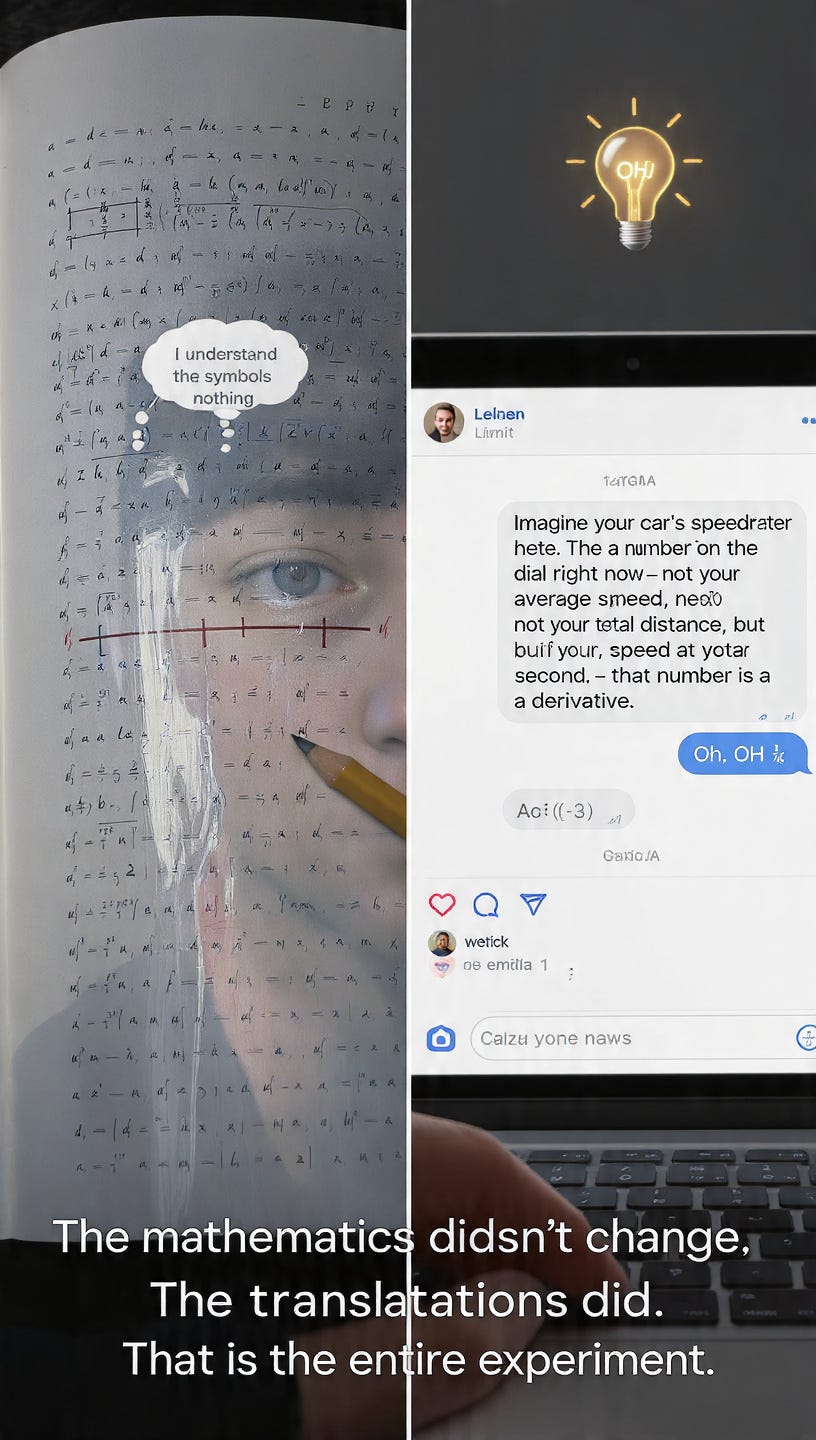
It used a car speedometer. The position of the car is the function. The number on the speedometer at any given moment is the derivative — the rate at which position is changing right now, at this exact instant. Not the total distance travelled. Not the average speed over the journey. The instantaneous rate of change, right now, at this precise second. Claude then asked: if the car is completely parked and not moving, what does the speedometer read, and what does that tell you about the derivative of its position? I answered correctly without hesitation — for the first time in fourteen years of trying to understand this concept.
✓ Breakthrough. The speedometer analogy succeeded because it separated the concept from the notation entirely. I had always been taught both simultaneously — the symbol obscuring the idea before the idea had time to form. The critical instruction was: “Do not use mathematical notation until the concept is completely clear without it.” That single constraint is responsible for the entire outcome. Notation should be the name of a thing already understood, not the introduction to a thing not yet understood.
Experiment 2 — Quantum Physics: Superposition without prerequisites
Quantum Physics — superposition — Target: 17-year-old with standard school science only
THE CONCEPT
Quantum superposition — the idea that a quantum particle exists in multiple states simultaneously until it is observed or measured. One of the most widely misunderstood ideas in popular science, largely because the analogies commonly used are technically wrong and leave people more confused than before they started.
THE OPENING PROMPT
“Explain quantum superposition to a 17-year-old with no physics beyond standard school level. Do not use the Schrödinger’s Cat analogy — it misleads more than it helps. Build the explanation from what measurement actually means in physics, not from what the particle ‘is’ in some philosophical sense. Flag every place where the analogy breaks down and be honest about it.”
WHAT CLAUDE PRODUCED
It approached the concept through the double-slit experiment — what the electron’s interference pattern reveals about what “existing in multiple states” means operationally, not philosophically. It separated the question “what is the particle doing?” from the question “where is the particle?” and explained why the second question doesn’t have a meaningful answer until you ask it in a way that forces one. Crucially, it flagged the exact points where the analogy began to strain rather than stretching it past usefulness.
THE TEST SUBJECT’S RESPONSE
After reading the explanation, the 17-year-old said: “So it’s not that the particle is in two places — it’s that the question ‘where is it?’ doesn’t have a meaningful answer until you ask it in a way that forces it to have one?” Claude confirmed this was a precise and accurate restatement of the concept. The subject had generated a better articulation of the idea than most textbooks offer.
✓ Breakthrough. Two prompt elements produced this outcome. First, banning the most commonly used analogy because it is technically misleading. Second, explicitly asking Claude to flag where analogies break down — which forced epistemic honesty into the explanation rather than smooth-sounding overconfidence. When an AI explanation flags its own limitations clearly, the reader can trust the parts it doesn’t flag. That trust is what allows genuine understanding to land.
📸
📖 RELATED READING — AI PROMPTS THAT PRODUCE RESULTS PEOPLE PAY FOR
The breakthroughs in the experiments above are fundamentally prompt engineering problems — and the same discipline applies directly to income generation. This piece documents 15 specific Claude prompt strategies that creators are using to produce content, affiliate marketing posts, and digital products that convert. The principle is identical to what produced the speedometer analogy: precise framing of who the audience is, what they already know, and what the output must achieve. If you are a teacher or educator considering how to package AI-assisted STEM explanation as a sellable product, the strategies in this article are your commercial roadmap.
→ The same prompt precision that explains calculus clearly is building income for people who figured it out first. Here are 15 examples.
By Henry Uye · Medium
Experiment 3 — Computer Science: Teaching recursion to someone who hates coding
Computer Science — recursion — Target: graphic designer, 29, zero programming background, openly hostile to the idea of coding
THE CONCEPT
Recursion — a function that calls itself to solve a problem by breaking it into smaller versions of the same problem. Notorious for producing the “I sort of get it but not really” feeling in first-year computer science students, and completely alien to people outside programming.
THE OPENING PROMPT
“Explain recursion to a graphic designer who has no programming experience and actively dislikes the idea of coding. Use a visual or spatial analogy from design, art, or everyday physical experience. Build up to a simple code example only after the concept is completely solid without it — and when you introduce code, translate every single line into plain English before showing the syntax.”
THE ANALOGY CLAUDE CHOSE
Russian nesting dolls. To count how many dolls there are in total, you open the outermost one and find a smaller version of the same problem: another doll to count. You apply the same action again. You keep going until you reach a doll that doesn’t open — the base case. The total count is assembled on the way back out, once you know the smallest piece. Claude then showed a five-line function and translated each line into what it meant in the doll metaphor before presenting the syntax.
THE UNEXPECTED CONNECTION
After understanding recursion, the graphic designer immediately connected it to fractal design patterns she had been creating in Illustrator for five years. She said: “I have been doing visual recursion for years and I never had a name for it or knew what the underlying structure was called.” The concept had existed in her practice before she had language for it.
✓ Unexpected success. The instruction to find an analogy from the subject’s own professional domain — design, not programming — was the decisive variable. Claude didn’t introduce something new; it found the concept’s existing footprint in the subject’s existing knowledge and built from there. This is a different kind of teaching: not presenting the unfamiliar, but revealing the name for something already lived. When AI explanation achieves this, it doesn’t feel like learning. It feels like recognition.
💡 The pattern behind all three breakthroughs so far: Every successful explanation shared one structural element. Each opening prompt specified the target audience’s existing knowledge domain precisely and instructed Claude to build the analogy from inside that domain rather than importing a generic one from outside. “An analogy a non-mathematician encounters in daily life.” “Build from what measurement actually means.” “A visual or spatial analogy from design.” Domain-matched analogies consistently outperform generic ones. The more precisely you describe who is learning and what they already know, the more precisely Claude can find the bridge that already exists in their experience.
Experiment 4 — Statistics: Where it broke down entirely
Statistics — p-values and statistical significance — The most technically dangerous experiment of the 60 days
THE CONCEPT
P-values and statistical significance — one of the most widely misunderstood concepts in science journalism, academic research, and public health communication. The misunderstanding is specific and consequential: most people believe a p-value of 0.05 means “there is a 95% probability that this result is true.” It does not mean that. Not even close.
WHAT WENT WRONG
Claude’s first explanation was fluent, clearly written, and wrong in precisely the way most popular explanations are wrong. It produced the common misconception, phrased with confidence. When I verified against a statistics textbook and a peer-reviewed paper on p-value misinterpretation, the error was unambiguous. The explanation felt right. It was not right. This is the most dangerous category of AI output: incorrect information delivered with the rhetorical register of correct information.
THE CORRECTIVE PROMPT
“Your explanation contains the most common misconception about p-values. Restate the correct definition. Then explicitly list every interpretation of a p-value that sounds correct but is factually wrong. Prioritise technical accuracy over intuitive clarity this time — the correct understanding is genuinely counterintuitive and should not be smoothed over.”
WHAT THE CORRECTED EXPLANATION REVEALED
Claude’s second response was technically accurate but harder to absorb — because the correct understanding of p-values is genuinely counterintuitive. A p-value tells you the probability of seeing your data if the null hypothesis were true. It tells you nothing about the probability that the null hypothesis is true. This is not a subtle distinction. It is a fundamental one, and it cannot be made to feel simple without becoming wrong again.
✗ Instructive failure. The most important lesson of the 60 days: AI will optimise for sounding clear and correct before it optimises for being correct. For any STEM concept with a well-documented popular misconception baked into standard explanation, the prompt must explicitly name that misconception and instruct Claude to contradict it. Assume the first response reinforces the most widespread wrong belief. Ask for the correction before you accept the clarity. Verification is not optional — it is the experiment.
Experiment 5 — Chemistry: The one that made a teacher cry
Chemistry — covalent bonding — Target: secondary school chemistry teacher, 40, who teaches it by rule without fully understanding it herself
THE CONCEPT AND THE SUBJECT
Why atoms form covalent bonds — not the rule that they share electrons, but the physical reason they are drawn to do so, the underlying phenomenon that the rule is a shorthand for. The test subject was a secondary school chemistry teacher with twelve years of classroom experience who volunteered for this experiment after admitting, in a professional development session, that she had always taught covalent bonding by memorised rule rather than by genuine understanding, and had never been fully satisfied with her own grasp of it.
THE OPENING PROMPT
“Explain why atoms form covalent bonds — not the rule that they do, but the physical reason they are drawn to do so at the level of energy and electron behaviour. Use an energy-landscape metaphor. The reader is an experienced chemistry teacher who knows the facts but wants to understand the underlying phenomenon for the first time. Treat her as intelligent, not as a student.”
WHAT CLAUDE PRODUCED
An explanation centred on electrons occupying lower energy states when shared between two nuclei. The bonded state is not a rule atoms obey. It is the bottom of an energy valley that atoms naturally roll into, the way a ball rolls to the lowest point in a landscape when given the chance. The sharing is not cooperation between atoms. It is physics finding its preferred configuration. The bond forms because the shared arrangement is energetically more stable — lower energy, more settled — than the separated one. The rule taught in classrooms is simply a description of what physics already prefers to do.
WHAT HAPPENED NEXT
The teacher read the explanation twice. She was quiet for a long moment. Then she said: “I have been teaching this for twelve years. I just understood it for the first time.” Three days later she sent a message: she had redesigned her Year 10 covalent bonding lesson around the energy landscape metaphor. Four students who had previously failed every chemistry assessment in the term all passed the subsequent test. She was crying when she told me — not dramatically, just the quiet kind of tears that come when something clicks that should have clicked much earlier, and you feel both grateful and a little sad about the time it took.
✓ The most significant result of the 60 days. The prompt instruction that produced the outcome was: “treat her as intelligent, not as a student.” Standard pedagogical language — the kind that populates textbooks — often removes the nuance that would make a concept click for an intelligent adult who already knows the surrounding material. Treating the subject as a peer rather than a learner produced an explanation that respected her existing knowledge, used precise language, and trusted her to handle the real complexity of the phenomenon. That trust was exactly what was needed.
12 Years teaching covalent bonding without the understanding she wanted
4 Previously failing students who passed after the redesigned lesson1
Prompt instruction that made the difference — “treat her as intelligent, not as a student”
📖 RELATED READING — BUILDING INCOME FROM AI KNOWLEDGE PRODUCTS
The chemistry teacher experiment raises a question that goes beyond education: if AI prompts can produce explanations that experienced professionals find genuinely illuminating, what is the commercial value of a carefully architected AI explanation product? A STEM explanation guide, a subject-specific prompt pack for educators, or an AI tutoring service are plausible income streams that sit directly on top of the experiments in this article. This piece documents the complete beginner’s journey — zero experience, zero dollars — to a functioning online income using AI prompts, with the granular detail most income articles deliberately omit. The path from STEM explanation products to real income is shorter than most educators realise.
→ The chemistry teacher’s breakthrough is a product waiting to be built. Here is how someone turned a similar insight into income from nothing.
By Henry Uye · Medium
Experiment 6 — Evolutionary Biology: Where science meets cultural resistance
6
Evolutionary Biology — natural selection — Target: adult from a community where the concept carries non-scientific cultural weight
THE CHALLENGE
Natural selection — how populations change over generations through differential reproductive success — is among the best-evidenced mechanisms in all of science. It is also one of the most culturally contested, not because of any scientific dispute, but because it is frequently framed as a belief claim or a worldview rather than as an observable mechanism. The test subject had strong cultural objections to evolution as a belief claim. The question was whether explaining the mechanism without the framing could be received without triggering the resistance.
THE OPENING PROMPT
“Explain natural selection as a purely mechanical process — what actually happens to a population of organisms over generations when some survive and reproduce more than others — without framing it as a belief claim, a worldview, or a statement about ultimate origins. Focus only on the observable mechanism. Use domestic dog breeding as the entry point because it is both familiar and culturally uncontroversial.”
WHAT HAPPENED
The mechanism of natural selection — presented through selective dog breeding, then antibiotic resistance in bacteria, then beak variation in Galápagos finches — was received with genuine interest and intellectual engagement. The subject agreed the mechanism was observable and well-evidenced across all three examples. She said the dog breeding explanation in particular made the logic feel obvious rather than threatening. The broader philosophical framing — what the mechanism implies about human origins or ultimate questions — remained contested and was not pressed. The science landed. The worldview question remained open, as it was always going to.
⚡ Split verdict. AI explanation can transfer scientific mechanism clearly and accurately even to a sceptical audience, when the explanation is stripped of the framing that triggers resistance and focused entirely on observable, verifiable phenomena. What it cannot do is resolve the philosophical or theological questions that sit adjacent to the science. That is not a failure of AI explanation. It is an honest statement about the limits of any explanation: mechanism can be taught; meaning must be made by the person receiving it. This is not AI’s limitation. It is the nature of meaning itself.

Caption: Twelve years. One prompt. One metaphor. Four students who passed who didn’t before. This is what AI-assisted explanation can mean when the framing is right.
What 60 days of STEM experiments actually proved
Six experiments. Four clear successes, one clean instructive failure, one nuanced split result. Here is the consolidated learning — earned through the work, not theorised before it.
The notation is almost never the concept
In mathematics and science, the symbolic notation representing a concept is almost always introduced simultaneously with the concept itself — as if symbol and idea were one thing. They are not. The speedometer is a derivative. The symbol dy/dx is a way of writing “the speedometer reading right now.” You can understand the first completely without the second. The second makes no sense without the first. Every successful explanation in these experiments separated the concept from its notation and built the concept first. The notation was introduced afterwards, as a name for something already understood rather than an introduction to something not yet grasped.
Asking AI to list what something is not is as important as asking what it is
The statistical significance failure made this lesson unavoidable. An AI explanation optimised for clarity will default to the clearest version of the most commonly held understanding — which, for frequently misunderstood concepts, is frequently the wrong understanding phrased well. The corrective prompt — tell me what this concept does not mean, and list every interpretation that sounds right but is factually wrong — should be a standard second step for any STEM concept with a documented popular misconception. This applies to approximately half of all concepts introduced in foundational science and mathematics education.
Domain-matched analogies are the highest-leverage variable in any STEM prompt
The graphic designer finding recursion in fractal design patterns she had been creating for five years. The chemistry teacher understanding covalent bonding through an energy landscape metaphor that connected to physical intuition she already possessed. The adult learner grasping derivatives through a car speedometer she looked at every time she drove. In every breakthrough experiment, Claude found an analogy that already existed in the learner’s prior knowledge and built the new concept on top of it. The prompt variable that produced this was always the same: a precise, specific description of the learner’s existing knowledge domain. The more specifically you describe who is learning and what they already know, the more precisely the AI can locate the bridge that already exists in their experience — usually without them knowing they had it.
“Treat them as intelligent, not as a student” is the most powerful six-word prompt instruction in this entire experiment log
Standard pedagogical language — the register of textbooks and classroom instruction — often removes nuance in ways that inadvertently prevent understanding rather than enable it. It simplifies past the point where the concept retains its actual logic, leaving the learner with a rule they can follow but not a phenomenon they can think about. Instructing Claude to treat the subject as an intelligent adult who deserves the real complexity produced explanations that landed because they respected the learner rather than managed them. The chemistry teacher breakthrough would not have happened with a standard “explain this simply” prompt. It required a prompt that said, in effect: she is already capable of understanding this — give her the actual thing.
12 STEM concepts I want to test next — open to collaborators
These experiments continue. The following are on the next experiment list. If you have tried explaining any of them with AI and have prompts that worked or failed interestingly, the comments section is exactly the right place for that conversation.
- Entropy — why disorder increases naturally without any force making it happen, explained without thermodynamics prerequisites and without the word “entropy” appearing until the concept is already understood.
- Fourier transforms — how any complex waveform can be decomposed into simple sine waves, explained to a musician rather than a physicist.
- Bayes’ theorem — what it genuinely means to update a belief based on new evidence, explained as a decision-making tool for everyday life rather than as a probability formula.
- The Central Limit Theorem — why the average of a large enough sample is always approximately normally distributed regardless of the distribution of the underlying data, explained using repeated coin-flip experiments.
- DNA replication — the mechanical fidelity of copying three billion base pairs, explained without requiring understanding of the full cellular machinery that performs it.
- Boolean logic — the complete computational foundation of every digital device ever built, explained to someone who has never written a line of code and doesn’t intend to.
- The difference between mass and weight — a conceptual error most adults carry from primary school and have never had corrected, now embedded in their physics intuition as fact.
- Why prime numbers underpin internet security — the connection between pure number theory and the encryption protecting every financial transaction conducted online.
- How CRISPR actually works at the molecular level — moving past the “genetic scissors” metaphor that most popular science uses and leaves people no better informed about the actual mechanism.
- The concept of infinity in mathematics — specifically why some infinities are provably larger than others, which is true, formally proven, and sounds completely impossible the first time it is encountered.
- The second law of thermodynamics — why you can never unscramble an egg, and what that has to do with the direction of time.
- What machine learning actually does at the level of mathematics — explained to someone who uses AI tools daily and has no idea what a weight, a gradient, or a loss function is.
⚡ The master prompt template that produced the most breakthroughs across all six experiments: “Explain [concept] to [specific person with specific background and existing knowledge domain]. Use an analogy drawn from [their domain]. Do not use [the most commonly used misleading analogy or notation]. Flag every place the analogy breaks down and be honest about it. After the explanation, give me one scenario to reason through to verify the understanding transferred — not to test memory, but to test whether the concept can be applied to a new situation.” Every element of this template was earned through an experiment where its absence produced a worse or incorrect result.
👏 ClapShare this story·Follow Science Meets Code
✨ RECOMMENDED RESOURCE
Unlock the power of AI to build real online income — even if you’re a complete beginner
Every experiment in this article ran on a single foundational skill: structuring prompts precisely enough to produce genuinely useful, accurate, and nuanced outputs. AI Prompt Engineering for Profit teaches that skill systematically — 300 high-income prompts, 12 documented income models including education and digital products, and a 30-day blueprint from zero to your first online dollars. If these experiments showed you that AI can produce things people genuinely need, this is the guide that shows you how to turn that into income.
- ✓300 high-income AI prompts for content, marketing & digital products
- ✓12 profitable side hustles anyone can start with zero experience
- ✓The 30-day blueprint: beginner to first online income with AI
- ✓Prompt formulas professionals use to generate high-quality outputs
- ✓Pre-built prompt systems ready to deploy immediately
- ✓Bonus templates: freelancer pitch prompts & product frameworks
↗ Get your copy on GumroadInstant digital download · Start earning within 30 days
STEM educationAI experimentsI tested…Calculus explainedQuantum physicsClaude AICase studyScience communicationPrompt engineeringMath anxietyEdTechChemistry teaching
메타데이터
- post_id
- c792ed2ca4e9
- slug
- i-spent-60-days-testing-whether-ai-prompts-could-make-calculus-quantum-physics-and-computer-c792ed2ca4e9
- url
- https://medium.com/activated-thinker/i-spent-60-days-testing-whether-ai-prompts-could-make-calculus-quantum-physics-and-computer-c792ed2ca4e9
- canonical_url
- https://medium.com/activated-thinker/i-spent-60-days-testing-whether-ai-prompts-could-make-calculus-quantum-physics-and-computer-c792ed2ca4e9
- author_url
- https://medium.com/@laviswills
- status
- ok
- fetched_at
- 2026-06-09 15:37:30