AI Powered Bond Post-Trade Break Detection & Resolution
Published August 13, 2025 | Version v1 Coreledger Technologies. Kelvin Musodza.
AI Powered Bond Post-Trade Break Detection & Resolution
Published August 13, 2025 | Version v1 Coreledger Technologies. Kelvin Musodza.
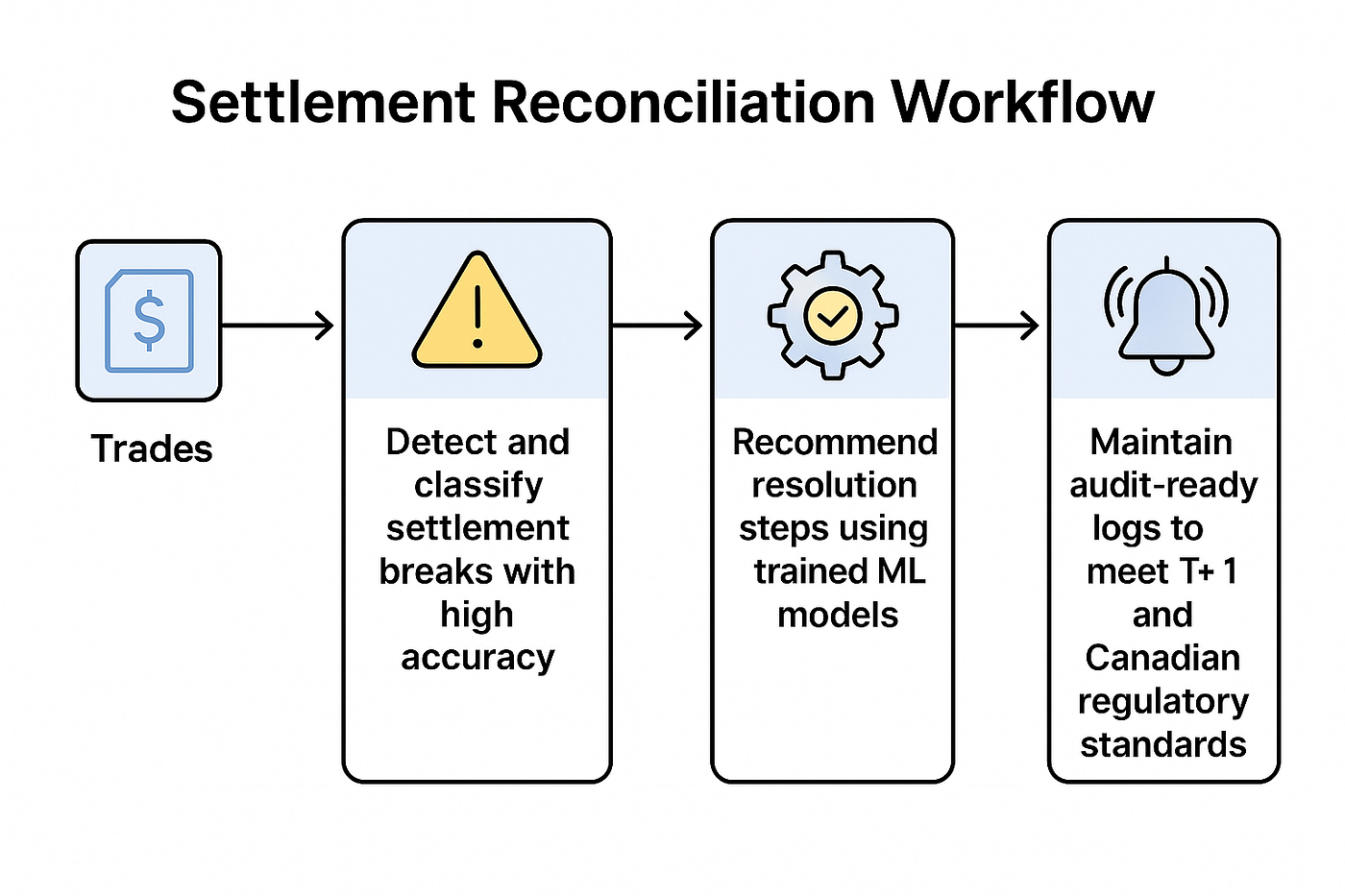
Settlement reconciliation workflow
Description
Financial institutions face significant challenges in post-trade reconciliation, matching internal trade records with external data, due to high volumes, complex data formats, and strict regulatory deadlines. Manual exception handling is error-prone and time-consuming, leading to inconsistencies that can result in financial misstatements or regulatory penalties highradius.com. This project addresses these challenges by automating trade break detection and reconciliation in fixed-income workflows.
To ensure the safe and compliant use of sensitive internal and external reconciliation data, we will leverage our internal privacy solution, PrivacyGuard. PrivacyGuard automatically identifies and anonymizes personally identifiable information (PII), laying a robust foundation for secure data sharing and future public data initiatives. This proactive approach strengthens our compliance posture while facilitating seamless integration and collaboration.
We leverage machine learning (ML) and advanced data pipelines to detect discrepancies (“breaks”), classify their root causes, and recommend resolutions, all while maintaining a tamper-proof audit trail for compliance. A domain-adapted DistilBERT model has been fine-tuned on millions of historical break-resolution pairs, achieving high accuracy (≈88% micro-F1) in classifying exception root causes and suggesting fixes. Additionally, we developed a fuzzy matching micro-service using RapidFuzz to link external tickets to internal trade IDs with over 96% accuracy and created a prototype dashboard for real-time break triage and monitoring.
Key results to date include significant improvements in efficiency and accuracy. Early demo estimates indicate a potential ≥ 60% reduction in manual reconciliation effort, substantially lowering settlement failure rates and associated penalty fees. The solution provides real-time alerts for trade breaks, enabling faster intervention to prevent failed settlements. Importantly, the system’s design aligns with regulatory requirements, logging all reconciliation actions and ML-driven decisions with hash-chained, tamper-evident records to satisfy T+1 audit trail obligations (regulators now expect robust record-keeping to validate compliance with the new T+1 settlement rules capco.com). This modular architecture, built with micro-services and open APIs, also facilitates easy integration with existing systems and positions us to extend the solution to other asset classes such as equities, repos, and crypto, with minimal retraining.
In summary, the project has delivered a robust suite of AI-powered reconciliation tools and prototypes demonstrating clear and tangible value. The next phase focuses on production readiness by scaling the real-time pipeline, enhancing the UI, refining XML parsing, and rigorously documenting model risks for compliance.
This white paper outlines our comprehensive initiative to automate exception handling and reconciliation in fixed-income trading workflows, leveraging advanced machine learning techniques and sophisticated data processing capabilities to address industry-wide challenges effectively.
Files
Additional details
- Abadi, M., Barham, P., Chen, J., Chen, Z., Davis, A., Dean, J., … Zheng, X. (2016). TensorFlow: A system for large-scale machine learning (OSDI ’16, pp. 265, 283).
- Brownlee, J. (2020). XGBoost With Python: Gradient Boosting in Python (2nd ed.). Machine Learning Mastery.
- Chen, T., & Guestrin, C. (2016). XGBoost: A scalable tree boosting system (KDD ’16, pp. 785, 794). https://doi.org/10.1145/2939672.2939785
- DTCC. (2025). Daily Total U.S. Treasury & Agency Fails [Data set]. Depository Trust & Clearing Corporation. https://www.dtcc.com/
- Financial Industry Regulatory Authority. (2025). Fails-to-Deliver files (2009, 2025) [Data set]. FINRA. https://www.finra.org/
- Financial Industry Regulatory Authority. (2025). TRACE Corporate Bond Transaction Data (2015, 2025) [Data set]. FINRA. https://www.finra.org/
- Honnibal, M., & Montani, I. (2023). spaCy 3: Industrial-strength natural language processing in Python (Version 3.7) [Software]. Explosion AI. https://spacy.io/
- ISO. (2013). ISO 20022 e-Repository (2013 edition) [XMI/ISO 20022 schemas]. International Organization for Standardization. https://www.iso20022.org/
- ISO. (2021). XML Tag , Abbreviation list (Version 2021–12). International Organization for Standardization. https://www.iso20022.org/
- Ke, G., Meng, Q., Finley, T., Wang, T., Chen, W., Ma, W., … Liu, T. Y. (2017). LightGBM: A highly efficient gradient boosting decision tree (NIPS ’17, pp. 3146, 3154).
- McKinney, W. (2010). Data structures for statistical computing in Python (SciPy 2010, pp. 51, 56).
- Microsoft. (2024). Presidio: An open-source text and data anonymization framework (Version 2.5) [Software]. GitHub. https://github.com/microsoft/presidio
- Pedregosa, F., Varoquaux, G., Gramfort, A., Michel, V., Thirion, B., Grisel, O., … Duchesnay, É. (2011). Scikit-learn: Machine learning in Python. Journal of Machine Learning Research, 12, 2825–2830.
- RapidFuzz Team. (2024). RapidFuzz (Version 3.5) [Software]. https://maxbachmann.github.io/RapidFuzz/
- Sanh, V., Debut, L., Chaumond, J., & Wolf, T. (2020). DistilBERT, a distilled version of BERT: Smaller, faster, cheaper and lighter. arXiv preprint, arXiv:1910.01108.
- Vaswani, A., Shazeer, N., Parmar, N., Uszkoreit, J., Jones, L., Gomez, A. N., … Polosukhin, I. (2017). Attention is all you need. Advances in Neural Information Processing Systems, 30, 5998–6008.
- Wolf, T., Debut, L., Sanh, V., Chaumond, J., Delangue, C., Moi, A., … Rush, A. M. (2020). Transformers: State-of-the-art natural language processing. Proceedings of the 2020 EMNLP: System Demonstrations, 38–45. https://doi.org/10.18653/v1/2020.emnlp-demos.6
- Zhang, C., & Pafka, S. (2023). PyTorch 2.1 [Software]. Meta AI. https://pytorch.org/
Musodza, K. (2025). Bond Settlement Automated Exception Handling and Reconciliation. Zenodo. https://doi.org/10.5281/zenodo.16828730 Originally published at https://zenodo.org.
[embed]
메타데이터
- post_id
- c7ac4431a559
- slug
- ai-powered-bond-post-trade-break-detection-resolution-c7ac4431a559
- url
- https://medium.com/@coreledger_tech/ai-powered-bond-post-trade-break-detection-resolution-c7ac4431a559
- canonical_url
- https://medium.com/@coreledger_tech/ai-powered-bond-post-trade-break-detection-resolution-c7ac4431a559
- author_url
- https://medium.com/@coreledger_tech
- status
- ok
- fetched_at
- 2026-07-31 04:24:36





