Why Monet Painted the Same Haystack Over 25 Times (And Why It Still Works Today)
If you walked past Claude Monet in a field near Giverny in 1891, you might have wondered what he was doing.
Why Monet Painted the Same Haystack Over 25 Times (And Why It Still Works Today)
If you walked past Claude Monet in a field near Giverny in 1891, you might have wondered what he was doing.
He wasn’t sketching different scenes.
He wasn’t exploring new subjects.
Instead, he was painting the same haystack — over and over again.
So why would one of the most innovative artists of the 19th century focus so obsessively on something so repetitive?
The answer reveals a lot about how modern art — and even modern visual culture — works today.
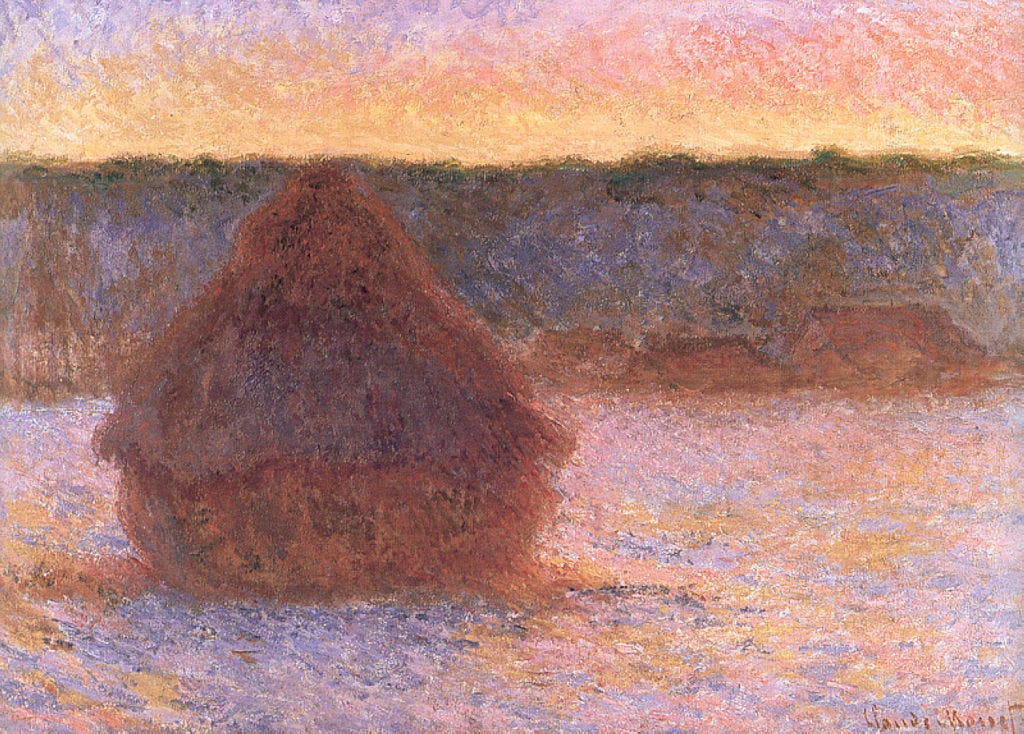
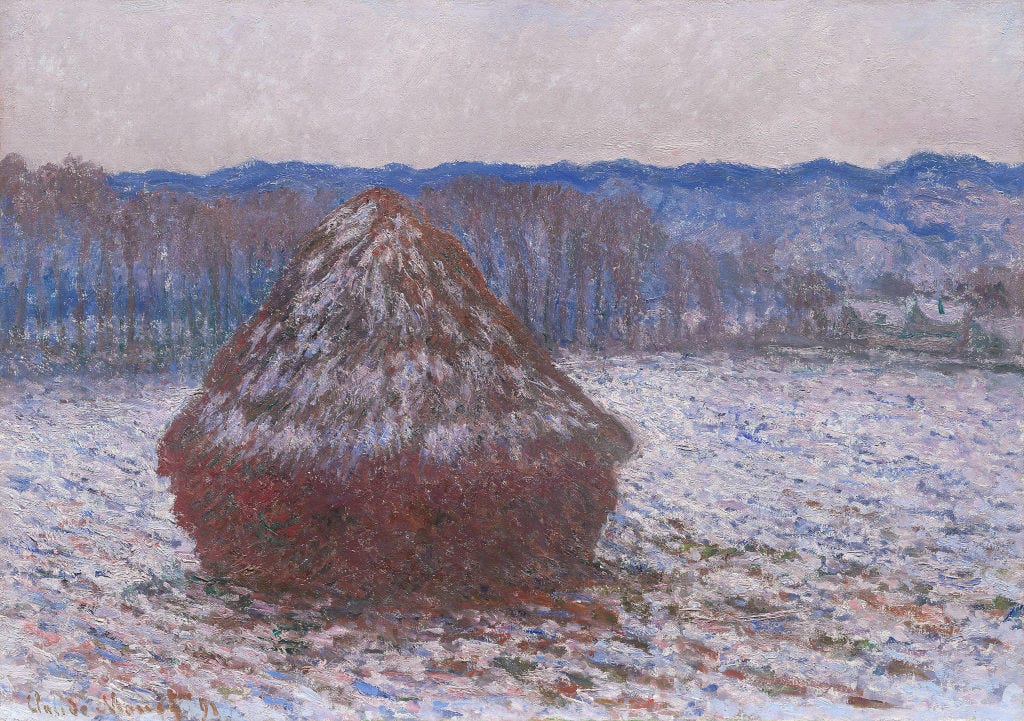
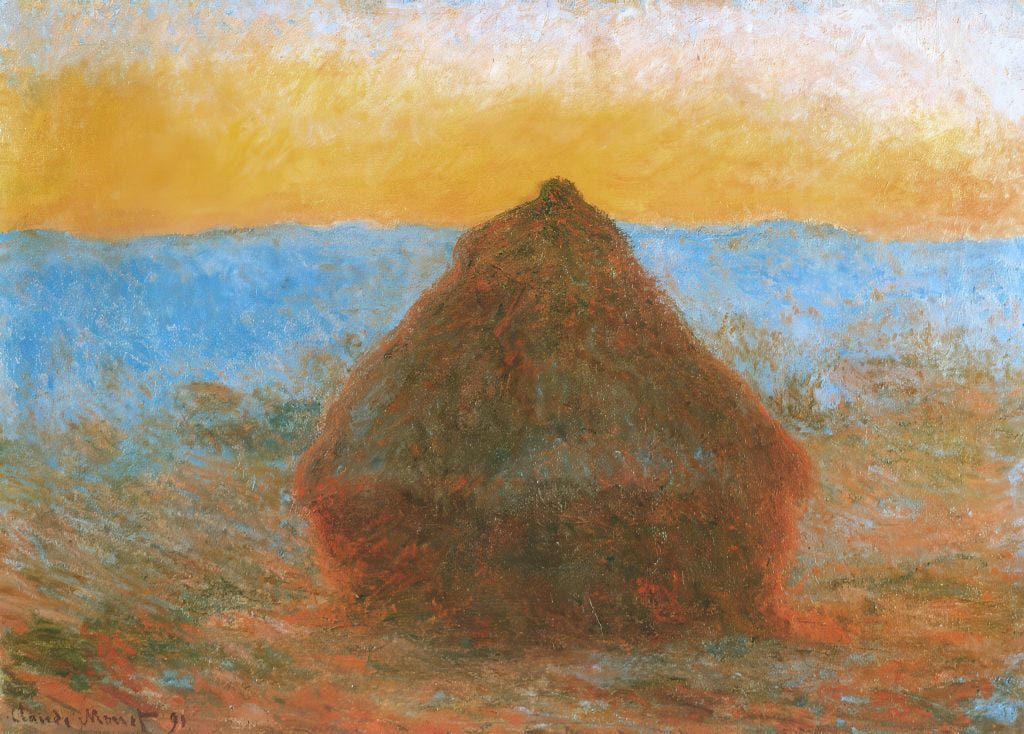
A selection of Claude Monet’s Haystacks series
The Problem Monet Was Trying to Solve
Traditional painting aimed to capture a subject clearly and permanently.
But Monet realised something uncomfortable:
There is no such thing as a fixed view.
Light changes constantly. Colour shifts depending on time of day, season, and atmosphere. Even shadows are not stable — they move, soften, intensify.
So instead of trying to “correct” this instability, Monet leaned into it.
The Haystacks became his laboratory.
A Series Designed for Comparison
Unlike a single masterpiece, the Haystacks are designed to be seen together.
Each painting captures a slightly different condition:
- Frosty morning light
- Warm afternoon glow
- Deep winter shadow
- Sunset dissolving into dusk
Individually, they are beautiful.
Together, they are transformative.
You begin to notice how dramatically perception can change — even when the subject remains the same.
This idea — variation within repetition — is something we now take for granted. You see it everywhere, from photography to Instagram grids.
Monet was doing it first.
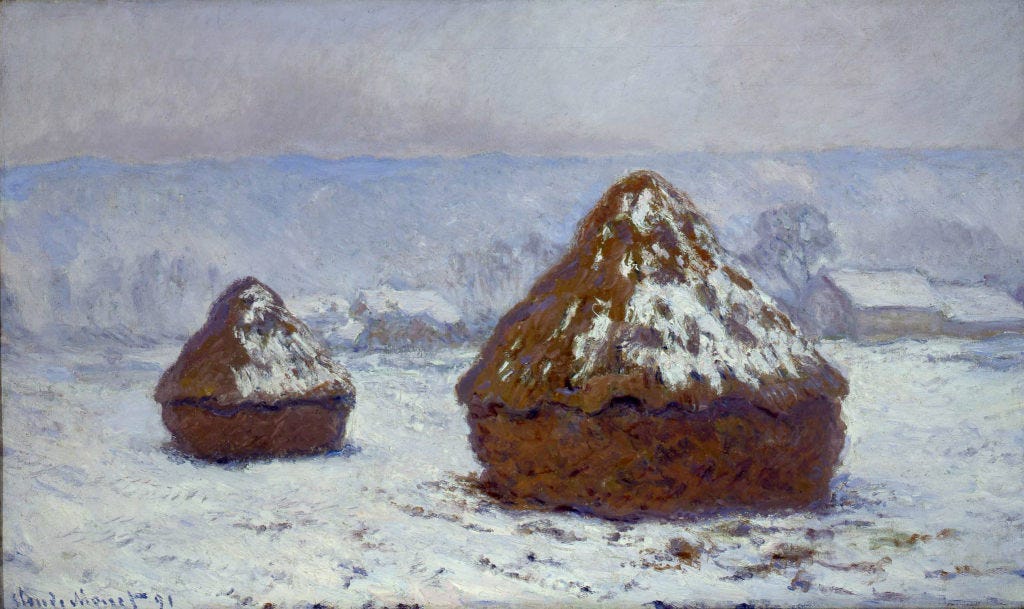

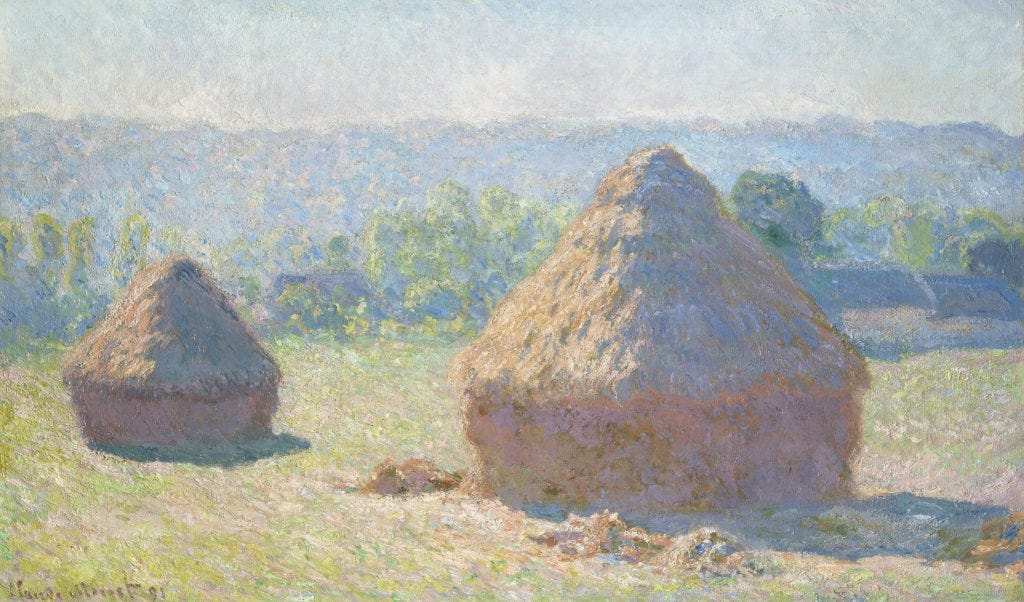
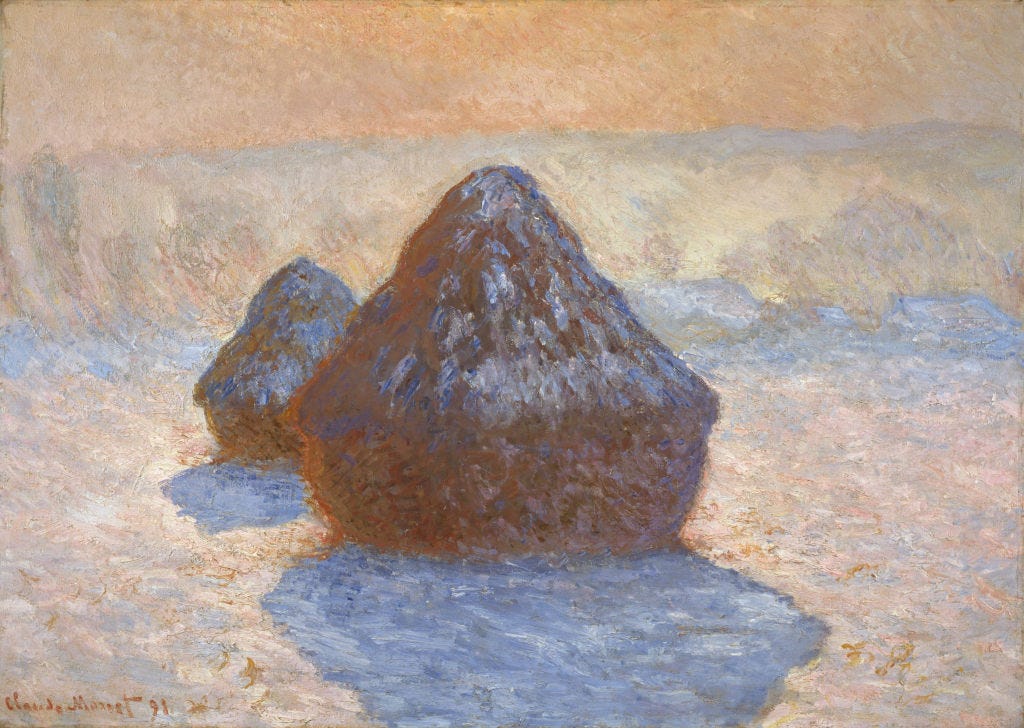
A variety of seasons, colours, weather across the same Haystacks
The Hidden Complexity of “Simple” Subjects
There’s a reason Monet chose haystacks.
They are structurally simple: large, rounded forms with minimal detail.
This simplicity allowed him to focus entirely on light and colour without distraction.
It’s a surprisingly modern strategy.
By reducing complexity in the subject, Monet increased complexity in perception.
Designers, photographers, and digital creators still use this principle today.
The Market Impact: Monet’s Unexpected Success
Interestingly, the Haystacks were also a commercial success.
When exhibited in Paris in 1891, the series sold quickly — something that had not always been the case for Impressionist artists.
Collectors began to see the value not just in individual works, but in owning part of a larger conceptual whole.
This shift — from single artwork to series — helped shape the modern art market.
What the Haystacks Teach Us Today
The Haystacks are more than paintings.
They are a lesson in attention.
They remind us that:
- The familiar can become extraordinary
- Small changes can have large visual impact
- Repetition is not redundancy — it’s exploration
In a world saturated with images, Monet’s approach feels surprisingly relevant.
He didn’t chase new subjects.
He looked deeper at the one he already had.
Article based on a full analysis of Monet’s Haystacks series, published at https://www.thehistoryofart.org/claude-monet/haystacks/.
It is also featured in our 500-page eBook, *The World’s Most Famous Artists*, which is currently on sale.
메타데이터
- post_id
- c7b49cded1f5
- slug
- why-monet-painted-the-same-haystack-over-25-times-and-why-it-still-works-today-c7b49cded1f5
- url
- https://medium.com/@tomgurney/why-monet-painted-the-same-haystack-over-25-times-and-why-it-still-works-today-c7b49cded1f5
- canonical_url
- https://medium.com/@tomgurney/why-monet-painted-the-same-haystack-over-25-times-and-why-it-still-works-today-c7b49cded1f5
- author_url
- https://medium.com/@tomgurney
- status
- ok
- fetched_at
- 2026-06-09 15:37:30