How to Grow Pothos Indoors Without Direct Sunlight
The only plant I stopped killing and why it might be the same for you.
How to Grow Pothos Indoors Without Direct Sunlight
The only plant I stopped killing and why it might be the same for you.
I have killed a lot of plants.
Peace lilies that went brown within weeks. A snake plant I somehow drowned. A succulent I placed too close to a cold window in January. At one point I genuinely thought I just wasn’t a “plant person.”
But here’s what nobody told me early on: most modern apartments are darker than plants need. Not pitch-dark, obviously — but darker than the bright, airy rooms you see in those Instagram posts where someone has a thriving fiddle leaf fig in the corner. Real life is rented flats, north-facing windows, rooms that get maybe four hours of soft light on a good day.
Pothos was the first plant that didn’t die on me. And the longer I’ve grown it across three apartments, on a work desk, on a bathroom shelf — the more I’ve understood why it works when almost everything else doesn’t.
It doesn’t need you to be perfect. It just needs you to not completely ignore it.
That’s really the whole secret. But let me explain the details, because there are a few small things that make a genuine difference.
Why Pothos Works So Well Indoors
Pothos (Epipremnum aureum) is native to the forest floors of Southeast Asia. Think about what that means for a second — it evolved under a thick canopy of trees, where direct sunlight barely reached the ground. Low light isn’t a stressful condition for pothos. It’s basically home.
That’s why it thrives in places where other plants struggle:
• A bedroom shelf three feet from a curtain-filtered window
• A corner office with fluorescent lighting and one small window
• A rented apartment where you can’t knock down walls to add skylights
• A bathroom that gets soft, indirect morning light
Most plant guides are written for people with ideal conditions. Pothos is the plant for everyone else — for people with real homes, inconsistent schedules, and zero desire to become a full-time horticulturist.
Low light doesn’t mean no light. That distinction is where most beginners get confused — and where most pothos plants get into trouble.
The Biggest Mistake People Make With Low-Light Plants
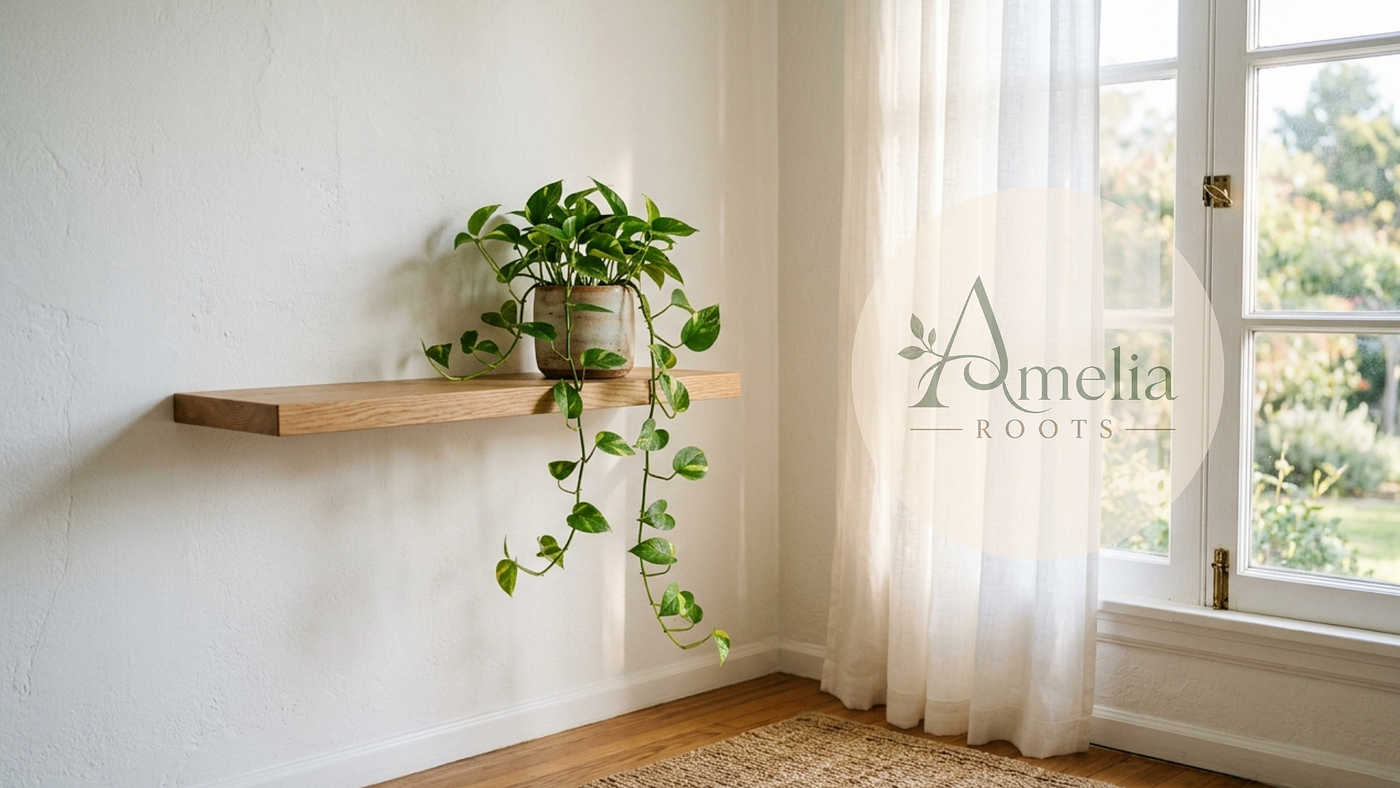
This is roughly the right distance from a window. Close enough for ambient brightness, far enough that no direct sun hits the leaves. The trailing vines are a sign the plant has been consistently happy here for a while.
On Reddit’s r/houseplants and r/plantclinic, you see this question almost every week: “My pothos leaves are turning yellow and the vines aren’t growing what’s wrong?”
Nine times out of ten, when you scroll down to their photo, the plant is sitting in a dark corner. And when someone asks where it’s placed, the answer is usually some version of: “Oh, I put it there because I heard pothos can handle low light.”
Here’s the thing pothos tolerates low light. That’s different from thriving in no light.
“Low light” in plant terms means indirect, ambient brightness. It means a room where you can comfortably read a book during the day without turning on a lamp. It doesn’t mean a hallway with no windows, or a corner where the only light source is a ceiling bulb after dark.
If your pothos is in a truly dark spot, it’ll survive for a while. But the leaves will get smaller over time, the vines won’t trail the way they should, and the plant will slowly lose the energy it needs to actually grow.
Some practical examples of what ‘low light’ actually looks like:
• A room with one north-facing window fine for pothos
• Across the room from a bright east-facing window actually pretty good
• A hallway that gets soft daylight filtering in from adjacent rooms workable
• A basement office with no windows genuinely too dark, even for pothos
The Spot Where My Pothos Started Growing Faster
When I first brought home a pothos cutting, I put it on a shelf in the middle of my living room away from the window because I liked the look of it there. For months, it just… existed. Green, alive, but not growing. I thought that was normal.
Then I moved it about two feet closer to my east-facing window — still not in direct sun, still on a shelf, just positioned where it could catch soft morning light for a few hours. Within a few weeks, the difference was obvious. New leaves appeared. The existing leaves looked more saturated, richer. The vines started trailing longer.
I’ve since noticed the same pattern every time I move a pothos from a darker spot to a brighter one (short of direct afternoon sun, which genuinely burns the leaves).
What actually works well:
• East-facing windows — soft morning light, no harsh afternoon heat
• A few feet back from a south or west-facing window, where bright indirect light fills the room
• Spots where natural light reflects off white walls — this matters more than people realize
• Avoid: south or west-facing windowsills where afternoon sun hits the leaves directly
Pothos usually tells you when it’s unhappy before it’s actually in trouble. The leaves lose their vibrancy first that’s your early warning.
Small pale patches, dull coloring, and slow growth in a plant that’s been healthy are all signs it wants a slightly brighter corner. You don’t need a light meter. You just need to pay attention.
Why Overwatering Kills More Pothos Than Low Light
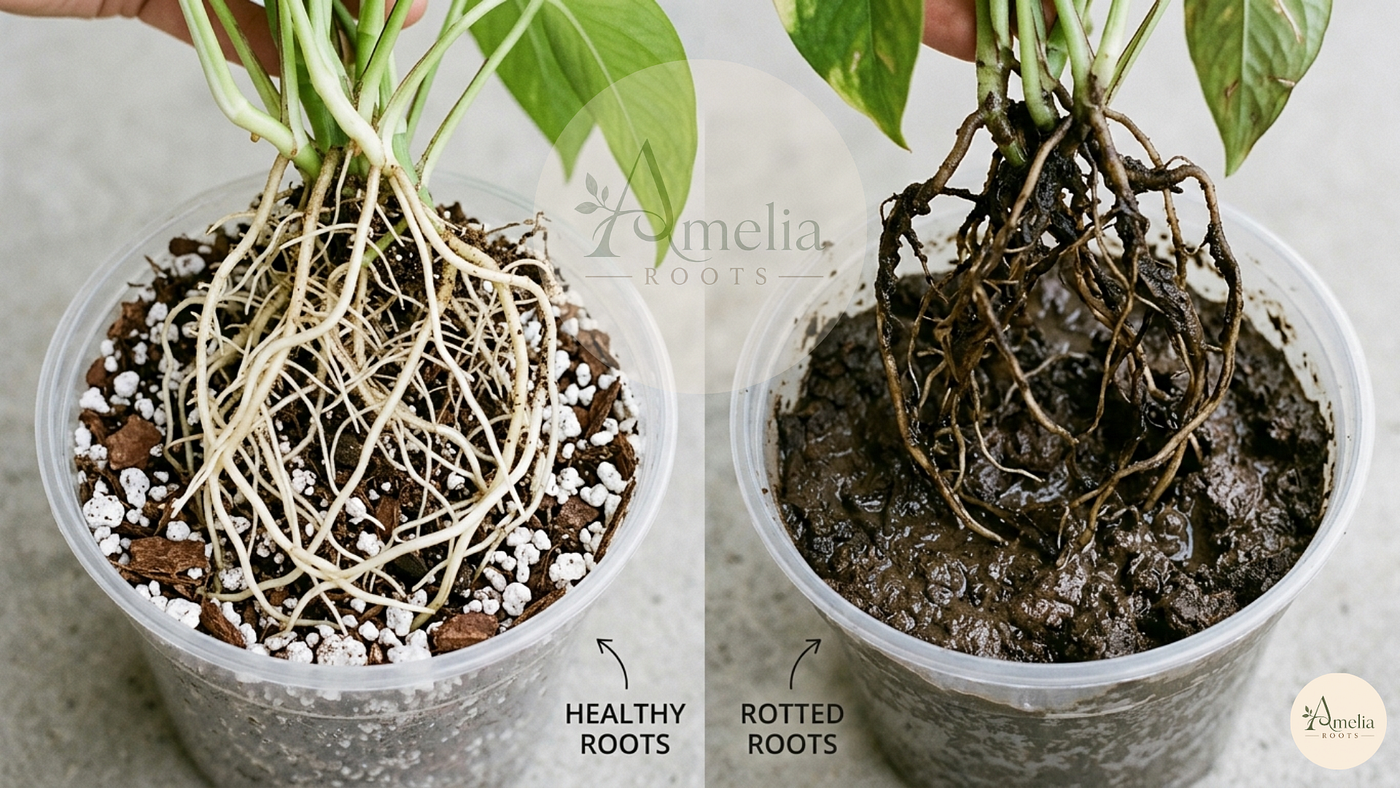
what roots look like when the soil dries properly between waterings — white, firm, with room to breathe. Right: what overwatering actually does beneath the surface, usually weeks before the leaves show any visible problem.
This is the thing I wish someone had told me directly at the start: pothos does not want to stay wet.
If you’re coming from a background of watering plants every few days — or even on a weekly schedule without checking the soil first — you will likely overwater your pothos. And in a low-light indoor environment, the soil dries out much slower than it would outdoors or in a brighter spot. So the usual watering schedules are almost always too frequent.
Signs you’re overwatering:
• Yellow leaves — not just one or two, but several at once
• Soil that stays wet for more than a week after watering
• Drooping vines even though the soil feels damp (classic root rot signal)
• A slightly musty smell from the pot
The rule I now follow: stick a finger about an inch into the soil. If it’s dry at that depth, water thoroughly. If it’s still damp, wait two or three more days and check again. In winter or in darker rooms, this can mean watering as infrequently as once every two to three weeks.
Underwatering is almost always easier to fix than root rot. A thirsty pothos perks up within a day of watering. A plant with rotted roots needs surgery — and sometimes doesn’t recover.
If you do suspect root rot, take the plant out of its pot, remove any black or mushy roots with clean scissors, let the healthy roots air dry for an hour, and repot in fresh, well-draining mix. It’s recoverable if you catch it early.
The Best Places to Keep Pothos Indoors
Part of what makes pothos genuinely useful as a houseplant is that it looks good in a lot of different spots. The trailing vines do something that few other low-light plants can do — they add a sense of movement and softness to a space.
Here’s where I’ve seen it work well, and why:
Bookshelf or floating shelves — The vines trail down naturally, softening the hard edges of the shelf. Any shelf near a window, or on a well-lit wall, works well.
Bathroom with an opaque window — Pothos actually handles the humidity well, and soft morning light coming through a frosted window is enough. I’ve kept one in a bathroom for two years with almost zero effort.
Office desk or work-from-home setup — Near a monitor, beside a window. It adds something living to a screen-heavy environment. Fluorescent office lighting alone is borderline — if there’s a window nearby, position it to catch that.
Kitchen corner near a window Especially effective above cabinets or on a high shelf where trailing vines can hang down without being in the way.
Bedside table A small pothos on a bedside table near a window is one of the coziest things in a bedroom. Just don’t put it on the side with no window access.
Small Things That Secretly Help Pothos Grow Better
None of these are essential. But if you’ve had a pothos for a while and it feels a little stagnant, these are the things that actually make a difference:
• Rotate the pot every few weeks — Pothos grows toward light. Rotating it ensures even growth rather than one-sided vines reaching for the window.
• Wipe dusty leaves — A fine layer of dust on the leaves blocks light absorption more than you’d expect. A damp cloth once a month is genuinely useful.
• Trim long, leggy vines — Counterintuitively, cutting a vine back encourages the plant to branch and grow more densely. Don’t be afraid to cut.
• Use well-draining soil — Standard potting mix with a handful of perlite mixed in. Soil that holds moisture too long is the enemy.
• Give it brighter indirect light occasionally — If you can put it near a sunnier window for a week every few months, it’ll come out of it looking noticeably healthier.
What Most Beginner Plant Guides Don’t Mention
The standard plant content online — listicles, YouTube care guides, even some nursery advice — presents pothos as if all indoor environments are roughly the same. They’re not.
Here are a few honest things that don’t usually get said:
Pothos grows slower in darker rooms — and that’s okay.
If your apartment genuinely doesn’t get much natural light, your pothos will grow — but slowly. That’s not a failure. It’s just the physics of photosynthesis. Don’t compare your plant’s pace to someone’s who has a south-facing conservatory.
Smaller leaves indoors are normal.
In the wild, mature pothos leaves can get huge. Indoors in lower light, the leaves stay smaller. You’ll see people online asking why their pothos leaves aren’t the size of dinner plates — the answer is almost always light and pot size. Smaller leaves aren’t unhealthy, they’re just adapted.
Every room has a different microclimate.
Humidity near a kitchen differs from a bedroom. Light near a window in summer is not the same as winter. A pothos that was perfectly happy in spring might need to move slightly in December. The plant gives you feedback — the skill is learning to read it rather than following a fixed routine.
Final Thoughts
Pothos is probably one of the few houseplants that actually fits the way most people live.
It doesn’t need you to have a green thumb. It doesn’t need a bright apartment, a strict watering calendar, or expensive soil. It needs a corner with some ambient light, water when the soil is dry, and occasional attention.
What I find genuinely interesting about pothos — after growing it for a few years now, in different homes and different conditions — is that it rewards observation more than effort. The more you pay attention to what it’s telling you, the better it does. And the less you try to force a rigid routine on it, the more forgiving it becomes.
Maybe that’s why so many people keep one alive for years without ever calling themselves a plant person.
Start with a small cutting or a plant from your local nursery. Put it near an east-facing window if you have one. Water it when the top inch of soil is dry. Move it if it looks unhappy for more than two weeks. That’s genuinely most of it.
The rest you’ll figure out as you go and the plant will help you
메타데이터
- post_id
- c7bd3e4e0d33
- slug
- how-to-grow-pothos-indoors-without-direct-sunlight-c7bd3e4e0d33
- url
- https://medium.com/@ameliaroots/how-to-grow-pothos-indoors-without-direct-sunlight-c7bd3e4e0d33
- canonical_url
- https://medium.com/@ameliaroots/how-to-grow-pothos-indoors-without-direct-sunlight-c7bd3e4e0d33
- author_url
- https://medium.com/@ameliaroots
- status
- ok
- fetched_at
- 2026-06-21 20:33:08