Lagrange’s Llama
The value of what’s left behind
Lagrange’s Llama
The value of what’s left behind
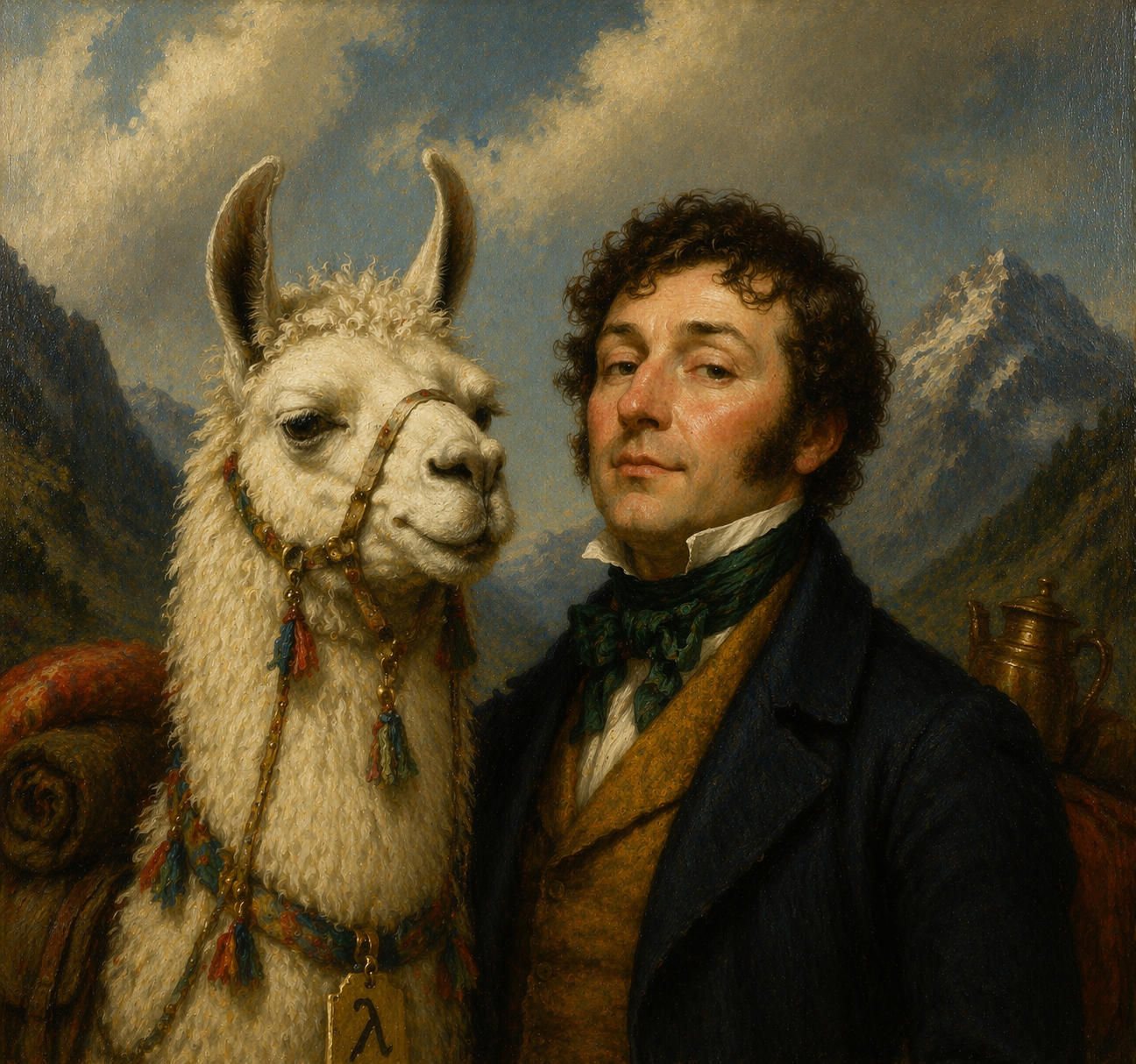
Monsieur Lagrange was not, by temperament, a light traveller.
When he set out for the mountain fair at Saint-Bernard, he loaded onto his llama a coat of serious wool, a smaller coat for contingencies, a brass coffee pot, a folding stool, a respectable ham, two jars of apricot conserve, a spyglass, a volume of Virgil, and an umbrella whose chief function was to suggest to the world that he might, in principle, be received by dukes.
The llama’s name was Lambda.
She was white, composed, and endowed with the expression of a governess who has seen a child about to make a mistake and has decided to let instruction proceed by consequence.
The path wound upward through pine and rock. Snow lingered in the shadows with an air of wounded pride. Lagrange walked ahead in excellent spirits, humming to himself and occasionally turning to say, “Not much farther now,” as if distance were a thing best settled by optimism.
By noon they came to the bridge.
It was a rope bridge over a ravine of theatrical depth, and beside it stood a painted sign:
NO MORE THAN 100 KILOS.
Lagrange stopped.
Lambda stopped with greater significance.
He looked at the bridge, then at the sign, then at the agreeable accumulation on Lambda’s back, which had seemed until that moment not excessive but merely civilised.
Nearby sat a boy on a stump, eating cherries with the concentration of one performing a local office.
“Is the sign trustworthy?” asked Lagrange.
The boy considered the bridge.
“It has been tested,” he said.
“Successfully?”
The boy moved one shoulder. “Not always by the same parties.”
This was unwelcome.
Lagrange removed his hat and surveyed the luggage with the grave irritation of a man discovering that reality has introduced mathematics into a perfectly cultivated afternoon. He had never objected to limits in the abstract. He objected only when they attached themselves to his belongings.
He began to unload.
The stool came down first, which was unfortunate, because the situation was plainly one that invited sitting. Then the coffee pot, which he set aside with a tenderness bordering on apology. Then the spare coat, though the mountain air retained a cool opinion of him. The apricot conserve followed one jar at a time, each removal diminishing the expedition in ways that felt out of proportion to jam.
Still the pile upon the ground and the pile upon the llama both remained alarmingly substantial.
The boy ate another cherry.
“What does the llama weigh?” he asked.
Lagrange stared at him.
“My good fellow,” he said, “one does not ask a lady such things.”
Lambda turned her head and regarded him with a level gaze that suggested engineering could not be indefinitely postponed by etiquette.
So they weighed her.
The boy produced a scale from somewhere behind the stump, in the manner of provincial boys who seem to draw from the landscape whatever object the lesson requires. Lambda submitted with dignity. Lagrange submitted less well. The luggage was weighed. The three totals were considered.
There was no possibility of crossing with everything.
Lagrange began to pace.
This was the moment, though he did not yet know it, at which his belongings ceased to be possessions and became alternatives. In the ordinary world, each object could enjoy its own separate importance. The ham was nourishment. The coat was warmth. Virgil was civilisation. The coffee pot was the morning rendered bearable. The umbrella was dignity under adverse skies.
But the bridge had altered their character.
Now the coat competed with the coffee pot.
The ham opposed Virgil.
Apricot conserve stood in direct rivalry with moral preparedness for rain.
It was monstrous.
Lagrange looked at the sign again. One hundred kilos. No more. That was the whole law, written in paint with a clarity the universe rarely grants to serious questions.
“Suppose,” he said slowly, “suppose the bridge would bear one kilo more.”
“Then you could take one kilo more,” said the boy.
“Yes, yes. But which kilo? That is the whole mystery.”
He knelt beside the objects. Here was the strange thing: the most valuable thing among them was suddenly not the ham, nor the coat, nor Virgil, nor even the coffee pot, whose claims remained powerful. It was the missing kilo itself. One more unit of capacity would not merely add weight. It would restore possibility. It would permit one more comfort, one more precaution, one more little fragment of the life he preferred.
The absent kilo had become sovereign.
Lagrange grew thoughtful.
A coat in a meadow was simply a coat. A coat under a weight limit was warmth bought at the price of something else. Virgil on a shelf was culture. Virgil at a bridge was culture measured against lunch. The value of each thing was no longer in the thing alone, but in what had to be given up to keep it.
He looked at Lambda.
She stood very still, relieved but not unburdened, wearing the patient expression of one who has long understood scarcity and has been waiting for a more verbal species to arrive at it.
“Lambda,” he said quietly, “you are not merely carrying this problem.”
She blinked.
“You are explaining it.”
The boy laughed. Lambda did not. Lagrange, who was right, declined to be discouraged.
He returned to the pile with a new severity. The spare coat went. Then the stool. Then one jar of conserve. The umbrella, after a decent interval of resistance, was relinquished. Last of all he picked up Virgil.
This was painful.
He turned the book in his hands and opened it as if hoping to find, somewhere in the Latin, an exemption for mountain travellers of cultivated instincts. None appeared.
“Must it be the book?” asked the boy, perhaps moved by the spectacle.
Lagrange considered.
“The ham feeds the body,” he said. “The coffee pot reconciles one to dawn. But Virgil — ”
He looked at the bridge, at Lambda, at the remaining load.
Then he placed the book upon the pile.
“Virgil,” he said, “must wait for a stronger bridge.”
This was, in its way, heroism.
The luggage was weighed again. Ninety-nine kilos and a little more, but not enough to offend fate. The bridge would hold.
“There,” said the boy.
“There,” agreed Lagrange, though with the subdued air of a man who has paid for wisdom in objects.
They crossed.
The bridge swayed with unnecessary drama. Below them the ravine sank into pines and water and old shadows. Halfway over, Lagrange felt a curious lightness that had nothing to do with kilos. It was the relief not of having less, but of having chosen. Constraint, once accepted, had simplified him.
On the far side he turned back.
There, in a neat little heap by the sign, sat the discarded articles: umbrella, stool, one jar of conserve, the second coat, and Virgil, who seemed to bear exclusion with Roman fortitude. The boy had opened the book and was reading it with sudden industry, as if what had been left behind had thereby acquired prestige.
Lagrange smiled.
He had begun the day believing that wealth meant carrying many admirable things. By afternoon he knew better. Under limit, the deepest value did not belong to the object itself, but to the room that might have held it. Not the coat alone, but the capacity in which coat or coffee pot or book could contend. Not merely possession, but margin.
At the fair he bought only a ribbon for Lambda, which she disliked, and a small round cake, which he did not.
That evening, at the inn, he cut the cake in two. One half he ate at once. The other he wrapped in a napkin and set aside for the morning.
It was not austerity. It was recognition.
What is left behind is not always loss. Sometimes it is the visible shape of a choice rightly made. Sometimes it is the cost that reveals the value. And sometimes, when a bridge is narrow and a llama is white and the world has reduced itself to one binding limit, what matters most is not the thing one carries, but the thing one has learned to leave.
From below came the faint sound of Lambda shifting in her stall, a sound almost — but not quite — like approval.
Lagrange allowed himself to take it as such.

An economical story, with ChatGPT 5.4
메타데이터
- post_id
- c7c8a6cf8e14
- slug
- lagranges-llama-c7c8a6cf8e14
- url
- https://medium.com/@economicalstories/lagranges-llama-c7c8a6cf8e14
- canonical_url
- https://medium.com/@economicalstories/lagranges-llama-c7c8a6cf8e14
- author_url
- https://medium.com/@economicalstories
- status
- ok
- fetched_at
- 2026-06-09 15:37:30




