The Neuroscience Behind Being “In the Zone”
A Deep Dive into your Mind Palace
The Neuroscience Behind Being “In the Zone”
A Deep Dive into your Mind Palace

I get a mystical feeling when I watch someone move in complete command of their craft.

We call it being “in the zone.” Psychologists call it flow.
What makes flow so fascinating is that it appears to involve a temporary shift in the area of the brain involved in focus and executive functioning.
The Executive Brain and Control
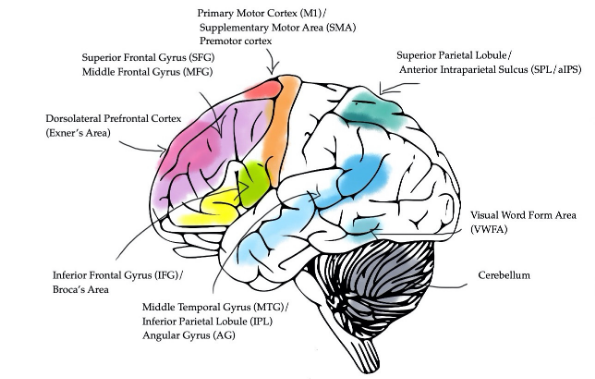
Much of our day-to-day thinking is guided by the Dorsolateral prefrontal cortex (DLPFC), a region of the brain deeply involved in executive function.
This system helps us:
- plan actions
- monitor behavior
- hold goals in working memory
- evaluate consequences
- regulate impulses

It asks questions like:
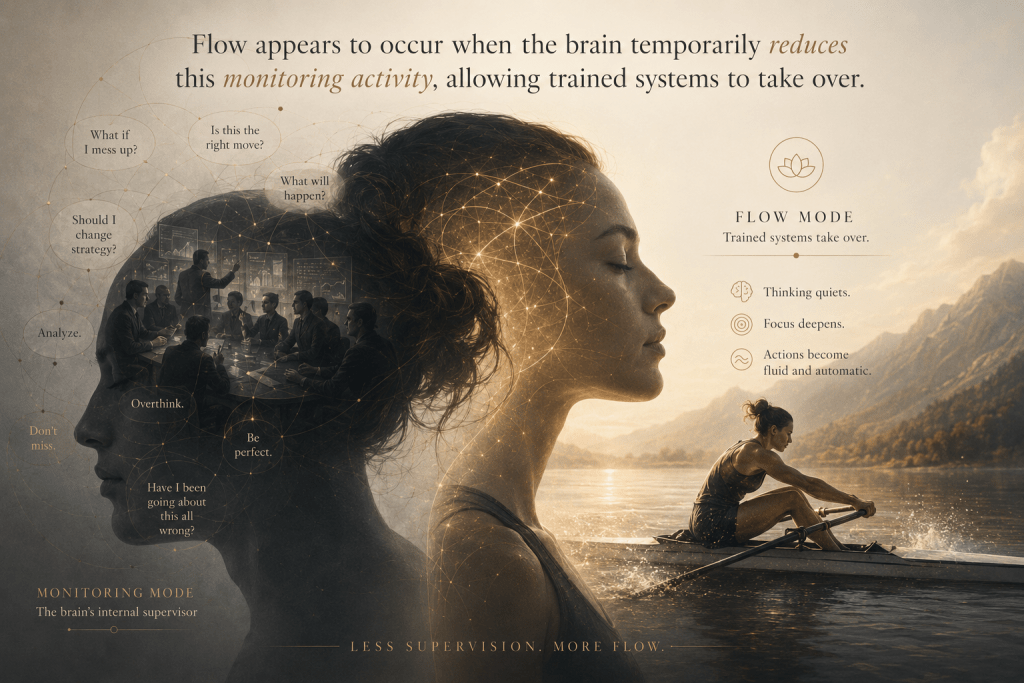
Is this the right move? What will happen if I do this? Should I adjust my strategy? Have I been going about this all wrong?
This system is essential. Without it, organized behavior would be impossible.
But, amazingly enough, when it steps aside, the most amazing human expressions are possible (or really bad mistakes, lol, but in this article we’re talking about FLOW).
The Subtle Quieting of the Prefrontal Cortex
Some neuroscientists have proposed that flow may involve a temporary quieting of certain self-monitoring and executive-control processes, a theory often discussed under the term transient hypofrontality. This term describes a temporary reduction in activity in parts of the prefrontal cortex during highly immersive tasks.
When this occurs, several interesting trends are witnessed:
- self-monitoring decreases
- rumination quiets
- time perception changes
- actions become fluid and automatic
In other words, the brain’s internal supervisor steps back. This allows well-practiced motor and cognitive systems to operate without constant interference from analytical thought (Dietrich, 2004; Ulrich et al., 2016).

The Paradox of the Thinking Mind
This creates a fascinating paradox. The same brain system that allows us to plan, analyze, regulate behavior can sometimes interfere with performance when it becomes too dominant. Anyone who has ever overthought a golf swing or stumbled through a presentation after becoming self-conscious has experienced this. The moment the executive brain becomes overly involved, the smooth execution of skill can break down.
Conditions That Promote Flow
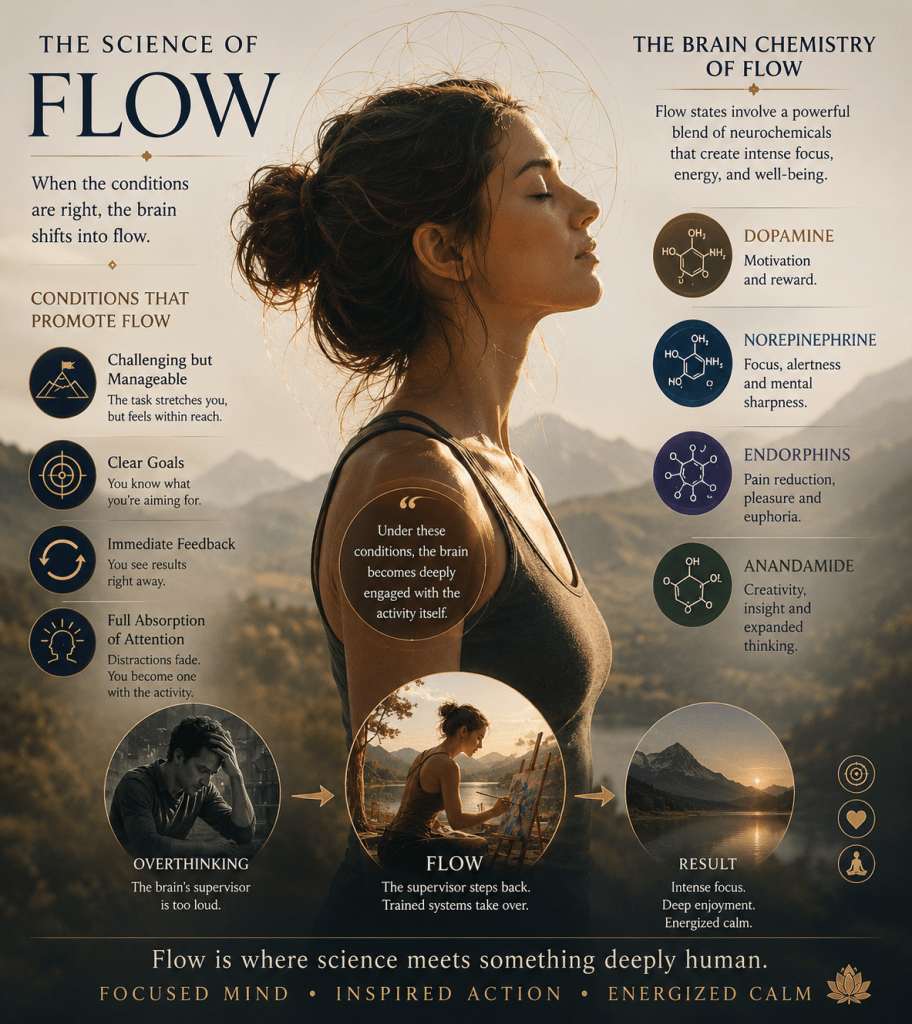
Psychologist Mihaly Csikszentmihalyi first studied this phenomenon extensively and identified several conditions that make flow more likely.
Flow tends to occur when:
- the task is challenging but manageable
- clear goals are present
- feedback is immediate
- attention becomes fully absorbed
Under these conditions, the brain becomes deeply engaged with the activity itself.
The Chemistry
Flow and the Committee
One of the most intriguing aspects of flow is the subjective experience people report. Many describe it as losing track of time, losing self-consciousness, and becoming fully present in the activity. In these moments, the constant internal narrator ~ the voice that plans, worries, and analyzes ~ fades into the background. The mind develops the “groove” feeling of moving with the activity instead of forcing it.
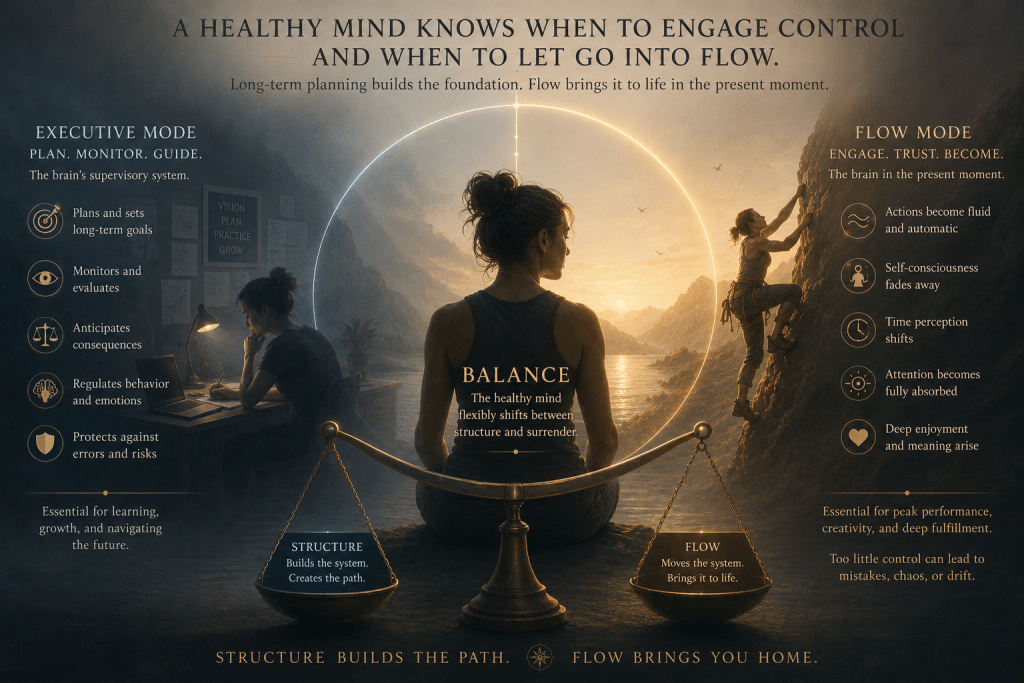
This does not mean the executive brain disappears entirely. As an ER nurse, I can tell you that I approve of this message. We need to make sure we don’t flow right into traffic.
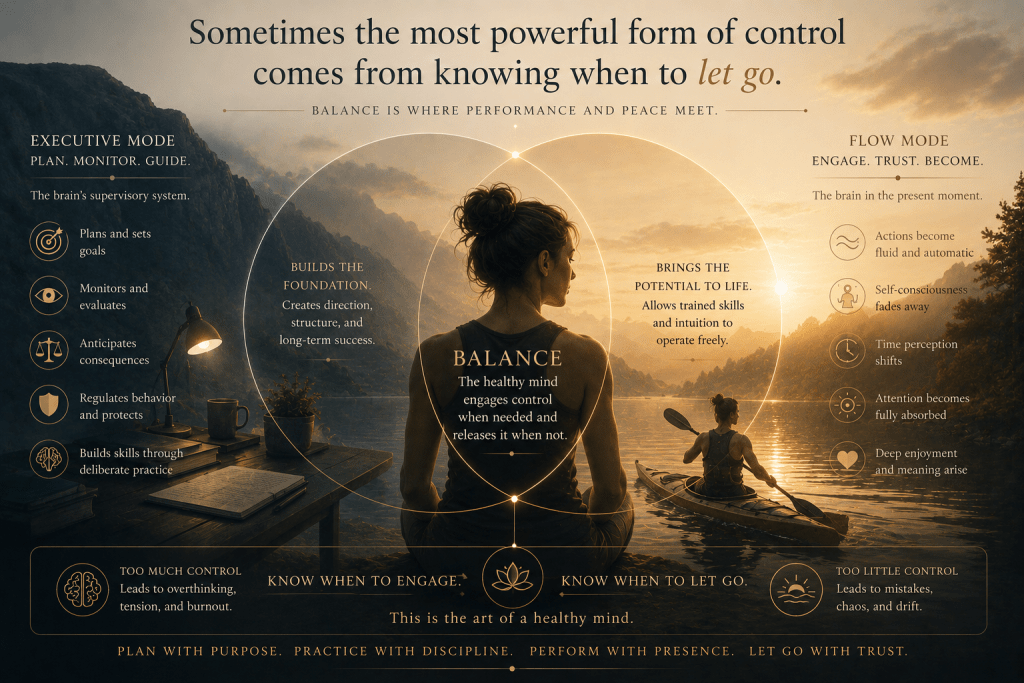
But it does suggest that healthy cognition involves flexibility.
Sometimes we need the executive brain to guide careful decisions and long-term planning.
Other times, the most effective action occurs when that system loosens its grip.
The Quiet Skill
Learning how to enter flow is a lesson in humility.
The thinking mind often assumes it must manage everything. And threatens us with death if we stop listening to it (which is sometimes good advice). But there is no traffic threatening me here as I write this article. The best pieces that come out of me are when my fingers dance along the keyboard (which has turned many a coffee way too cold, way too fast. I must microwave the same cup of coffee 5 times throughout the day sometimes. As I write this it grows cold, again, because I forgot it… in the microwave.)
Athletes call it being in the zone. Artists call it losing themselves in the work. Didn’t BBC’s Sherlock call it his “Mind Palace”? (Amazing show, btw.)
Psychologists call it flow.
Whatever the name, it reveals something profound about the human mind:
All art written, designed, and directed by Amy Dinaburg AI-assisted visual production
If this resonates, subscribe to get access to more of the same.
Notes
Dietrich, A. (2004). Neurocognitive mechanisms underlying the experience of flow. Consciousness and Cognition.
Ulrich, M., Keller, J., & Grön, G. (2016). Neural signatures of experimentally induced flow experiences. NeuroImage.
Csikszentmihalyi, M. (1990). Flow: The Psychology of Optimal Experience.
Kotler, S., & Wheal, J. (2017). Stealing Fire.
Harris, D. J., Vine, S. J., & Wilson, M. R. (2017). Neurocognitive mechanisms of flow states in sport. Progress in Brain Research.

This is for you, my Sherlock crew!
메타데이터
- post_id
- c7c8d1082b88
- slug
- the-neuroscience-behind-being-in-the-zone-c7c8d1082b88
- url
- https://medium.com/health-science/the-neuroscience-behind-being-in-the-zone-c7c8d1082b88
- canonical_url
- https://medium.com/health-science/the-neuroscience-behind-being-in-the-zone-c7c8d1082b88
- author_url
- https://medium.com/@thehumilitykey
- status
- ok
- fetched_at
- 2026-06-09 15:37:30