Between Memory and Algorithm: Aesthetic Ritual and Zwischenhalt in AI Video Creation
This experiment set out to explore whether an AI-generated visual narrative, rooted not in conventional storytelling, but in the aesthetic…
Between Memory and Algorithm: Aesthetic Ritual and Zwischenhalt in AI Video Creation
This experiment set out to explore whether an AI-generated visual narrative, rooted not in conventional storytelling, but in the aesthetic and temporal rupture defined by Zwischenhalt (a Heideggerian concept of ontological pause,) could evoke authentic emotional resonance, sustain viewer engagement, and trigger algorithmic traction. It sought to challenge the assumptions of digital media by removing dependence on traditional narrative arcs, viral pacing strategies, or familiar cultural tropes, and instead, to test whether something deeply felt could emerge through silence, stillness, and mythic rhythm.
Data as of May 27, 2025, 13:12
This experiment began with a simple, yet quietly radical question: Can an AI-generated artifact, devoid of traditional narrative, viral hooks, or theatricalism, emerge as emotionally resonant, algorithmically favorable, and aesthetically authentic, if grounded in philosophical rhythm rather than content logic? It was not a test of whether AI could mimic beauty, but whether it could be shaped to hold silence, to carry a wound, to open time. At the heart of the experiment lay the Heideggerian notion of **Zwischenhalt** — a rupture in temporality, where meaning dissolves long enough for something sacred to pass through. Around that fracture, two pieces were born.
[embed]
The first, The Last Field, (or Richard’s story,) followed the archetype of romantic departure. A knight leaves, a princess remains, lavender fields flutter in memory. The music was melancholic, the pacing solemn, the tone noble. It was visually exquisite, emotionally coherent, and narratively traditional in its pain.
[embed]
The second, We Kneel to No One, (or “The North”,) turned inward — toward snow, stone, and the silent vow of the Teutonic North. It featured no grand farewell. Instead, it gave us a woman by the fire with red hair and no title, a stew that would never be eaten, and knights who vanished into the mist without song or gaze. It was colder, slower, and narratively ambiguous, but it held a deeper silence.
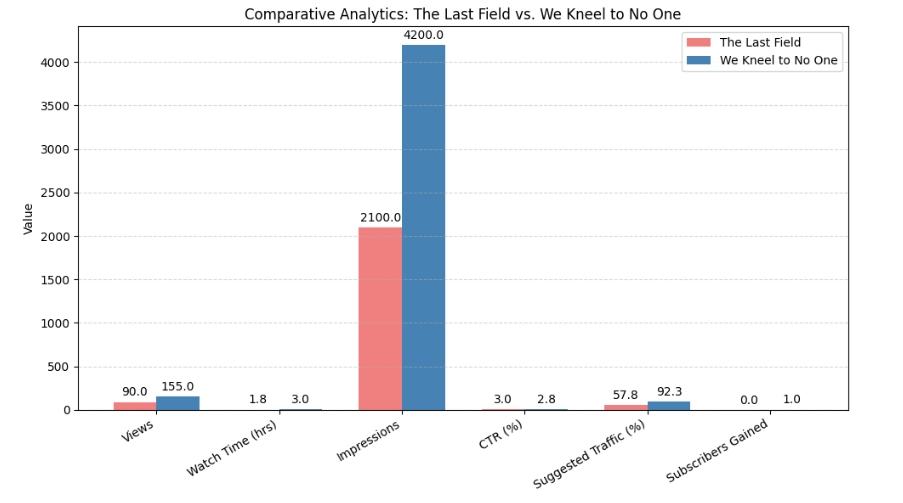
Quantitatively, the two episodes performed in startling contrast. The Last Field received 90 views in 48 hours, with a 3.0% click-through rate and an average view duration of 1:01. These are solid figures for a quiet video with no promotional engine. Yet, We Kneel to No One, in less than 24 hours, reached 155 views with a slightly lower CTR of 2.8%, but a longer average retention of 1:09. Crucially, while Richard’s story was discovered mostly by returning or casual viewers, The North was propelled by YouTube’s own system, 92.3% of its traffic came from Suggested Videos, indicating that the algorithm not only recognized its holding power, but chose to push it.
Why? The reason lies in aesthetic tension. The Last Field was emotionally satisfying but narratively clear. Viewers understood it, and so they moved on. The North, on the other hand, was veiled in symbolic stillness. It didn’t beg to be understood. It asked to be felt. The red-haired woman, who was no princess and made no speeches, evoked not desire but familiarity, the ache of someone we once knew, or might become. That grounded realism, rendered with ritual restraint, transformed the AI artifact into something mythically true. It didn’t look like content. It looked like memory.
The algorithm, trained not only to reward popularity but to detect non-bounce ritual behavior, noticed. Despite a softer initial click rate, it saw that viewers who entered The North did not skip. They watched past the one-minute mark. They often stayed silent. They allowed the rhythm to unfold. These are the very signals, watch time, slowness, emotional suspension, that mark ritual media from disposable content. In this case, the AI didn’t push virality. It honored gravity.
In conclusion, this experiment validated the core aesthetic hypothesis: that if crafted with ontological rhythm and emotional restraint, AI-generated work can hold authenticity. Not because it simulates life, but because it opens space where memory can return. Zwischenhalt, in this frame, is not a glitch. It is the sacred breath before the next word. We Kneel to No One emerged not because it told a story, but because it refused to. In that refusal, it became real. Not to the many, but to the few who stayed.
./
메타데이터
- post_id
- c7cdb5facec6
- slug
- between-memory-and-algorithm-aesthetic-ritual-and-zwischenhalt-in-ai-video-creation-c7cdb5facec6
- url
- https://medium.com/@sikkha/between-memory-and-algorithm-aesthetic-ritual-and-zwischenhalt-in-ai-video-creation-c7cdb5facec6
- canonical_url
- https://medium.com/@sikkha/between-memory-and-algorithm-aesthetic-ritual-and-zwischenhalt-in-ai-video-creation-c7cdb5facec6
- author_url
- https://medium.com/@sikkha
- status
- ok
- fetched_at
- 2026-07-19 17:36:43