FOIA Request Volume and Reading Room Naming Conventions as they Pertain to the Standardization of…
With the still recent removal of public access to government datasets in 2025, public access to federal datasets has been challenged. With…
FOIA Request Volume and Reading Room Naming Conventions as they Pertain to the Standardization of Public Access to FOIA Data
With the still recent removal of public access to government datasets in 2025, public access to federal datasets has been challenged. With access to data continuing to be a concern under the Trump Administration, it is important to have an understanding of public engagement with federal records.
Historically, access to federal data has had a defined process through the Freedom of Information Act (FOIA). Passed in 1966, its aim is for government transparency through supplying the public with access to government records. This is done through three main avenues. FOIA requires federal agencies to make records publicly available through publishing in the Federal Register, available electronically in agency archives (often called “reading room access”), and by request. The public has the right to request and receive data (with nine exemptions for legal and safety reasons) from federal agencies. You can find the full text of the Freedom of Information Act here.
FOIA Reading Rooms, also commonly referred to as FOIA Libraries, are the publicly accessible archives where people are able to view both proactively released information and information that has been released as the result of a FOIA request. Each agency covered under FOIA is required to maintain a reading room. The Electronic Freedom of Information Act Amendments of 1996 updated the terms of FOIA to require that these materials be electronically accessible.
In 2019, Lisa DeLuca, who at the time was the social services librarian at Seton Hall University, compiled information on the electronic location and naming conventions of FOIA Reading Rooms. You can find that dataset here. In her 2020 article (available here), DeLuca highlights the importance of awareness of these different naming conventions when navigating FOIA records, and advises that agencies continue to refine and streamline their online document accessibility, while researchers can improve search results by including terms like “FOIA Library” in their searches.
On reviewing DeLuca’s dataset, it was clear that there was a wide range of naming conventions, with 55 variations appearing across 241 represented agencies. The five most common were “FOIA Library”, “FOIA Reading Room”, “Electronic Reading Room”, “FOIA Electronic Reading Room”, and “FOIA”, respectively.
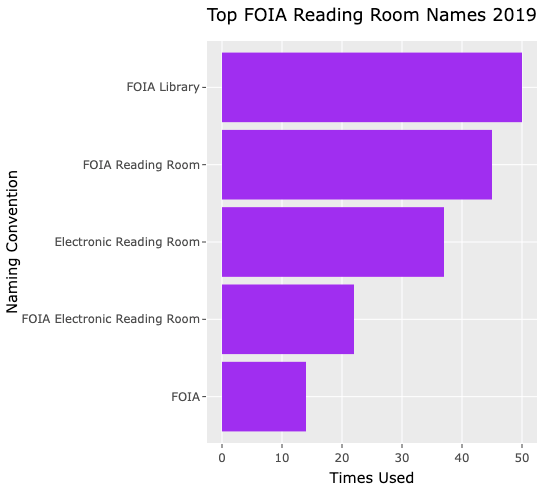
Click Here to Download Interactive Plot
Given this diversity of naming practices, I was curious to see what the correlation might be between reading room naming conventions and agencies receiving the highest volume of FOIA requests. While FOIA requests are different than FOIA reading room access, I hoped to gain insight into what, if any, connection might be found between high volume agencies and any standardization of data management and accessibility.
FOIA.gov supplies annual datasets available for download, which includes, among other yearly metrics, information on the number of requests received by individual and collective agencies annually. Current available datasets cover the years 2008–2024. It is important to note that since this data is gathered at an agency level, per the Data Working Group (DWG) of the Chief FOIA Officers’ Council, “The data metrics agencies gather and how that data is analyzed differs widely depending on the size of the agency and the nature of the agency’s mission and work.” This is another clear indicator of the lack of standardization when it comes to FOIA data.
Looking at the 2019 dataset, the five agencies receiving the most FOIA requests were, in order, the Department of Homeland Security, the Department of Justice, the National Archives and Records Administration, the Department of Defense, and the Department of Health and Human Services.
Now, how does that connect to the most common reading room naming conventions at the time?

Click Here to Download Interactive Plot
The top five agencies in terms of received requests were, in order, the Department of Homeland Security (DHS), the Department of Justice (DOJ), the National Archives and Records Administration (NARA), the Department of Defense (DOD), and the Department of Health and Human Services (DHHS). All of these agencies used different naming conventions for their reading rooms.
While three of the most common naming conventions were used by the top agencies (and the Department of Homeland Security did use “FOIA Reading Room”), there was not a direct correlation between naming conventions and volume of requests. Prior to examining the 2019 datasets more closely, I hypothesized that there might be a closer connection between request volume and naming conventions, as standardized naming conventions could be reflective of an effort toward streamlining data management and public access across agencies.
However, as FOIA requests are more likely to be focused on specific content rather than how that content is labelled, the result is not completely unexpected, but is in fact another point that is illustrative of the lack of homogeneity across agencies when organizing their FOIA data.
In a time where access to data is currently more restricted, and challenges to access stretch beyond naming conventions, it is worth looking at the patterns in FOIA requests over time. Assuming members of the public still interested in accessing this data, how much of an impact might lack of access make?
In the 2008–2024 period, the Department of Homeland Security was consistently the agency that received the most FOIA requests, but there were 7 other agencies that appeared repeatedly in the top five during that time, namely the Departments of Veteran Affairs, Justice, Health and Human Services, the National Archives and Records Administration, Social Security Administration, and the Department of Agriculture. The Department of Homeland Security’s requests trended upwards over time, with 911,535 requests received in 2024.
Overall FOIA requests have also increased over time, with the total combined requests almost tripling in volume from 2008–2024. Requests saw a more rapid increase in recent years, beginning in 2022 and continuing through 2024, which saw a total number of requests of 1,501,432. There are a variety of factors that have been proposed to explain this, including an increase in public demand for government accountability, and the Attorney General issuing new transparency guidelines in 2022. These guidelines noted continuing issues with processing practices, and called for agency improvements in removing barriers to access through proactive disclosure, employee communication, and website and search design.

Click Here to Download Interactive Plot
Ease of public access to government data is just as, if not even more, important now than it was in 2019. Request backlogs continue to be a top issue for agencies, with staffing shortages, outdated technology, and complex requests being cited as some of the factors slowing processing times. These are challenges that can be expected to continue under the current administration, which has showed itself more likely to restrict information than increase access. Given these ongoing issues, it is important to continue to pay attention to FOIA data as we continue to evaluate where processes might be improved in the interest of data accessibility.
Referenced Information, in Order of Article Appearance:
https://www.nytimes.com/2025/02/02/upshot/trump-government-websites-missing-pages.html
https://www.congress.gov/crs-product/R46238
https://www.archives.gov/federal-register/the-federal-register/about.html
https://www.foia.gov/agency-search.html
https://www.congress.gov/bill/104th-congress/house-bill/3802
https://www.shu.edu/profiles/delucali.html
https://data.mendeley.com/datasets/f7ysn96hny/1
https://www.sciencedirect.com/science/article/abs/pii/S0740624X18304702?via%3Dihub
https://www.foia.gov/foia-dataset-download.html
https://www.foia.gov/chief-foia-officers-council/leveraging-foia-data
메타데이터
- post_id
- c7d235d1e5fc
- slug
- foia-request-volume-and-reading-room-naming-conventions-as-they-pertain-to-the-standardization-of-c7d235d1e5fc
- url
- https://medium.com/@caitlyn.m.strayer/foia-request-volume-and-reading-room-naming-conventions-as-they-pertain-to-the-standardization-of-c7d235d1e5fc
- canonical_url
- https://medium.com/@caitlyn.m.strayer/foia-request-volume-and-reading-room-naming-conventions-as-they-pertain-to-the-standardization-of-c7d235d1e5fc
- author_url
- https://medium.com/@caitlyn.m.strayer
- status
- ok
- fetched_at
- 2026-06-16 19:09:56