Your Terraform State File May Be Your Biggest Security Risk.
Remote Backends Protect Storage, Not Visibility. OpenTofu’s Built-in State Encryption Adds Another Layer of Defense for Infrastructure as…
Your Terraform State File May Be Your Biggest Security Risk. Here’s How OpenTofu’s Native State Encryption Changes the Game.
Remote Backends Protect Storage, Not Visibility. OpenTofu’s Built-in State Encryption Adds Another Layer of Defense for Infrastructure as Code.

Infrastructure as Code has transformed the way we provision and manage cloud environments. Whether you’re deploying Kubernetes clusters, AWS infrastructure, or Azure resources, tools like Terraform and OpenTofu have become part of almost every modern DevOps workflow.
But there’s one file that often receives far less attention than it deserves, the Terraform state file.
It isn’t just metadata about your infrastructure. It frequently contains resource identifiers, networking information, and, depending on the providers and resources in use, sensitive values that organizations would never intentionally expose.
Many teams secure their remote backend and assume the problem is solved.
Unfortunately, that’s only part of the story.
Why State Files Matter
The state file acts as the source of truth for your infrastructure. It allows Terraform or OpenTofu to understand what already exists so future deployments can be planned accurately.
Because of that responsibility, state files often include information such as:
- Cloud resource identifiers
- Internal IP addresses and DNS records
- IAM resource metadata
- Database connection details
- Outputs that may contain sensitive values
- Provider-specific attributes
Although sensitive outputs can be hidden from console output, many providers still store sensitive resource data in the state itself because it’s required for lifecycle management.
That means protecting the backend alone isn’t always enough.
Encryption at Rest Isn’t the Entire Solution
Most production teams already store state remotely using services such as:
- Amazon S3 with SSE-KMS
- Azure Blob Storage
- Google Cloud Storage
- HCP Terraform / Terraform Cloud
These services encrypt data while it’s stored.
However, once an authorized user or CI/CD pipeline retrieves the state file, its contents are available in readable form because the storage service transparently decrypts the object.
In other words, backend encryption protects storage media, it doesn’t necessarily reduce exposure after the file has been accessed.
That’s an important distinction.
OpenTofu’s Native State Encryption
One of OpenTofu’s most significant security enhancements is native state encryption, introduced in version 1.7.
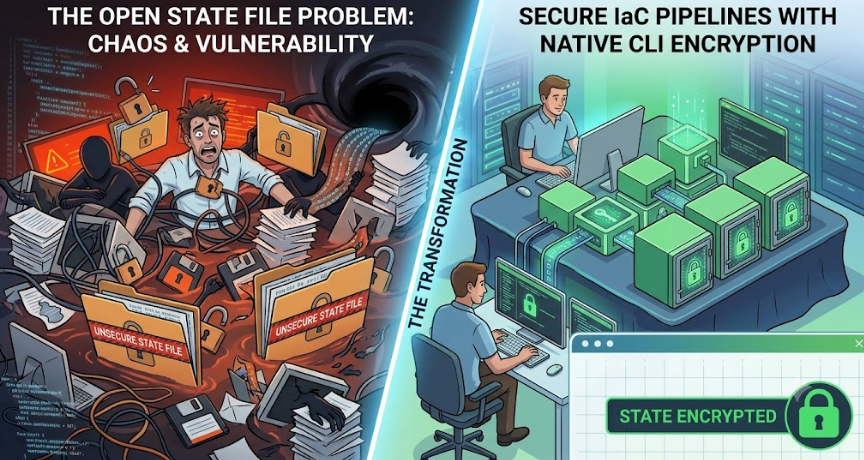
Instead of relying solely on backend storage encryption, OpenTofu can encrypt state before it is written to the backend.
A simplified configuration looks like this:
terraform {
  encryption {
    key_provider "aws_kms" "state_key" {
      region = "us-east-1"
      key_id = "arn:aws:kms:..."
  }
method "aes_gcm" "state" {
      key = key_provider.aws_kms.state_key
    }
    state {
      method  = method.aes_gcm.state
      enforce = true
    }
  }
}
With this configuration, the state is encrypted by OpenTofu itself before it’s stored remotely, providing another security layer beyond backend encryption.
How Does This Compare with Terraform?
This is where the two projects begin to differ.
OpenTofu includes configuration-level state encryption directly in its open-source CLI.
Terraform Open Source does not currently offer an equivalent built-in feature.
That doesn’t mean Terraform is insecure.
Terraform users commonly rely on encrypted remote backends, strict IAM permissions, secret management solutions, and, in many organizations, HCP Terraform, which provides managed state storage with additional security controls.
The difference is where the encryption capability lives.
OpenTofu provides it directly in the CLI.
Terraform generally relies on backend and platform-level protections.
For many organizations, both approaches can satisfy security requirements. OpenTofu simply offers another option for teams that prefer encryption to be managed within their Infrastructure as Code workflow.
Flexible Key Management
Photo by Richard Horvath on Unsplash
OpenTofu supports several key providers, allowing organizations to integrate with existing security practices.
Teams already using cloud-native key management services can leverage AWS KMS or Google Cloud KMS, while smaller teams can use passphrase-based encryption through PBKDF2.
That flexibility allows organizations to choose an approach that matches their operational maturity without forcing a single deployment model.
Things to Know Before Enabling It
Enabling state encryption is generally straightforward, but there is one implementation detail worth understanding.
The encryption configuration is evaluated very early during initialization.
If the encryption key itself depends on variables that aren’t yet available, such as values loaded later from a .tfvars file, the initialization process may fail.
For that reason, encryption keys are typically supplied through environment variables or platform-managed configuration rather than standard variable files.
Planning for this upfront avoids unnecessary migration issues.
Should You Switch to OpenTofu?
If your organization already has a mature Terraform workflow with properly secured remote state, strong IAM controls, and HCP Terraform, there may not be an urgent need to migrate.
However, if you’re evaluating Infrastructure as Code platforms today, or you’re looking for additional protection around state files, OpenTofu’s native state encryption is a compelling capability worth considering.
Migration is typically straightforward because OpenTofu maintains compatibility with Terraform providers, modules, and existing state in most common scenarios.
Final Thoughts
State files are among the most sensitive artifacts in any Infrastructure as Code workflow.
Protecting the storage backend is essential, but it isn’t the only consideration.
OpenTofu’s native state encryption adds another layer of defense by protecting state before it reaches remote storage, giving security-conscious teams greater control over how sensitive infrastructure metadata is handled.
Whether you choose Terraform or OpenTofu, the takeaway is the same: treat your state file like production credentials.
Because in many environments, that’s exactly what it contains.
Thanks For your Precious Time!
메타데이터
- post_id
- c7e31e52b461
- slug
- your-terraform-state-file-may-be-your-biggest-security-risk-c7e31e52b461
- url
- https://medium.com/infradecodedops/your-terraform-state-file-may-be-your-biggest-security-risk-c7e31e52b461
- canonical_url
- https://medium.com/infradecodedops/your-terraform-state-file-may-be-your-biggest-security-risk-c7e31e52b461
- author_url
- https://medium.com/@sneharani2509
- status
- ok
- fetched_at
- 2026-07-16 06:05:14