The Evolution of Marketing, Part 2
Competitive advantage is determined by the biggest problems in its era.
The Evolution of Marketing, Part 2
Competitive advantage is determined by the biggest problems in its era.
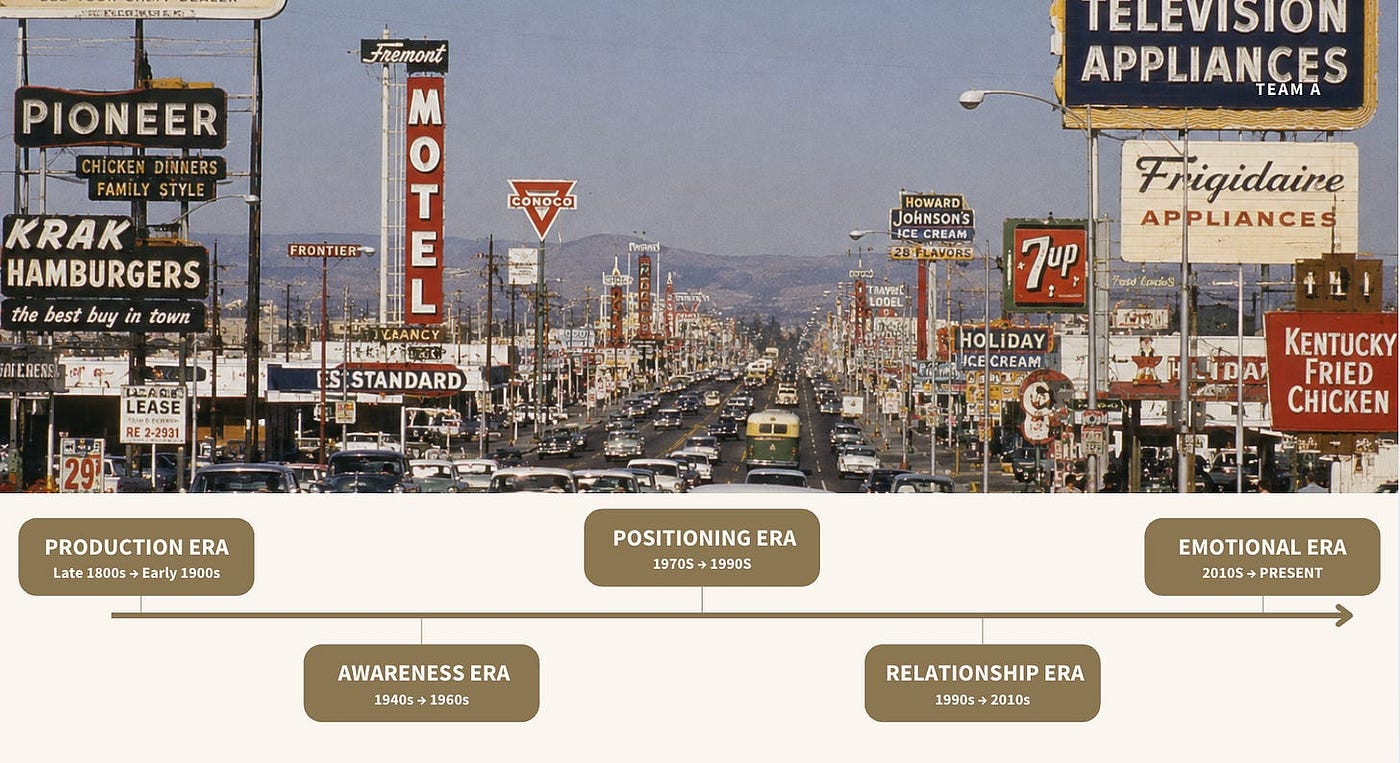
In Part I, we explored a simple idea.
Marketing didn’t evolve because marketers decided to become more creative, it evolved because their consumers’ behaviors changed.
Due to technological advances and cultural events, consumer behaviour shifted, which led to businesses being forced to adapt to continually changing challenges.
Marketing, in response, evolved alongside those changes, leading to every era demonstrating the different challenges in its time.
The Production Era (Late 1800s-Early 1900s)
When Utility Was Enough
Industrialisation created the opportunity for mass production, allowing companies to produce products at a much faster, higher scale than ever before.
Companies were now able to expand their customer base, by providing access to products that were only available to a select few, and at more affordable costs.
However, options still remain limited as only a few manufacturers had the capability for mass production.
As the Henry Ford Museum puts it:
“Technological advances in manufacturing processes and materials dramatically increased the flow and production of goods. Factories churned out a dazzling array of affordable goods for a growing middle class of consumers.”
This shaped the earliest form of modern marketing.
Competitive advantage came from being able to provide a product. The marketing reflected that environment.
Advertising focused on practical value.
- This product works.
- This machine saves time.
- This soap cleans.
- This tool solves your problem.
Utility was the differentiator.
The challenge wasn’t standing out, it was showing customers these products exist.
But as industrialisation accelerated, more and more companies gained the ability to mass produce.
More products slowly entered the market.
And with choice came an entirely new challenge.
The Awareness Era (1940s-1960s)
The Battle for Attention Begins
A couple of things happened in this era to change the way marketing evolved:
- Mass production became widespread, leading to more companies fighting for a share of the same marketplace
- Mass media created additional touch points to customers
This meant more companies now had the inventory and the means to reach audiences at a national scale.
As more companies entered the market, customers now had the power to choose.
Which meant visibility became the competitive advantage.
Television didn’t just create another advertising channel, it changed the scale at which brands could compete.
From Woojin Kim’s paper titled ‘Television and American consumerism’ in the Journal of Public Economics,
“TV with its unprecedented advertising appeal drew Americans into a culture of… purchasing products.”
“Counties with television access experienced 3–4% greater retail sales growth than counties without television access.”
Companies now needed to make their brands memorable, which sparked the area of creative advertising. This was the era which introduced jingles, slogans, mascots, celebrity endorsements.
Marketing has shifted from “This product exists” to “Remember this brand”.
The Positioning Era (1970s -1990s)
Perception Became the product
This was the era of globalisation, expanding competition due to advances in manufacturing, distribution and even more expansive mass media networks.
Three forces converged in this era:
- Mature manufacturing (more companies could make good products)
- Global competition (more companies entered the market)
- Information abundance (consumers were exposed to more brands)
Markets became crowded. Functionality was no longer enough to stand out.
By the early 1980s, Theodore Levitt in his Harvard Business Review article argued that technology was transforming separate national markets into a single global marketplace. As businesses increasingly competed beyond their domestic borders, consumers were exposed to more brands — and more choices — than ever before.
Too many choices created a different challenge -
Consumers no longer struggled to find products, they struggled to distinguish them.
As markets started to become saturated, companies needed to find a way to occupy mental space on top of shelf space. Terms such as ‘top of mind’ became more common in marketing briefs.
In Positioning: The Battle for Your Mind (1981) by Al Ries and Jack Trout:
“Marketing is not a battle of products. It’s a battle of perceptions.”
The question was no longer:
Can you make a good product?
It became:
Why should anyone choose yours?
Marketing changed from trying to be memorable to owning a concept, associating products and brands into a singular perception.
- Volvo = safety
- Nike = athletic ambition
- Apple = creative rebellion
- Red Bull = extreme performance
Positioning has evolved marketing from simply communicating to psychology.
The Relationship Era (1990s -2010s)
Experience Becomes a Commodity
By the late 1990s, another technological revolution was quietly reshaping the marketplace and unlike television, which transformed how brands communicated, the internet transformed how consumers interacted with brands and how quickly they could get their information.
Customers were also now able to engage with brands before and after the initial purchase.
A company was no longer just a logo on a billboard or a commercial between television shows.
It became a website. A customer support portal.A loyalty programme.An email newsletter.
Eventually, a mobile app sitting permanently in a customer’s pocket.
Consumers weren’t simply buying products anymore.
They were entering ongoing relationships.
The Internet Changed Consumer Expectations
The commercialisation of the internet fundamentally changed the balance of power between businesses and consumers.
Before the internet, information was largely controlled by brands — companies could decide what customers saw, what they knew.
The internet disrupted that model entirely.
Consumers could now compare prices within minutes, read reviews from complete strangers, research products before entering a store.
Businesses were no longer competing only through advertising, they were competing through every interaction a customer had with them.
As marketing scholars Philip Kotler and Kevin Keller observed:
“Marketing is about identifying and meeting human and social needs.”
In an increasingly connected world, those needs expanded beyond the product itself, consumers began expecting convenience.
Accessibility. Personalisation. Speed. Consistency.
The experience surrounding the product increasingly became part of the value proposition.
The Experience Economy
In 1998, B. Joseph Pine II and James H. Gilmore introduced a concept that would become one of the defining ideas of modern marketing.
Writing in the Harvard Business Review, they argued:
“Experiences have emerged as the next step in what we call the progression of economic value.”
Their central argument was remarkably simple — businesses no longer competed solely through goods or services.
They increasingly competed by designing memorable experiences.
This represented a profound shift. Previously, marketing’s job had largely been to shape perception before purchase, now it also had to shape experience after purchase.
Branding was no longer confined to advertising.
Every interaction became marketing.
Every Touchpoint Became Branding
As digital technology matured, consumers encountered brands through dozens of interconnected touchpoints.
Packaging. Customer support. Websites. Mobile apps. Delivery. Returns. Community forums. Customer ratings and reviews.
Each interaction reinforced — or undermined — the brand promise, leading to some companies building ecosystems rather than isolated products.
Apple didn’t simply sell the iPhone.
It connected hardware, software, retail, customer support, cloud services and subscriptions into one seamless experience.
Amazon transformed convenience into a competitive advantage through Prime, making fast shipping, entertainment and digital services part of a single membership.
Starbucks extended the café experience beyond the store through mobile ordering, rewards and personalised offers.
Increasingly, customers weren’t evaluating products in isolation.
They were evaluating the relationships.
From Perception to Experience
The Relationship Era didn’t replace positioning, it expanded it.
Positioning answered an important question:
What do consumers think about your brand?
The internet introduced another:
Does every interaction reinforce what your brand promises?
Brands could no longer rely solely on memorable advertising or clever positioning statements, they had to deliver those promises consistently across every customer touchpoint.
Marketing was no longer just about shaping expectations — it became responsible for shaping the experience itself.
In many ways, this era quietly laid the foundation for everything that followed.
Because once products became easier to buy… and experiences became easier to design… businesses faced an entirely new challenge:
If everyone could build a functional product and everyone could create a seamless experience…
what would consumers choose next?
The Emotional Era (2010s -Present)
When Products Need Meaning
At this point in our timeline, marketing has fundamentally changed how consumers interacted with brands.
Companies already see the importance of investing in customer journeys, loyalty programmes and interconnected ecosystems on top of delivering a quality product.
They have realised that every touchpoint contributes to the overall brand.
But as these practices became standard, they also stop being sources of competitive advantage.
Fast delivery became expected. Mobile apps became commonplace. Good customer service became the minimum rather than the differentiator.
Businesses once again found themselves asking the same question that had defined every previous era:
If everyone can do this, what makes people choose us?
A World of Abundance
Today’s marketplace is defined by abundance.
Global manufacturing has dramatically lowered the barriers to producing physical goods and digital platforms have made it possible for almost anyone to launch a business.
Social media allows brands to reach global audiences without purchasing television airtime.
Artificial intelligence has begun reducing the time and cost required to create content, design campaigns and develop products.
In many categories, competitors can imitate features, aesthetics and marketing tactics faster than ever before.
As Theodore Levitt observed in Marketing Success Through Differentiation — of Anything:
“The new competition is not between what companies produce in their factories, but between what they add to their factory output…”
Levitt was writing in the 1980s, but his insight feels even more relevant today.
Products alone rarely create lasting advantage.
The question has shifted from:
“What do you sell?”
to
“Why should anyone care?”
From Human Needs to Human Meaning
Philip Kotler and Kevin Keller (Marketing Management), define marketing as:
“Marketing is about identifying and meeting human and social needs.”
Not products. Or advertising. Or campaigns.
It begins with people.
As products become increasingly indistinguishable, understanding human needs becomes even more important than understanding product categories.
Customers start looking for more than functionality.
They try to see if products give them confidence. Status. Belonging. Purpose. Recognition. Meaning.
Marketing has now evolved beyond just communicating features.
It has become understanding the psychological and social roles brands play in people’s lives.
Consumers Don’t Think as Rationally as We Assume
This shift is also supported by behavioural economics.
In Thinking, Fast and Slow, Nobel Prize-winning psychologist Daniel Kahneman demonstrated that much of human decision-making is driven by fast, intuitive thinking rather than slow, rational analysis.
“Nothing in life is as important as you think it is while you are thinking about it.”
His broader research challenged one of the central assumptions of classical economics — that people consistently make purely rational decisions.
Instead, emotion, context, memory and cognitive shortcuts all influence our choices.
Behavioural economist Rory Sutherland extends this idea into marketing.
In Alchemy, he argues that value is not created solely through physical utility but also through perception.
As he writes:
“The opposite of a good idea can also be a good idea.”
In other words, products don’t always succeed because they are objectively better.
They often succeed because they mean something different.
Brands Became Identity Systems
This helps explain why some of today’s strongest brands command extraordinary loyalty despite offering products that competitors can easily replicate.
Liquid Death doesn’t simply sell water. It sells rebellion.
Patagonia doesn’t simply sell outdoor clothing. It communicates environmental values.
Nike rarely talks about rubber soles or foam technology. It is creating stories about ambition, perseverance and achievement.
Apple no longer differentiates itself solely through hardware specifications. It represents creativity, simplicity and thoughtful design.
Jennifer Aaker’s research on brand personality found that consumers consistently attribute human personality traits to brands, suggesting that people often relate to brands in much the same way they relate to other people.
Brands stopped functioning purely as commercial entities, they have became symbols of identity.
Simon Sinek captured a similar idea in Start With Why:
“People don’t buy what you do; they buy why you do it.”
Whether or not every purchasing decision follows this pattern, the broader principle remains compelling.
Consumers increasingly align themselves with brands that reflect their values, aspirations and sense of self.
Emotional Resonance Becomes a Competitive Advantage
During the Production Era, companies competed through utility.
During the Awareness Era, they competed through visibility.
During the Positioning Era, they competed through perception.
During the Relationship Era, they competed through experience.
Today, many brands compete through meaning.
This doesn’t mean products no longer matter, or that positioning has become irrelevant.
Every previous layer still exists.
But as each source of competitive advantage became more accessible, it also became easier to imitate.
Meaning remains difficult.
Communities cannot be copied overnight. Trust cannot be manufactured. Culture cannot simply be generated. Belonging cannot be reverse-engineered.
The strongest brands today don’t simply occupy space in consumers’ minds.
They occupy space in their identities.
This concludes the different eras, how marketing has steadily evolved, and more importantly why. These are important lessons we can learn to continually grow and evolve our own practices and how we see the world.
In Part 3, we continue into today’s cultural and economic landscape to see how marketing continues to evolve and what we, as marketers should be paying attention to to keep our brands in our consumer’s hearts.
메타데이터
- post_id
- c7f6fb4ccf99
- slug
- the-evolution-of-marketing-part-2-c7f6fb4ccf99
- url
- https://medium.com/@hello_16320/the-evolution-of-marketing-part-2-c7f6fb4ccf99
- canonical_url
- https://medium.com/@hello_16320/the-evolution-of-marketing-part-2-c7f6fb4ccf99
- author_url
- https://medium.com/@hello_16320
- status
- ok
- fetched_at
- 2026-08-17 07:31:42