Gradually, Then Suddenly: The Quiet Stewardship of Waiting Well
Reflections on reading Mark Batterson’s Gradually, Then Suddenly and listening to the audiobook
Gradually, Then Suddenly: The Quiet Stewardship of Waiting Well
Reflections on reading Mark Batterson’s Gradually, Then Suddenly and listening to the audiobook
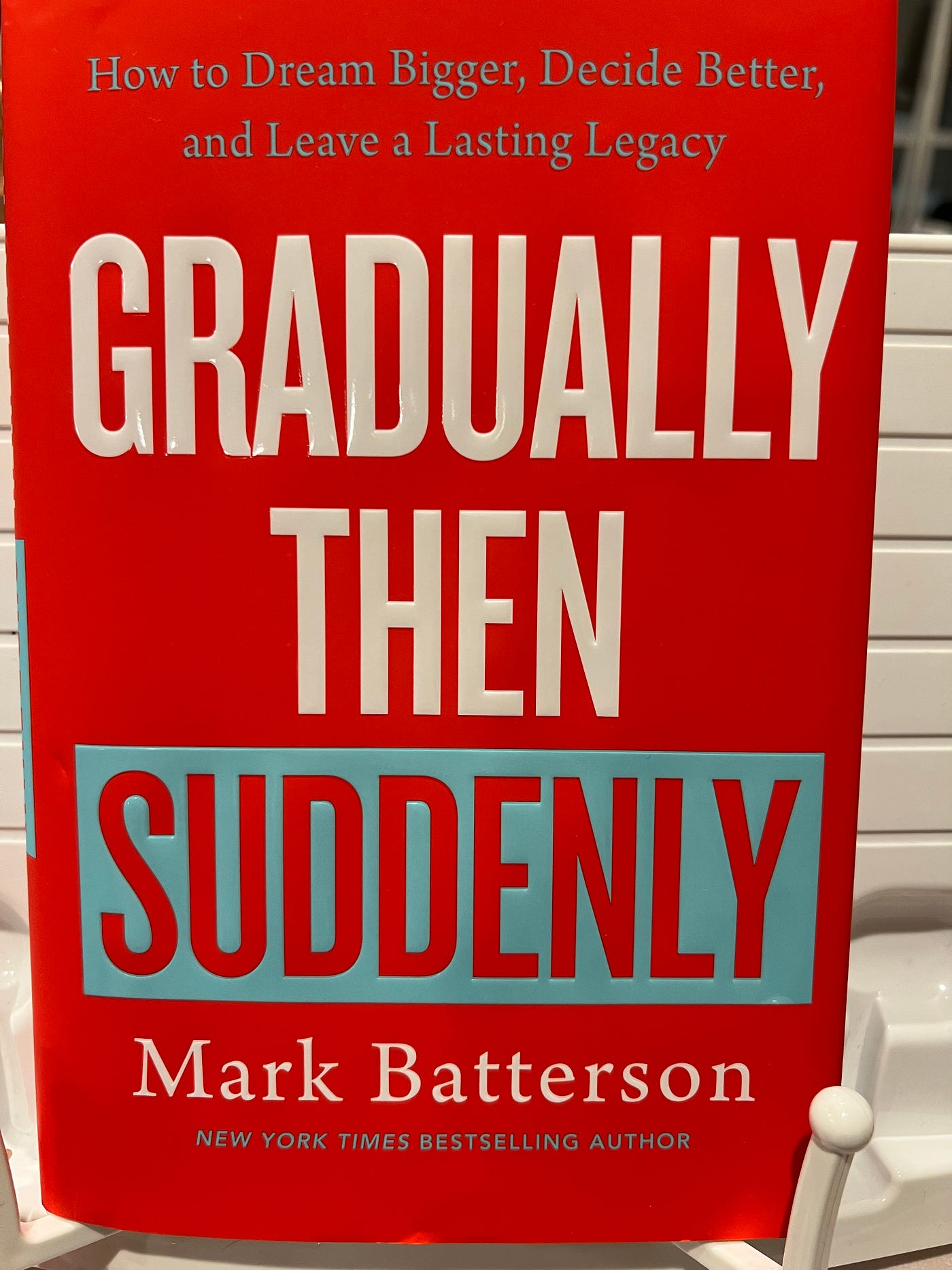
I rarely buy a paper copy after completing both the audiobook and e-book — but some books ask to be held, marked up the old-fashioned way, and kept within arm’s reach.
If you’re in the middle of a waiting season right now — and most of us are, in one way or another — I want you to know: the waiting is doing its deep work, even when it doesn’t feel like it.
I picked up Mark Batterson’s Gradually, Then Suddenly during one of those in-between seasons. Not the triumphant, post-worthy kind, but the quieter one — the season of preparation, uncertainty, and no clear evidence that anything is moving forward. The book’s central image stopped me cold.
The Moso bamboo is the fastest-growing plant on earth, but for the first five years after planting, there is zero visible growth. Nothing. The seed disappears beneath the soil and, to the naked eye, the plot looks abandoned. But underground, an aggressive root system is silently spreading across dozens of meters, building the infrastructure for what comes next. Then, in a single rainy season, the bamboo shoots up ninety feet — growing as fast as three feet per day.

Five years of silence underground. Six weeks to ninety feet. The roots always come first.
The visible growth is always the suddenly. The invisible growth is always the gradually. And gradually is where we spend most of our lives.
This reframing changed how I think about waiting — in every area.
We live in an era that worships speed. AI is reshaping industries overnight. Social media feeds are highlight reels of breakthroughs, announcements, and milestones. It’s easy to look at your own quiet season — whether you’re navigating a desired career change, healing from a medical condition or traumatic event, building a relationship, raising a family, or simply trying to become the person you sense you’re meant to be — and feel like your efforts are fruitless, you are hidden and falling behind.
We steward so many domains of life at once, and nearly all of them involve waiting. Waiting to grow up. Waiting for years of study to finally prove useful somewhere. Waiting for a key project through to completion. Waiting for the next promotion. Waiting for the right role to open after years of expertise that no one seems to need — until suddenly some place does. For those who worked in artificial intelligence in the past decades, suddenly everywhere does. For Olympic athletes, the world sees the medal — not the tens of thousands of miles swum in silent, pre-dawn pools that made it possible. Waiting to meet the right person worth building a life with, for savings and investments to compound, for a body to recover what illness took, and for a heart to mend what loss left behind. Waiting for a baby to be born, for kids to leave home, for adult children to come back and visit, for sick or elderly loved ones to get well. Waiting for prayers that feel unanswered. … Even learning to rest without guilt while you wait — that, too, is its own quiet work. You’re not falling behind. You’re building roots.

What’s visible above the soil is never the whole story.
Every skill you’re sharpening in the evenings, every hard conversation you’re showing up for, every application met with silence, every habit you’re trying to rewire, every hope you’re holding onto without evidence — that is root work. It doesn’t photograph well. It won’t trend. But it is the very thing that will let you grow fast when your season comes. Batterson writes about “cathedral thinking”: the medieval architects who laid foundations for cathedrals they would never see completed understood that the most important work is often invisible to the one doing it.

The builders who laid these foundations never saw the finished spires — and that was never the point.
This ancient wisdom wasn’t just present in Europe. In 66 CE, 2,690 Han dynasty workers carved the Baoxie Plank Road through cliffs, inscribing their labor on stone for people a thousand years away to read. In the 7th century, a retired official named Huang Ju spent eight years carving a granite tunnel by hand, answering his skeptics: “Let it water ten thousand generations — I care not for my own name.” They never saw the fruit. They built anyway. That is cathedral thinking. That is root work.
Opportunity favors the prepared — but preparation is lonely.
The harder question most advice skips over is this: how much time are we willing to invest in unglamorous, invisible work before the moment arrives? In the AI era, the temptation is to panic-pivot — to chase whatever is trending this quarter, to mistake motion for progress. But sustainable growth is not built at the speed of hype cycles. It is built at the speed of a seed. Slow, deliberate, compounding. Whether that’s a career taking shape through years of upskilling and quiet persistence, or a relationship deepening through thousands of unremarkable Tuesday evenings, or a body healing one careful day at a time — the principle holds.
And here’s what I’ve come to believe: preparation is never just about the thing you’re waiting for. The seasons that look like “waiting” are often doing double duty — building not just your readiness but your resilience, your clarity about what you actually want, your capacity to hold something bigger when it arrives. The person you’re becoming in the process matters as much as whatever you’re becoming ready for.
Learn to find abundance in the ordinary.
In the daily discipline of showing up. In the small wins nobody claps for. In the morning routine that feels pointless but is quietly rewiring how you think. In the act of helping someone else while your own situation is unresolved. These are not filler days between the real moments of your life — these are your life. The harvest days are few; tending the fruitless tree is the real work. The breakthroughs are rare; the seasons of quiet accumulation are where a life is actually built.

Every forest began with a single seed that nobody noticed.
If you’re in a “gradually” season right now — and statistically, most of us are, at any given time — I’d encourage you to stop measuring your progress by what’s visible above the soil. Tend your roots with intention. Keep learning, keep preparing, keep showing up. Not with frantic urgency, but with the steady confidence of someone who understands how growth actually works.
The Moso bamboo doesn’t panic in year three. It just keeps rooting.
Your suddenly is coming. Steward the gradually.
What are you waiting for right now — and what are you discovering in the process? How are you learning to live the present moment fully while holding onto hope for what’s ahead? Share in the comments — and if this resonated, follow along. You’re not waiting alone. Let’s find joy in the steady doing, together.
Keep doing the invisible work diligently and consistently at the speed of a seed. Prepare by faith, not by sight. Tend the roots. The shoots will come.
메타데이터
- post_id
- c837ce69a34c
- slug
- gradually-then-suddenly-the-quiet-stewardship-of-waiting-well-c837ce69a34c
- url
- https://medium.com/@luluyan/gradually-then-suddenly-the-quiet-stewardship-of-waiting-well-c837ce69a34c
- canonical_url
- https://medium.com/@luluyan/gradually-then-suddenly-the-quiet-stewardship-of-waiting-well-c837ce69a34c
- author_url
- https://medium.com/@luluyan
- status
- ok
- fetched_at
- 2026-06-15 20:49:13