Far Cry 4 — A Template For The Future.
Far Cry 4 was released in 2014 and follows Far Cry 3 in Ubisoft’s Far Cry series. Far Cry 4 is set in the fictional Himalayan country of…
Far Cry 4 — A Template For The Future.

Far Cry 4 was released in 2014 and follows Far Cry 3 in Ubisoft’s Far Cry series. Far Cry 4 is set in the fictional Himalayan country of Kyrat, a region being torn apart by civil war. The player takes on the role of Ajay Ghale, a young man who returns to his home country to grant his mother’s dying wish of spreading her ashes alongside her deceased child Lakshamana. Pagan Min, tyrant and king, controls Kyrat’s Royal Army, who is battling the Golden Path, a rebellion started by Ajay’s father Mohan, whom are fighting for their existence in Kyrat. After Ajay arrives and takes the bus to spread his mother’s ashes, the bus is stopped by soldiers of the Royale Army, which quickly escalates into a violent shoot-out with soldiers from the Golden Path. Seconds after the altercation, arriving by helicopter, the “villain” or “king” of Kyrat, Pagan Min, apologizes to Ajay about the misunderstanding that took place. Pagan then proceeds to brutally kill his own soldier for opening fire on the bus. Min then kidnaps both Ajay and his tour guide and hosts them for dinner at his mansion. Pagan suspects that Ajay’s tour guide is a spy from the Golden Path, so he asks to be excused and leaves dinner to briefly torture the tour guide for information. The game opening cutscene now ends, as you are prompted to escape the mansion with the help of Sabal, a commander in the Golden Path. The brilliant opening scene of the game is just one of many heart racing moments. Far Cry 4’s excellent blend of narrative depth, player agency and dynamic level design make it a staple in open world video games.

Pagan Min
Narrative Depth
Far Cry 4’s strong narrative premise gives the game a fun and immersive playing experience. After you leave Pagan behind to leave and join the Golden Path, the first-person shooter begins. As you liberate outposts and free hostages, the player progresses the story campaign.

Far Cry 4 Map
Far Cry 4’s narrative does an excellent job of keeping the players engaged in the story. As Jan Simons explains “Reader-response researchers and film theorists have argued time and again that readers and film spectators experience events narrated in novels and films as if they occur in the present, and anyone who has ever seen a Hitchcock movie knows that film spectators are very much concerned about “what is going to happen.” (Simons) Far Cry 4 does an excellent job of keeping you on your toes. In the opening scene we learn that Pagan Min is unpredictable, as he had no problem killing his own soldier in front of us. This gives the player uncertainty about how Pagan may react after taking down the next outpost. The Golden Path plans to take down Pagan by targeting his 3 general governors. However, with the Golden Path and its newfound momentum brought along by Ajay, the rebellions future is threatened by differences between Commander Sabal and Amita. Sabal is in favor of traditional values, while on the other hand, commander Amita is in favour of relying drug production and exporting them for means of economic growth for Kyrat. As the story continues, the Golden Path advances intro enemy territory. Ajay is then contacted by CIA agent Willis Huntley who offers intelligence for the Golden Path in exchange for killing Pagans disciples. Huntley then admits that the killings were CIA assets, and that the CIA no longer saw Pagan as a threat. Ajay then ends up in a prison, just managing to escape. The game ends with Ajay encountering Pagan. Pagan offers for Ajay to either shoot him now or listen. This gives the player the option to do either. “ A meaningful choice means that the player is fully aware that they are making a choice, the choice has clear noticeable consequences and there are reminders of the choice after the choice has been made.” (Kiander, 1970) Far Cry 4 continues to positively change player experiences based on information given from the narrative.

If we choose to listen to Pagan, we learn that Mohan sent Ajay’s mother Ishwari as a spy in the beginnings of the Golden Path. However, Ishwari and Pagan fell in love and had a child, Lakshmana. Mohan kills Lakshamana, and Ajay’s mother Ishwari kills Mohan, before fleeing the country. Pagan then shows Ajay to the shrine of Lakshmana’s ashes and then departs on a helicopter flying away from Kyrat. The country ends up in the hands of the Golden Path where you choose either commander Amita, who will turn Kyrat into an authoritarian drug state, forcing people to work in factories and drug fields, and enlisting children as soldiers to defeat the remains of the Royal Army. Or choosing Sabal, Kyrat becomes a patriarchal fundamentalist theocracy where Amita’s supporters are executed, Bhadra is a religious symbol for the country to rally around and women are denied fundamental political rights.

Sabal (on the left) and Amita (on the right)
However, there is an easter egg ending found at the beginning of the game. If you wait at the mansion with Pagan at the dinner table, he eventually returns so Ajay so he can spread his mother's ashes at Lakmana’s shrine, while Pagan explains family history. This begs the question, who is the villain? Whichever decision you make, you are always at ease because as Jan Simons quotes, “Moreover, game players also know that whatever happens to their avatars in the Gameworld, nothing nasty will happen to them.” (Simons) With Far Cry 4’s incredible character depth of Pagan Min, whichever choice is made throughout the narrative the game continues to be engaging and exciting.

Player Agency
Far Cry 4’s open world design is one that is not only large and visually appealing but also incorporates a perfect amount of player agency. The first-person shooter gives the player lots of “space where a player explores the rules and mechanics of a game; as such.” (Karlsson et al., 2022) The open world allows the player to go anywhere, however if the player has not liberated a certain area on the Map, the further into enemy territory the more difficult fighting the Royal Army becomes. Far Cry 4 does a good job balancing out player agency. The large cut scene at the beginning and others throughout give good depth to the characters, allowing the player to gather information on what path one might choose. Far Cry’s multiple story lines give the game an outcome which is more personalized to the player, since you are the one that is making these decisions. After defeating outposts, the rhythm of the game increases, with more defences for the future. “Agency may be thought as “rhythm as a changing flow is relevant to the aesthetics of agency in gameplay. “ (Kalmanlehto, 2023).

As the player liberates Kyrat, the rhythm and emotion of the game tighten up. While Ajay continues his journeys, “the player achieves agency as aesthetic by focus[ing] solely on the practical task of the game, because striving for the goal is what produces the agency” (Kalmanlehto, 2023). Far Cry achieves this by creating a villain such as Pagan Min. The game has many meaningful choices. Choosing between Sabal and Amita has profound effects on the people and future of Kyrat. Picking this option at the end of the game makes neither outcome seem like a good one. Prompting us back to the easter egg ending where Ajay decides to stay with Pagan. Potentially Pagan was the better choice for Kyrat. Or at the end of the Game, the player has the option to kill Pagan. If one decides to spare Pagan, you learn insight to about Pagan who actually may not be the villain he is portrayed to be. While killing him may leave Kyrat in more chaos by leaving it in the hands of Amita or Sabal. “There is a widespread assumption among videogame proponents that interactivity means that the player is afforded agency within the game.” (Stang)

Far Cry has many moments that prompt agency through making big decisions that can change the fate of the entire country of Kyrat. Player agency is also largely achieved in which the way player plays the game. How does one approach defeating outposts? Will they be silent and sneaky, loud, or use components of the environment to help? Far Cry 4 achieves player agency is many ways than just being open world game, which why it makes it a staple in this category of games.
Level Design
The level design that Far Cry 4 has implemented is largely based off outposts. Outposts are enemy strongholds from Pagan’s Royale Army, which are placed all throughout Kyrat. After liberating an outpost, this allows players to fast travel, unlock new missions, and eliminates the amount of enemies present in the region. “a “mechanic”, [is] something that connects players’ actions with the purpose of the game and its main challenges.” (Sicart) Outposts are a great place for learning the mechanics of the game. Here we get to learn about basic mechanics of the game such as shooting, walking, crouching, throwing objects, scouting an area, along with many other mechanics.
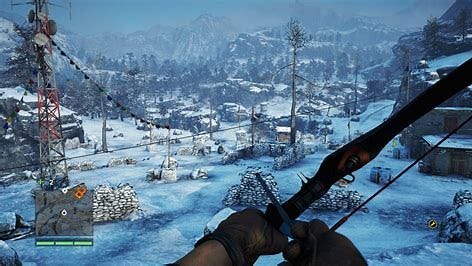
Approach strategies to taking down outposts are also quickly learnable. A player can approach the outpost “silently” completing either mele attacks, take downs, crouching, suppressed weapons and distraction tools (such as throwing a rock). If guards are alerted that you are in the area, reinforcements will be called. “Methods are the mechanisms an object has for accessing data within another object. A game mechanic, then, is the action invoked by an agent to interact with the game world, as constrained by the game rules.” (Sicart) Once the mechanics have been understood, we can apply this as a method to the next outposts. That involves using different strategies, taking snipers out first from a distance or vantage point, using the terrain to your advantage; using explosives when necessary, or sneaking and crouching. “Contextual mechanics are analytical concepts that can be used to understand how players decode the information in a level” (Sicart). Far Cry 4 does a great job using contextual mechanics by allowing the player to easily decode an outpost. The player is able to gather information such as terrain, game physics, environmental interactions, and CPU behaviours. As Karlsson states, “Some suggest that level design is an artistic role that should focus on composition and visual storytelling (Piaskiewicz, 2014; Pugh, 2018), while others describe it as a design-focused role with a strong focus on game mechanics and metrics (Sergeev, 2017; Stout, 2016).” (Karlsson et al., 2022)

Far Cry’s beautiful open world scenery of the Himalayan mountains and towns along with a strategy-based takedown to an outpost, creates a great design for a level which if done silently earns more ratings and rewards. The uniqueness about Far Cry 4’s levels is variability and environmental factors. These environmental factors include the AI of the enemy soldiers who can create chaos fast when guards have been alerted. Careful planning can be just as effective as guns a blazing. The variable yet masterful approach to outposts and Far Cry 4’s level design makes it a staple in the category of open world video game level design.
Conclusion
Far Cry 4 does an excellent job of creating an open world game that is immersive for the player throughout the entirety of the campaign. The immersive narrative following the tyrant Pagan Min, who turns out to be an anti-villain, gives several layers to the story Ajay follows in Kyrat. The beautiful landscape of Kyrat and its open world possibilities leave the player with a good but not overwhelming amount of player agency, which is crucial to keeping players engaged in the story mode. The thoughtful creation of outposts make progression of the game clear and allows the player to easily develop an understanding of the game mechanics. This allows the story mode to be more immersive, challenging and rewarding. Far Cry 4 is an exemplary open world story video game, through its immersive narrative, player agency, and intuitive level design makes it a great template for open world story games for the future.

References
Kalmanlehto, J. (2023). Aesthetics of agency and the rhythm of gameplay. Games and Culture, 19(8), 1038–1054. https://doi.org/10.1177/15554120231185630
Karlsson, T., Brusk, J., & Engström, H. (2022). Level design processes and challenges: A cross section of game development. Games and Culture, 18(6), 821–849. https://doi.org/10.1177/15554120221139229
Kiander, V. (1970, January 1). Choice and the illusion of it in narrative-driven video games. Theseus. https://www.theseus.fi/handle/10024/167282
Sicart, M. (n.d.). Game studies. Game Studies — Defining Game Mechanics. https://gamestudies.org/0802/articles/sicart
Simons, J. (n.d.). Game studies. Game Studies — Narrative, Games, and Theory. https://gamestudies.org/0701/articles/simons
Stang, S. (n.d.). Game studies. Game Studies — “This Action Will Have Consequences”: Interactivity and Player Agency. https://gamestudies.org/1901/articles/stang
AI Acknowledgement
AI was used on this assignment to gather information on Far Cry 4, without having to play through the game entirely. The information I recieved was overall positive. Below I list some example promts and answers.
“from Far Cry 4, what would Pagin Min be categorized as?”
Pagan Min is best described as a charismatic dictator and antagonist with shades of anti-villain. He’s flamboyant, brutal, and absolutely capable of horrendous acts… but he’s also layered, with motivations that complicate his role as the “villain.” Depending on how you interpret the game (especially with the secret ending), you could classify him as:
🟣 Anti-villain
- He has seemingly villainous traits (violence, authoritarianism, manipulation), but his motives aren’t always entirely evil. He genuinely wants a sort of stability for Kyrat and even sees himself as a father figure to Ajay.
- His brutal methods are aimed at maintaining order — in contrast to the chaotic infighting of the Golden Path.
🔴 Tragic villain
- His backstory, especially with Ishwari (Ajay’s mother), and his estranged relationship with his daughter Lakshmana, adds tragedy to his character. His cruelty may stem from personal loss and a need for control in a chaotic world.
🟡 Narrative foil / dark mirror
- He reflects Ajay in a way — a man born into legacy and power he didn’t ask for, trying to make sense of it all. Pagan represents what Ajay could become under certain choices.
🟢 Possibly the “right” choice
- Here’s where it gets spicy: depending on how you interpret the game’s ending(s), Pagan might actually be the most honest and stable choice for Kyrat — making him a subversion of the classic villain archetype. He offers peace, albeit under dictatorship, while the Golden Path leaders lean toward extremism.
“talk about the level design and outposts of Far Cry 4"
scattered throughout Kyrat, and liberating them unlocks fast travel points, new missions, and reduces enemy presence in the region.
What makes them great:
- Multiple Entry Points: Each outpost has numerous ways to approach — frontal assault, stealth entry via the back, or even air-dropping in with a gyrocopter.
- Verticality & Terrain: Thanks to Kyrat’s mountainous geography, outposts often take advantage of height and terrain. You can snipe from hills, sneak through riverbeds, or use ziplines and cliffs to plan ambushes.
- Dynamic Environments: Wild animals can be released from cages to cause chaos. Fire spreads realistically, and alarms can be disabled to prevent reinforcements. This creates emergent gameplay — no two takeovers feel exactly the same.
🧠 Takeaway: Outposts feel like little sandbox puzzles, giving players the freedom to experiment with tactics and tools in a meaningful way.
“what happens in far cry 4 when you silently take down an outpost”
When you silently take down an outpost in Far Cry 4, several things happen that highlight the game’s rewarding mechanics and level design. Here’s what you can expect from a stealthy approach:
1. No Alarms Triggered
- Key Outcome: If you complete the outpost without triggering alarms, you prevent reinforcements from arriving. This allows you to keep the element of surprise on your side and reduces the intensity of combat.
- What it Teaches: It reinforces the value of stealth mechanics (sneaking, taking down enemies silently, and avoiding detection), and rewards you for taking the time to observe and plan your attack carefully.
2. Higher Rewards and Ratings
- Key Outcome: If you liberate the outpost without being detected, you often earn a higher rating (a “S” or “A” rating for completion) and better loot or rewards, like more currency or rare crafting materials.
- What it Teaches: It rewards players for using stealth as a primary tool and highlights the importance of patience and strategic thinking.
3. Minimal Environmental Disruption
- Key Outcome: Taking out enemies quietly means there’s less chaos. Environmental factors like fires, explosions, and the release of wild animals (which might otherwise cause collateral damage) are avoided.
- What it Teaches: This teaches you how to control the battlefield, limiting the chaos and destruction that can make it harder to manage outposts later in the game. It emphasizes that careful planning can be just as effective as brute force.
4. Silent Takedowns and New Tools
- Key Outcome: Successfully executing a silent takedown (using the knife or a silenced weapon) rewards you with a sense of mastery over stealth tactics. You can clear the area undetected without alerting the enemy or leaving bloodshed behind.
- What it Teaches: It introduces players to the various tools needed for stealth — like the silenced pistol, bow, or throwing knives — which require finesse but allow for more controlled and calculated engagements.
5. Story and World Implications
- Key Outcome: Taking down the outpost quietly doesn’t just benefit you in gameplay terms. It leaves fewer signs of conflict, maintaining a more peaceful world state. The Golden Path can establish a more sustainable presence in the area without angering the civilian population or the enemy.
- What it Teaches: Stealth helps the player feel more connected to the narrative implications of their actions, especially in a game that constantly presents moral choices. Sometimes, silence is more impactful than force.
6. Enemy AI Reacts Differently
- Key Outcome: If you avoid detection and take out the guards one by one, the AI reacts in a more isolated and disoriented way. Guards may be found missing, but their patrol routes will remain normal, so you can pick them off one by one.
- What it Teaches: It shows the value of careful positioning and timing — rewarding careful observation of AI patterns and rewarding the player for exploiting them.
Final Note:
By silently taking down an outpost, Far Cry 4 shows players that stealth is a valid playstyle, and it rewards you for being precise and thoughtful. It offers an experience that feels different from a loud, explosive approach, but can be just as rewarding, allowing you to engage with the game’s systems in a more measured and controlled way.
메타데이터
- post_id
- c83847ddd44e
- slug
- far-cry-4-a-template-for-the-future-c83847ddd44e
- url
- https://medium.com/@jsaaldus/far-cry-4-a-template-for-the-future-c83847ddd44e
- canonical_url
- https://medium.com/@jsaaldus/far-cry-4-a-template-for-the-future-c83847ddd44e
- author_url
- https://medium.com/@jsaaldus
- status
- ok
- fetched_at
- 2026-08-22 12:12:46




