What Are VRF Copper Components? A Complete Guide
Variable Refrigerant Flow (VRF) systems have become one of the most efficient HVAC solutions for commercial buildings, offices, hotels…
What Are VRF Copper Components? A Complete Guide

Variable Refrigerant Flow (VRF) systems have become one of the most efficient HVAC solutions for commercial buildings, offices, hotels, hospitals, educational institutions, and residential projects. While compressors, indoor units, and outdoor units often receive the most attention, the VRF Copper Components used within the refrigerant piping network are equally important.
These components ensure that refrigerant flows efficiently, pressure remains balanced, and every indoor unit receives the required amount of refrigerant. A well-designed copper piping network directly impacts cooling performance, energy efficiency, and the overall lifespan of a VRF system.
This guide explains what **Copper Components** are, why they matter, their different types, and how to select the right ones for your HVAC project.
What Are VRF Copper Components?
VRF Copper Components are precision-engineered copper fittings and assemblies that form the refrigerant distribution network in a VRF system. They connect copper pipes, regulate refrigerant flow, reduce pressure losses, and help maintain the efficiency of the entire HVAC installation.
Unlike ordinary plumbing fittings, these components are specifically designed to handle high refrigerant pressures while maintaining leak-free performance.
They are commonly manufactured using premium-quality copper and are tested to meet industry standards for strength, durability, and reliability.
Why Are Copper Components Important in VRF Systems?
Every VRF installation depends on smooth refrigerant circulation. If refrigerant does not flow correctly, the system may experience uneven cooling, compressor overload, higher energy consumption, and costly maintenance.
High-quality Copper Components help by:
- Maintaining balanced refrigerant flow
- Reducing pressure drops
- Preventing refrigerant leakage
- Improving overall system efficiency
- Supporting longer equipment life
- Simplifying installation and maintenance
- Enhancing system reliability
Whether the project is a small office or a multi-story commercial building, properly selected copper components contribute significantly to long-term performance.
Types of VRF Copper Components
Modern VRF systems use a variety of specialized copper components, each designed for a specific purpose.
1. VRF Copper Y Joint
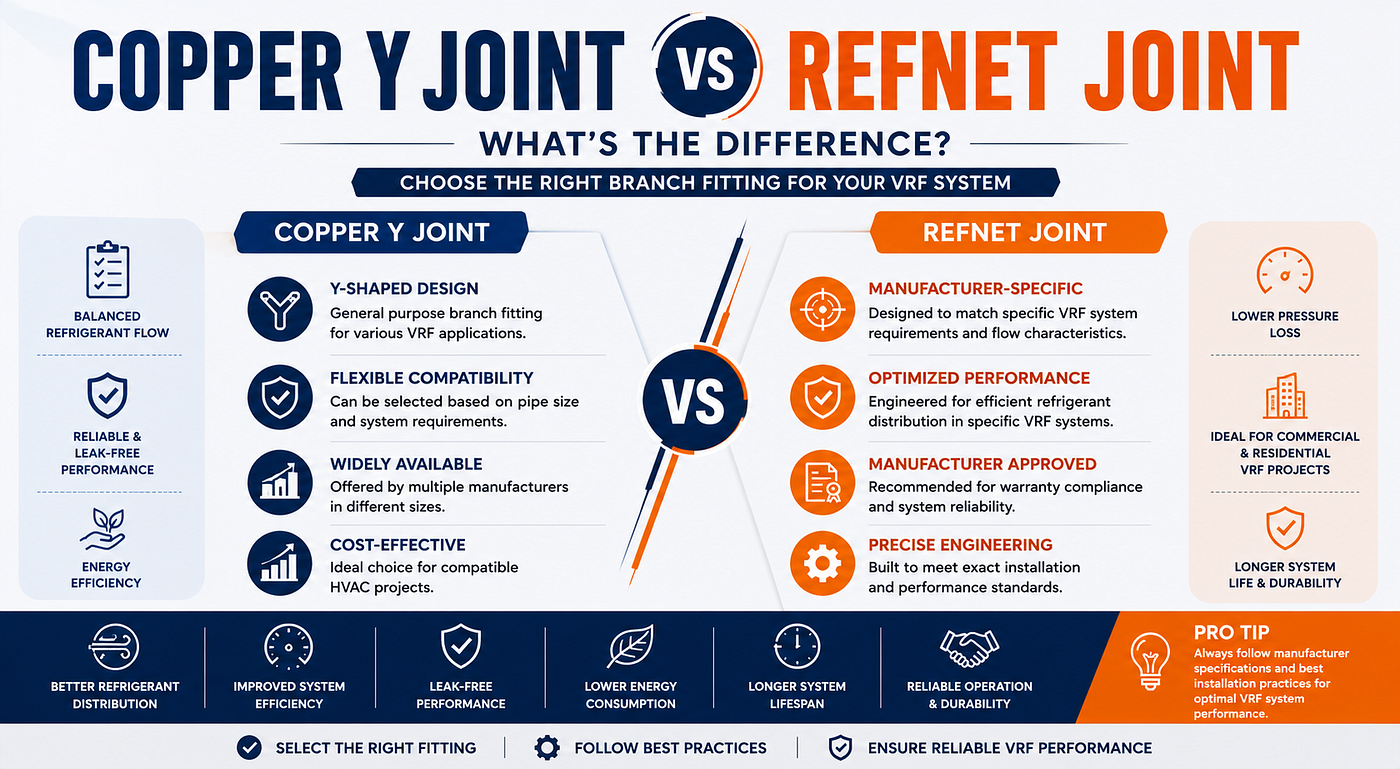
The VRF **Copper Y Joint** is one of the most widely used components in refrigerant piping systems.
It divides refrigerant from the main pipeline into multiple branches while maintaining balanced flow across indoor units.
Benefits
- Uniform refrigerant distribution
- Reduced pressure loss
- Improved cooling efficiency
- Suitable for multi-zone VRF systems
- Precision-engineered for accurate flow
Proper installation of a Y Joint ensures that every connected indoor unit receives the required refrigerant volume.
2. VRF Strainers
**VRF Strainers** protect sensitive system components by preventing contaminants from circulating through refrigerant lines.
During installation or maintenance, tiny particles such as dust, metal fragments, or brazing residue can enter the piping system. A strainer captures these contaminants before they damage compressors or expansion valves.
Advantages
- Protects compressors
- Prevents blockage
- Improves system reliability
- Reduces maintenance costs
- Extends equipment life
A clean refrigerant circuit always performs more efficiently than one contaminated with debris.
3. VRF Mufflers
Noise reduction is an important aspect of HVAC system design, especially in hotels, hospitals, offices, and educational facilities.
**VRF Mufflers** are designed to reduce refrigerant pulsation and compressor noise traveling through copper piping.
Benefits
- Lower operating noise
- Reduced vibration
- Better occupant comfort
- Improved compressor performance
- Longer piping life
Although often overlooked, mufflers contribute to a quieter and more comfortable indoor environment.
4. VRF Stubs
**VRF Stubs** are pre-fabricated copper connection pieces that simplify refrigerant piping installation.
Instead of fabricating small pipe sections on-site, installers can use factory-manufactured stubs to achieve consistent quality and accurate dimensions.
Benefits
- Faster installation
- Improved brazing quality
- Reduced material waste
- Consistent dimensions
- Lower installation errors
They are especially useful for large commercial HVAC projects where installation speed is important.
5. VRF Tubular Assemblies
**VRF Tubular Assemblies** consist of pre-engineered copper pipe sections designed for specific HVAC applications.
These assemblies are manufactured under controlled conditions to ensure precision, reducing the need for extensive field fabrication.
Advantages
- Factory-tested quality
- Better dimensional accuracy
- Faster project completion
- Reduced installation time
- Enhanced reliability
Many contractors prefer tubular assemblies because they improve productivity while maintaining consistent quality.
6. Customized Insulation
Copper piping alone cannot deliver maximum efficiency. Proper insulation is equally important.
**Customized insulation** is specially designed to fit the exact dimensions of VRF copper components, minimizing energy losses and preventing condensation.
Customized insulation offers:
- Improved thermal efficiency
- Reduced condensation
- Protection against moisture
- Enhanced energy savings
- Longer service life
It also provides a cleaner and more professional appearance for completed HVAC installations.
Why High-Quality Copper Matters
Not all copper components offer the same performance.
Premium-quality copper provides:
- Excellent thermal conductivity
- High corrosion resistance
- Superior pressure handling
- Easy brazing
- Long service life
- Reliable refrigerant sealing
Using low-quality fittings may initially reduce project costs, but it can increase the risk of refrigerant leakage, system failures, and expensive repairs later.
Applications of VRF Copper Components
These components are widely used across various HVAC installations, including:
- Commercial office buildings
- Shopping malls
- Hotels and resorts
- Hospitals
- Educational institutions
- Industrial facilities
- Residential apartments
- Data centers
- IT parks
- Mixed-use developments
Any project using a **VRF system** relies on precision-engineered copper components for dependable refrigerant distribution.
How to Choose the Right VRF Copper Components
Selecting suitable components can improve both installation quality and long-term system performance.
Consider the following factors:
Material Quality
Choose components manufactured from high-purity copper that complies with recognized industry standards.
Pressure Compatibility
Ensure every component is suitable for modern refrigerants and designed to withstand high operating pressures.
Dimensional Accuracy
Accurate dimensions simplify installation and reduce refrigerant leakage risks.
Manufacturing Standards
Select products manufactured under strict quality control with pressure and leak testing.
Compatibility
Always verify compatibility with the selected VRF system and refrigerant piping layout.
Supplier Reputation
Work with experienced manufacturers that provide consistent product quality and technical support.
Common Installation Mistakes to Avoid
Even premium components can underperform if installed incorrectly.
Avoid these common mistakes:
- Using incorrect pipe sizes
- Poor brazing techniques
- Inadequate insulation
- Improper refrigerant line support
- Mixing incompatible components
- Skipping pressure testing
- Ignoring manufacturer guidelines
Professional installation helps maximize system efficiency and reliability.
Benefits of Using Premium VRF Copper Components
Choosing high-quality components offers several long-term advantages:
- Higher energy efficiency
- Reliable refrigerant flow
- Lower maintenance costs
- Reduced refrigerant leakage
- Better cooling performance
- Longer equipment lifespan
- Faster installation
- Improved indoor comfort
- Greater system reliability
- Enhanced return on investment
These benefits make quality copper components a valuable investment for any VRF project.
The Future of VRF Copper Components
As **HVAC technology** evolves, manufacturers are introducing more advanced copper solutions to improve efficiency and simplify installation.
Emerging developments include:
- Precision-engineered refrigerant distribution components
- Factory-tested modular assemblies
- Advanced VRF Tubular Assemblies
- Improved Customized insulation solutions
- Lightweight and compact component designs
- Better compatibility with energy-efficient refrigerants
- Higher manufacturing accuracy using automated production
These innovations help contractors complete projects faster while improving long-term system performance.
Conclusion
Although they may not be as visible as indoor or outdoor units, VRF Copper Components are among the most important parts of any VRF HVAC system. From VRF Copper Y Joint fittings that distribute refrigerant evenly to VRF Strainers, VRF Mufflers, VRF Stubs, VRF Tubular Assemblies, and Customized insulation, each component plays a specific role in ensuring reliable and efficient operation.
Investing in high-quality Copper Components not only improves cooling performance but also reduces maintenance, minimizes refrigerant losses, and extends the lifespan of the entire HVAC system. Whether you’re designing a new installation or upgrading an existing one, choosing the right copper components is essential for achieving dependable, energy-efficient performance that lasts for years.
FAQs
What are VRF Copper Components? VRF Copper Components are specialized copper fittings and assemblies used in VRF HVAC systems to distribute refrigerant efficiently between outdoor and indoor units while maintaining system performance.
Why are copper components preferred in VRF systems? Copper offers excellent thermal conductivity, corrosion resistance, high-pressure tolerance, and long service life, making it the ideal material for refrigerant piping applications.
What is the function of a VRF Copper Y Joint? A VRF Copper Y Joint divides refrigerant flow evenly to multiple indoor units, ensuring balanced cooling and improving the efficiency of the entire VRF system.
How do VRF Strainers protect an HVAC system? VRF Strainers trap dirt, metal particles, and other contaminants before they reach critical components like compressors and expansion valves, helping prevent damage and costly repairs.
Why are VRF Mufflers used in refrigerant piping? VRF Mufflers reduce refrigerant pulsation, vibration, and operating noise, creating a quieter and more reliable HVAC system.
What are VRF Stubs used for? VRF Stubs are pre-fabricated copper connection pieces that simplify installation, improve brazing consistency, and reduce installation time on HVAC projects.
What are VRF Tubular Assemblies? VRF Tubular Assemblies are factory-manufactured copper pipe assemblies designed for precise refrigerant flow, faster installation, and improved reliability.
Why is customized insulation important for VRF copper components? Customized insulation minimizes heat loss, prevents condensation, improves energy efficiency, and protects refrigerant piping from moisture-related damage.
How can high-quality copper components improve HVAC performance? Premium copper components reduce refrigerant leakage, improve refrigerant distribution, lower maintenance requirements, and extend the lifespan of the entire VRF system.
What should you consider when choosing VRF Copper Components? Look for high-purity copper, pressure-tested construction, dimensional accuracy, compatibility with your VRF system, and products manufactured under strict quality control standards.
Source: https://www.slideshare.net/slideshow/what-are-vrf-copper-components-a-complete-guide/289016511
메타데이터
- post_id
- c83958692e7a
- slug
- what-are-vrf-copper-components-a-complete-guide-c83958692e7a
- url
- https://medium.com/@acharyabhairavi77/what-are-vrf-copper-components-a-complete-guide-c83958692e7a
- canonical_url
- https://medium.com/@acharyabhairavi77/what-are-vrf-copper-components-a-complete-guide-c83958692e7a
- author_url
- https://medium.com/@acharyabhairavi77
- status
- ok
- fetched_at
- 2026-08-23 19:16:47