AI Agent Crypto Wallet Like Coinbase x402: The Future of Autonomous Payments
The cryptocurrency industry has always focused on giving users complete control over their assets. Yet, despite major advancements in…
AI Agent Crypto Wallet Like Coinbase x402: The Future of Autonomous Payments
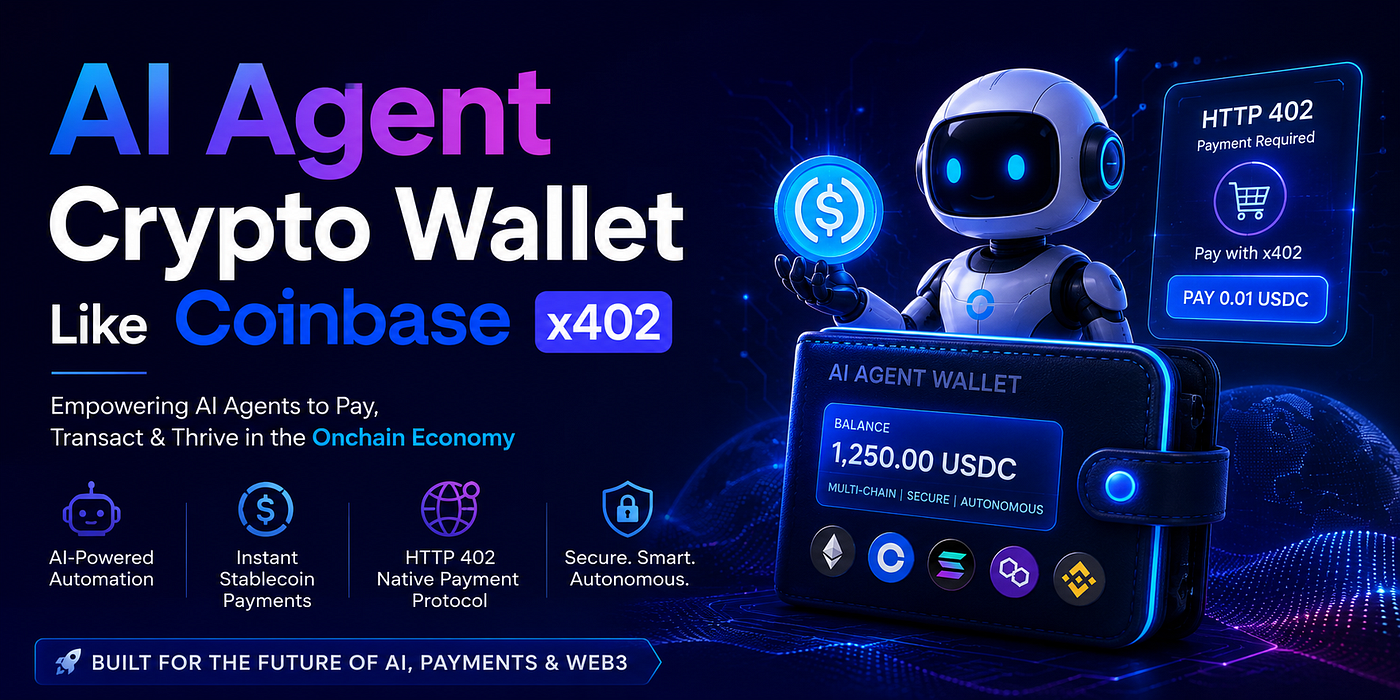
The cryptocurrency industry has always focused on giving users complete control over their assets. Yet, despite major advancements in blockchain technology, most crypto wallets still require constant human interaction. Users must manually approve transactions, manage subscriptions, connect to decentralized applications, and pay for digital services. As artificial intelligence evolves, a new generation of wallets is emerging that can think, decide, and transact independently. This is where AI Agent Crypto Wallets enter the picture.
The launch of Coinbase’s x402 protocol has accelerated interest in autonomous payment systems by enabling AI agents and applications to make instant stablecoin payments directly over HTTP. The protocol uses the long-dormant HTTP 402 Payment Required status code to create machine-native payment experiences that eliminate traditional payment friction. According to Coinbase, x402 allows APIs, applications, AI agents, and autonomous systems to exchange value as easily as they exchange data.
For businesses exploring the future of digital finance, building an AI-powered crypto wallet similar to Coinbase x402 represents a major opportunity. Such wallets can automate payments, manage digital assets intelligently, interact with APIs, and participate in the emerging machine-to-machine economy. As AI agents increasingly become digital workers capable of completing tasks independently, the need for intelligent payment infrastructure will only continue to grow.
Understanding the Rise of AI Agent Wallets
The digital economy is rapidly transitioning from human-centric interactions toward machine-driven operations. AI agents can already write code, analyze data, execute business workflows, and communicate with software systems. The next logical step is enabling these agents to make payments and manage financial transactions autonomously.
Traditional wallets were designed around human users. Every payment requires approval, every service subscription requires manual setup, and every interaction introduces friction. While this approach provides control, it limits scalability in an ecosystem where millions of automated transactions may occur every second. AI agent wallets address this limitation by introducing intelligent automation directly into the wallet infrastructure.
Imagine an AI travel assistant booking flights, purchasing hotel reservations, and paying service providers without requiring user intervention. Consider a trading bot purchasing market intelligence reports automatically whenever new opportunities arise. These scenarios require more than a standard crypto wallet; they require a wallet capable of understanding context, evaluating decisions, and executing payments independently.
The convergence of blockchain, artificial intelligence, and decentralized finance has created the perfect environment for agentic wallets. Businesses that invest early in this technology can position themselves at the center of a new economic model where software entities become active participants in global commerce.
Why Traditional Crypto Wallets Are No Longer Enough
Conventional wallets excel at asset storage and transaction execution. However, they struggle to support the dynamic requirements of AI-powered ecosystems. Human approval requirements introduce delays, while subscription-based payment systems create barriers for automated services.
AI agents require real-time access to digital resources, datasets, APIs, cloud infrastructure, and computational services. Waiting for human authorization defeats the purpose of automation. The future demands payment systems capable of supporting microtransactions, instant settlement, and autonomous decision-making.
The Evolution of Autonomous Digital Finance
Autonomous finance represents the next stage of fintech innovation. Just as online banking transformed traditional financial services, AI-powered wallets are transforming blockchain-based financial management. These wallets move beyond passive asset storage and become active financial participants capable of optimizing decisions and executing transactions on behalf of users.
What Is Coinbase x402?
Coinbase introduced x402 as an open payment protocol that enables instant stablecoin payments directly through HTTP interactions. The protocol is specifically designed to support APIs, applications, and AI agents seeking frictionless payment experiences. According to Coinbase Developer Platform documentation, x402 allows services to monetize APIs and digital content without requiring accounts, subscriptions, or complex authentication workflows.
At its core, x402 transforms payment into a native internet function. Instead of redirecting users to payment gateways or requiring API keys, services can request payment directly through standard HTTP communication. AI agents can interpret these requests, complete payments automatically, and continue executing tasks seamlessly.
Coinbase describes x402 as an “internet-native payment protocol” built specifically for AI-friendly payments and machine-to-machine commerce. The protocol supports instant USDC payments and enables developers to charge for API access, AI inference requests, datasets, cloud resources, and digital services.
How x402 Revives HTTP 402 Payment Required
The HTTP 402 status code was originally reserved for future payment functionality but remained largely unused for decades. Coinbase’s x402 protocol brings this status code back to life by creating a structured payment workflow.
When an AI agent requests a paid resource, the server responds with a “402 Payment Required” message containing payment instructions. The agent processes the request, signs a blockchain transaction, submits payment proof, and retries the request. Once verified, access is granted automatically.
Why AI Agents Need Native Payment Infrastructure
AI agents increasingly interact with premium services that require payment. Whether accessing specialized data, purchasing computing resources, or consuming API services, agents need financial capabilities. x402 solves this challenge by creating a payment standard specifically designed for autonomous systems.
How AI Agent Crypto Wallets Work
An AI Agent Crypto Wallet combines blockchain infrastructure with intelligent automation. Unlike standard wallets, these systems include multiple layers responsible for analysis, decision-making, payment execution, and risk management.
Core Architecture of an Agentic Wallet
Wallet Layer
The wallet layer manages private keys, digital assets, token balances, and blockchain interactions. Security remains the highest priority because the wallet controls access to financial resources. Advanced wallets often incorporate multi-signature functionality, hardware security modules, and smart contract wallets to enhance protection.
Decision-Making Layer
This layer introduces artificial intelligence into the wallet environment. Machine learning models analyze requests, evaluate risks, monitor spending patterns, and determine whether transactions align with predefined objectives.
For example, an AI trading assistant may decide whether purchasing a premium analytics report is justified based on expected return on investment. Rather than blindly executing every request, the wallet applies contextual intelligence.
Payment Execution Layer
The execution layer connects AI decisions with blockchain infrastructure. It interacts with payment protocols such as x402, validates payment instructions, signs transactions, and completes settlements across supported blockchain networks.
Key Features of an AI Agent Crypto Wallet Like Coinbase x402

Autonomous Stablecoin Payments
Stablecoins provide the foundation for agentic commerce because they eliminate volatility concerns associated with traditional cryptocurrencies. AI agents can budget, forecast expenses, and transact predictably when using stable assets such as USDC.
Coinbase specifically designed x402 around stablecoin payments, allowing applications and agents to transact instantly without traditional banking intermediaries.
API Monetization and Machine-to-Machine Transactions
One of the most exciting use cases involves API monetization. Developers can charge small fees for each API request instead of relying on monthly subscriptions. AI agents simply pay for the resources they consume, creating a more efficient economic model.
Multi-Chain Asset Management
Modern AI wallets should support multiple blockchain ecosystems, including Ethereum, Base, Solana, Polygon, BNB Chain, and emerging Layer-2 networks. Multi-chain compatibility increases flexibility and reduces dependency on any single ecosystem.
Benefits of Building an AI Agent Wallet
Organizations investing in AI wallet development can unlock entirely new revenue streams and user experiences. These wallets support automated commerce, intelligent spending, and decentralized financial management.
Enhanced User Experience
Users increasingly expect seamless interactions. Nobody enjoys repeatedly approving small transactions or managing dozens of subscriptions. AI wallets simplify these processes by automating repetitive tasks while maintaining user-defined controls.
The result is a more intuitive experience where financial management becomes proactive rather than reactive. Users focus on outcomes while AI agents handle operational complexity.
New Revenue Opportunities
Businesses can monetize APIs, digital content, AI services, cloud infrastructure, datasets, and computational resources through pay-per-use models. The ability to charge fractions of a cent per interaction opens opportunities that were previously impractical.
Recent ecosystem reports indicate growing adoption of x402-based infrastructure across AI agent marketplaces and machine payment ecosystems. Industry participants are actively exploring autonomous commerce applications powered by agentic payment protocols.
Essential Technologies Required for Development
Building a sophisticated AI Agent Crypto Wallet requires expertise across multiple domains, including blockchain engineering, artificial intelligence, cybersecurity, and decentralized finance.
AI Models and Agent Frameworks
Popular AI frameworks such as LangChain, AutoGen, CrewAI, and custom LLM architectures can serve as the intelligence layer. These frameworks enable wallets to reason, plan, evaluate requests, and execute actions autonomously.
The effectiveness of an AI wallet depends heavily on the quality of its decision-making engine. Developers must implement guardrails, spending limits, compliance checks, and explainability mechanisms to ensure responsible operation.
Blockchain Infrastructure and Smart Contracts
Blockchain networks provide transparency, security, and settlement capabilities. Smart contracts can automate spending policies, enforce compliance requirements, and manage treasury operations.
Key technologies often include:
- Smart contract wallets
- Account abstraction
- Multi-signature authorization
- Stablecoin integration
- Cross-chain bridges
- Decentralized identity systems
- Zero-knowledge security solutions
- AI Agent Wallet Development Process
Creating an AI-powered crypto wallet requires a structured development approach that balances innovation with security.
Planning and Architecture Design
The first stage focuses on identifying business objectives, target users, supported blockchains, AI capabilities, and payment workflows. Developers must define how the wallet will interact with external services and determine what level of autonomy should be permitted.
Risk assessment plays a critical role during this phase. Autonomous systems require carefully designed safeguards to prevent misuse, overspending, and unauthorized transactions.
For businesses seeking professional implementation, partnering with a **crypto wallet development company can accelerate development while ensuring enterprise-grade security standards. Organizations often leverage [White Label Crypto Wallet Development](https://www.suffescom.com/product/white-label-crypto-wallet-development)** solutions to reduce time-to-market and development costs.
Development, Testing, and Deployment
The implementation phase involves building wallet infrastructure, integrating AI models, connecting blockchain networks, and implementing payment protocols such as x402. Security testing is particularly important because autonomous payment systems introduce new attack surfaces.
Recent academic research has highlighted potential security considerations related to authorization, replay protection, and payment verification within agentic payment protocols. Developers should implement robust safeguards, monitoring systems, and continuous auditing processes to address these challenges.
Organizations interested in learning the technical foundations should also explore guides on **How to Create a Crypto Wallet**, which cover wallet architecture, private key management, blockchain integration, and user experience considerations.
Future of AI Agent Commerce and Crypto Wallets
The future of digital commerce increasingly points toward autonomous interactions. AI agents will negotiate contracts, purchase resources, subscribe to services, access premium content, and collaborate with other agents. Payment infrastructure must evolve to support this reality.
Industry adoption is accelerating as major technology companies explore agent-based payment systems. Recent collaborations involving AWS, Coinbase, and Stripe demonstrate growing confidence in autonomous payment infrastructure for AI ecosystems. These initiatives aim to enable AI agents to purchase APIs, content, and digital services independently using stablecoin-based payment rails.
As the machine economy expands, AI wallets will become essential infrastructure. They will function as financial operating systems for autonomous software, enabling agents to participate directly in global markets. Businesses that invest in agentic wallet technology today may gain a significant competitive advantage as this transformation unfolds.
Conclusion
AI Agent Crypto Wallets represent a major leap beyond traditional digital asset management. By combining artificial intelligence with blockchain technology, these wallets enable autonomous payments, intelligent decision-making, and machine-to-machine commerce. Coinbase’s x402 protocol has emerged as a foundational component of this evolution by providing a native payment standard designed specifically for AI agents and internet-scale transactions.
As AI systems become more capable and autonomous, the demand for intelligent financial infrastructure will continue to rise. Businesses that develop AI-powered wallets can unlock new revenue models, improve user experiences, and position themselves at the forefront of the emerging agent economy. Whether you choose custom development or a white-label solution, the opportunity to build the next generation of autonomous payment systems has never been greater.
메타데이터
- post_id
- c83b47719a2f
- slug
- ai-agent-crypto-wallet-like-coinbase-x402-the-future-of-autonomous-payments-c83b47719a2f
- url
- https://mobileappcircular.com/ai-agent-crypto-wallet-like-coinbase-x402-the-future-of-autonomous-payments-c83b47719a2f
- canonical_url
- https://mobileappcircular.com/ai-agent-crypto-wallet-like-coinbase-x402-the-future-of-autonomous-payments-c83b47719a2f
- author_url
- https://medium.com/@Rathi.rajdeep
- status
- ok
- fetched_at
- 2026-07-09 17:36:58