The Reign of Diffusion Models is Nearing Its End: Why They Will Soon Be Replaced as the Primary…
If we evaluate the essence of diffusion models with cold objectivity, they do not actually “paint” images. Rather, they function as highly…
The Reign of Diffusion Models is Nearing Its End: Why They Will Soon Be Replaced as the Primary Tech in Image Generation
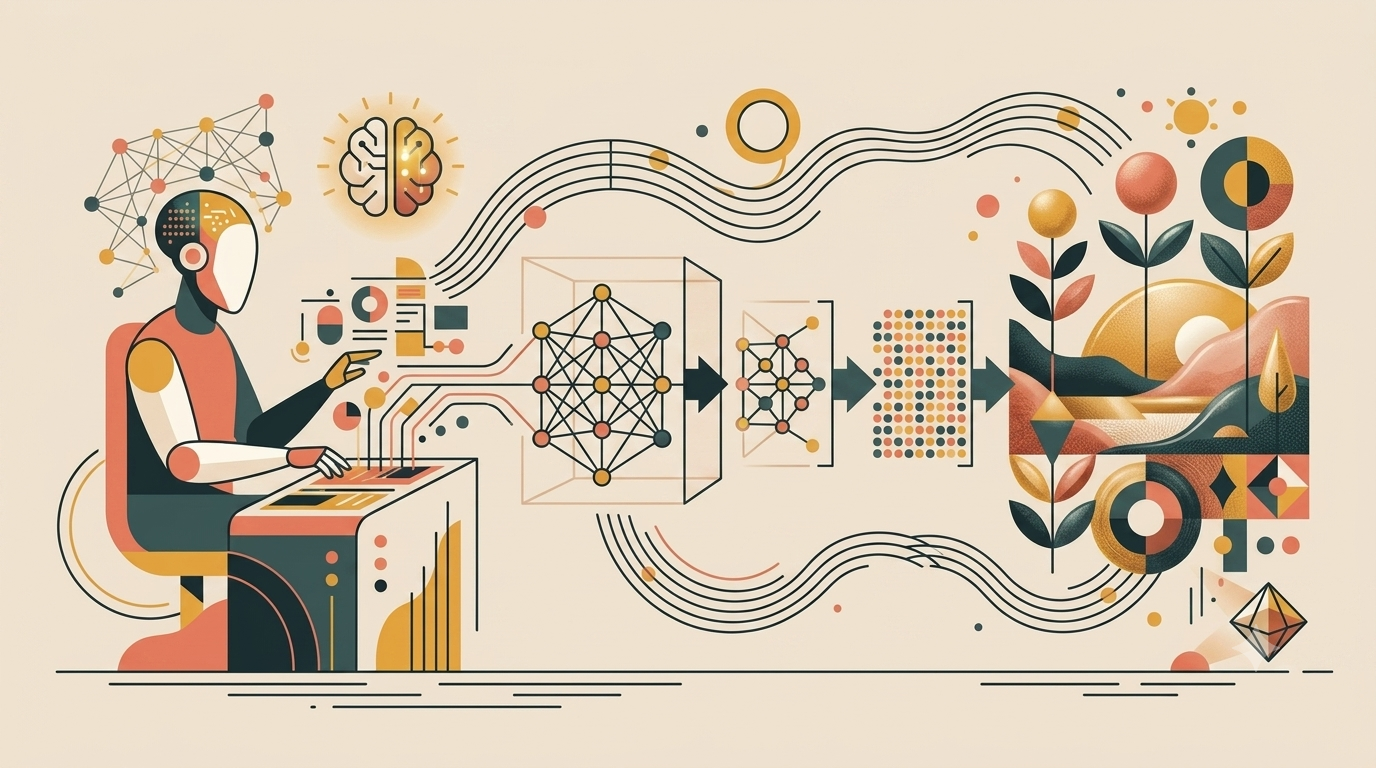
If we evaluate the essence of diffusion models with cold objectivity, they do not actually “paint” images. Rather, they function as highly sophisticated automatic slot machines that generate “plausible-looking” pictures. By merely predicting the smooth, statistical transitions between pixels, the model itself has zero comprehension of what it is actually rendering.
As long as we stick to this approach of “probabilistic noise removal,” the following fundamental flaws will remain permanently unresolved:
- Collapse of Logical Structure (Mangled Text and Fingers): The architecture inherently lacks discrete, numerical rules required to grasp concepts like “draw exactly five fingers” or “render three precise horizontal lines for a letter.”
- Lack of Physical Consistency: Lacking an underlying “knowledge” of 3D geometry (perspective), light-and-shadow causality, and occlusion (foreground/background depth), diffusion models frequently generate surreal, physically impossible anomalies that look plausible only at a casual glance.
- Low Hit Rates and the “Gacha” Dilemma: Because minor deviations in the initial random noise drastically alter the final output, achieving deterministic control — such as pinpointing an exact composition or reproducing the exact same character across different angles — is theoretically near-impossible.
Currently, we are forced to artificially offset this poor reliability by relying heavily on external control frameworks (like ControlNet) and obsessive human filtering (cherry-picking).
The Next Protagonist: “World Models” That Simulate Reality
When humans draw a picture or draft a blueprint, we mentally project a virtual 3D space. We consciously apply the laws of physics and anatomy to actively draw each line with intent.
Next-generation image generation AI aims to replicate this exact human approach. Stepping up to take the spotlight is a paradigm known as “World Models.”
As championed by Yann LeCun and his work on JEPA (Joint-Embedding Predictive Architecture), the primary technology of tomorrow will not be an AI that merely mimics visual surfaces. It will be an AI that simulates the physics, structures, and causal relationships of our world.
Upon receiving a prompt, this primary AI will first construct a logical, geometric blueprint within its internal representation: “The light source is here, a cube is positioned there, and gravity is acting in this direction.” It actively originates a structural skeleton free of logical contradictions.
Treating Images as “Tokens”: The LLM Approach to Graphics
Another major contender for the throne is the integration of Autoregressive Models with tokenization technologies (such as VQ-VAE and MAGVIT-v2), which stop treating images as smooth, probabilistic blurs and instead handle them as a collection of discrete, meaningful parts (tokens).
Just as a Large Language Model (LLM) accurately selects the next logical “word” based on context, a next-gen image AI arranges elements like “hands,” “finger joints,” and “building windows” as explicit, minimal units of meaning.
By doing so, absurd errors like fingers randomly multiplying into six become logically impossible — just as an LLM does not suddenly invent a fabricated alphabet and insert it into a sentence.
The Future of Diffusion Models: Relegated to “Cosmetic Assistants”
Does this mean diffusion models will become obsolete and vanish entirely? The short answer is no. Because when it comes to rendering texture, they are absolute geniuses.
When tasked with depicting the subtle translucency of human skin, the dull luster of metal, or the scattering of light through fog — complex textures that inherent randomness — nothing matches the fidelity of a diffusion model.
Consequently, the future image generation pipeline is expected to transition into a highly efficient, hybrid division of labor:
- Step 1 (The Protagonist: World Model): Actively designs a physically consistent 3D skeleton and spatial layout.
- Step 2 (The Co-Star: Tokenizer): Establishes logically sound semantic boundaries and structures.
- Step 3 (The Contractor: Diffusion Model): Applies the exquisite “texture” (pixels) over that flawless blueprint as the final coat of paint.
Conclusion: From Dexterous Paintbrushes to Intentional Intelligence
The current golden age of diffusion models will likely be remembered in AI history as a peculiar, fleeting phase where the art of applying digital paint became hyper-refined before the AI ever understood the laws of the world it was painting.
The era of “just generating pictures that happen to fit the criteria” is drawing to a close.
Once next-generation core technologies allow AI to comprehend world structures and sketch with deliberate intent and planning, we will finally be able to engage in truly creative, logical dialogues with AI — asking it to cast a shadow precisely because of a specific narrative intent.
This article was written with significant assistance from Gemini.
메타데이터
- post_id
- c83ebd44a648
- slug
- the-reign-of-diffusion-models-is-nearing-its-end-why-they-will-soon-be-replaced-as-the-primary-c83ebd44a648
- url
- https://medium.com/@outermostkt/the-reign-of-diffusion-models-is-nearing-its-end-why-they-will-soon-be-replaced-as-the-primary-c83ebd44a648
- canonical_url
- https://medium.com/@outermostkt/the-reign-of-diffusion-models-is-nearing-its-end-why-they-will-soon-be-replaced-as-the-primary-c83ebd44a648
- author_url
- https://medium.com/@outermostkt
- status
- ok
- fetched_at
- 2026-07-08 09:22:44