Memory Competition: Musicians vs Nonmusicians
One often associates musicians with having very good memory, especially while watching them perform long songs by heart or easily transpose…
Memory Competition: Musicians vs Nonmusicians

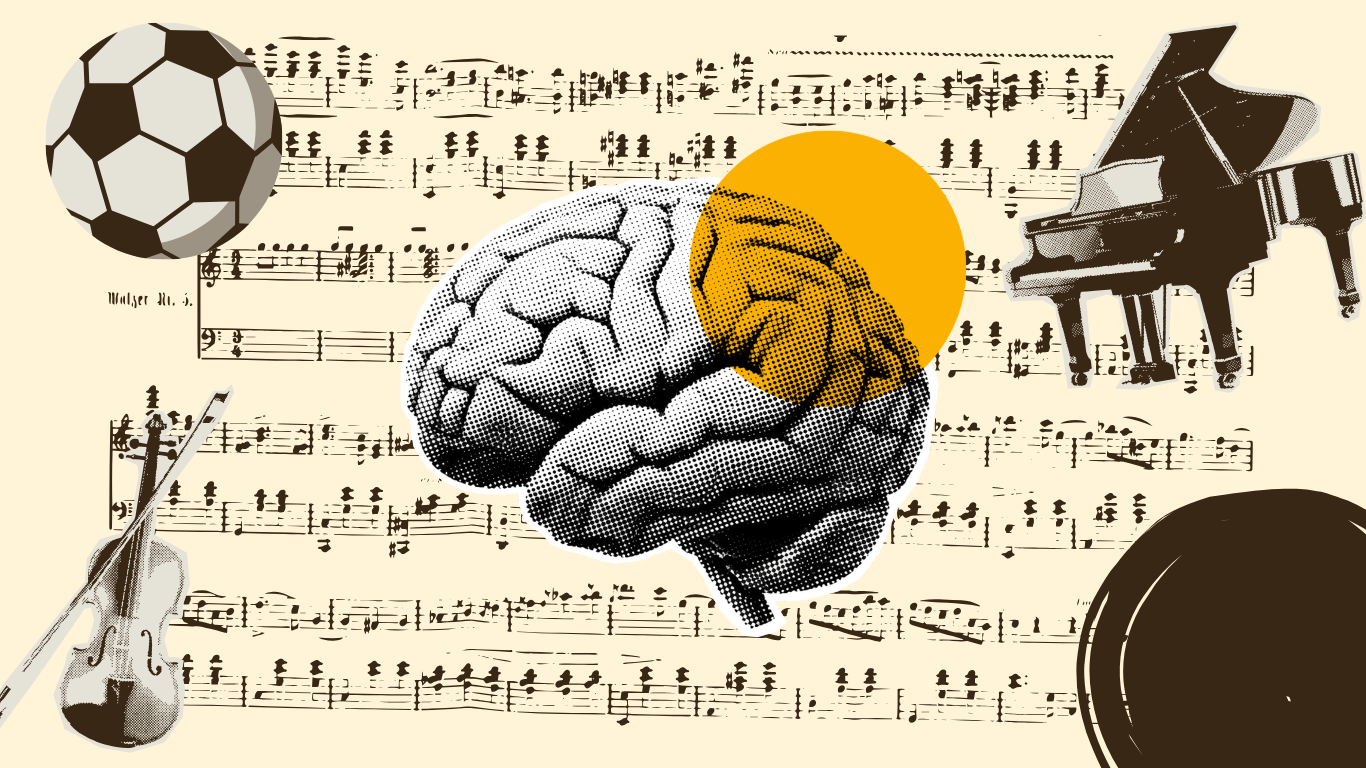
Image source
One often associates musicians with having very good memory, especially while watching them perform long songs by heart or easily transpose notes. This quickly leads to the question of whether musicians have better memory than nonmusicians? A meta analysis published in 2017 by Talamini et al. reported that musicians have better short term memory than nonmusicians and many studies have found that musicians outperform nonmusicians in musical tasks as well as other cognitive skills. However, past studies have been relatively small and difficult to directly compare, so it has not been possible to accurately determine the size of this effect. As a musician myself, I found this topic very interesting and through our lab I was able to have the opportunity to work on a multilab study combined with labs from all over the world who are investigating this question.
The study looked at whether musicians have better short term memory than nonmusicians for musical, verbal, and visuospatial stimuli. It used 600 musicians and 600 nonmusicians which allowed for a large enough sample to estimate the effect size of the advantage. Additionally, it helped set a framework for future studies comparing musicians and nonmusicians, as well as looked at how participants’ differences in cognitive abilities, personality, and socioeconomic status affected the results. We expected to see that musicians would have better short term memory than nonmusicians with the largest effect for musical stimuli, then verbal stimuli, and the smallest effect for visuospatial stimuli.
My role in the study was to run participants through all of the tasks they were required to complete for the experiment. The participants started with three short term memory tasks. For the musical short term memory task the participants were played a standard melody followed by a comparison melody. They then had to decide whether the comparison melody was identical or different from the standard. For the verbal short term memory task the participants were shown a sequence of digits one at a time on the computer screen and once the sequence ended were instructed to type the digits in the same order. For the visuospatial short term memory task the participants were shown a grid where a dot would appear one at a time in different positions. Similarly to the verbal task, participants then had to click through all of the positions the dot appeared in order.
The next part of the experiment tested participants’ music aptitude, music sophistication, and music reward. We used the Profile of Music Perception Skills- mini (PROMS) to test music perception. Participants listened to a standard stimulus twice and then were played a comparison stimulus and asked to determine if they were the same or different. Trials compared melody, tuning, beat, and speed. We used the Goldsmiths Musical Sophistication Index (Gold-MSI) to test musical sophistication. This is a questionnaire participants would fill out that asked questions about active engagement with music, perceptual abilities, musical training, singing abilities, and emotional engagement with music. We used the extended Barcelona Music Reward Questionnaire (eBMRQ) to get information on how much participants seek out music, how much music evokes their emotions, how music helps them regulate mood, how music helps them produce body movements, how music increases social reward, and how absorbed they become in music.
In the next section participants completed the Big Five Inventory- 2 (BFI-2) questionnaire which gave scores on their open-mindedness, conscientiousness, extraversion, agreeableness, and negative emotionality.
We assessed intelligence using the Raven Advanced Progressive Matrices (Raven) and the Wechsler Adult Intelligence Scale (WAIS).
After this, we measured executive function using an N-back task. The participants were shown a series of letters and had to respond when the letter they saw matched the letter that was shown two letters ago.
In order to control for socioeconomic status we had participants fill out the Hollingshead four factor index which asked about education, occupational status, and relationship.
Lastly, participants completed more demographic questions that asked about sex, age, education, and musical experience.
The results of the study showed that overall musicians performed better in the short term memory tasks than nonmusicians. Effect size was shown through Hedges’ g. This showed the difference in mean memory performance between groups, as well as the strength of the relationships, instead of just whether they are significant or not. For musical short term memory the effect size was large (g=1.08), for verbal it was very small (g=0.16), and for visuospatial it was small (g=0.28). Musicians performed better on musical tasks such as the PROMS and on cognitive tasks such as the Raven and N-back. They also found that musicians came from families with higher socioeconomic status and had differences in personality from nonmusicians, such as being more open to experiences.
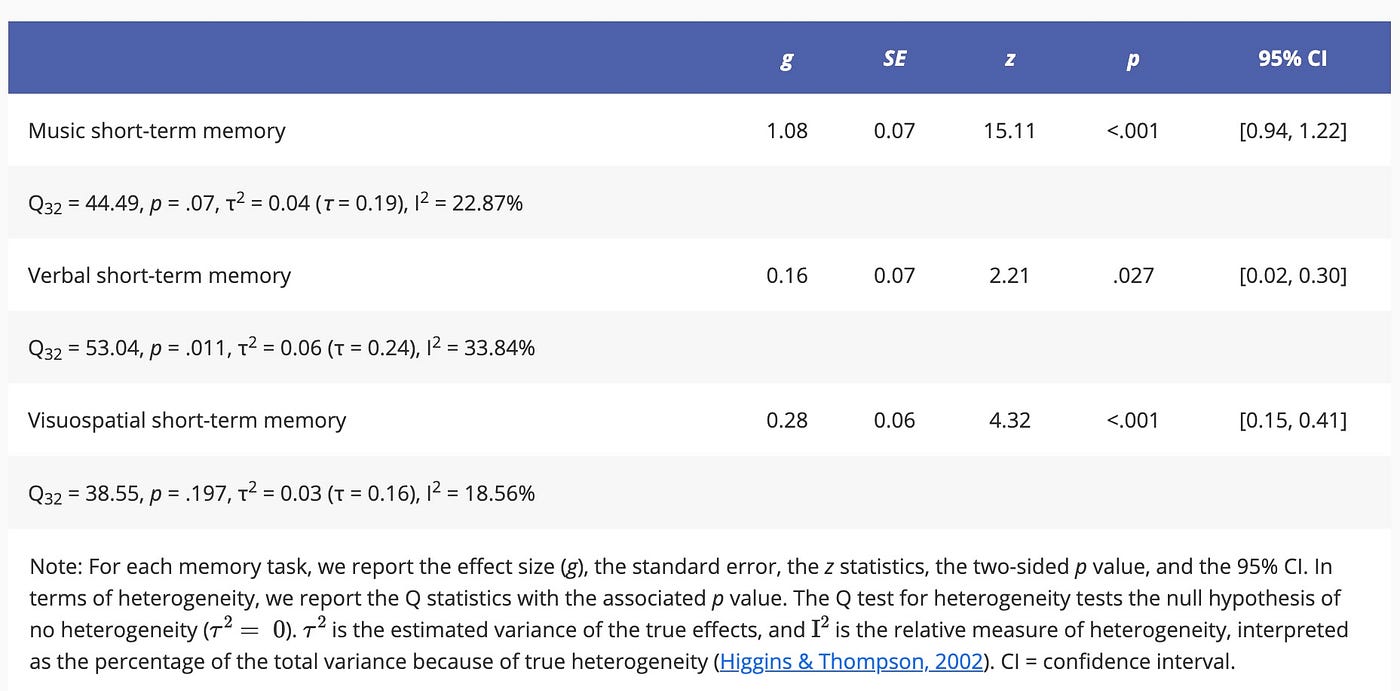
Table showing random effects meta-analyses for music, verbal, and visuospatial short term memory between musicians and nonmusicians. Source
This study allowed us to gain a better understanding of the effects of music on short term memory and also opened the door for future studies on this topic by showing a multilab approach and clearly defining the difference between a musician and nonmusician participant. This was my first real research experience and I loved having the opportunity to play a role in collecting the data and found it very interesting to see the final paper come to life. I will always look back on this experience as I continue my academic career.
References:
Grassi M, Talamini F, Altoè G, et al. Do Musicians Have Better Short-Term Memory Than Nonmusicians? A Multilab Study. Advances in Methods and Practices in Psychological Science. 2025;8(4). doi:10.1177/25152459251379432
Talamini F., Altoè G., Carretti B., Grassi M. (2017). Musicians have better memory than nonmusicians: A meta-analysis. PLOS ONE, 12(10), Article e0186773. https://doi.org/10.1371/journal.pone.0186773
메타데이터
- post_id
- c83f56f4e930
- slug
- memory-competition-musicians-vs-nonmusicians-c83f56f4e930
- url
- https://medium.com/langmuscoglab/memory-competition-musicians-vs-nonmusicians-c83f56f4e930
- canonical_url
- https://medium.com/langmuscoglab/memory-competition-musicians-vs-nonmusicians-c83f56f4e930
- author_url
- https://medium.com/@ctuske
- status
- ok
- fetched_at
- 2026-07-07 12:54:49