How Crypto Founders Should Measure Community Quality During a Token Sale Campaign
TL;DR: Crypto founders should measure community quality through useful actions, not member count. A large Telegram or Discord group can…
How Crypto Founders Should Measure Community Quality During a Token Sale Campaign
TL;DR: Crypto founders should measure community quality through useful actions, not member count. A large Telegram or Discord group can still hide low intent. Stronger signals come from contribution, conversion, retention, referral quality, quest depth, governance participation, and on-chain behavior. A token sale campaign needs people who understand the project, return after incentives, and take meaningful steps. The right scorecard helps founders find real participants, weak channels, and campaign areas needing work.
Community Size Only Shows Reach, Not Quality
Community size can make a campaign look healthy. A project may have many followers and members across Telegram, Discord, and X. But those numbers only show reach, not quality or intent.
This gap matters in a token sale campaign. Some users join only for rewards. Some accounts move from one campaign to another. Some wallets complete tasks, then disappear when points end. This is why teams need a clean community growth plan before scaling. TokenMinds covered this issue in Grow Crypto Community for Token Sale Without Bots and Bounty Hunters.
a16z explains that crypto growth needs adapted metrics. Crypto funnels include onchain behavior, token incentives, and community-driven dynamics. These factors change how teams should measure growth.
CoinGecko data adds another reason to use better filters. They found that 53.2% of cryptocurrencies on GeckoTerminal had failed. In 2025 alone, 11.6 million tokens failed. This data does not prove that failed tokens had weak communities. But it shows why surface signals need stronger checks. A better starting point is simple. Measure size as reach. Measure quality as behavior.
What Community Quality Means in Web3
Community quality means members show useful behavior. They do not only join a group. They learn, act, return, and help others understand the project.

For a token sale campaign, quality usually appears through clear signals.
- Project understanding Quality members ask specific questions about utility, roadmap, token mechanics, product access, or ecosystem role. Their questions show that they read, compare, and think.
- Useful contribution Strong members help the campaign move forward. They share feedback, answer basic questions, and explain project details to others.
- Conversion intent Qualified members take steps beyond discussion. They join a waitlist, connect a wallet, complete registration, or finish sale-related actions.
- Retention after incentives Good communities do not disappear after rewards end. Members return after quests, AMAs, announcements, and education sessions.
- Referral quality Strong referrals bring users who also take real actions. Weak referrals only increase signups without deeper activity.
- Verifiable behavior Onchain actions can support the quality check. Wallet activity, repeat transactions, holdings, or governance actions can show stronger intent.
This makes community quality easier to measure. It is not a vague feeling. It is a group of signals that founders can review every week.
Why Community Quality Matters Before a Token Sale
Community quality matters because token sale activity starts before purchase. Members need to learn, trust, and complete smaller actions first.
Strong community quality can support:
- Higher whitelist conversion because members already understand the project.
- Better KYC completion because serious users finish required steps.
- Lower Sybil participation because quality filters reduce reward farming.
- Better token holder retention because informed users have more reasons to stay.
- Reduced sell pressure after TGE because the campaign attracts users with stronger intent.
Key Metrics to Score Community Quality
Community quality needs a scorecard because one metric cannot explain the whole picture. A member can chat often but never convert. Another member may stay quiet but complete wallet setup, join updates, and return after quests.
The goal is not to create a perfect scoring model. The goal is to compare useful signals across channels. This helps founders see which community activities create serious participation.
Below are the core signals founders can use to score community quality during a token sale campaign:
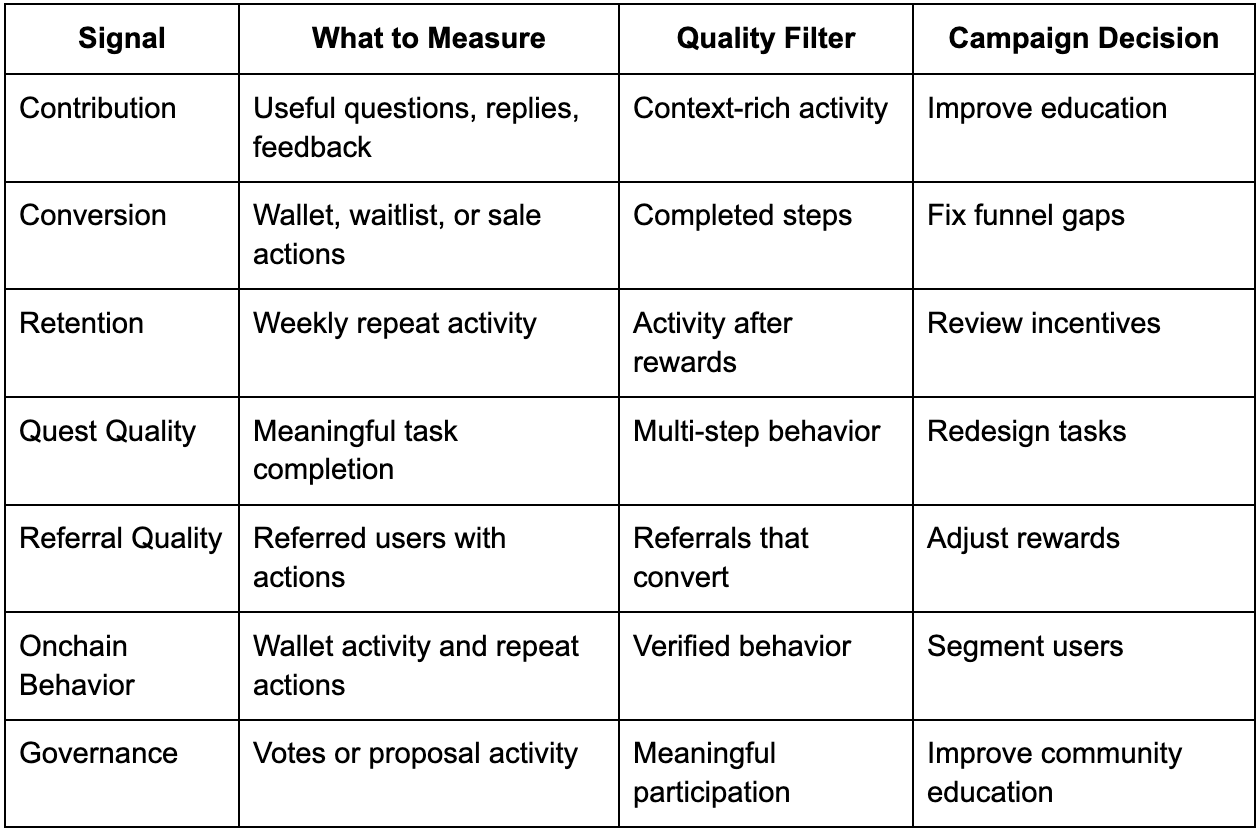
The scorecard should not treat every metric equally. Each project needs different weights. A DeFi project may weigh on-chain behavior more heavily. A gaming project may value product testing and feedback more.
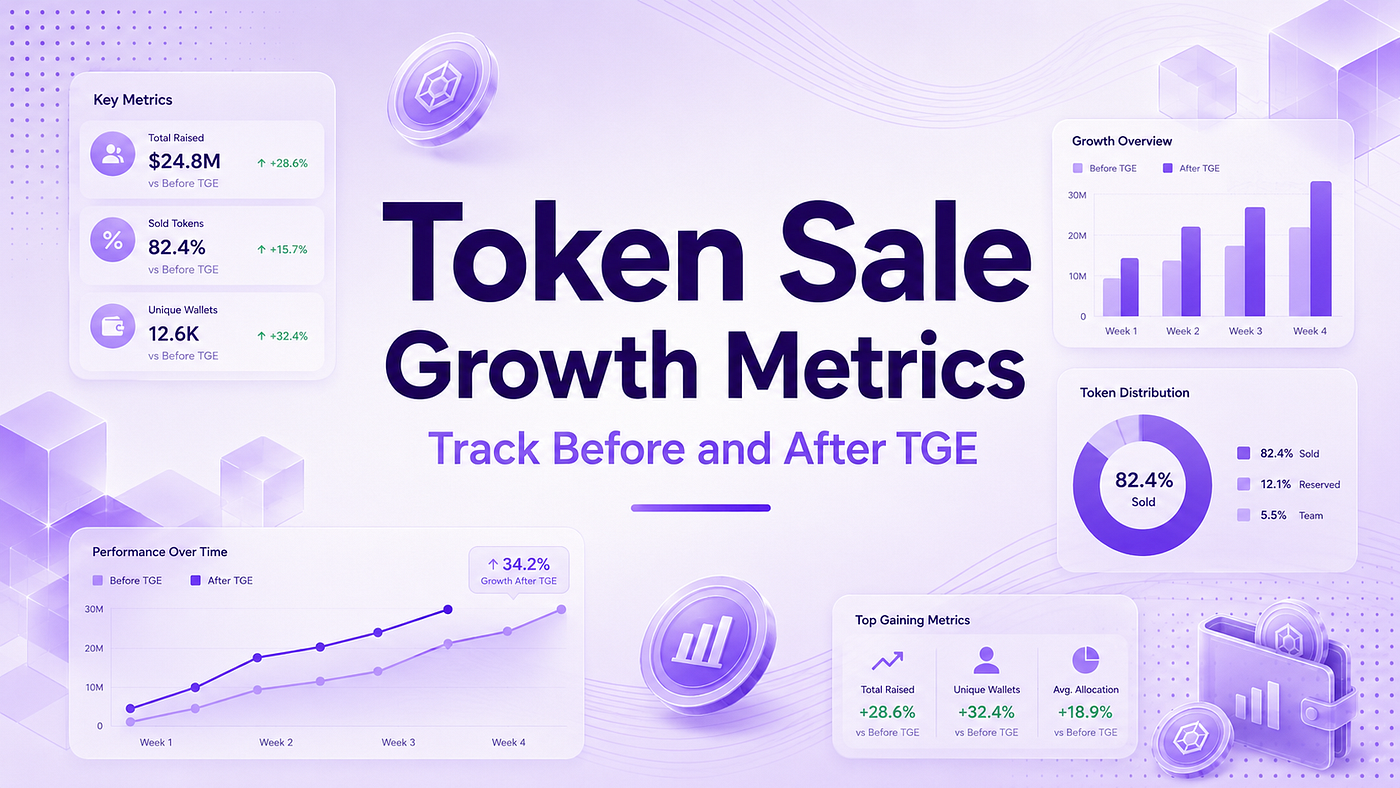
Still, the same logic applies. Quality comes from repeat, relevant, and traceable actions. These signals also connect community quality with broader growth tracking. The article Token Sale Growth Metrics, What Crypto Founders Should Track Before and After TGE (TM-22) can support the next layer of campaign measurement.
Community Quality Score Formula
Community quality should not stay as a rough opinion. Founders need one simple score to compare channels, cohorts, and campaign weeks. Use the Community Quality Score, or CQS, as a working formula. It is not an industry benchmark. It is a benchmark-informed model that teams can adjust by project type.
According to Optimism’s Airdrop 5 analysis, receiving 50 OP increased 30-day retention by 4.2 percentage points. The same study found that a frequent-user bonus decreased 30-day retention by 7.1 percentage points. This shows why post-reward retention matters more than raw activity.
According to ICO research by Lyandres, ICOs with KYC were 15 percentage points more likely to raise funds. They were also 21 percentage points more likely to list tokens on an exchange. This supports conversion steps like KYC, whitelist, wallet setup, and registration as quality signals.
Score each signal from 0 to 100, then apply the weight below.
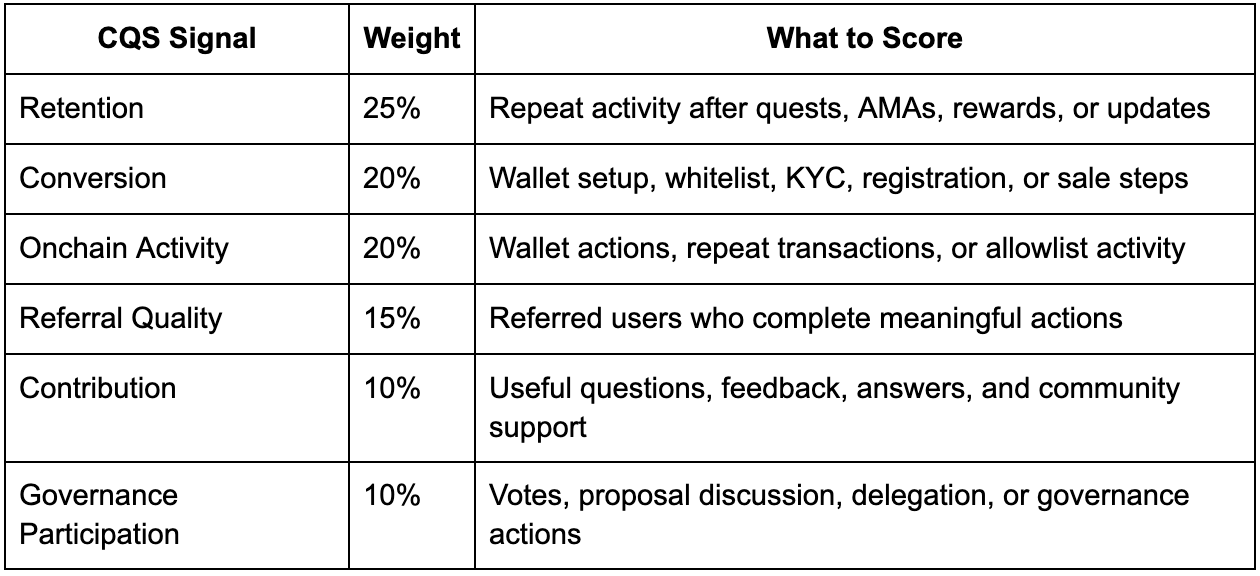
CQS = Retention × 25% + Conversion × 20% + Onchain Activity × 20% + Referral Quality × 15% + Contribution × 10% + Governance Participation × 10%
The score should stay flexible. A DeFi project may increase onchain activity weight. A gaming project may increase product testing and contribution. An infrastructure project may increase developer participation.
How to Measure Contribution, Retention, Referrals, Quests, and Onchain Behavior
The scorecard becomes useful when each signal has a clear source. Without that, teams may still count shallow activity as community quality.
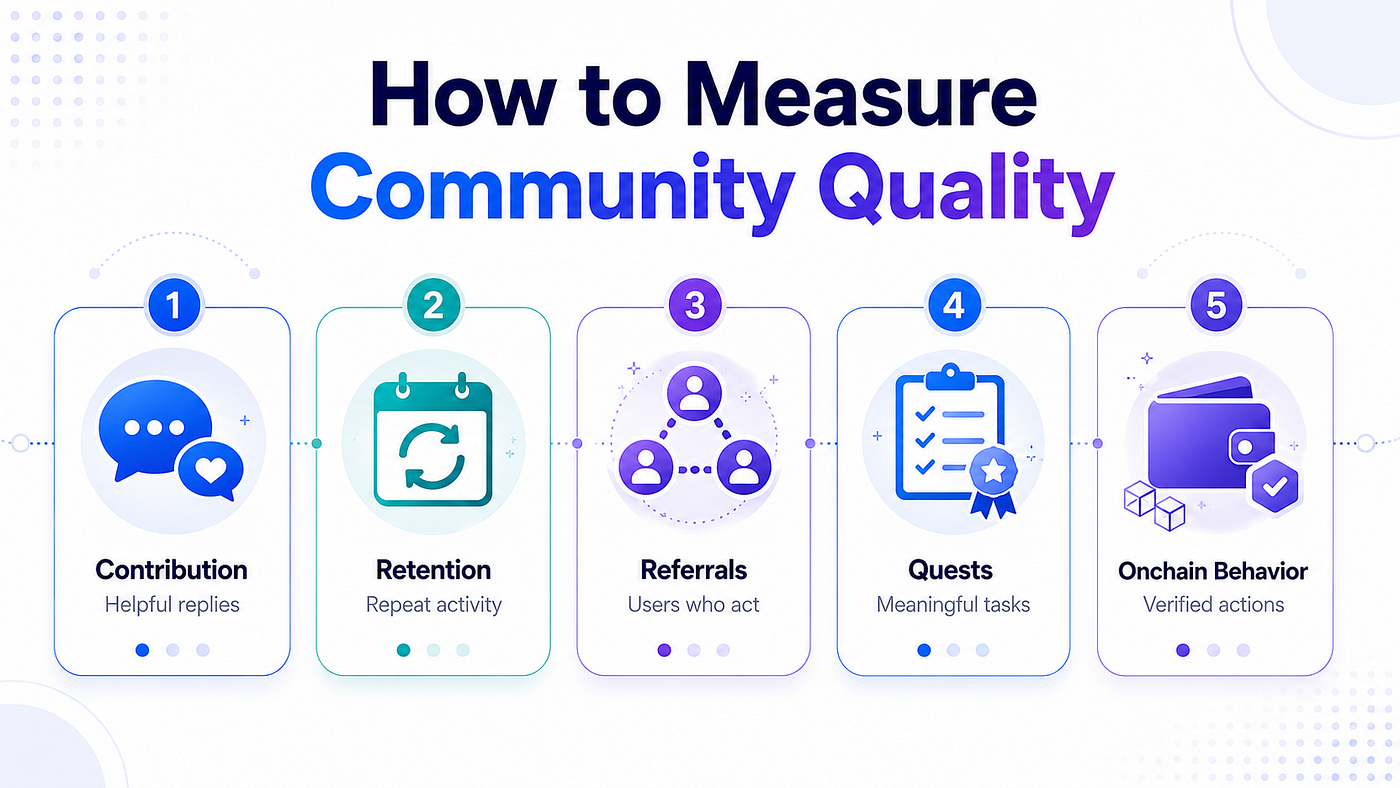
Below are the key areas founders should measure during a token sale campaign. By understanding these signals, founders can see which actions create qualified participation.
Contribution Quality
Contribution quality measures how members help the community learn. It shows whether members only talk, or actually add useful context.
Measure it through:
- Questions about utility, roadmap, token mechanics, or product access
- Replies that help other members understand the project
- Feedback shared after AMAs, quests, or product updates
- Community answers that reduce repeated basic questions
- Discussion quality across Telegram, Discord, X, or forums
Chat volume should not stand alone here. A busy Telegram group may still show weak understanding. A quieter Discord may have stronger discussions and better user intent.
Retention Quality
Retention quality measures who stays active after the first interaction. It helps founders separate real interest from reward-driven activity.
Measure it through:
- Members who return weekly after joining
- Quest users who stay active after points end
- AMA attendees who join later updates
- Wallet-connected users who open follow-up announcements
- Community members who keep engaging after incentives change
This matters because incentives can inflate short-term activity. a16z notes that crypto growth needs adapted measurement because token incentives can affect user behavior. Retention helps teams see which users still care after the campaign push.
Referral Quality
Referral quality measures whether invited users create real campaign value. A referral should not only increase signups. It should bring users who take meaningful steps.
Measure it through:
- Referred users who join the right community channel
- Referred users who complete wallet setup
- Referred users who finish waitlist or registration steps
- Referred users who complete meaningful quest tasks
- Referred users who return after the first action
Referral quality gives a cleaner view of network growth. A strong referral source brings participants. A weak referral source only brings names into a list.
Quest Completion Quality
Quest completion quality measures the depth behind completed tasks. This is important because not every completed quest shows intent.
Measure it through:
- Task type, such as reading, testing, answering, or connecting
- Completion depth, not only task count
- Wallet quality behind completed tasks
- Repeat participation across different campaign stages
- Activity after quest rewards or points end
A weak quest only asks users to follow, like, or repost. A stronger quest asks users to understand, test, explain, or complete a relevant action. That difference creates better behavior signals.
Onchain Behavior
Onchain behavior measures verifiable actions linked to wallets. It adds another layer beyond community chat and social engagement.
Measure it through:
- Wallet connection during campaign flows
- Repeat wallet activity after the first action
- Token holding or allowlist-related activity
- Governance voting, where applicable
- Product usage connected to the campaign journey
Onchain data should not replace community context. One wallet may not always equal one real user. But it can strengthen the scorecard when combined with Telegram, Discord, CRM, quest, and referral data.
Warning Signs of a Low-Quality Token Sale Community
Not every weak community looks inactive. Some campaigns look busy, but the activity does not move users closer to participation.
Founders should watch for these warning signs.
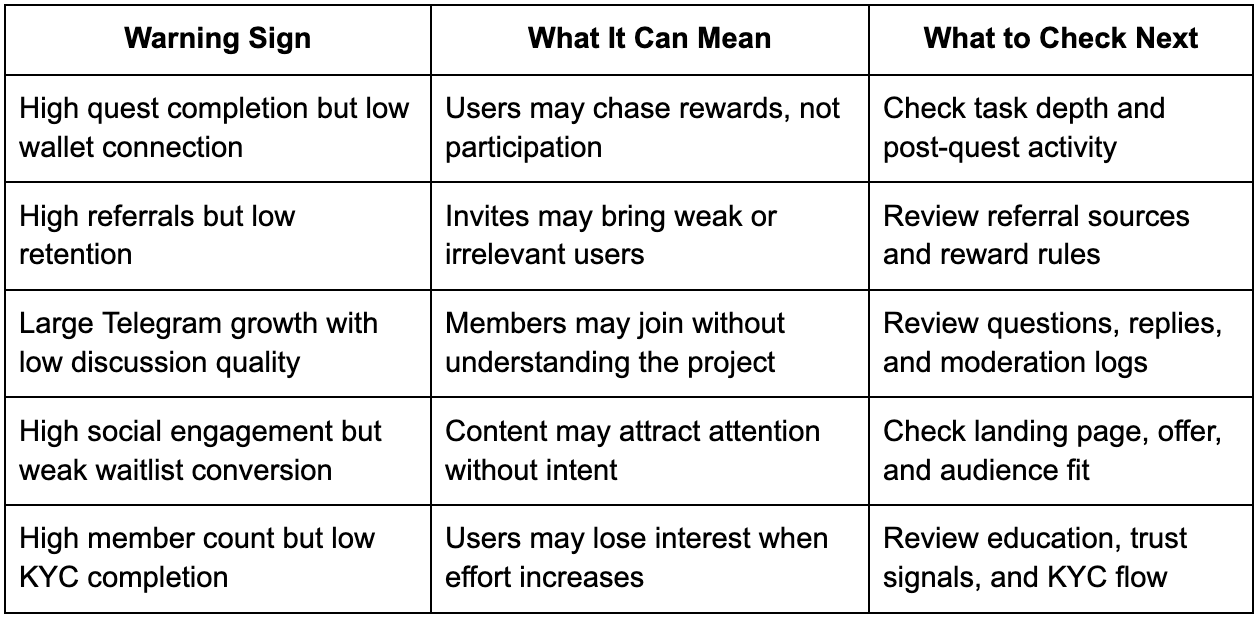
These warning signs should not be judged alone. A single weak metric can have many causes. But when several weak signals appear together, the campaign needs review before scaling.
How Founders Can Turn Community Signals Into Campaign Decisions
After the scorecard shows the strongest and weakest signals, the next step is campaign action. Community data should guide where the team spends, what message needs fixing, and which audience segment is closest to participation.
A token sale campaign often has many moving parts. KOLs may bring reach. Ambassadors may bring trust. Quest platforms may bring activity. Referrals may bring new users. But not every channel brings the same quality.
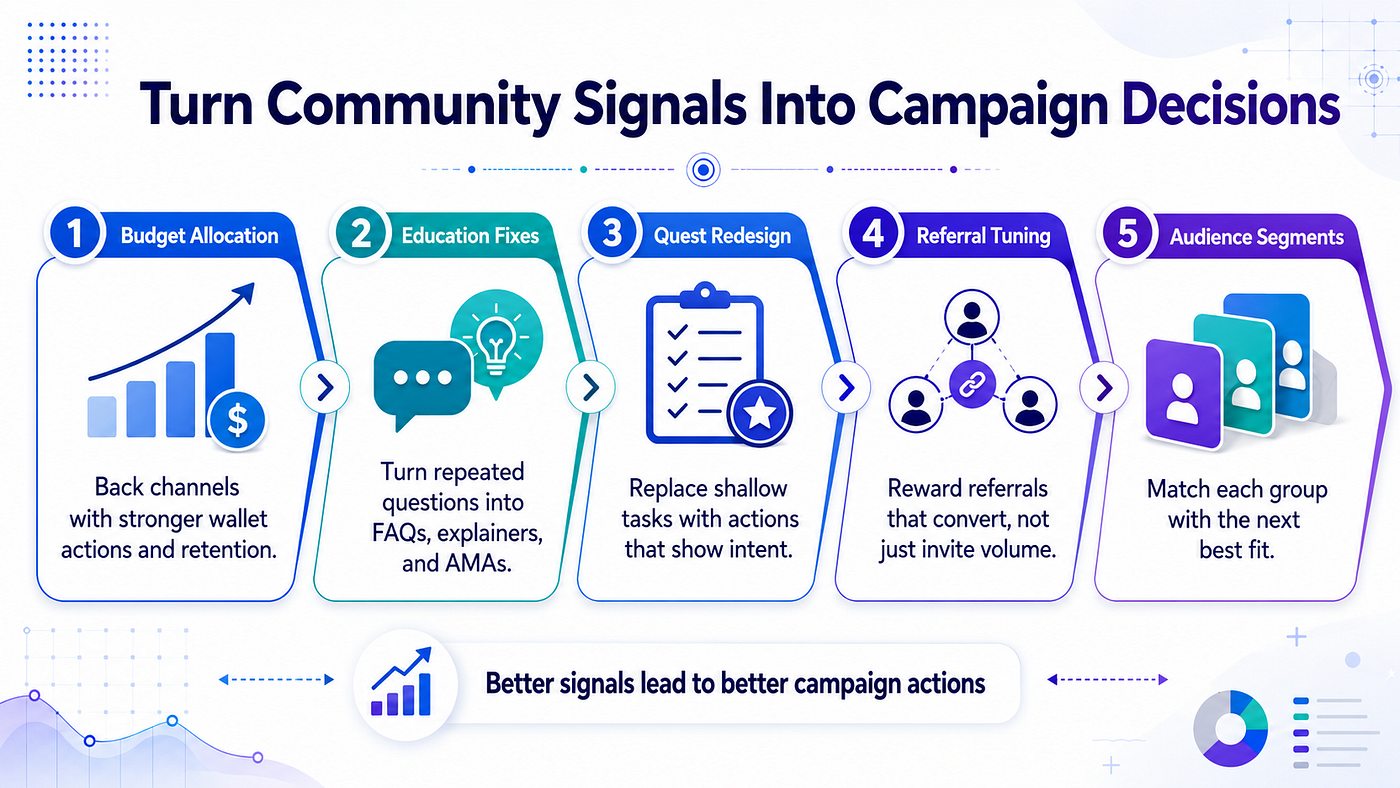
Founders can use the scorecard through these five steps:
1. Shift budget toward channels with stronger participants
The budget should follow quality, not volume. A KOL may bring many followers but few wallet connections. A smaller ambassador may bring fewer users but stronger conversion.
Founders can compare each channel by contribution, wallet setup, referral quality, and retention. Channels with stronger participants deserve more budget. Channels with shallow activity need review.
2. Improve education where questions show confusion
Repeated questions often show weak messaging. If members keep asking about utility, token mechanics, roadmap, or sale steps, the campaign needs clearer education.
Founders can turn these questions into better FAQs, explainer posts, AMAs, and quest tasks. This helps the community move from awareness into real understanding.
3. Redesign quests when completion looks shallow
Quest completion does not always mean quality. Some users finish tasks only to collect points. This can create activity without real interest.
Founders can review task depth, wallet quality, and post-reward activity. If users disappear after rewards, the task design needs change. Better quests should make users read, answer, test, connect, or explain.
4. Adjust referrals when invites do not convert
Referral campaigns should bring participants, not only signups. A large referral number means little if referred users do not act.
Founders can track referred users by wallet setup, waitlist completion, quest activity, and retention. Referral rewards should favor users who bring active participants.
5. Segment the community by readiness
Not every member needs the same next step. New learners need education. Active contributors need recognition. Wallet-ready users need clearer conversion paths. Dormant users need re-engagement.
This segmentation helps founders avoid generic campaign messages. It also makes each community action more relevant.
The same thinking should appear in What should a founder include in a token launch GTM brief or agency RFP? (TM-25). A founder should define quality signals, reporting cadence, and action triggers.
Audit Community Quality With TokenMinds
Crypto teams often collect community data across Telegram, Discord, X, quest tools, referral systems, CRMs, and wallet dashboards. The harder task is understanding which signals show real token sale readiness.
TokenMinds helps founders review community quality across the full campaign flow. This includes contribution, retention, quest quality, referral quality, wallet actions, and channel performance. The goal is to help teams see which community segments create serious participation.
A community quality audit can also show where the campaign needs action. Weak quest design may need better tasks. Low-retention channels may need new education. Poor referral quality may need cleaner reward rules.
Book a community quality scorecard audit with TokenMinds.
FAQs
- What is community quality in a token sale? Community quality means members show real intent during a token sale campaign. They do not only join a group. They ask useful questions, complete real actions, return after incentives, and move closer to participation.
- Why is community size not enough to measure token sale success? Community size only shows reach. It does not prove trust, understanding, or conversion intent. A large group can still contain bots, reward hunters, inactive members, or users who leave after points end.
- Which community metrics matter most before a token launch? The most useful metrics are contribution, conversion, retention, quest quality, referral quality, and on-chain behavior. These signals show whether members understand the project and take meaningful steps.
- How do you measure referral quality in a token sale campaign? Referral quality is measured by the actions of referred users. Strong referrals bring users who join the right channel, connect wallets, complete registration, finish quests, or return after the first action.
- Can on-chain activity predict token sale participation? Onchain activity can support the prediction, but it should not stand alone. Wallet connections, repeat actions, holdings, or governance activity can show intent. Teams should combine those signals with community and campaign data.
메타데이터
- post_id
- c848c9fd126d
- slug
- how-crypto-founders-should-measure-community-quality-during-a-token-sale-campaign-c848c9fd126d
- url
- https://medium.com/tokenminds/how-crypto-founders-should-measure-community-quality-during-a-token-sale-campaign-c848c9fd126d
- canonical_url
- https://medium.com/tokenminds/how-crypto-founders-should-measure-community-quality-during-a-token-sale-campaign-c848c9fd126d
- author_url
- https://medium.com/@tokenminds_marketing
- status
- ok
- fetched_at
- 2026-06-11 05:11:55