If AI Is the New Electricity, You Need to Build Your Own “AI Solar Panel”
Why the smartest move in the AI era isn’t buying more tokens, it’s generating your own intelligence.
If AI Is the New Electricity, You Need to Build Your Own “AI Solar Panel”
Why the smartest move in the AI era isn’t buying more tokens, it’s generating your own intelligence.
Disclaimer: AI-assisted content, managed and reviewed by me. But 100% worth reading this.
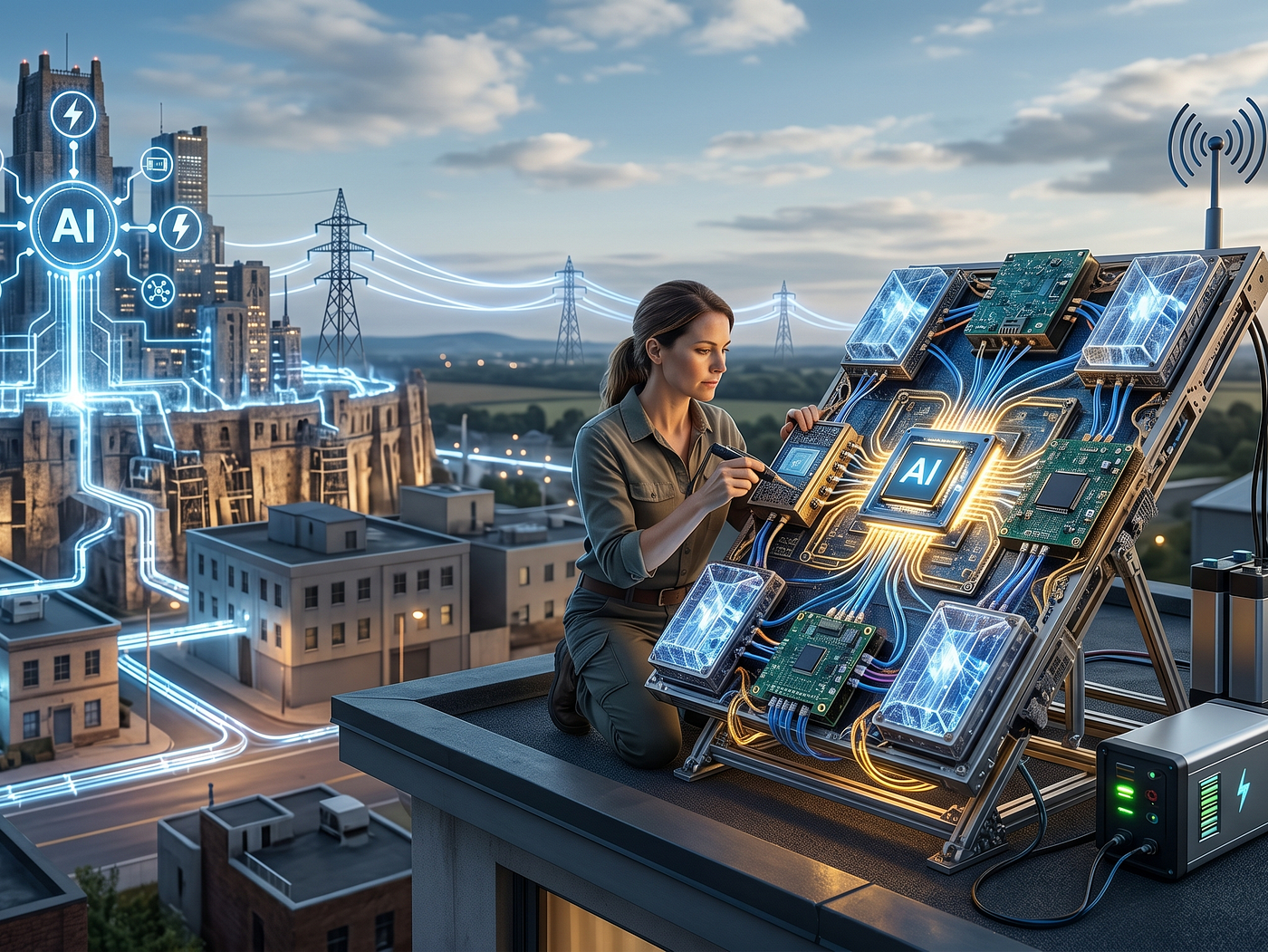
Everyone keeps saying AI is the new electricity. Sundar Pichai said it. Andrew Ng said it. Every keynote speaker at every tech conference in the last three years has said it.
But nobody is talking about what that analogy actually implies.
Because if AI really is the new electricity, then most of us are about to make the same mistake our great-grandparents made a century ago: becoming completely dependent on a handful of companies to supply something we can’t live without.
You Already Pay Four Utility Bills. AI Will Be the Fifth.
Think about your life right now. Every month, money leaves your account for electricity, gas, water, and internet. You don’t think about it. You just pay. These are the non-negotiables of modern existence.
Now look at what’s happening with AI. OpenAI charges per token. Anthropic charges per token. Google charges per token. Every API call, every query, every generated image — metered, billed, recurring. The pricing pages are already structured exactly like utility rate cards: tiered usage, overage fees, enterprise plans.
This isn’t a coincidence. This is the endgame.
Within five years, AI won’t be a fun tool you experiment with. It will be infrastructure. Your business will need it the way it needs email. Your workflow will depend on it the way it depends on cloud storage. Your daily life will be woven through it the way it’s woven through Google Search today.
And when that happens, “AI tokens” will sit right next to electricity on your monthly bill. Another meter. Another dependency. Another cost you can’t opt out of.
Unless you build your own solar panel.
The Energy Analogy No One Is Finishing
Here’s what people miss when they compare AI to electricity.
When electricity first arrived, there was no choice. You bought it from the power company or you sat in the dark. The generation required massive infrastructure — coal plants, hydroelectric dams, continent-spanning grids. No individual could produce their own.
For decades, that was the deal. And the power companies did well. Very well.
But then something shifted. Solar panels got cheap. Wind turbines got efficient. Battery storage became viable. Suddenly, ordinary people could generate their own electricity. Not all of it, maybe. But enough to matter. Enough to cut the bill. Enough to gain independence.
Some people went further. They went off-grid entirely. They became net producers, selling excess energy back to the very companies that once had a monopoly on their light switches.
AI is following this exact trajectory — but compressed into years instead of decades.
Right now, we’re in the “power company” phase. The big providers — OpenAI, Anthropic, Google — are building massive data centers, training enormous models, and selling access through metered APIs. They are the coal plants and hydroelectric dams of artificial intelligence.
But the “solar panel” phase has already begun. And most people haven’t noticed.
The Sun Is Already Shining. The Panels Are Already Free.
Here’s what’s remarkable about this moment: the natural resources for AI self-generation are already abundant, accessible, and in many cases, completely free.
The sun, wind, and water of AI are open-weight models. Meta’s Llama. Mistral. Phi. Gemma. Qwen. DeepSeek. StableLM. These aren’t toys. These are production-grade models released under permissive licenses, capable of handling real workloads that businesses currently pay thousands of dollars a month to run through commercial APIs.
The “solar panels” are consumer hardware. A modern laptop with a decent GPU can run a 7-billion-parameter model locally. A $2,000 desktop with a used server GPU can run models that rival what cost $0.03 per query through an API. A Raspberry Pi can run smaller models for specific tasks. The hardware you might already own is the installation on your roof.
The “inverters and batteries” are the tooling ecosystem. Ollama. llama.cpp. vLLM. LocalAI. These projects have made running models locally almost embarrassingly easy. What once required a PhD in machine learning now requires a terminal and ten minutes.
This is the equivalent of solar panels dropping from $76 per watt in 1977 to under $0.30 today. The economics have already flipped. Most people just haven’t done the math.
Do the Math
Let’s make this concrete.
Say you’re a freelance developer, a small team, or a startup. You use AI for code assistance, writing, data analysis, and customer-facing features. At current API pricing, you might spend $200–$500 a month on tokens. For a mid-size company, that number is in the thousands.
Now consider the alternative. A single NVIDIA RTX 4090 — a consumer graphics card — can run a quantized 70B-parameter model at usable speeds. That’s a one-time hardware cost of roughly $1,600. After that, your “electricity” is your actual electricity, which comes to a few dollars a month in additional power draw.
Your payback period? Two to four months. After that, every query is virtually free. Forever.
And you don’t need cutting-edge hardware. A MacBook with Apple Silicon can run 7B–13B models through llama.cpp with no GPU required. An older workstation with 32GB of RAM can handle quantized models that cover 80% of common use cases.
The upfront investment is real. But so was buying solar panels in 2010. The people who did it early aren’t regretting it now.
But Wait — Won’t the Big Models Always Be Better?
This is the argument you’ll hear from every AI company selling tokens: “Sure, you can run a small model locally, but our frontier model is so much better.”
And they’re right. GPT-4-class models and Claude Opus are genuinely more capable than a 7B model running on your laptop. No argument there.
But here’s the thing: you don’t need a nuclear power plant to charge your phone.
Most AI tasks don’t require frontier-model intelligence. Code completion, summarisation, classification, extraction, drafting, translation, data formatting — these are the bread and butter of daily AI use, and a well-tuned local model handles them perfectly well.
This is the same pattern as energy. You don’t go off-grid to run an aluminium smelter. You go off-grid for lights, heating, cooking, and daily appliances. You stay connected to the grid for the heavy stuff, but you’ve cut your bill by 70%.
The smart play isn’t “local models OR cloud APIs.” It’s a hybrid approach: run the routine workloads locally and tap into frontier APIs only when the task genuinely demands it. Just like a house with solar panels that’s still connected to the grid.
Fine-Tuning Is Your Home Renovation
Here’s where the analogy gets even more powerful.
A generic open model is like a standard solar panel. It works. It generates value. But when you fine-tune that model on your own data — your company’s documents, your writing style, your domain-specific knowledge — you’ve essentially customised the panel for your exact latitude, roof angle, and sun exposure.
Fine-tuned local models can outperform much larger general-purpose models on your specific tasks. A 7B model fine-tuned on your codebase can be more useful for your daily work than a 400B model that knows everything about everything but nothing about your particular stack.
This is the equivalent of energy independence plus energy optimisation. You’re not just generating your own power. You’re generating exactly the power you need, in the exact form you need it, with zero waste.
The Real Risk Is Doing Nothing
Here’s what concerns me most.
Every month you spend entirely dependent on commercial AI APIs, you’re building deeper dependency. Your workflows crystallise around a specific provider’s interface. Your team’s muscle memory forms around a particular model’s quirks. Your costs compound.
And pricing will only go in one direction once AI becomes true infrastructure. When electricity was a novelty, it was cheap. When it became essential, prices consolidated, and the power companies knew exactly how inelastic your demand was.
The same will happen with AI tokens. Right now, providers are competing for market share with aggressive pricing. That won’t last. Once AI is as essential as email, the calculus changes entirely.
The people who will be least affected are the ones who already have their solar panels installed.
Your AI Solar Panel Starter Kit
If you’re convinced — or even just curious — here’s where to start.
Phase 1: Install a panel. Download Ollama or LM Studio. Pull a model — Llama 3, Gemma, Mistral, Phi — and start using it for simple tasks. Get comfortable with local inference. This takes fifteen minutes and costs nothing.
Phase 2: Connect it to your workflow. Use tools like Open WebUI, Jan, or LocalAI to create a ChatGPT-like interface for your local models. Set up API endpoints so your existing tools can talk to your local models instead of cloud APIs.
Phase 3: Optimise for your roof. Experiment with quantised models (GGUF format) to find the best quality-to-speed ratio for your hardware. Try different model sizes. Find the sweet spot where quality meets your needs without maxing out your resources.
Phase 4: Fine-tune. Take an open model and train it on your domain-specific data. This is where local models go from “good enough” to “better than the cloud for my use case.” Tools like Unsloth, Axolotl, and HuggingFace’s TRL make this increasingly accessible.
Phase 5: Go hybrid. Route tasks intelligently — simple queries to your local model, complex reasoning to a cloud API. Use frameworks like LiteLLM or OpenRouter to abstract the routing. Pay for frontier intelligence only when you genuinely need it.
The Bigger Picture
There’s a philosophical dimension here that goes beyond cost savings.
Energy independence changed the relationship between individuals and power companies. It decentralised control. It created resilience. It gave people agency over something fundamental to their lives.
AI independence will do the same.
When you run your own models, your data stays on your machine. Your queries aren’t logged by a third party. Your intellectual property isn’t potentially fed into someone else’s training pipeline. You control the model, the context, and the output.
This isn’t paranoia. It’s architecture. The same way owning solar panels isn’t “anti-grid” — it’s simply a smarter, more resilient design for your energy life.
The Window Is Open
We’re in a rare moment. Open models are improving at a staggering pace. Hardware costs are falling. Tooling is maturing. The gap between what you can run locally and what you have to pay for in the cloud is narrowing every quarter.
But this window of openness isn’t guaranteed to last. Regulatory pressure, licensing changes, and consolidation could all shift the landscape. The best time to go solar was five years ago. The second-best time is now.
The same is true for AI.
The “electricity” is coming whether you’re ready or not. The only question is whether you’ll be buying every watt of it from someone else — or generating your own.
Start building your panel.
Cheers!
If this resonated, share it with someone who’s still paying full price for their AI electricity. And if you’ve already started running local models, I’d love to hear about your setup in the comments.
메타데이터
- post_id
- c86a4ad0fed3
- slug
- if-ai-is-the-new-electricity-you-need-to-build-your-own-ai-solar-panel-c86a4ad0fed3
- url
- https://medium.com/@binodmx/if-ai-is-the-new-electricity-you-need-to-build-your-own-ai-solar-panel-c86a4ad0fed3
- canonical_url
- https://medium.com/@binodmx/if-ai-is-the-new-electricity-you-need-to-build-your-own-ai-solar-panel-c86a4ad0fed3
- author_url
- https://medium.com/@binodmx
- status
- ok
- fetched_at
- 2026-07-11 06:57:34




