AI for Everybody — Lesson 3
What Is This Thing? A Short, Honest History
AI for Everybody — Lesson 3
What Is This Thing? A Short, Honest History
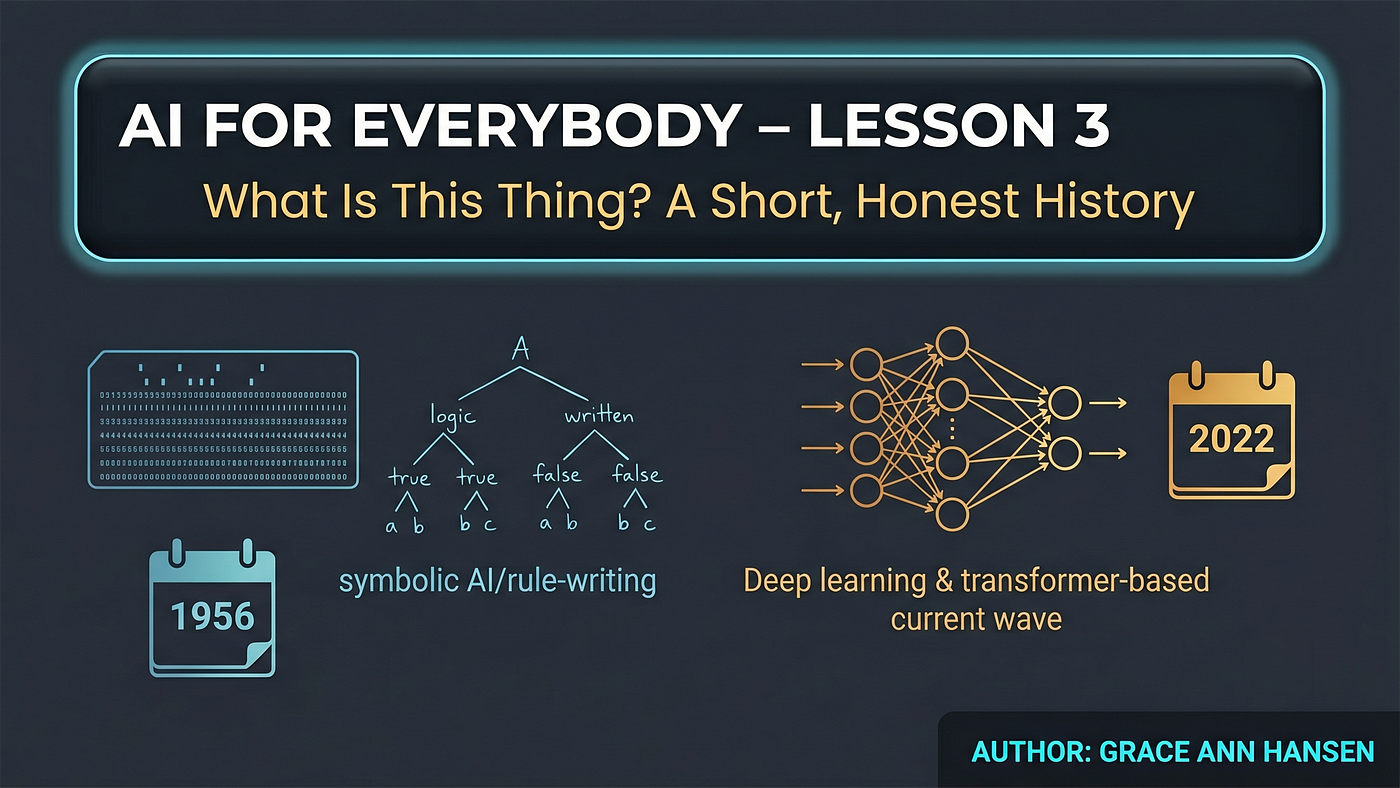
Image by Grace Ann Hansen using NANO BANANA 2
This is the field’s third or fourth resurrection. People declared it dead, with funding obituaries in serious publications, more than once. The version of AI that is in your phone right now sits on top of seventy years of false starts, busted hype, two famous winters, and one quiet 2012 result that almost nobody outside the field noticed for several years.
You do not need to know that history to use a chatbot. You need to know it to read the headlines about chatbots without being played. Most articles about “the AI revolution” are written by people who have never read a paragraph about the AI revolution of the 1980s. The same shape of optimism and the same shape of disappointment has happened before. Naming the pattern is what this lesson is for.
1956: the name shows up
The phrase artificial intelligence was coined in the summer of 1956, at a workshop at Dartmouth College that four mathematicians had proposed the year before. Their pitch, written by John McCarthy, Marvin Minsky, Nathaniel Rochester, and Claude Shannon, sat in a single document submitted on August 31, 1955 (McCarthy et al., 2006), and it is striking to read now. They asked for ten people for two months to make real progress on, among other things, how machines could use language, form concepts, and improve themselves. They expected to make real progress that summer.
They did not. But the workshop did one durable thing: it gave the project a name. After 1956, the program of building intelligent machines existed as a named research field, and from there it could attract funding, attract students, and generate cycles of hope and disappointment, which it began doing almost immediately.
The early approach was symbolic. The idea was that intelligence is the manipulation of symbols according to rules; a machine that follows the right rules over the right symbols is, in some meaningful sense, thinking. Decades of work went into writing those rules by hand: rules for theorem proving, rules for playing chess, rules for diagnosing infections, rules for parsing English sentences. The work produced real results, especially in narrow technical domains. It did not produce the kind of broad intelligence the Dartmouth pitch had promised.
The first winter
In 1972 the British government commissioned the mathematician Sir James Lighthill to assess AI research and recommend what to fund. His report, published in 1973 (Lighthill, 1973), concluded that the field had badly oversold itself, that the techniques that worked in toy domains were not generalizing to real ones, and that public money should largely be withdrawn. It was. Most UK university AI work shut down for a decade.
A similar pattern unfolded in the United States a few years later, where DARPA, which had been funding ambitious AI projects through the 1960s, became more selective about results. The combination of these moves gave the field its first long pause. Researchers stayed in their labs and kept publishing; what dried up was the funding, the press attention, and the sense of imminent breakthrough. “AI winter” is the term that stuck.
What is worth pausing on is why the winter happened. The technical work was not all wrong. It just could not deliver what had been promised, which was general human-like intelligence on a near-term timeline. The promise was the problem. When the promise broke, the field could not regroup before the funding cycle turned.
The second wave and the second winter
The 1980s brought a second wave, this time focused on expert systems: programs that captured the rules a human specialist used in a narrow domain (medical diagnosis, geological survey, hardware configuration) and applied them automatically. The technology was real. Companies bought it. A whole hardware market grew up around specialized LISP machines designed to run AI programs. Magazine covers got excited.
That, too, broke. The systems were brittle: they worked well inside their tight domain and badly outside it, and as soon as the domain shifted (a new disease, a new geology, a new chip) the rules a year ago needed rewriting. Companies that had paid millions for expert systems found they were paying again to maintain them, and again to retire them. The LISP machine market collapsed. The second winter arrived around 1987 and lasted into the mid-1990s.
By the time it ended, the public conversation about AI had become the joke version of the field: machines that confidently solve toy problems and embarrassingly fail on real ones, in service of nothing much.
2012: the result almost nobody noticed
In September 2012, three researchers (Alex Krizhevsky, Ilya Sutskever, and Geoffrey Hinton) submitted a paper to the annual ImageNet image-recognition contest. Their entry was a deep neural network, trained on a pair of consumer graphics cards, that recognized objects in photographs with a top-5 error rate of 15.3 percent, where the previous year’s best had been 25.7 percent. They published the result (Krizhevsky et al., 2017) and waited for the field’s reaction.
The reaction was muted. Inside academic vision and machine-learning circles, it was a clear shock; outside those circles, almost nothing changed for several years. No news cycle. No tech-press wave. The technique was old (neural networks were a 1950s idea); the compute (consumer GPUs) was newly cheap; the data (the ImageNet dataset, fourteen million labeled photographs) was newly available. When all three lined up, an idea that had not worked at scale for fifty years suddenly worked at scale, and the field quietly pivoted away from rule-writing and toward training.
Almost everything in the consumer AI world today traces back through that 2012 result. The image generation, the speech recognition, the recommendation systems, the translation that no longer sounds robotic, the autocomplete that finishes your sentences. All of it is downstream of “deep networks plus enough data plus enough compute.” The pivot took several years to propagate. By 2015 the major labs had reorganized around it. By 2017 the next architectural move was on the way.
2017: the architecture that woke up text
In June 2017, a team of researchers at Google Brain and Google Research, including Ashish Vaswani and seven coauthors, posted a paper called “Attention Is All You Need” (Vaswani et al., 2017). It described a neural network architecture they called the transformer. The architecture is the technical center of every modern language model and most modern AI you have heard of: GPT is a transformer, Claude is a transformer, Gemini is a transformer, Llama is a transformer.
We will open up what the transformer actually does in Lesson 11. For now, the historical point is enough: the transformer made it practical to train language models on much larger amounts of text than older architectures could digest, and to do so without the kind of slow sequential processing that had bottlenecked earlier approaches. Between 2017 and 2022, the major labs scaled transformer-based language models from research-paper curiosities to systems that could write a coherent paragraph on demand. The work was technical and incremental. None of it was a public conversation.
November 30, 2022: the public moment
On a Wednesday afternoon five days after the United States Thanksgiving holiday, OpenAI released ChatGPT (OpenAI, 2022) as a free public demo. It was not the company’s most advanced model. It was not their most expensive product. It was a research preview that they thought a few academics and developers might play with briefly.
Five days in, it had a million users. Two months in, it had a hundred million. Then the whole world started reading about it, and then arguing about it, and then changing curricula and corporate policies and job descriptions around it. The transformer had been out for five years. The model behind ChatGPT had been mostly built for over a year. The thing that was new in November 2022 was a chat interface, dropped onto an existing model, marketed gently, and made free.
What you are using today (and what we are spending this year unpacking) is the result of that interface choice, plus everything that has happened since. The technical lineage runs straight back through 2017’s transformer, through 2012’s deep-learning shift, through the symbolic-AI work of the 1960s and 70s, through the Dartmouth proposal of 1955. Every part of that lineage produced both believers and obituarists. You can decide which group to join, but you should not assume the field’s age starts in November 2022. You are studying something older than the moon landing.
Going Deeper (optional)
Why does the field keep doing this? The cycle has a recognizable shape: a new technical idea proves itself in a narrow benchmark; the press extrapolates wildly; funding and talent rush in; the technique runs into the limits of what it was actually good at; the funding pulls back; the field appears to die; researchers keep working in the quiet; the next idea matures; the cycle restarts.
Three forces shape the boom-bust pattern and are worth holding in mind right now. The first is overpromising. Every wave’s leading figures, including the four Dartmouth signatories, predicted timelines for human-level AI that proved to be off by decades. The second is underdelivering against the wrong measure. Each wave’s working ideas were genuinely useful for narrower tasks than the press headlines implied, and when the broader promise failed, the narrower successes got dragged down with it. The third is compute and data scarcity. Each wave was bottlenecked by what the era’s hardware and datasets could not yet supply. The 2012 shift happened in part since consumer GPUs and a million labeled images were finally cheap enough to feed an old idea.
The question for the present is whether the current cycle is genuinely different in degree (very large models, very much data, very much compute, all together) or whether the same cycle is just running at higher amplitude. The honest answer is that experienced researchers disagree, and this lesson will not adjudicate that. By Lesson 6 you will have a way to think about that disagreement; for now, take from the history that the pattern exists and the smartest people in the field have been overconfident about timelines for seventy years running.
What you have, what comes next
You now have a timeline to hang everything on. The field is old. The current moment is the latest peak in a series of peaks. The technical pattern (rule-writing then training; symbolic then statistical; small models then large) repeats with variations, and the cultural pattern (boom, hype, winter, quiet work, next boom) is as much part of the story as the algorithms.
In Lesson 4 we step out of the historical narrative and into the technical recipe. There are three ingredients that every wave of AI has needed: data, compute, and algorithms. Each winter happened in part since one ingredient was missing. Each renaissance happened in part since all three lined up at once. Naming the recipe is what opens the next several lessons, which crack open the engine you have been hearing about for the last three weeks.
If You Want to Dig Deeper
For the canonical readable history of the field through the 1970s, Machines Who Think is still the best long-form treatment of why the early waves overpromised and what the people involved actually thought they were doing. McCorduck, P. (2004). Machines who think: A personal inquiry into the history and prospects of artificial intelligence (25th anniv. ed.). A K Peters/CRC Press. https://doi.org/10.1201/9780429258985 (Originally published 1979)
For a journalist’s narrative of the 2012 turning point and the years immediately after, Genius Makers follows the small group of researchers whose work made the modern wave possible, including the Krizhevsky-Sutskever-Hinton ImageNet result. Metz, C. (2021). Genius makers: The mavericks who brought AI to Google, Facebook, and the world. Dutton. https://www.penguinrandomhouse.com/books/616762/genius-makers-by-cade-metz/
For the second-winter story with documents and dates rather than personalities, Strategic Computing is the definitive account of how the 1980s expert-system boom collapsed and what the funding actually did. Roland, A., & Shiman, P. (2002). Strategic computing: DARPA and the quest for machine intelligence, 1983–1993. MIT Press. https://mitpress.mit.edu/9780262182263/strategic-computing/
Author Note:
Grace Ann Hansen is an independent researcher and writer, and an MBA graduate student in health informatics and artificial intelligence. She is also a published author, a professional musician, a gymnastics coach, and a queer transgender woman living in Sioux Falls, South Dakota. She corrects all her papers and articles with Grammarly, because even though she has deep thoughts, she has shallow patience for punctuation. She uses Anthropic’s Claude in Research mode for source location and verification on cited factual claims; all interpretation, argument, and prose are her own. Correspondence concerning this article should be addressed to Grace Ann Hansen at grace@graceannhansen.com.
References
Krizhevsky, A., Sutskever, I., & Hinton, G. E. (2017). ImageNet classification with deep convolutional neural networks. Communications of the ACM, 60(6), 84–90. https://doi.org/10.1145/3065386 (Originally presented at NeurIPS 2012)
Lighthill, J. (1973). Artificial intelligence: A general survey. In Artificial intelligence: A paper symposium. Science Research Council. http://www.chilton-computing.org.uk/inf/literature/reports/lighthill_report/p001.htm
McCarthy, J., Minsky, M. L., Rochester, N., & Shannon, C. E. (2006). A proposal for the Dartmouth Summer Research Project on Artificial Intelligence, August 31, 1955. AI Magazine, 27(4), 12–14. https://doi.org/10.1609/aimag.v27i4.1904 (Originally submitted 1955)
OpenAI. (2022, November 30). Introducing ChatGPT. https://openai.com/index/chatgpt/ (accessed 2026–05–19)
Vaswani, A., Shazeer, N., Parmar, N., Uszkoreit, J., Jones, L., Gomez, A. N., Kaiser, Ł., & Polosukhin, I. (2017). Attention is all you need. Advances in Neural Information Processing Systems, 30, 5998–6008. https://doi.org/10.48550/arXiv.1706.03762
메타데이터
- post_id
- c871a4724403
- slug
- ai-for-everybody-lesson-3-a-short-honest-ai-history-c871a4724403
- url
- https://ai.plainenglish.io/ai-for-everybody-lesson-3-a-short-honest-ai-history-c871a4724403
- canonical_url
- https://ai.plainenglish.io/ai-for-everybody-lesson-3-a-short-honest-ai-history-c871a4724403
- author_url
- https://medium.com/@graceannhansen
- status
- ok
- fetched_at
- 2026-06-20 20:29:01