Is the Universe Rendering Itself?
Rethinking Consciousness, Evolution, and the Quantum Engine
Is the Universe Rendering Itself?
Rethinking Consciousness, Evolution, and the Quantum Engine
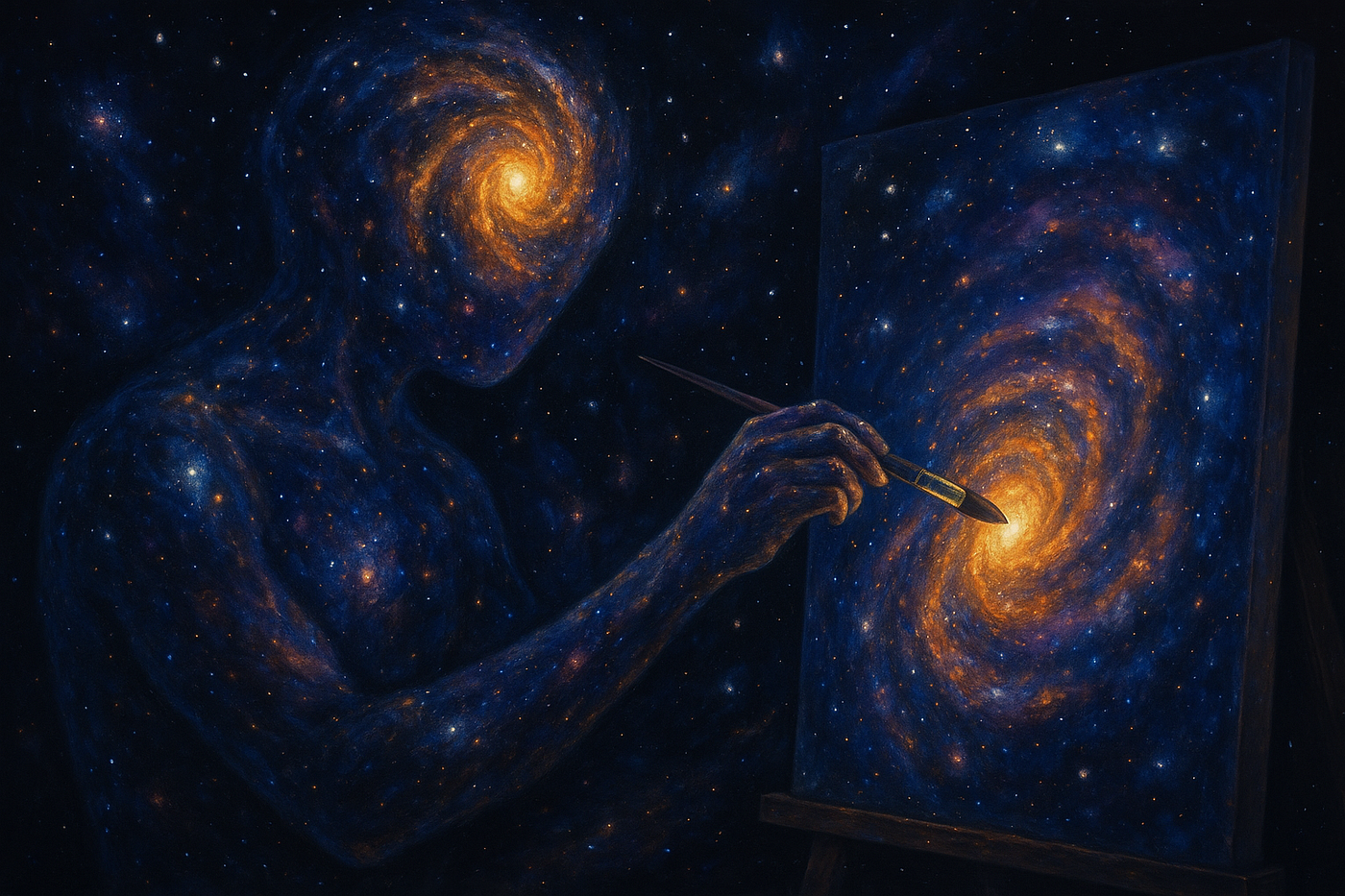
Image by Sora
We tend to think of quantum mechanics as a cold, precise mathematical framework — a set of rules for subatomic behavior, useful for explaining electrons, atoms, and entanglement. But what if that’s only half the story?
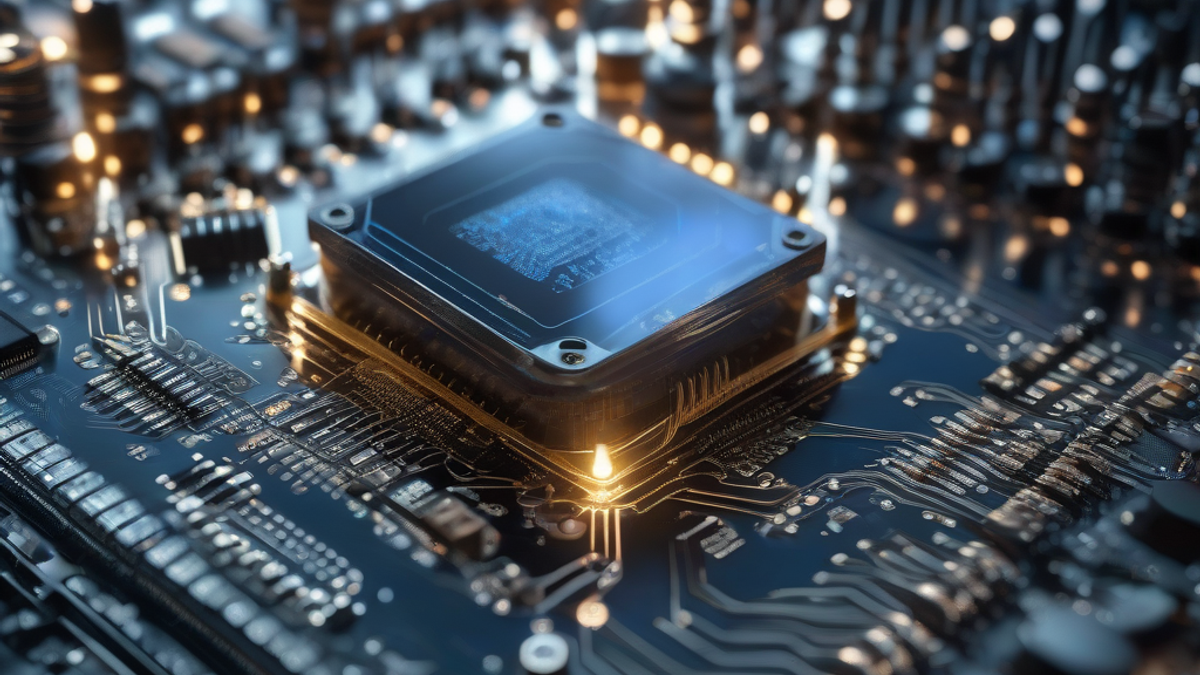
What if quantum mechanics is more like a rendering engine — a cosmic GPU designed not just to describe the universe, but to efficiently generate it? And more provocatively: What if the very experience of consciousness, the “redness of red,” is the result of quantum mechanics self-optimizing to render the most complex structures in existence — us?
Schrödinger’s Equation May Be Incomplete
Physicists know that Schrödinger’s equation, the heart of quantum theory, is linear and deterministic. It governs how quantum states evolve — until someone makes a measurement.
But here’s the catch: it doesn’t explain collapse.
Why does the infinite “superposition” of possibilities suddenly snap into a definite outcome when observed? Why do you see one apple, not a blur of all possible apples? This is the so-called measurement problem, and after nearly a century of debate, we still don’t know what causes the shift from probability cloud to reality.
Some argue collapse is an illusion (Many-Worlds). Others say it’s fundamental (Copenhagen). But maybe we’re asking the wrong question.
What If the Universe Is Rendering Reality?
Think about how a video game works.
Your GPU doesn’t render every tree in the forest — only the ones you can see. It saves processing power by skipping objects out of view. This is called occlusion culling or level-of-detail rendering. It’s how we simulate huge worlds without infinite computing resources.
Now imagine the universe working the same way.
What if quantum collapse isn’t a glitch, but a feature — a way for the universe to conserve computational energy by rendering only what’s observed? Unobserved states remain in fuzzy superposition, like off-screen assets in a game. Only when a conscious observer “looks” does the universe finalize the detail.
Consciousness as a High-Cost Render Target
Here’s where it gets interesting.
Life, especially complex, conscious life, is not trivial to simulate. It’s the product of billions of years of evolutionary causality — chemical reactions, DNA mutations, neural adaptations. Every conscious moment is built on layers of irreducible biological and informational history.
If quantum mechanics really renders reality, then consciousness is the hardest thing it has to render.
And if the system is optimizing for efficiency — like any good renderer — then over time, it must self-optimize to better simulate minds, attention, perception, and internal experience. In other words, qualia (subjective feelings like the redness of red, or the taste of coffee) may be the output of this optimization — the most efficient internal rendering of mental objects.
Mental Imagery: The Test Case
Ever imagined a red apple?
No photons are hitting your retina. There’s no light, no object. Yet you experience something. Not as vividly as real perception, but the redness is there.
How?
Your brain reactivates the same visual pathways that would fire if the apple were real. In a sense, you’re locally rendering a simulation. Perhaps your internal renderer — optimized over evolutionary time — has learned to efficiently collapse an imagined state into a real-feeling experience.
The Universe Learns to Render Minds
Here’s the punchline:
Maybe the universe is learning how to render itself by simulating beings complex enough to reflect on their own existence.
Just as neural networks become better with feedback, perhaps the universe — via quantum mechanics — adapts to the existence of observers by “fine-tuning” its collapse mechanics to support rich, coherent subjective experience.
Not because it wants to — but because that’s the least computationally costly way to simulate a world with consciousness in it.
Consciousness as an Emergent Compression
We often treat subjective experience as a mystery — an emergent property, or a metaphysical problem. But what if it’s a data compression strategy?
- Vision compresses light into stable images.
- Memory compresses history into patterns.
- Consciousness compresses the recursive modeling of self and world into a felt moment — an efficient format for high-level, self-referential awareness.
In this framing, the universe must give rise to experience — not as magic, but as a necessity of efficient rendering.
What This Means
If true, this idea has stunning implications:
- The collapse of the wave function might not be random — but an efficiency-driven computation.
- Subjective consciousness isn’t a byproduct of biology — it’s a rendering artifact.
- Minds are not epiphenomena — they are central players in how the universe constructs reality.
- Quantum mechanics isn’t just a rulebook — it’s a game engine that only works when played.
Final Thought
We usually think of physics as fixed and impersonal. But perhaps reality is more like a dynamically optimized simulation, where the most complex parts — us — shape the rendering algorithm itself.
In that case, the “hard problem of consciousness” isn’t a bug in our theories. It’s a sign we’re finally peering behind the curtain at how the universe gets its graphics just right.
메타데이터
- post_id
- c87358acce10
- slug
- is-the-universe-rendering-itself-c87358acce10
- url
- https://pub.aimind.so/is-the-universe-rendering-itself-c87358acce10
- canonical_url
- https://pub.aimind.so/is-the-universe-rendering-itself-c87358acce10
- author_url
- https://medium.com/@philogen888
- status
- ok
- fetched_at
- 2026-06-21 23:24:37