AI Agent Decisions Are Data. Treat Them Like It.
Most systems validate the data. Almost none validate the decision.
AI Agent Decisions Are Data. Treat Them Like It.
Most systems validate the data. Almost none validate the decision.
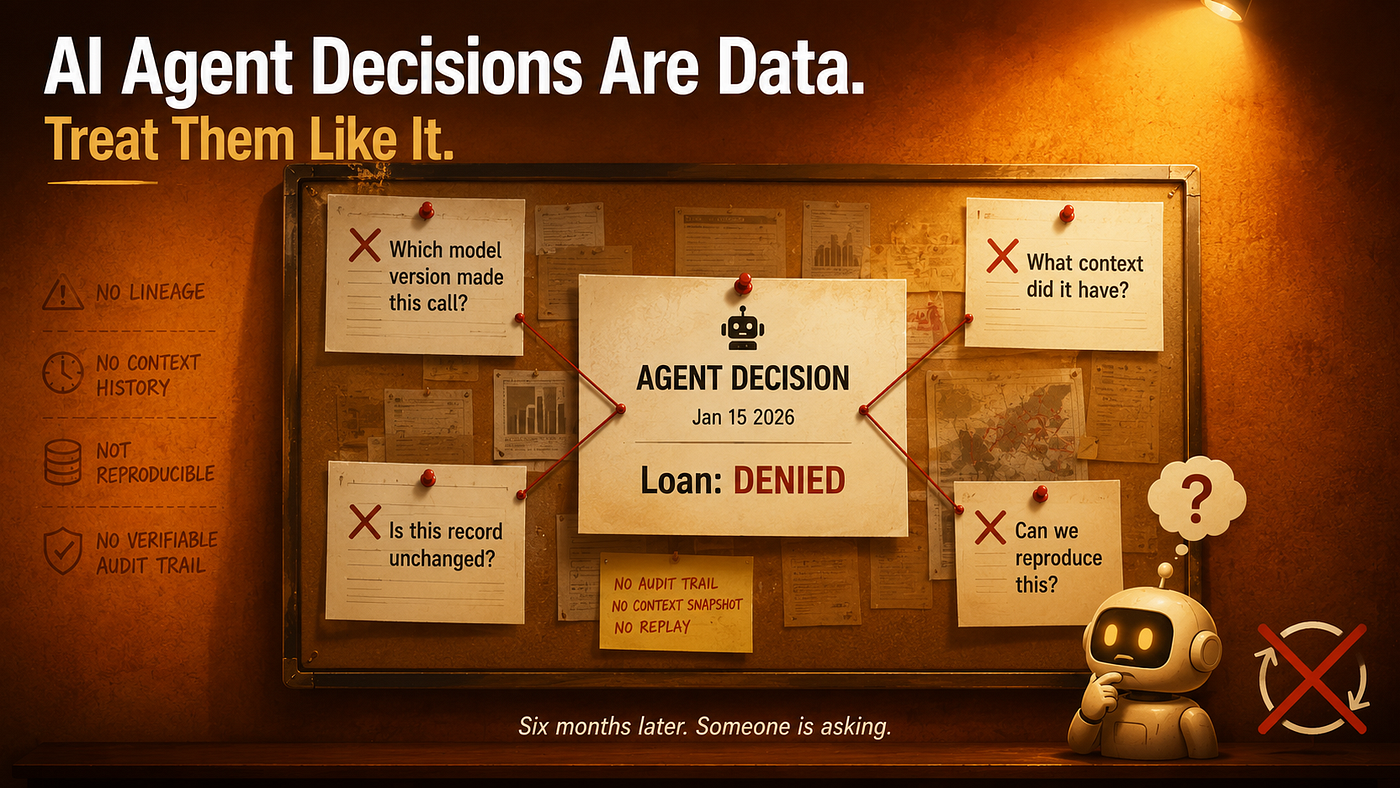
An AI agent denied a loan application last Tuesday. The reasoning was sound — three risk signals in combination, each within policy. The decision was logged. The system moved on.
Six months later, the applicant filed a dispute. Someone pulled the record.
The record looked fine. Clean. Complete. But was it exactly what the agent decided? Or was it what survived the journey from the agent runtime, through a logging service, through a storage system, through a reporting layer, to the person reading it now?
Nobody could say for certain. The agent had made a decision that affected a real person. The record of that decision had traveled through four systems. Nothing along the way had checked whether it arrived intact.
There is something about AI agents that makes this harder than it sounds. An agent is not deterministic. Ask it the same question tomorrow with the same inputs and it may reach a different conclusion. You cannot reconstruct what it decided by re-running it. The decision it made was made once, by a model in a specific state, with specific context it retrieved at that moment. The original record is not a copy of something you can regenerate. It is the only evidence that the decision happened the way it happened.
That changes how seriously you have to take what happens to it after it leaves the agent.
The record looks fine. That’s the problem.
When an agent makes a decision — flag this account, approve this request, escalate this ticket, deny this application — that decision doesn’t sit still. It moves. It gets logged, stored, copied, summarized, aggregated, and eventually queried.
At every step, something can change. A logging service serializes the decision into a string and drops the structured fields. A storage system has a column that’s too short and truncates the reasoning silently. A reporting layer aggregates decisions into counts and destroys the individual records in the process. A sync job runs six months later against a slightly different schema and fills missing fields with defaults.
None of these are catastrophic failures. No alarm fires. No error surfaces. The record lands in the final system looking perfectly reasonable. The agent made a decision at 9am. By the time anyone reads about it, the record is a compressed, transformed, potentially incomplete version of what actually happened.
The scary part is not that this happens. It is that nothing tells you.
The agent’s decision is not what gets stored. What gets stored is what survived the journey.
Where it breaks, specifically
The failure modes are predictable once you look for them.
The first is at the point of logging. Most agent systems write a human-readable summary of the decision rather than a structured, machine-verifiable record. The summary is useful for a developer scanning logs. It cannot be programmatically verified months later. You cannot confirm that the summary accurately represents the full decision, or reconstruct the reasoning that produced it.
The second is schema drift. Agent systems evolve. A new field gets added to the decision record in the next release. An existing field gets renamed. The system receiving those records handles it gracefully — by ignoring what it doesn’t recognize. Old records and new records look identical in storage. The fields that would distinguish them are gone.
The third is aggregation. Dashboards and reports summarize decisions into counts and rates. That summarization destroys the individual records. When someone needs to understand one specific decision six months later, the individual record may no longer exist in a form that can answer the question.
The fourth is context evaporation. An agent running in January gets queried in September. The record doesn’t say which version of the model made the call. The context the agent had — the data it retrieved, the signals it weighed — was never preserved. You have the outcome. You’ve lost everything that explains it.
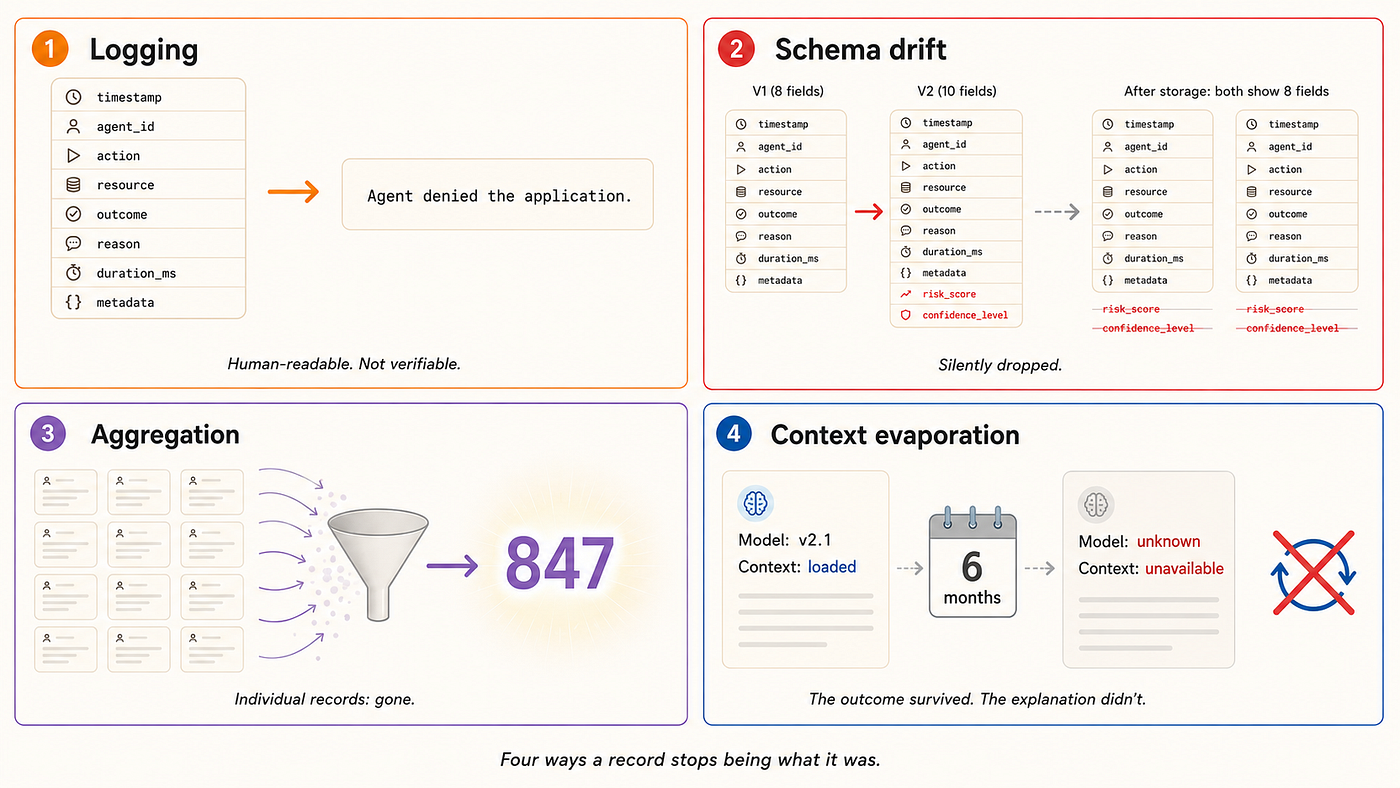
What integrity looks like for agent decisions
The fix is conceptually simple. Every agent decision should carry a structured record — a manifest — that travels with it through every system it touches. That manifest contains enough information to verify the record at any future point, and to reconstruct the context in which the decision was made.
At minimum, a decision manifest should capture: a unique identifier for the decision, the version of the agent and model that made it, a timestamp, a hash of the input the agent received, a reference to the full context the agent had access to, the decision itself, and a hash covering the entire manifest.
{
  "decision_id": "dec_9f3a2c",
  "agent_id": "loan-review-agent-v2",
  "model_version": "claude-sonnet-4-6",
  "timestamp": "2026-01-15T09:14:33Z",
  "input_hash": "sha256:a3f9...",
  "context_snapshot_id": "ctx_7b2d",
  "decision": "deny",
  "confidence": 0.91,
  "reasoning_hash": "sha256:c91e...",
  "manifest_hash": "sha256:f44a..."
}
The manifest_hash covers the entire object. Any system that receives this record can verify the hash before doing anything with it. If the hash doesn’t match, something changed in transit. That’s caught at the boundary — not discovered during a dispute six months later.
The context_snapshot_id points to a separate store where the full context is preserved — not summarized, not truncated, the complete set of information the agent had when it made the call. That’s what makes reconstruction possible. Without it, you have an outcome with no explanation.
The model_version field means every decision is queryable by which model made it. When behavior changes after an update, you can isolate when the pattern started. Without it, you’re guessing.
Because the agent is probabilistic — it cannot be re-run to reproduce the original answer — the context_snapshot_id is not optional. It is the only way to explain the decision after the fact. The outcome survived. Without the context, the explanation did not.
What you need to be able to answer
Go back to the opening scenario. An applicant disputes the loan denial six months later. With a decision manifest in place, the answer takes five minutes: here is the exact decision the agent made, here is the model version that made it, here is the complete context it had access to, and here is proof the record has not changed since it was produced.
Without it, the answer is: we have a log entry that says the application was denied. We believe it is accurate. We cannot verify it.
Every system that receives a decision record should verify the manifest before acting on it. If the verification fails, the record stops. It does not proceed silently to the next system. That is the difference between an audit trail and a best guess.
Who this matters for right now
Teams building agents that make high-stakes decisions — in credit, healthcare, hiring, content moderation, fraud detection — are already thinking about this. Regulation is arriving. Audit requirements are real. The question of whether a record accurately represents what an agent decided is not hypothetical for them.
Teams whose agents feel lower-stakes are usually one bad outcome away from needing to think about it. An automated decision that seemed routine becomes the subject of a complaint, a review, or a question that nobody can confidently answer. The gap between “we have logs” and “we can verify what the agent decided” matters a lot in that moment.
Starting small is fine. One agent. One decision type. Add a manifest. Store the context. Verify the hash at one point in the system. See what you learn. The cost of the experiment is low. The cost of not running it — when the question gets asked — is higher.
Agent decisions affect real people. The records of those decisions deserve the same integrity guarantees we apply to any other information that matters. The discipline isn’t new. The habit is.
Before you go
- Please take a moment to like the post and follow the writer!
- Did you know that over 400,000 developers share what they’re building, learning, and discovering across our platforms every month? Learn how you can contribute here
메타데이터
- post_id
- c8999e386efe
- slug
- ai-agent-decisions-are-data-treat-them-like-it-c8999e386efe
- url
- https://blog.stackademic.com/ai-agent-decisions-are-data-treat-them-like-it-c8999e386efe
- canonical_url
- https://blog.stackademic.com/ai-agent-decisions-are-data-treat-them-like-it-c8999e386efe
- author_url
- https://medium.com/@akanksha.lonkar25
- status
- ok
- fetched_at
- 2026-07-15 16:01:43