The autonomous car war has been going on for twenty years and nobody has won yet
A history of the self-driving obsession that swallowed billions of dollars, ended companies, and is now finally, maybe, actually happening…
The autonomous car war has been going on for twenty years and nobody has won yet
A history of the self-driving obsession that swallowed billions of dollars, ended companies, and is now finally, maybe, actually happening in your city.
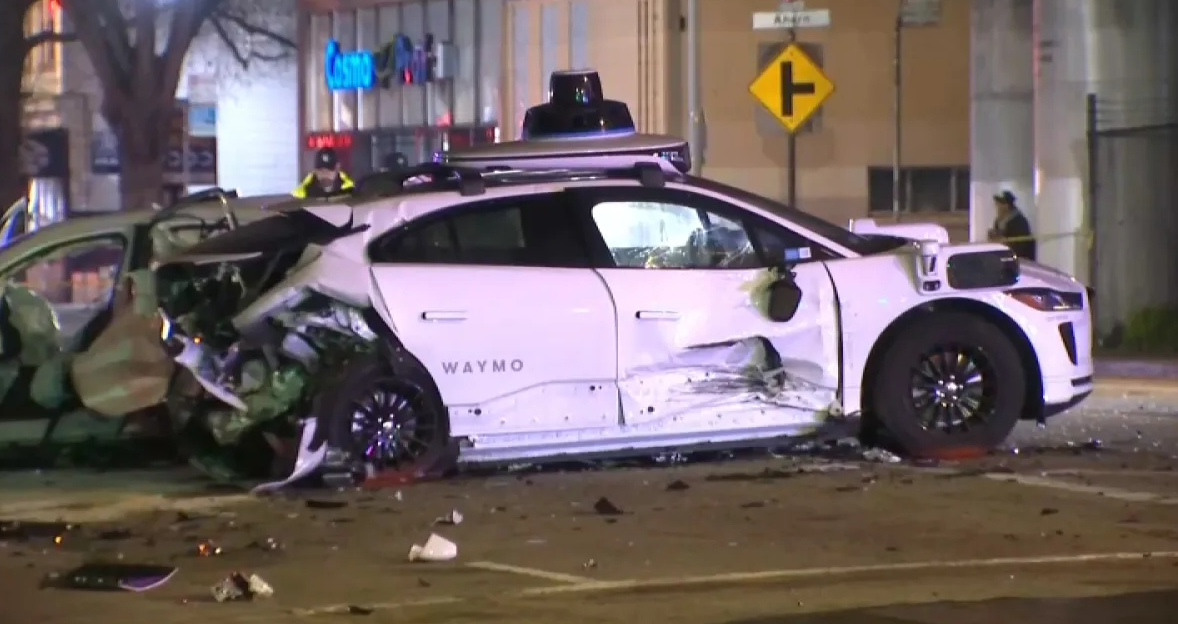
Car crash involving a Waymo car
There is a Waymo driving around my neighborhood right now. I know this because I can see it from my window. It moves the way all Waymos move, which is carefully and slightly too slowly, with the confident unhurry of something that has nothing to prove and nowhere particular to be. A sensor pod on the roof rotates continuously. The car has no driver. Last week I got in one and rode it from Noe Valley down to the Embarcadero and it did not crash, get confused, or do anything strange. This felt both completely normal and faintly surreal, because I have been watching this technology fail to arrive for most of my career.
The promise of the self-driving car is one of Silicon Valley’s oldest and most expensive obsessions. It has consumed something north of $100 billion across two decades. It has destroyed companies, ended careers, produced genuine breakthroughs, and generated an almost unbroken record of missed deadlines. It has been six months away from mass deployment approximately forty times. And now, in early 2026, it is actually, finally, genuinely happening, not at the scale or speed the evangelists promised, but happening nonetheless. San Francisco is about to become the only city on earth where you can choose between four competing robotaxi services. That is a real sentence about the real world, and I find it strange that it doesn’t feel stranger.
[embed]
The origin story starts in the Mojave Desert in March 2004. DARPA, the US military research agency, staged something called the Grand Challenge: a race for autonomous vehicles across 142 miles of desert terrain. Fifteen teams showed up with their machines. The best performer, a modified Humvee from Carnegie Mellon University, managed 7.4 miles before getting stuck on a rock. The winner’s prize of one million dollars went unclaimed. Nobody finished. The robots lost to the desert. But the people watching, a generation of engineers and researchers, saw not failure but possibility.

Military personnel watch as the SciAutononics II autonomous vehicle leaves the starting line in a quest for a million-dollar prize at the DARPA Challenge on March 13, 2004. It went about seven miles before getting stuck on an embankment.PHOTOGRAPH: DAVID MCNEW/GETTY IMAGES
What followed was a decade of mass hallucination, and I mean that with affection. Every major car company, every tech company with a research budget, and several hundred startups decided simultaneously that self-driving cars were going to arrive in three to five years and that whoever owned the technology would own transportation. The money was staggering. GM paid $1 billion in 2016 for a startup called Cruise that had been founded eighteen months earlier. Ford poured a billion dollars into a company called Argo AI. Uber spent hundreds of millions and eventually killed someone with a test vehicle in Arizona in 2018, which was a turning point of the bad kind. Intel bought Mobileye for $15 billion. Apple began Project Titan and then repeatedly restarted it. Everyone was building the future of mobility.
“Every major car company, every tech company with a research budget, and several hundred startups decided simultaneously that self-driving cars would arrive in three to five years. The money was staggering.”
The timelines were a collective exercise in wishful thinking. In 2015, Elon Musk said Tesla would have a fully self-driving car within two years. In 2016, he said drivers would be able to sleep in a Tesla by 2018. GM said Cruise would have a driverless taxi service by 2019. Waymo said it would launch a commercial robotaxi service in Phoenix by the end of 2018, and it did, sort of, with a small geofenced area and safety drivers in the cars. The technology kept improving. The promised dates kept slipping. The industry developed a pattern: a confident announcement, a demonstration, a quiet extension of the timeline, and then another confident announcement.

Twenty years of milestones, setbacks, and missed promises. The green dots are real. The red dots are expensive lessons.
The reckoning arrived in stages. In October 2023 a Cruise robotaxi in San Francisco struck a pedestrian who had already been hit by another car. That part was arguably not Cruise’s fault. What happened next was. The company withheld key video footage from investigators, showed regulators an edited version of events, and lost its operating license in California. By December 2023, GM had shut Cruise down entirely and written off billions. Ford had already killed its Argo AI investment the year before. The graveyard of self-driving ambition was getting crowded. Apple’s Project Titan, a ten-year effort that had consumed enormous resources and the attention of some of the best hardware engineers in the industry, quietly died in early 2024. The dream of consumer self-driving cars, it turned out, was somewhere between extremely hard and currently impossible.
What survived was different from what everyone had predicted. The companies that were still standing in 2025 were not the ones that had tried to do everything fastest. They were the ones that had picked a constrained problem and gotten very good at it. Waymo had spent years mapping specific cities in extraordinary detail, building cars that knew exactly where they were to within centimeters, and building redundant safety systems on top of that foundation. It was expensive, slow, and methodical. It was also the approach that actually worked.

Waymo vs. Zoox: The Race for Autonomous Dominance in San Francisco
Which brings us to the present, and to what I think is a genuinely underappreciated moment. San Francisco in 2026 is on the verge of becoming the only city in the world where you can choose between four competing robotaxi services. Waymo is already at scale, crossing an estimated 450,000 weekly paid rides and serving 14 million trips in 2025. Tesla’s Robotaxi launched in Austin last June and has been methodically, if slowly, expanding. Zoox, the Amazon-owned company with its unusual bidirectional vehicle, is planning to begin charging for rides in San Francisco in 2026. Uber, not wanting to be left out, is building its own robotaxi partnership for the same market.
The competitive dynamics are more interesting than the simple narrative of “Waymo winning.” Waymo’s approach is expensive and constrained in specific ways. Each Waymo vehicle costs somewhere between $150,000 and $200,000, which means scaling is a capital problem as much as a technology problem. Tesla’s camera-only approach is far cheaper per vehicle, and if the software ever reaches the reliability of Waymo’s system, the economics are dramatically better. Musk has said Tesla would expand its Austin fleet to 500 cars by the end of 2025. The actual number hovered around three dozen. The gap between the promise and the reality is the central story of Tesla’s entire self-driving program.
“The gap between the promise and the reality is the central story of Tesla’s entire self-driving program. It has been true for a decade. It may eventually become false.”
It has been true for a decade. It may eventually become false. Tesla has something no other company has: millions of consumer vehicles on the road, collecting data every day. If that data advantage translates into a superior neural network for driving, the current gap with Waymo could close faster than the current trajectory suggests. Or it might not. Skeptical analysts have been making the argument that camera-only systems have fundamental limitations that more data cannot solve. Nobody actually knows which view is correct, which is why both the bulls and the bears on Tesla’s robotaxi program have plausible arguments.
What I find most interesting, as someone who came here to work on hardware and stayed to watch one of the stranger technology races of my lifetime, is how the story of self-driving cars reflects something specific about Silicon Valley. The optimism here is not performative. It is genuine, and it is sometimes wrong in ways that cost people their money and occasionally their lives, and it is also sometimes right in ways that change the world. The cars are on the road. They are not crashing into things. The last driver’s license holder is, in fact, probably already born. It just took twenty years longer than everyone said it would, and the path there looked nothing like the route anyone planned.
I got back in a Waymo last week. It took me where I was going without incident, without a driver, and without drama. I watched the city go by. The car knew every turn before it got there. Somewhere a sensor pod was rotating, building a model of the world, comparing it to the map, deciding what to do next. Outside the window, San Francisco looked exactly like it always does: beautiful, expensive, s
메타데이터
- post_id
- c8a16d6cdda6
- slug
- the-autonomous-car-war-has-been-going-on-for-twenty-years-and-nobody-has-won-yet-c8a16d6cdda6
- url
- https://medium.com/@lindqvisterik480/the-autonomous-car-war-has-been-going-on-for-twenty-years-and-nobody-has-won-yet-c8a16d6cdda6
- canonical_url
- https://medium.com/@lindqvisterik480/the-autonomous-car-war-has-been-going-on-for-twenty-years-and-nobody-has-won-yet-c8a16d6cdda6
- author_url
- https://medium.com/@lindqvisterik480
- status
- ok
- fetched_at
- 2026-07-11 13:42:50




