Victorian and Edwardian Botanical Perfumery Series: Angel Water
Formulas for Angel water, a perfume and cosmetic distilled from a variety of aromatic plants and plant resins, have origins in 17th century…
Victorian and Edwardian Botanical Perfumery Series: Angel Water
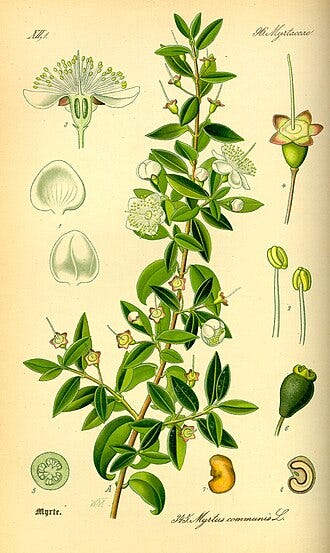
True Myrtle (Myrtus communis) Prof. Dr. Otto Wilhelm Thomé Flora von Deutschland Wikimedia Commons Image License
Formulas for Angel water, a perfume and cosmetic distilled from a variety of aromatic plants and plant resins, have origins in 17th century Europe. In the Victorian era, this perfume gained more floral notes, leading changes to its formula as a fragrance that was increasingly based on the distillations or oils of the myrtus communis shrub, also known as common myrtle.
18th century cosmetic formulary books provide early examples for the botanical ingredients used to prepare this perfume. This 1711 example does not contain any myrtle, but instead combines fragrant resins with spices and citrus to create a distillation.
Angel-water boil’d. TAKE Six Quarts of Water in an Earthen Vessel, to which put One Pound of Benjamin¹, half a Pound of Storax, One Ounce of Cinnamon, half an Ounce of Cloves, all beat to Pouder[sic], with Two or Three Pieces of Calamus Aromaticus and Two Lemons cut in Quarters ; afterwards put the Vessel upon the Fire cover’d, boil to the Diminution of One Quart; then return the Water into a Bason, and keep it till it is cool enough for bottling. If you would make a larger Quantity of the said Water, fill the Vessel again as at the same Time, and boil as before : You may add these together, or keep ’em apart, which you please. (p. 281)
A more floral early example that seemed to be the more direct inspiration for the floral blends that would predominate Victorian versions of angel water formulations can be found in the 1772 edition of Toilette of Flora.
- Angelic Water, of a most agreeable Scent. PUT into a large alembic the following ingredients, Benjamin, four ounces ; Storax, two ounces ; Yellow Sanders², an ounce ; Cloves two drachms; two or three bits of Florentine Orrice³, half the Peel of a Lemon, two Nutmegs, half an ounce of Cinnamon, two quarts of Rose-water, a pint of Orange Flower-water, and a pint of Magisterial Balm-water⁴. Put the whole into an alembic⁵ well luted⁶ ; distil [sic] in a water bath ; and what you draw off will prove an exquisite Angelic Water. (p. 61–62)
A litany of botanical ingredients went into the production of these early versions of angel water, some of which can be found in Victorian era formulas of the perfume. Resins like benzoin, and Styrax or storax, a resin from the Styrax officinalis shrub, also a common ingredient in incense. Fragrant roots like calamus aromaticus and violet-scented orris work as fixatives in the blend of scents compounding some versions of angel water.
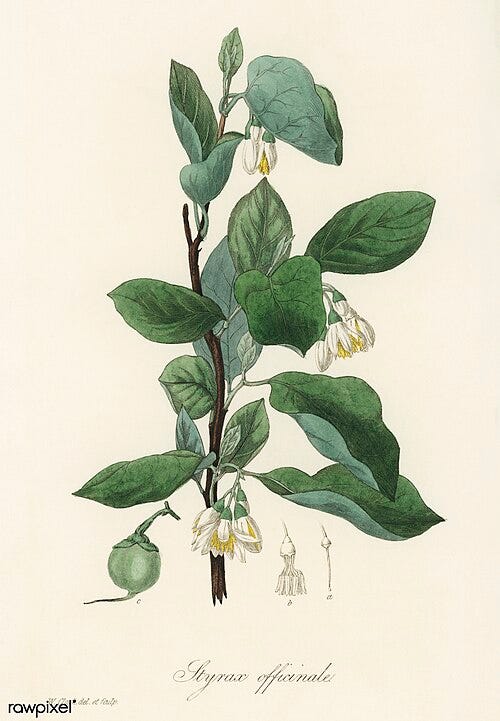
Styrax officinalis, from Medical Botany (1836) by John Stephenson and James Morss Churchill. Wikimedia Commons Image License
Calamus aromaticus, also known as Acorus calamus or sweet flag, has long been used for incense, sachet-making and perfumery purposes, the root’s fragrance often compared to cinnamon, and essential oil extracted from the root has fragrance similar to patchouli.
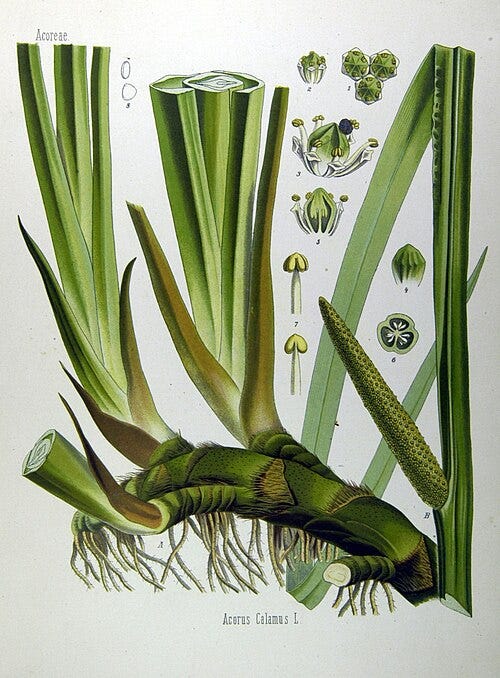
Acorus Calamus (1887) by Hermann Adolf Köhler (1834–1879) Wikimedia Commons Image License
Myrtus communis, or common myrtle is a flowering evergreen shrub with origins in the Mediterranean and Middle East, and was introduced into England by the 16th century. The scent of myrtle flowers is described as a sweet and spicy aroma, which may have led them to becoming the main ingredient in angel water, as a substitute for the fragrances typically derived from more expensive resins and roots. Angel water as a myrtle-based perfume begins to appear in Victorian era formulary books like this 1850 example.
EAU D’ ANGE. Flowering tops of myrtle 16 oz., rectified spirit a gallon ; digest and distil to dryness in a water-bath. Or dissolve ¼ oz essential oil of myrtle in 3 pints of rectified spirit. (p. 188)
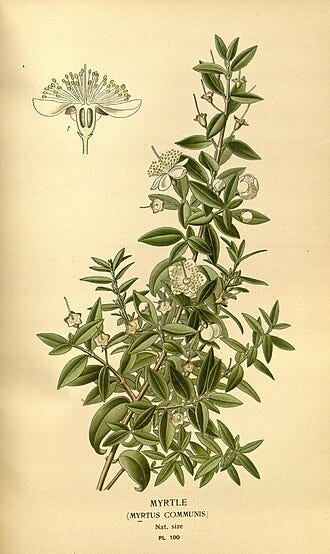
Myrtle (Myrtus Communis) (1897) Favourite Flowers of Garden and Greenhouse by Edward Step Wikimedia Commons Image License
This 1853 example of angel water is used for perfuming and cosmetic purposes, the ingredients adhering more to use of aromatic spices of earlier formulas.
- Eau D’ Ange — Pound in a mortar fifteen cloves and one pound of cinnamon ; put the whole into a quart of water, with four grains anise-seed ; let it stand over a charcoal fire twenty-fours ; then strain off the liquor and bottle it. The perfume is excellent, and will be useful for the hands, face, and hair. (p. 149)
Later Victorian perfume formulary books present angel water recipes as entirely myrtle based, like this 1866 formula from The Toilet and Cosmetic Arts in Ancient and Modern Times.
EAU D’ANGE ; ESPRIT D’ANGE ; EAU DE MYRTE. — Take of
Flowering tops of myrtle (bruised) 1 ½ to 2 pounds ;
Rectified spirit…………………. 7 pints ;
Water…………………………… 3 pints ;
digest a week, throw the whole into a still, add of
Common salt ………………… 2 pounds ;
and draw over 1 gallon. A delicate and refreshing perfume. It is often supported with a slight dash of some other scent. (p. 560)
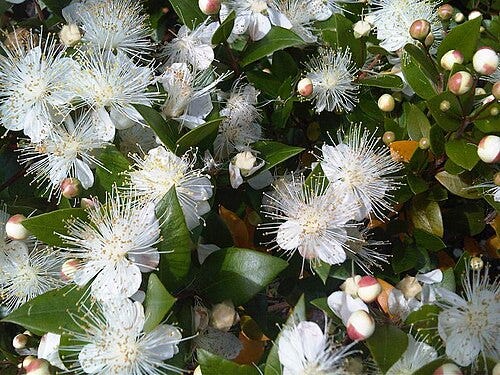
True Myrtle (Myrtales — Myrtus communis) flowers in Kew Gardens, London, England by Emőke Dénes Wikimedia Commons Image License
The same book also contains a formula for angel water more parallel to earlier blends of sweet resins and spices.
EAU D’ANGE DISTILLÉE. — Take of
Gum-benzoin (crushed small) …… 4 ounces ;
Liquid styrax ………………………… 2 ounces ;
Cloves (bruised) ……………………. ½ ounces ;
Calamus aromaticus (bruised) …. ½ ounces;
Cinnamon (bruised) ………………. ¼ ounce;
Coriander-seed (bruised.)…………. 1 drachm ;
Water …………………………………. 7 pints ;
Distil ½ gallon (p. 573)
Myrtle fragrance was also imitated, the 1891 edition of *Piesse’s Art of Perfumery *describes a formula for making a faux myrtle extract, the passage afterward also mentioning angel water as a myrtle based distillation.
A very fragrant otto may be procured by distilling the leaves of the common myrtle ; one hundredweight will yield about five ounces of the volatile oil. The demand for essence of myrtle being very limited, the odour as found in perfumer’s shops is very rarely a genuine article, but is imitated thus: —
Imitation Essence of Myrtle.
Extract of vanilla ………………… ½ pint
Extract of roses……………………. 1 pint
Extract fleur d’oranger ………….. ½ pint
Extract of tubereuse …………….. ½ pint
Extract of jasmine ……………….. 2 oz.
Mix, and allow to stand for a fortnight : it is then fit for bottling, and is a perfume that gives a great deal of satisfaction. Myrtle-flower water is sold in France under the name of eau d’ange and may be prepared like rose, elder, or other flower waters. (p. 159)
True Myrtle (Myrtus communis) Prof. Dr. Otto Wilhelm Thomé Flora von Deutschland Wikimedia Commons Image License
Angel water formulas are less present in published works on the subject of perfumery by the early 20th century, and by the 1930’s angel water was placed firmly under the heading of “old English” perfumery, a historic curiosity for contemporary formulators. Floral-forward blends for myrtle perfumes can be found in many perfumer’s books dating the Edwardian era, like this example of a myrtle perfume from 1915 remarkably similar to the Victorian formula for the imitation myrtle perfume.
MYRTLE (EXTRAIT DE MYRTHE).
Extract of jasmine ……………………. ½ pint.
Extract of orange flower……………… 1 qt.
Extract of rose …………………………. 2 qts.
Extract of tuberose……………………. 1 qt.
Tincture of vanilla……………………. 1 qt.
Oil of myrtle……………………………. 2 drams. (p. 197)
By the Edwardian era, angel water as a myrtle based formula seemed to win out as a concept of over spicier blends of cloves, sweet resins, cinnamon and other aromatics. The enduring popularity of myrtle notes in today’s perfumes are the remaining trace of this once complex herbal distillate that was ubiquitous in Victorian and Edwardian perfumery.
Notes:
- Benjamin is an alteration of benjoin, an early name for benzoin resin.
- Yellow sanders is an alternate name for yellow sandalwood.
- Orrice is a variant spelling of orris.
- Magisterial balm water recipe from the same book can be found here.
- An alembic is a vessel that can be used to make botanical distillates.
- Lute is an old term for French potter’s clay, used as a descriptor for any material used for creating a waterproof seal between two different surfaces.
If you love history, plants or the history of plants, consider supporting Plant Based Past by buying me a coffee!
For more vegan, vegetarian, and botanical histories, follow *Plant Based Past* on Medium.
You can sign up for email alerts to receive the next story when it becomes available, just by clicking the envelope icon. Receive a bonus historical recipe not seen in the publication, article recaps with free friend links to read, save or share once a month in your inbox by subscribing to Plant Based Past’s newsletter, Nutshell.
Next Week: 5 Vegan Fruit Preserve Recipes From History to Enjoy the Sweetness of Spring
메타데이터
- post_id
- c8a2b81bdab5
- slug
- victorian-and-edwardian-botanical-perfumery-series-angel-water-c8a2b81bdab5
- url
- https://medium.com/plant-based-past/victorian-and-edwardian-botanical-perfumery-series-angel-water-c8a2b81bdab5
- canonical_url
- https://medium.com/plant-based-past/victorian-and-edwardian-botanical-perfumery-series-angel-water-c8a2b81bdab5
- author_url
- https://medium.com/@plantbasedpast
- status
- ok
- fetched_at
- 2026-06-13 12:55:53