The Fake American Towns of World War II
The Fake American Towns of World War II
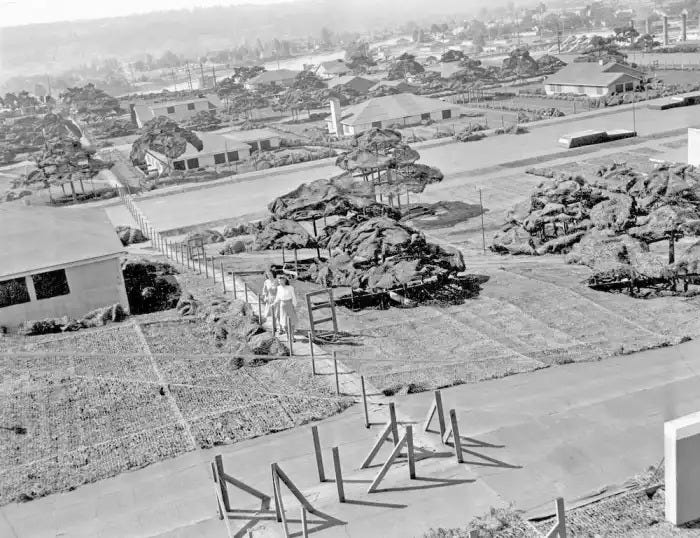
Camouflaging reached an entirely new level as completely fake residential neighbourhoods were created on the top of Boeing aircraft plants in which more than 30,000 men and women labored, constructing 300 bombers per month.
The Pearl Harbor Attack Shook Americans
From a distance, the scene resembled a typical American town.
Brightly painted homes with windows stood alongside trees that framed leafy suburbs.The streets were lined with buildings of various sizes and shapes, and there were sidewalks, detached garages, and empty lots.People could be seen walking, hanging clothes on clotheslines, and tending to their gardens.There were also women lounging in swimsuits around a community pool.It was a picture-perfect American neighborhood.
However, when viewed more closely, things did not look quite right.
The buildings were only four feet tall.The homes seemed too small to live in, and the streets were eerily quiet.The people walking on the streets also did not look like ordinary middle-class Americans.Something was clearly off.
This town was entirely fake.
During World War II, the surprise Japanese attack on Pearl Harbor deeply impacted the American people.Many of the country’s aircraft manufacturing plants were located on the West Coast and were at risk of being attacked by Japanese forces.Although Pearl Harbor was nearly 4,000 miles from Japan, the Japanese were able to cause great damage.This raised concerns among American leaders about the possibility of a Japanese assault on the West Coast, making the entire nation restless and anxious.
In response, the U.S.
military collaborated with Hollywood set designers to hide important wartime aircraft factories from enemy aircraft.This camouflage effort reached a new level as entire fake residential areas were built on top of Boeing plants.Thousands of men and women worked below, producing 300 bombers each month to support the war effort.

Following the attack on Pearl Harbor, the U.S. military built entire fake towns along the West Coast to hide its airplane factories from Japanese bombers.
The American West Coast Was Vulnerable to Japanese Attack
Within a month of the Pearl Harbor attack, the Japanese had captured Manila, Hong Kong, and Singapore.
Their rapid advances caused panic among Americans.The West Coast, where most aircraft factories were located, was particularly vulnerable to air raids.
General John Lesesne DeWitt, commander of the Fourth U.S.
Army and the Western Defense Command, asked Major John Francis Ohmer, Jr., to develop a plan to protect the factories.Born in Dayton, Ohio, in 1891, Ohmer was the son of a prominent inventor and manufacturer.He had served in World War I and later returned to his family’s business while maintaining his rank in the Engineer Officers Reserve Corps.His goal was to make the aircraft factories invisible from the air.
His connection to Hollywood provided access to John Stewart Detlie, a top set designer.
Ohmer asked Detlie to create realistic fake neighborhoods on top of the Boeing factories using Hollywood techniques.

Dozens of fake houses, schools, and public buildings were made of canvas. Thousands of shrubs and trees were created using burlap over chicken wire matrices.
Fake American Towns Were Created
Tens of fake homes, schools, and public buildings were made from canvas.
Thousands of shrubs and trees were constructed using burlap over chicken wire.Lawns were painted in various shades of green, some even appearing brown to give the look of dry grass.Fake streets, sidewalks, fences, cars, and garages were built over an area of 23 acres.Actors were hired to walk the streets, lounge by the pool, and wash clothes at public laundries.Every detail, from the color variations in the foliage to the simulated fireplugs through chimneys, was carefully crafted.
The houses were intentionally kept no taller than four feet because the camouflage was meant to be viewed from the air and later examined in photographs.
A bomber pilot would have less than two minutes to survey the area and would be looking straight down, so the height would not be visible.This was the largest scale of camouflage ever attempted, and Ohmer called the technique ‘visual disinformation.’

’Actors were engaged to ‘walk’ on the streets, ‘lounge’ in the swimming pools, and even wash clothes in public laundries
The Towns Were Dismantled After the War
By 1944, the Japanese were on the defensive, and the risk of an attack had decreased.
However, it wasn’t until June 1945, when the Japanese formally surrendered to the Allies, that the secrecy surrounding the fake towns was officially lifted.Boeing released details about the camouflage efforts.
A month later, the Army Corps of Engineers announced contracts had been given to civilian firms to dismantle the town.
The entire project had cost over $2 million.By the end of 1946, the last remnants of the fake towns were removed.
Though the towns no longer exist, they remain a remarkable feat in military history.
The scale and complexity of the operation have inspired generations of military planners.The photographs of these towns serve as a testament to the skill and creativity of the Hollywood technicians and craftsmen who helped protect America from potential destruction.

To this day, the size and scale of the operation have amazed countless generations of military planners worldwide.
Follow me for more such interesting Stories :)
메타데이터
- post_id
- c8a831ef0a23
- slug
- the-fake-american-towns-of-world-war-ii-c8a831ef0a23
- url
- https://medium.com/@pagesofwisdom/the-fake-american-towns-of-world-war-ii-c8a831ef0a23
- canonical_url
- https://medium.com/@pagesofwisdom/the-fake-american-towns-of-world-war-ii-c8a831ef0a23
- author_url
- https://medium.com/@pagesofwisdom
- status
- ok
- fetched_at
- 2026-07-13 06:23:13