Sodium Replacing Lithium in the Battery Industry
MULTIPOLAR LENS JOURNAL
Sodium Replacing Lithium in the Battery Industry
MULTIPOLAR LENS JOURNAL
Author : Gayathri Nair C [ZHAERYN-MULTIPOLAR LENS]
Preface
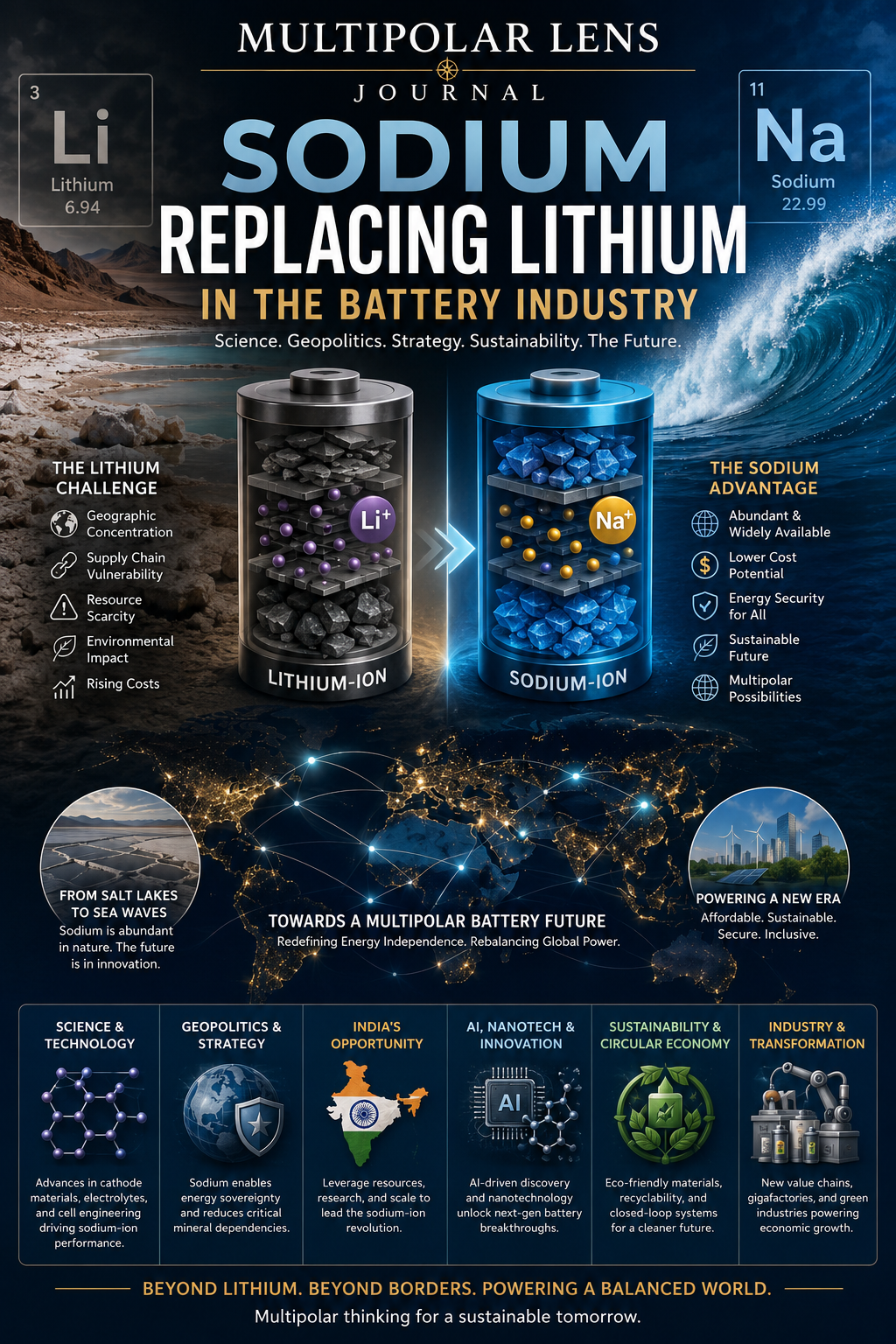
The global energy transition has accelerated the demand for advanced battery technologies at an unprecedented scale. For more than three decades, lithium-ion batteries dominated the landscape of portable electronics, electric vehicles, renewable energy storage systems, and smart infrastructure. However, the increasing geopolitical pressure on lithium resources, environmental concerns surrounding extraction, supply-chain instability, and rising production costs have triggered an international search for alternative electrochemical storage systems.
Among the emerging candidates, sodium-ion batteries have become one of the most promising technological alternatives. Sodium, being one of the most abundant elements on Earth, offers the possibility of large-scale, low-cost, and geographically diversified battery manufacturing. While lithium remains highly effective in terms of energy density and commercialization maturity, sodium-based systems are gradually redefining the future trajectory of energy storage.
This journal explores the transition from lithium dependency toward sodium-centered battery ecosystems through scientific, industrial, environmental, economic, geopolitical, and technological perspectives. Using the framework of the Multipolar Lens Journal, the study investigates how multiple forces — science, policy, sustainability, economics, innovation, and international power structures — intersect to reshape the future of global energy systems.
Chapter 1
The Rise of the Battery Civilization
Human civilization has always been defined by its relationship with energy. From wood combustion and coal-driven industrialization to oil-powered globalization, every era has depended upon a dominant energy system. The 21st century marks the emergence of an electrified civilization where batteries function as the foundational infrastructure of modern technological society.
Smartphones, electric vehicles, satellites, AI infrastructure, drones, renewable energy grids, and military systems all depend heavily upon energy storage technologies. The transition toward carbon neutrality has further intensified the importance of battery manufacturing.
The rise of lithium-ion batteries revolutionized modern electronics because of several advantages:
- High energy density
- Long cycle life
- Lightweight electrochemical structure
- Fast charging capabilities
- Commercial scalability
Lithium-ion technology became the backbone of:
- Electric mobility
- Consumer electronics
- Grid-scale renewable storage
- Aerospace applications
- Smart infrastructure systems
However, the rapid growth of lithium demand created severe structural vulnerabilities:
- Concentration of lithium reserves in limited regions
- Ecological destruction caused by mining
- Water-intensive extraction methods
- Supply-chain monopolization
- Rising costs of rare materials
- Geopolitical tensions surrounding critical minerals
These challenges opened the pathway toward sodium-ion research and commercialization.
Chapter 2
Understanding Sodium as an Energy Material
Sodium is the sixth most abundant element on Earth and exists extensively in seawater, mineral deposits, and natural salts. Unlike lithium, sodium resources are geographically widespread, making the material less vulnerable to geopolitical concentration.
Electrochemical Characteristics of Sodium
Sodium belongs to the alkali metal family, similar to lithium. Both elements possess a single valence electron, enabling ion movement during charge and discharge cycles.
The larger ionic radius of sodium historically created challenges for electrode design because sodium ions do not move as easily through conventional battery materials. Yet recent advances in nanomaterials, carbon structures, layered oxides, and Prussian blue analogues have significantly improved sodium-ion performance.
Chapter 3
The Scientific Foundations of Sodium-Ion Batteries
Sodium-ion batteries operate through principles similar to lithium-ion systems. During charging and discharging, sodium ions move between the cathode and anode through an electrolyte.
Core Components
Cathode Materials
Researchers are exploring several cathode chemistries including:
- Layered transition metal oxides
- Polyanionic compounds
- Prussian blue analogues
- NASICON structures
These materials influence:
- Voltage stability
- Capacity retention
- Thermal performance
- Cycle durability
Anode Materials
Graphite, commonly used in lithium-ion batteries, performs poorly with sodium because sodium ions cannot intercalate efficiently.
Alternative sodium-ion anodes include:
- Hard carbon
- Biomass-derived carbon
- Nanostructured carbon composites
- Alloy-based materials
Hard carbon has emerged as one of the most commercially viable sodium-ion anode materials.
Electrolytes
Electrolyte research focuses on:
- Improved ionic conductivity
- Enhanced thermal safety
- Low-temperature performance
- Long-term electrochemical stability
Scientists are also developing:
- Solid-state sodium batteries
- Gel polymer electrolytes
- Aqueous sodium systems
Chapter 4
Why the World is Looking Beyond Lithium
The battery revolution has created enormous pressure on lithium supply chains.
Lithium Resource Concentration
A significant percentage of global lithium reserves are concentrated in:
- Chile
- Argentina
- Bolivia
- Australia
- China
This concentration creates geopolitical dependency and strategic vulnerability.
Environmental Concerns
Lithium extraction often requires massive quantities of water. In arid regions, this leads to:
- Groundwater depletion
- Ecosystem imbalance
- Agricultural disruption
- Indigenous community displacement
The environmental cost of lithium mining has become a major ethical issue in the global green transition.
Economic Pressures
Rapid electric vehicle expansion has increased lithium demand dramatically, causing:
- Price volatility
- Supply shortages
- Manufacturing instability
- Increased battery costs
Sodium offers a pathway toward reducing dependence on expensive critical minerals.
Chapter 5
Industrial Transformation Through Sodium Batteries
Sodium-ion technology is increasingly attracting investment from:
- Automotive industries
- Renewable energy companies
- Grid-storage manufacturers
- Defense sectors
- Semiconductor and AI infrastructure industries
Applications of Sodium-Ion Batteries
Grid Energy Storage
Sodium-ion batteries are highly suitable for stationary storage systems because cost efficiency matters more than energy density in such applications.
Electric Mobility
Although sodium batteries currently possess lower energy density than lithium systems, they are increasingly viable for:
- Urban mobility
- Electric scooters
- Public transportation
- Budget electric vehicles
Renewable Energy Integration
Solar and wind energy systems require scalable storage technologies. Sodium batteries provide:
- Lower manufacturing cost
- Improved supply security
- Better sustainability potential
Rural Electrification
Developing countries can benefit significantly from sodium-based storage because of affordability and resource accessibility.
Chapter 6
China and the Global Sodium Race
China has emerged as one of the leading nations in sodium-ion battery commercialization.
Chinese companies and research institutions have accelerated:
- Large-scale sodium battery manufacturing
- Sodium cathode innovation
- Industrial pilot projects
- Grid-storage deployment
China’s strategy reflects broader geopolitical objectives:
- Reducing dependence on imported lithium
- Securing technological leadership
- Dominating next-generation battery supply chains
Other countries including India, Japan, the United States, Germany, and South Korea are also expanding sodium-ion research.
Chapter 7
India’s Opportunity in Sodium Battery Development
India possesses a unique strategic opportunity in sodium-ion technology.
Why Sodium Matters for India
India faces several lithium-related challenges:
- Limited domestic lithium reserves
- Rising electric vehicle demand
- Dependence on battery imports
- Expanding renewable energy targets
Sodium-ion batteries align with India’s developmental priorities because sodium resources are widely available.
Potential Advantages for India
- Reduced import dependency
- Domestic manufacturing growth
- Affordable battery production
- Rural energy access
- Strengthened renewable energy infrastructure
Indian institutions are actively researching:
- Hard carbon anodes from agricultural waste
- Biomass-derived battery materials
- Sustainable battery recycling
- Indigenous sodium-ion cell development
The convergence of renewable energy, AI-driven smart grids, and affordable storage systems could position India as a major player in future battery ecosystems.
Chapter 8
Environmental Sustainability and Circular Economy
The environmental sustainability of battery systems extends beyond extraction. It includes:
- Manufacturing emissions
- Recycling efficiency
- Toxicity levels
- Resource renewability
- End-of-life management
Advantages of Sodium-Based Systems
Abundance
Sodium exists in immense quantities globally, reducing resource scarcity.
Lower Ecological Pressure
Compared to lithium extraction, sodium sourcing may create less environmental strain.
Potential for Sustainable Recycling
Researchers are developing advanced recycling systems for sodium-ion batteries that may lower future waste burdens.
Challenges Still Remaining
Despite its promise, sodium technology still faces:
- Lower energy density
- Commercial scaling difficulties
- Material optimization challenges
- Infrastructure adaptation costs
The transition toward sodium will likely complement rather than immediately replace lithium systems.
Chapter 9
Nanotechnology and the Future of Sodium Batteries
Nanotechnology plays a critical role in improving sodium-ion battery performance.
Researchers are using nanomaterials to:
- Increase electrode surface area
- Improve ionic diffusion
- Enhance conductivity
- Reduce degradation
- Improve charging speed
Emerging Nanomaterial Approaches
Graphene Composites
Graphene-enhanced electrodes improve conductivity and mechanical stability.
Carbon Nanotubes
Carbon nanotubes enable efficient electron transport pathways.
Biomass-Derived Nanocarbons
Agricultural waste materials are increasingly transformed into advanced porous carbon structures for sustainable anode production.
Solid-State Nanostructures
Solid-state sodium batteries may significantly improve:
- Safety
- Energy stability
- Thermal resistance
- Battery lifespan
The integration of AI-driven materials discovery and computational physics is accelerating sodium battery innovation.
Chapter 10
AI, Data Science, and Battery Intelligence
Artificial intelligence is transforming battery research.
AI systems are increasingly used for:
- Predicting battery degradation
- Optimizing charging cycles
- Discovering new materials
- Simulating electrochemical behavior
- Enhancing manufacturing efficiency
Machine learning models can analyze massive datasets from:
- Electrochemical experiments
- Material simulations
- Industrial battery operations
- Smart energy grids
The convergence of sodium-ion systems with AI-driven battery management may accelerate commercialization significantly.
Chapter 11
Multipolar Geopolitics of Energy Storage
The battery industry is no longer merely technological; it has become geopolitical.
The transition toward clean energy is reshaping global power structures.
Multipolar Energy Competition
Major powers are competing for dominance in:
- Critical minerals
- Semiconductor manufacturing
- Battery technologies
- AI-driven industrial systems
- Renewable infrastructure
Sodium-ion technology could decentralize battery production by reducing reliance on geographically concentrated lithium reserves.
This may create:
- More distributed manufacturing ecosystems
- Greater energy sovereignty for developing nations
- Reduced geopolitical dependency
- More affordable electrification pathways
The rise of sodium technology reflects the emergence of a multipolar technological order where no single resource monopoly fully controls global energy systems.
Chapter 12
Can Sodium Fully Replace Lithium?
The future of battery technology will likely involve coexistence rather than total replacement.
Areas Where Lithium May Continue Dominating
- High-performance electric vehicles
- Aerospace applications
- Premium consumer electronics
- Ultra-high energy density systems
Areas Where Sodium Could Dominate
- Grid storage
- Affordable EV markets
- Rural electrification
- Renewable backup systems
- Low-cost energy infrastructure
The battery ecosystem of the future may become diversified:
- Lithium-ion for high-density applications
- Sodium-ion for affordable scalability
- Solid-state systems for advanced mobility
- Hydrogen storage for industrial energy systems
Chapter 13
Ethical Questions in the Green Transition
The green transition is often portrayed as universally sustainable, yet ethical contradictions remain.
Important questions include:
- Who controls critical resources?
- Which communities bear extraction costs?
- Can renewable technologies become truly equitable?
- Will developing countries remain dependent on technological monopolies?
Sodium-ion systems may contribute toward a more democratized energy future by reducing mineral concentration and lowering entry barriers for emerging economies.
However, technological transitions alone cannot solve structural inequality without ethical governance and sustainable policy frameworks.
Chapter 14
The Future Landscape of Battery Civilization
The coming decades may witness:
- AI-managed smart grids
- Decentralized renewable systems
- Solid-state battery revolutions
- Sustainable battery recycling ecosystems
- Intelligent urban energy infrastructure
Sodium-ion technology represents more than a scientific innovation.
It symbolizes:
- Resource democratization
- Industrial decentralization
- Sustainable technological adaptation
- Multipolar energy transformation
The future energy civilization may not depend upon a single dominant technology but rather an interconnected ecosystem of complementary systems.
Conclusion
The rise of sodium-ion batteries marks a critical turning point in the global energy transition. While lithium-ion systems transformed modern civilization, their limitations have exposed the vulnerabilities of resource concentration, ecological pressure, and geopolitical dependency.
Sodium offers a compelling alternative rooted in abundance, affordability, and scalability. Although challenges remain in energy density and commercialization maturity, advances in nanotechnology, AI-driven materials science, and industrial innovation are rapidly improving sodium-ion performance.
From a Multipolar Lens perspective, the transition toward sodium-based systems represents more than an industrial evolution. It reflects the restructuring of global technological power, sustainability ethics, and economic sovereignty.
The future battery landscape will likely become increasingly diversified, intelligent, and decentralized. In this emerging world, sodium-ion batteries may serve as one of the foundational pillars of equitable and sustainable electrification.
메타데이터
- post_id
- c8b8cc0a92e0
- slug
- sodium-replacing-lithium-in-the-battery-industry-c8b8cc0a92e0
- url
- https://medium.com/@futureoffuture/sodium-replacing-lithium-in-the-battery-industry-c8b8cc0a92e0
- canonical_url
- https://medium.com/@futureoffuture/sodium-replacing-lithium-in-the-battery-industry-c8b8cc0a92e0
- author_url
- https://medium.com/@futureoffuture
- status
- ok
- fetched_at
- 2026-06-09 15:37:30