Welcome to X: How Elon Musk Walked Into Twitter with a Sink and Walked Out with a Dumpster Fire
A documented autopsy of what happens when the world’s richest man mistakes a social media platform for a personal megaphone
When a billionaire buys a town square and watches it burn
Welcome to X: How Elon Musk Walked Into Twitter with a Sink and Walked Out with a Dumpster Fire
A documented autopsy of what happens when the world’s richest man mistakes a social media platform for a personal megaphone
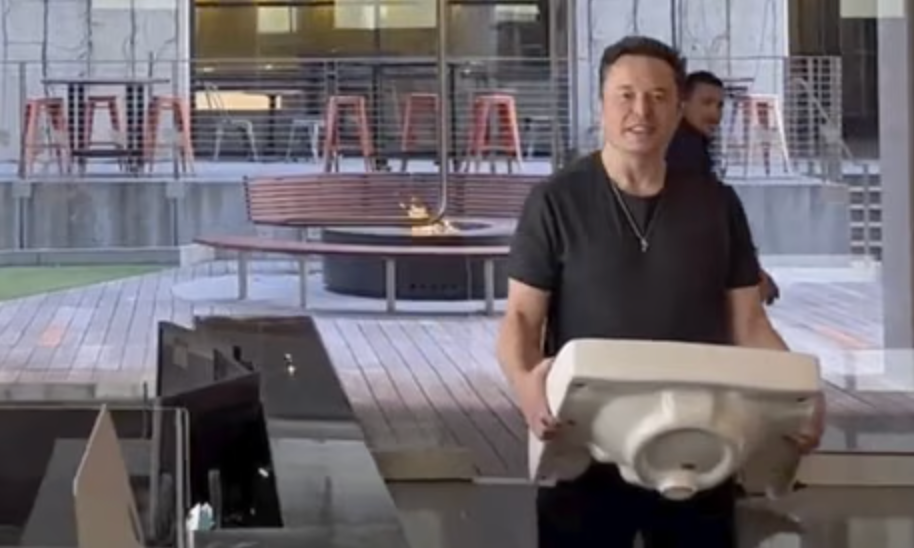
Image generated by Perplexity AI (2026)
On October 27, 2022, Elon Musk walked into Twitter headquarters carrying an actual kitchen sink — a prop meant to signal his grand entrance with a pun (“let that sink in”) — and immediately fired the CEO, the CFO, and the head of legal.
In any other context, a man showing up to work with a sink and summarily sacking the leadership team would be grounds for a psychiatric hold. At Twitter, it was apparently a Tuesday.
What followed is one of the most extensively documented corporate demolitions in recent history — not by critics, not by competitors, but by peer-reviewed journals, federal filings, financial disclosures, and the platform’s own collapsing revenue statements.
This isn’t a hit piece built on opinion. This is a story built on receipts.
Step One: Fire Everyone Who Knows What They’re Doing
Within days of taking control, Musk laid off approximately 50% of the company’s 7,500 employees in a single sweep — without the legally required 60-day notice, which promptly triggered a federal lawsuit under the Worker Adjustment and Retraining Notification Act.
The chief privacy officer, chief compliance officer, and chief information security officer all resigned within the first week.
The entire curation team — roughly 150 people responsible for flagging misinformation and contextualizing trending events — was eliminated on day one.
By February 2023, Engadget reported that roughly 80% of Twitter’s full-time workforce had either been laid off or quit.
The Trust and Safety team — the people tasked with keeping child exploitation material, terrorist content, and coordinated harassment off the platform — had been reduced to fewer than 20 full-time employees.
Twenty. For a platform serving hundreds of millions of users globally.
Musk’s stated rationale was simple:
the company was hemorrhaging money, and he would fix it by cutting costs.
What he cut, among other things, was the entire institutional infrastructure that made the platform functional and defensible to advertisers.
Step Two: Watch the Money Leave
Here’s where the numbers get uncomfortable.
Before Musk’s acquisition, Twitter generated over $5 billion in revenue annually and was on an internal trajectory toward $7.5 billion by end of 2023.
What actually happened: ad revenue cratered. Musk himself acknowledged that U.S. advertising revenue dropped 60% under his ownership.
Globally, ad spending on the platform declined approximately 54% year-over-year by 2023, according to Insider Intelligence data.
Apple, Disney, IBM, Warner Bros., Comcast, Paramount, and the European Commission all pulled their ad spending. A Kantar Group marketing survey found the platform’s trust score among advertisers dropped from 28% in 2021 to just 16% in 2023.
In March 2024, Musk himself acknowledged the company was valued at approximately $20 billion — less than half the $44 billion he paid for it. Fidelity reported its investment had lost approximately 79% of its value by mid-2024, based on the purchase price.
Rather than course-correct, Musk’s response to fleeing advertisers was to tell them, at a public event in November 2023, to “go f*** yourself.” He then sued the Global Alliance for Responsible Media — an industry coalition focused on brand safety — effectively shutting it down.
He later expanded that lawsuit to include Nestlé, Lego, Colgate-Palmolive, and Tyson Foods, among others. His stated position: “We tried peace for two years. Now it is war.”
This is, to be precise, the business strategy of a man who sets his own house on fire and then sues the neighbors for calling the fire department.
Step Three: Reinstate Everyone Who Was Banned for a Reason
Among Musk’s early moves was a mass amnesty for suspended accounts.
Accounts banned for violating Twitter’s policies on abusive behavior, inciting violence, and spreading extremist content were reinstated en masse.
According to NBC News, this included hundreds of far-right activists, white supremacists, and QAnon adherents. Alex Jones returned.
Andrew Tate returned. Nick Fuentes returned. Tommy Robinson — the UK anti-immigrant activist — returned.
The rationale offered was “free speech.” The documented outcome was a 50% increase in hate speech.
Researchers at UC Berkeley, UCLA, and USC analyzed approximately 4.7 million English-language posts on the platform from early 2022 through June 2023, published in the peer-reviewed journal PLOS One.
Their findings: the weekly rate of hate speech was approximately 50% higher than in the months before Musk’s purchase, with measurable increases in racist, homophobic, and transphobic content.
The average number of “likes” on hate posts increased by 70%, indicating not just more hate content, but greater audience engagement with it.
When X threatened to sue the Center for Countering Digital Hate for publishing similar research, the organization’s CEO told the Associated Press it had never received such a response from any major tech company in its history — despite having published critical reports on Facebook, TikTok, and others.
X’s response to the research was to sue the researchers. The scientific response to X’s response was to continue publishing in peer-reviewed journals.
Step Four: Flood the Zone With Your Own Posts
Musk didn’t just own the platform. He became its most algorithmically promoted user — by design.
Reporting documented that after Musk’s personal tweets failed to outperform a competitor’s during the 2023 Super Bowl, engineers were pulled in at 2 a.m. and tasked as a “high urgency” matter with fixing his engagement numbers.
The result was a bespoke algorithmic system ensuring Musk’s posts received unprecedented promotion across the platform’s entire user base.
When Fortune set up twelve test accounts to measure his prevalence, Musk’s posts appeared in approximately 90% of sessions — and clicking “not interested in Elon Musk” caused his posts to more than double in frequency.
For context: that is not how “not interested” is supposed to work.
The Real-World Consequences
The downstream effects of this experiment have been neither theoretical nor contained.
In the summer of 2024, following a knife attack in Southport, England that killed three young girls, a Twitter account with a history of anti-immigrant and Islamophobic content falsely identified the attacker as a Muslim immigrant.
By the time the killer was confirmed to be a non-Muslim British citizen born to parents from Rwanda, the misinformation had already ignited riots across the United Kingdom.
Mosques were attacked. Hotels housing asylum seekers were stormed. False or unverified claims about the Southport attacker received at least 155 million impressions in the days following the attack.
Tommy Robinson — who Musk had reinstated — used the moment to build a far-right movement that organized a major rally in London shortly thereafter.
Musk’s response to the unfolding UK riots was to post: “Civil war is inevitable.”
He posted this on the platform he owned.
The Scorecard, Three Years In
Since October 2022:
- **80% of Twitter’s workforce gone**, including the teams responsible for safety, security, and compliance.
- **Ad revenue down approximately 54–60%**, with global ad revenue collapsing from over $4.5 billion in 2022 to an estimated $2 billion in 2024.
- **Platform valuation declined by nearly 80%** from the $44 billion purchase price.
- **Hate speech up 50%**, with increased engagement metrics suggesting broader audience reach, per PLOS One.
- **Researchers cut off from API access** when academic data licensing was terminated and replaced with unaffordable payment tiers — arguably ensuring that independent verification of these trends becomes increasingly difficult going forward.
Musk entered Twitter carrying a sink and a promise to save civilization from a “nihilistic mind virus.”
What followed was a documented collapse in revenue, a documented rise in hate speech, a documented exodus of users and advertisers, and a documented expansion of extremist content that contributed to real-world violence in at least one instance.
The sink, for the record, now sits in the lobby of X headquarters. No one has confirmed whether it drains properly.
메타데이터
- post_id
- c8d60f98e769
- slug
- welcome-to-x-how-elon-musk-walked-into-twitter-with-a-sink-and-walked-out-with-a-dumpster-fire-c8d60f98e769
- url
- https://medium.com/write-a-catalyst/welcome-to-x-how-elon-musk-walked-into-twitter-with-a-sink-and-walked-out-with-a-dumpster-fire-c8d60f98e769
- canonical_url
- https://medium.com/write-a-catalyst/welcome-to-x-how-elon-musk-walked-into-twitter-with-a-sink-and-walked-out-with-a-dumpster-fire-c8d60f98e769
- author_url
- https://medium.com/@jusbouey
- status
- ok
- fetched_at
- 2026-06-09 15:37:30