Hybrid Isn’t a Stepping Stone Anymore: Designing for Workload Portability in 2026
The old question was “which cloud?” The question that matters now is “how easily can this workload move?”
Hybrid Isn’t a Stepping Stone Anymore: Designing for Workload Portability in 2026
The old question was “which cloud?” The question that matters now is “how easily can this workload move?”
For most of the last decade, hybrid cloud carried an unspoken asterisk. It was treated as a waypoint — something enterprises passed through on the way to “real cloud,” a polite label for unfinished migrations and legacy systems nobody had gotten around to retiring yet. The implicit assumption was that maturity meant eventually landing everything in a single public cloud.
That assumption hasn’t just aged poorly. It’s been quietly retired.
By 2026, the enterprises pulling ahead aren’t the ones who bet correctly on a single cloud provider years ago. They’re the ones who minimized the friction of moving between environments — because they built for a world where “where a workload runs” is a decision made repeatedly, not once. Hybrid isn’t a compromise anymore. It’s an operating model.
If you’re leading migration strategy, platform engineering, or governance for an enterprise right now, this shift changes what “done” looks like. Here’s what’s actually driving it, and what a portability-first architecture needs to include.
Why the Destination Model Broke
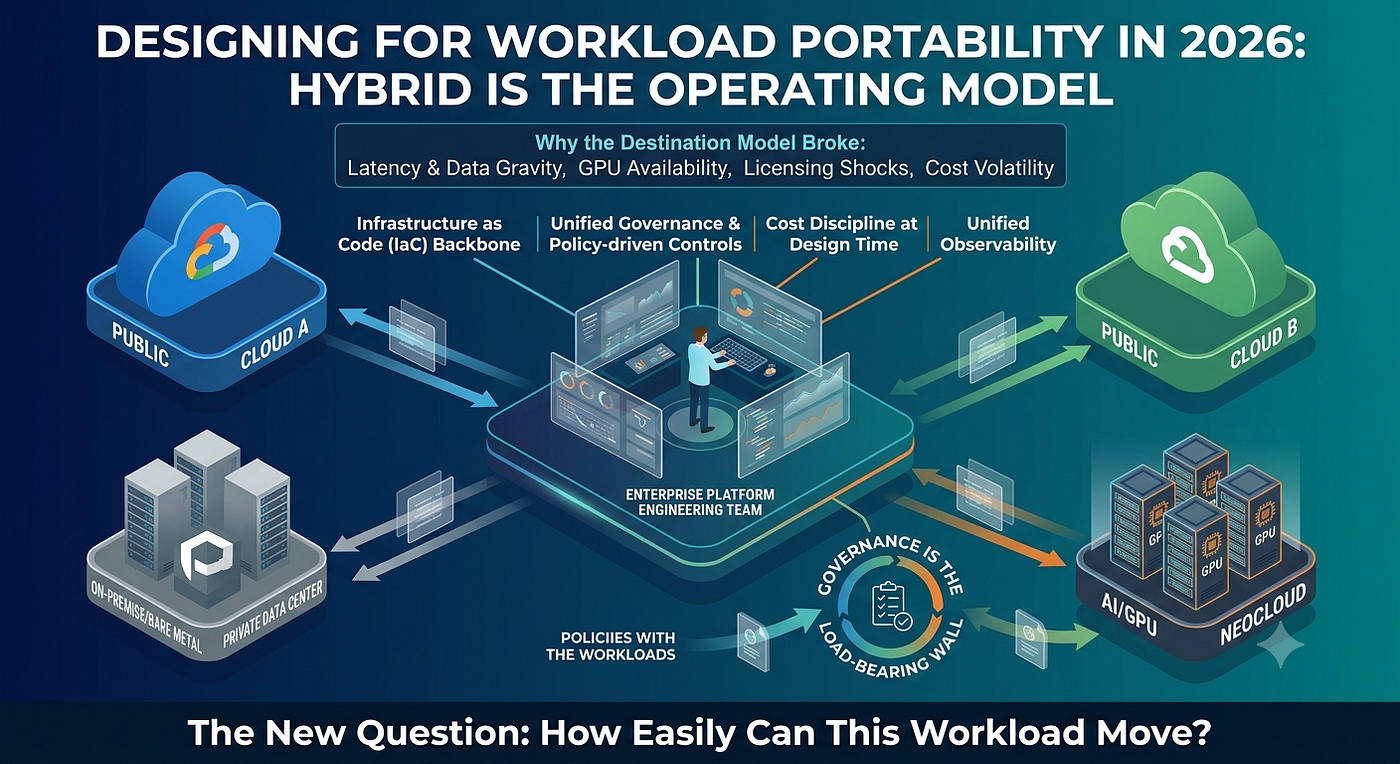
The “pick a cloud and migrate everything” strategy was built on an assumption that’s no longer holding: that one environment could stay optimal for every workload over time. In practice, several forces are now pulling in different directions at once:
Latency, data gravity, and sovereignty requirements diverge by workload. A healthcare claims-processing pipeline in a HIPAA-regulated environment has fundamentally different data residency and access-control needs than a public-facing marketing site — and those needs shift as regulations evolve, not just as the business grows.
GPU availability has become its own constraint. With AI infrastructure spending climbing into the trillions globally and hyperscalers racing to expand capacity, GPU access is no longer guaranteed on-demand in any single provider. Enterprises are increasingly forced to plan for multiple sourcing paths — public cloud, reserved capacity, bare metal, or neoclouds — for AI-heavy workloads.
Licensing shocks reset the calculus overnight. The VMware/Broadcom licensing disruption pushed a wave of enterprises into re-evaluating private cloud architectures they hadn’t touched in years, almost entirely for reasons that had nothing to do with technical merit.
Cost volatility punishes rigid architectures. Rising energy costs, GPU scarcity premiums, and inflated storage/network I/O charges for AI workloads mean that the “right” placement for a workload today may not be the right placement in six months.
Put together, these forces mean workload placement has stopped being a one-time architectural decision and started being an ongoing operating discipline. That’s the real definition of the 2026 hybrid shift: not “we run in two places,” but “we can move without disruption when the economics, risk profile, or performance requirements change.”
What Changed Isn’t the Idea — It’s the Tooling
Hybrid and multi-cloud aren’t new concepts. What’s different now is that the tooling finally supports fluid movement instead of forcing brittle, manual reconciliation between environments.
A few years ago, “hybrid” often meant stitching environments together with custom scripts, one-off integrations, and tribal knowledge about which system owned which source of truth. That approach doesn’t survive contact with modern compliance requirements or AI workload scale. What’s replacing it:
- Infrastructure as Code as the backbone, not an optional layer — standardizing deployment patterns across cloud, hybrid, and AI environments so a workload’s definition isn’t tied to a single provider’s console.
- Policy-driven, API-orchestrated controls that treat infrastructure as genuinely interchangeable, rather than assuming a workload will live in one place forever.
- Unified governance and observability across platforms, instead of a separate security and monitoring stack per environment — a distributed architecture with consistent controls, not a fragmented one.
- Platform engineering as an operating model, providing internal teams with self-service, golden-path patterns and automated guardrails so portability doesn’t depend on a handful of specialists knowing where the landmines are.
This is the difference between hybrid-by-accident and hybrid-by-design. The former accumulates technical debt every time a workload has to move. The latter treats movement as a routine, low-drama event.
Governance Is the Load-Bearing Wall
Here’s the part that doesn’t get enough attention in most portability conversations: none of this works without governance built into the architecture from the start, not bolted on after the fact.
As AI agents, service accounts, and automated pipelines proliferate across environments, non-human identities are becoming a primary risk vector — and most organizations still don’t have a governance model that accounts for them. That gap matters more, not less, in a portable architecture, because every additional environment a workload can move to is another place where access control, audit logging, and compliance posture have to travel with it consistently.
This is where the Data Owner / Steward / Architect / Governor role framework earns its keep. In a single-cloud world, you could get away with informal ownership boundaries because everything sat in one place with one provider’s native controls. In a portable, multi-environment world, ambiguous ownership is exactly what breaks compliance during a workload migration — nobody notices that a policy didn’t travel with the data until an audit or an incident surfaces it.
Practically, that means:
- Policy-as-code (OPA/Rego, admission controllers) enforced consistently regardless of which environment a workload currently occupies
- Compliance and data models tied to the workload definition itself, not to the environment it happens to be running in today
- Automated guardrails that block a migration if governance metadata doesn’t validate in the destination environment, rather than relying on a manual checklist
Regulatory pressure is accelerating this requirement, not easing it. New AI-specific compliance obligations taking effect in the EU and in several U.S. states are layering onto existing frameworks, which means the audit trail for “where did this workload run, and who could access it, at every point in time” is becoming a hard requirement rather than a nice-to-have.
Cost Discipline Moves to Design Time
The FinOps model built for elastic, bursty cloud workloads is straining under sustained GPU pipelines and steady LLM inference demand — usage has scaled faster than per-unit costs have declined, and the result is enterprise AI bills reaching well into the tens of millions monthly at scale. That’s forced a shift in when cost decisions actually happen.
Cost optimization used to live in monthly dashboard reviews — a retrospective exercise. In a portability-first architecture, cost has to be a design-time input: choosing between public cloud, reserved capacity, bare metal, or on-premises isn’t just a technology decision anymore, it’s a cost-governance decision made at the point of architecture, not after the invoice arrives.
For migration teams, this means workload portability and FinOps discipline are effectively the same conversation now. A workload that can’t move cheaply and safely to a lower-cost environment when GPU pricing spikes isn’t actually portable — it just looks portable on an architecture diagram.
A Practical Portability Readiness Checklist
If you’re assessing how ready your current environment actually is for workload portability — rather than just hybrid-in-name — a few concrete questions cut through the noise:
- Can a workload’s governance metadata (ownership, classification, compliance tags) move with it automatically, or does someone have to manually recreate policy in the destination environment?
- Is your Infrastructure as Code environment-agnostic, or does it contain provider-specific assumptions that would need rewriting for a migration?
- Do you have real cost modeling at the workload level — not just aggregate cloud spend — so a placement decision can be justified with numbers rather than instinct?
- Is observability consistent across environments, or does moving a workload mean losing visibility until a new monitoring stack catches up?
- Have you actually tested a non-trivial workload migration recently, or is “portability” a property you’re assuming rather than one you’ve verified?
Most organizations can answer “yes” to one or two of these. Very few can answer “yes” to all five — and that gap is a reasonable proxy for how much technical debt is hiding behind a hybrid cloud diagram that looks clean on paper.
The Real Shift
The organizations gaining ground in 2026 aren’t the ones that guessed right about which cloud to bet on. They’re the ones that stopped treating cloud placement as a single decision and started treating it as a capability — something the architecture supports repeatedly, cheaply, and safely, as constraints change.
That’s a harder thing to build than a migration plan with an end date. It requires governance, cost modeling, and infrastructure automation to be part of the same conversation from day one, rather than three separate workstreams that get reconciled under deadline pressure. But it’s also the difference between an organization that adapts when the next licensing shock, GPU shortage, or compliance mandate hits, and one that’s forced into another multi-year migration project to catch up.
Cloud stopped being a destination. The sooner the architecture reflects that, the less disruptive the next transition will be.
메타데이터
- post_id
- c8d6fdceddd4
- slug
- hybrid-isnt-a-stepping-stone-anymore-designing-for-workload-portability-in-2026-c8d6fdceddd4
- url
- https://medium.com/@glenrmathew/hybrid-isnt-a-stepping-stone-anymore-designing-for-workload-portability-in-2026-c8d6fdceddd4
- canonical_url
- https://medium.com/@glenrmathew/hybrid-isnt-a-stepping-stone-anymore-designing-for-workload-portability-in-2026-c8d6fdceddd4
- author_url
- https://medium.com/@glenrmathew
- status
- ok
- fetched_at
- 2026-07-13 06:23:13





