Deciphering FILM : KAI
“[I wanted to show] that I can do anything and that anything is possible. It’s the connection between teleportation and the limitless…
Deciphering FILM : KAI
“[I wanted to show] that I can do anything and that anything is possible. It’s the connection between teleportation and the limitless possibilities that I have as an artist, as Kai. I wanted to showcase that all of these different sides are Kai, are myself.” — Teen Vogue, December 2020

On November 26, 2020, SM Entertainment released *FILM : KAI. The nearly 7-minute film teased every song on KAI’s debut solo album KAI (开)*, scheduled for release on November 30th.
FILM : KAI is divided into six scenes, each showcasing the six songs on his EP. Therefore, it meets the definition of a visual album — a concept whereby each song on an album is accompanied by a music video, and either these videos standalone or are melded into a larger film.
In recent years, SM has been creating more visual content to accompany album releases beyond the typical concept teasers and music videos. An early iteration of this effort was (fx)’s *Pink Tape Film* from 2013, a two-minute film that was the brainchild of Min Hee-jin, a former visual director at SM. Looking back at that film now, it functions much like the mood samplers SM has employed lately for its artists.
Mood samplers are meant to capture an album’s mood and concept. A b-side also plays in the background, offering the first preview of any song from the album. In 2020, SM went a step further with NCT 127’s album Neozone, releasing one-and-a-half minute “track videos” for each song.


JOY 조이 ‘안녕 (Hello)’ Mood Sampler #2 / NCT 127 「Neo Zone」 ‘우산 (Love Song)’ Track Video
With SM incorporating more visual elements for their releases, FILM : KAI can be seen as a natural progression of that effort, but taken up a notch.
Visual albums have been around since the 1960s but came into greater significance in the modern pop landscape with the release of Beyoncé’s Lemonade in 2016.

Beyoncé’s Lemonade film
While Lemonade wasn’t Beyoncé’s first visual album, it was the first time she blended separate music videos together to tell a singular story, full of powerful themes, symbolism, and poetic narration.
The success of Lemonade led to more visual albums being produced by artists across genres, including K-Pop. In the past, KAI has shown admiration for Beyoncé, Solange, and The Weeknd — all of whom released visual films to accompany their albums — so he may have garnered inspiration from their efforts as he looked towards his own solo debut.
Where FILM : KAI stands apart from other K-Pop visual albums and aligns itself closer to Lemonade, is that the music videos for each song on his album are connected into a larger story. This is a first in K-Pop.
Where it differs from Lemonade is that KAI’s songs do not explicitly relate to the film. Since he’s not a songwriter himself, the music and lyrics written for KAI’s album came from other artists. So, the film visually presented his story within the songs that best suited particular parts of that story.
In a 2016 interview with GQ Magazine, KAI said: “I really like thinking of images when I listen to music. For example, when a droplet falls in the darkness it kind of splashes. The image of it spreading out. In these instances, I always think with color. Sometimes in black and white.” It makes sense then that he was drawn to the idea of creating visuals for all his songs, and not just the title track.
KAI explained the film like this: “You could also see this work as simply as another promotional effort for my solo album but it really holds what I wanted to say…To me this video is more than a performance video. The way I see it, it truly shows the true identity of KAI, the solo artist.”
The Making of FILM : KAI
“… what I worried about is, if the concept for the first album is too unique, it may create a fixed image of future albums. The first concept would define everything in the future album. So, I choose to apply various concepts to the cover and showing them various images people won’t define exactly. Likewise, in FILM : KAI we talked about various concepts and images.”
— Monotube, March 2021
FILM : KAI tells the story of KAI’s experiences as an artist as well as the human being beneath the artist, Kim Jongin. In meetings with the production team, KAI and the staff discussed the emotions he experiences as a performer so they could put them on screen. Regarding the film, KAI explained: “Each song has a story. They’re connected in one flow.”


Director Ming-yu Song / 2018 Levi’s Commercial
FILM : KAI was directed by Ming-yu Song under the South Korean visual media production company LOVEANDMONEY. The film was shot over the span of three days towards the end of October.
Song and the LOVEANDMONEY team previously worked with KAI on a 2018 Levi’s commercial. KAI said he trusted the director because he produced good work in a short amount of time, and they had many meetings together where KAI could share his ideas for the film.
Mihawk Back served as the film’s performance director. He has a long history as an EXO choreographer and backup dancer.
Since KAI is best known as a performer, that had to be a central part of his solo debut. So a diverse team of choreographers crafted choreography for each of the album’s six songs:
- Mmmh *— Mihawk Back, Kolanie Marks
- Nothing on Me — Jemma Lee
- Amnesia — Nino Kim, Yunhwan Ji
- Reason — Bada Lee, Vata (Taehyun Kim)
- Ride or Die — Keone Madrid, Nino Kim
- Hello Stranger — Mecnun Giasar
(The Mmmh* choreography appears in the music video but not the film.)
With KAI being named one of the world’s most fashionable men, it was sure the film would feature him in a diverse array of outfits. There is a total of nine looks, featuring clothing from luxury brands such as Gucci to custom-made fits from Korean designers. KAI mentioned that his outfits, “involved lots of detailed planning” to make sure they contributed accurately to the story being told. Accessories, hair extensions, nail art, and makeup were also employed to create stand-out looks that significantly differed from sequence to sequence.


Regarding his solo debut, during a press conference, KAI said: “I wanted to show the music, dance styles, fashion, and visual arts that I like as a solo artist.”
Planned across several months, with every detail considered, the film offers much to digest and examine. Let’s dive into these details to understand the meaning behind them.
Hello Stranger
“In situations where I cannot dance, I simply listen to various genres of music and imagine how I would dance. I close my eyes and fall deeper and deeper into the music. Though I love dancing and always dreamed of becoming a singer, music is the one thing that has truly become my life.” — The Celebrity Magazine, 2014 (cr. fy-exo)

FILM : KAI opens with the Hello Stranger sequence. We see KAI sitting in a bathtub with food strewn all over the floor around him. There are Gucci items around the apartment such as a porcelain box, panel screen, suitcase, and pillows — a clue that we are in KAI’s home as he is Gucci’s global brand ambassador.
KAI did confirm this sequence takes place in his home and he’s been eating to relieve stress. In the first few shots, which focus on him and the messy setting, we are meant to take in his emotions and notice that he is deep in thought.


In the next scene, KAI is out of the bathtub and dancing in unison with a projected version of himself. The KAI in the projection is wearing a different outfit –– one that will appear in the film’s final sequence, Ride or Die.
“Inspiration” is the keyword for this sequence, according to KAI. He also said: “For this scene, I wanted to show my emotions…Basically, I am watching myself to get inspired.” In recent years, KAI has stated he has no role models or any performer he seeks to emulate. He only seeks to be himself. It’s certainly accurate then to show KAI watching himself as a source of inspiration.


KAI is known to watch his own dance videos as a way of monitoring himself to see where he needs to improve. In 2019, he even critiqued himself in real-time during an Instagram live while watching EXO’s promotions for Obsession, giving fans a peek into his perfectionist nature, as he pointed out details of his performance that needed to improve.


191208 Instagram Live
This perfectionist nature has been around since KAI’s early days, as he was known to log long hours in the SM practice rooms during his trainee days––a habit he did not shake after debuting as the main dancer in EXO in 2012.


SBS Documentary
Whether this scene, where KAI watches himself as inspiration, is a direct reflection of his habits or a metaphor, is up for debate. If we think of it as a metaphor, then it could mean KAI only looks inward when he considers how he wants to grow and develop as a performer, rather than looking to other artists as a measure of comparison or following a path they already set.
This sequence was shot on a soundstage built to resemble an apartment. For the projection, they filmed KAI dancing to the Hello Stranger choreography in his Ride or Die outfit and projected the recording over falling dry ice, which produced a smoke effect.


Production Record from KAI #2 | ‘KAI (开)’ Behind The Scenes


Naver blog from production staff
During this performance, we briefly see a masked figure appear behind KAI, dancing in unison with him. According to KAI, this is his “inner self”. We’ll return to this idea later, as well as the visual inspiration behind the mask.

The song Hello Stranger can be interpreted as a romantic call to a lover to open up and deepen the intimacy between them. However, in consideration of this scene, it could be said that KAI is singing the song to himself. Regarding the song, he explained: “It’s not just about talking to a stranger but myself feeling strange as well.”
These lines are sung during the sequence: Even if I go under the lights, I’m lonely I’m alone in the back of the noise Reflected in the glass, I see you Something familiar to me Hello stranger Come closer It’s not strange Tell me your story

In the background of this scene, a curtain has the English translation of these lines: Reflected in the glass, I see you. Something familiar to me. Since this sequence features KAI dancing to his own projection, these lines were aptly chosen.
Even if I go under the lights, I’m lonely recalls the stage lights KAI dances under, as well as the alienation of being an idol in an unrelentingly harsh industry. Not to mention how hard he is on himself, especially when he is home alone, watching his videos and seeing the faults in his performances.
This sequence ends with a black fade-out––the only one to have such an ending. It feels like we are leaving KAI’s home, but going deeper into his mind.
Reason
“KAI is me in my dream state. When I’m sleeping, it’s like my dream character comes alive, and that would be KAI. I’m more of a normal, down-to-earth person. That’s just me, but KAI is this persona that’s on stage… I do notice that when I’m dancing and pulling off all these different concepts, [I’m] like a totally different person outside of myself doing that.” — Teen Vogue, November 2020

The second sequence in the film is for the song Reason. From the first shot, the first thing that is noticeable is KAI’s appearance. He is dressed up, his hair is slicked back, and he’s wearing a jade ring (which he referred to as a “symbol of wealth” in the behind-the-scenes clip from this shoot). Three separate outfits appear in this sequence, more than any other sequence, so we can deduce that fashion is important to the story being told here.


So before we go further, let’s look at KAI’s fashion history, particularly his association with the luxury fashion house, Gucci.

In 2018, KAI attended a Gucci event in the South of France, wearing one of the bolder looks from Gucci’s FW 2018 collection. The outfit included a crystal headpiece, an accessory highly favored by Gucci designer, Alessandro Michele. Vogue named him the “star of the night” for pulling off this look.
This was a pivotal moment in his relationship with the luxury fashion house. KAI was not just any celebrity who looked good in a Gucci suit; he had a strong artistic sense, adventurous fashion taste, and the ability to covet attention. In 2020, he was appointed their global brand ambassador––the first Korean to ever hold that title. In 2021, the capsule collection KAI x Gucci was released, inspired by the singer and the bear persona his fans bestowed on him.
The scenes of KAI attending Gucci shows in Europe are quite a sight. Fans packed the sidewalks to catch a glimpse of him. Inside the events, celebrities such as Elton John, Jared Leto, and A$AP Rocky greeted him and posed for pictures.


It’s not entirely clear these celebrities know who KAI is––not really. In an interview, Bollywood star Karan Johar recalled seeing KAI among screaming fans at a 2018 Gucci show in Paris, but not knowing who he was. Even with luxury brands increasingly aligning themselves with K-Pop stars, there is still a lack of awareness of who they are and what they do for a living.
All of that leads us to the Reason sequence and what it represents in KAI’s life. KAI said: “Reason is what I want to tell the world, the public, and the fans.”
The sequence was filmed inside the Selena Hall in the Imperial Palace hotel in Seoul. Used primarily for wedding receptions, the hall’s look is dubbed as “European”.


This sequence is the only one with extras. Among the people seen in this upscale restaurant, most appear to be white and, for a brief moment, you can hear voices speaking French. Thus, it seems this setting is meant to be Europe. And if we go further, it could even be reflective of the Gucci parties and events KAI has attended.
KAI enters the restaurant and sits down at a table, seemingly at random. He tries to get the attention of the man next to him, to no avail. “At a restaurant, every table has its own conversation. KAI is trying to mix in and join the conversation but they are simply busy eating, not paying me any attention,” KAI explained.
When KAI first appears in Reason, his hair is slicked back and he’s wearing a printed shirt and wool-crepe jacket. However, during the following choreography scene, his hair is looser, he changed his shirt and added jeans along with chains around his neck and wrists. As KAI put it, he switches into a “semi-casual style” to show he’s different. In the beginning, he tried to fit in with the crowd but it got him nowhere so he changes his approach.
Regarding the next scenes where he’s dancing, KAI said: “I go to the restaurant and see that no one bothers to pay attention to me. And in the midst of that, I show my performance anyway. I express my true self.” And he dances to a song you’d never expect to hear in a setting like this.


This second look is reminiscent of KAI’s looks for his appearances at Gucci events. Disruptive contrast is a major feature of Alessandro Michele’s designs for Gucci, and KAI has not shied away from dawning these runway looks––at times, even adding more contrast to elevate them higher.
After all, contrast is not unknown to him. Rather, it is the most common descriptor placed on him, wherein the sweet and humble Kim Jongin differs from the cocky and cool onstage persona of KAI.


Later on in this sequence, KAI dances in another new outfit inside of a glass box. KAI said: “This [box] is my personal space. This shot shows my determination to steal people’s hearts.” (Which could explain the mask he wears.) The performance inside the box is just a further grasp to solidify his space and garner attention. As KAI put it: “I’m creating my own territory in a crowd at a restaurant.” With his own space defined, he doesn’t need to conform to what everyone else in the room is doing. And by being utterly different, maybe he has a better shot at getting them to notice him.
During a press conference for the release of his album, KAI described Reason as his will to achieve his goals and deliver his messages, no matter what others think about him. While he was talking about the song, it’s likely he had the story used in FILM : KAI in mind with this description.
The song Reason is about seducing someone at a party and convincing them to take a chance on you. Isn’t that just what KAI tries to do with this audience?
While dancing in the box, his clothing is closer to “hip-hop” style (in KAI’s words). This is KAI fully formed, dancing in an outfit that best suits the song’s vibe. In stage performances for Reason, he will recreate elements of this look and not others from this sequence.


FILM : KAI / Reasonㅣ NOW. performance
At the end of this sequence, we are boxed in with KAI but soon, a square frame appears and we are transported to the next scene. This is just the first of several transporting frames that appear in the film.


Amnesia
“When I go on stage, I’m not just excited because I’m on stage but because I feel joy seeing and hearing the audiences’ expressions and cheers, and with that joy I receive energy.”— 1st Look Magazine, November 2020 (cr. @KaiNationUnion_)

Amnesia’s sequence is set at an empty train station at night time. KAI is completely alone in the cold and walking across two train tracks with a contemplative expression.
KAI’s explanation is that one of the tracks represents his past, the path he has walked so far, while the other represents his future. At the beginning of the sequence, he looks back at his career. EXO’s accomplishments are simply too long to list here, but they are solidified in K-Pop history forever as one of the most successful groups. And KAI found success again as part of the SM supergroup SuperM, whose debut album reached #1 on the Billboard 200 Albums Chart.


Despite all of that, debuting as a solo artist is an entirely new path. No wonder it is represented with its own train track. As a solo artist, you are breaking free on your own, which is an opportunity to express your personal creativity but also invites new pressures, which fall on your shoulders alone.
KAI describes the thoughts he’s having in these first scenes: “I’m not sure what I want to do as a soloist. I’m feeling nervous, excited, and worried at the same time.”

Behind the scenes of FILM : KAI
KAI directed the hairstylist to make his hair look messy, adding purple extensions to create a windswept mullet. Another curious feature — colorful nails, each finger displaying its own design. KAI described them as: “cuteness hidden inside the coolness.” A hint at KAI’s duality to have contrasting ideas within one look.
KAI looks vulnerable here, baring his skin against the cold by wearing nothing underneath his jacket. But as he walks in the darkness, a spotlight follows him all the way to the stage where he will appear to perform the song in a custom-made bedazzled outfit. “I wanted to express loneliness and I wanted to show I can shine alone,” KAI explained. “That’s why I’m wearing a sparkly outfit and we used lighting to highlight the stage where I dance. I keep moving forward believing in myself.”
When news of KAI’s upcoming solo debut dropped, there was heavy skepticism from some K-Pop fans if this main dancer could even sing. And could he really shine on his own, without the EXO hue?

On stage, KAI’s eyes are closed and his head bowed. He is readying himself. Concentrating. And he switches into performance mode in a millisecond as he is so well-known for being able to do. Once he begins performing, his movements are quick and strong. And his confidence oozes off the screen. He is confident he can, in fact, shine on his own.
He dances on a stage that is placed between the two tracks as if to show he needs to complete this performance and get past these worries before he can move forward into the future and leave behind the past.
This is the only sequence where we see these flash cuts, like the ones from the introduction. They appear like hazy memories; some moments are foggy and others are clear. This stylistic choice plays upon the song’s concept, which is about the effects of love on memory.
The English translation of the lyrics: Forget me before I know you Erase everything that’s not you My memories are only filled with you Can’t remember anything before ya


At the end of this sequence, another square frame appears and we are transported to the next scene and song.
“Towards the end, I see the path I can take,” KAI said.

Mmmh
Q: Do you have any role models in acting or singing? A: No one. I just wanna be myself and be different from others. – L’optimum Thailand, 2018

The Mmmh sequence is the shortest in the film, and as it is the title track, it makes sense they didn’t want to craft a visual sequence that would detract from the upcoming music video.
In this scene, we move through a series of square frames with KAI, who takes us from Jermyn Street in London to Mateo Street in Los Angeles to Stadtmitte station in Berlin (all accomplished through green screen technology).


Why we’re being taken through these cities is unclear but they do have some significance in KAI’s life. London is home to his beloved football team Chelsea, and the city where he filmed his EXO Pathcode teaser.

Pathcode #KAI
EXO did not perform much in Europe, but they were a part of Music Bank’s 2018 tour which took them to Berlin. And while EXO did perform in Los Angeles, it is more notably the site of his American debut with SuperM in 2019.

SuperM at L.A.’s the Forum in 2019
As we continue to teleport, two prior sequences reappear from new angles, Hello Stranger and Reason. So starting from Amnesia at the beginning, and ending at Reason, we are taken through each sequence thus far through these frames.

As his superpower is teleportation, KAI has teleported in EXO and SuperM music videos. For a film with this sort of artistic intent, it would have been strange for him to teleport like a superhero, so instead, this movement was conveyed in a more subtle way.
Regarding this sequence, KAI said: “I’ve been teleporting for ten years now. So I’m using that power to move across time and space, to show my very own performance. My very own image. That’s the message here.”
At the end of this sequence, we are pulled through the final frame and into an empty field just as the sun is setting.
Nothing on Me
Q: Have you ever been tired of dancing or performing? A: Of course I have. There were times when it felt really painful. It was the most painful when I wasn’t satisfied with myself, that’s when I felt extremely stressed. It not only felt like it was eating away at my life as a singer, but also the human being, Kim Jongin. I really felt ‘this isn’t healthy’. I had to let it go.
— W Korea, 2020

KAI fans know all too well the personal and professional trials he has been through. Being at the center of one of the biggest K-Pop groups in history certainly comes with its share of burdens. Not only does he hold himself to very high standards, but KAI also shared he is the EXO member who suffers most from other people’s criticisms.


Radio Star Episode 646
Nothing on Me is a sequence where we see how KAI battles with himself to overcome his worries. In the beginning, KAI is wandering absently in an empty field, seeming to bask in the sun. KAI said: “This is KAI before I had worries.”

Then he begins a contemporary dance that involves him falling to the ground and rolling through the dirt. About this scene, KAI said: “I dance alone and my mind is busy. I’m clean in white clothes. If you look closely, my hands have already turned gold. And then I crawl as I think. And my clothes get dirty and tainted. They take on colors.”

Behind the scenes of FILM : KAI
These ‘colors’ as they’re described, are representative of every hardship. While he began the sequence clean, like a blank slate, as he goes through different events in his career and life, the slate is no longer white. KAI said: “As I’m dancing, the outfit would get dirty. Like taking on all these hardships and trials you experience in life. I wanted to express that here.”
After KAI finishes his solo dance, he stands in front of a mirror, through which another figure is seen. A woman wrapped in black and white clothing, with a mask around her head.
This is the second masked figure we see in the film, with the first appearing in Hello Stranger––both are representing KAI’s inner self, with one depicted by a man and the other depicted by a woman. Each of them is masked by fabric wrapped around their heads, recalling the work of Belgian surrealist René Magritte and his paintings, The Lovers I and The Lovers II.

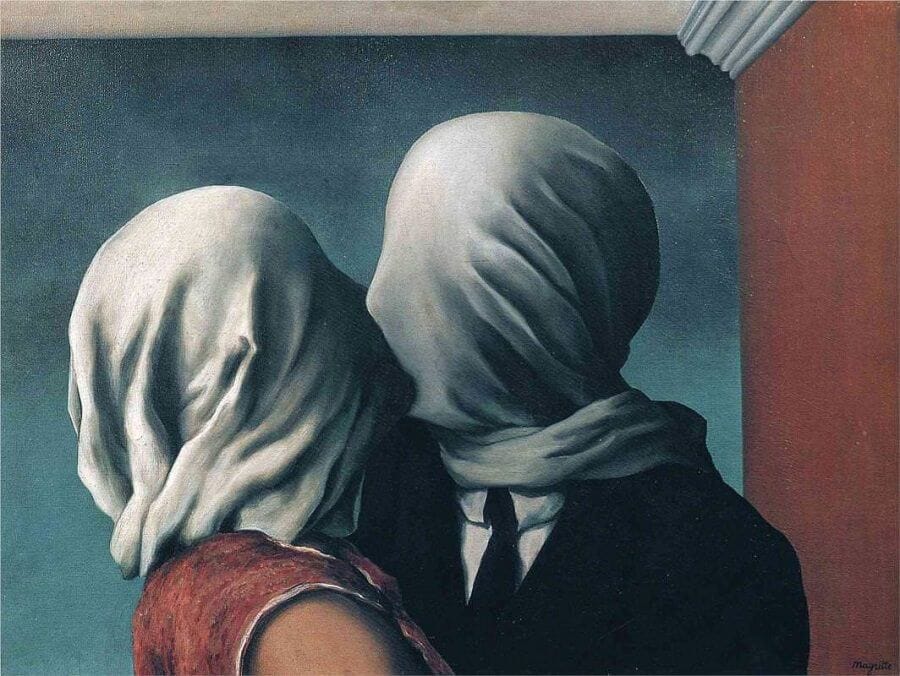
‘The Lovers I’ (left) and ‘The Lovers II’ (right) by René Magritte
Magritte himself never shared the meaning behind these pieces, but there are many theories on why these lovers are covered with white sheets. The images evoke hidden intentions and secret desires. Indeed, all the things one holds within their inner selves and don’t necessarily share with the world.
In the case of FILM : KAI, we are shown two masked figures as representatives of his inner self rather than simply exact mirror images or identical double figures. Perhaps we’re meant to infer that while we will always recognize KAI as a performer, there are limits to what we know about his inner self. The human behind the performer.

What’s significant about the setting of the first part of Nothing on Me is it’s the same place where KAI danced as part of a film series called *The Performers*, a collaboration between Gucci, GQ, and Vogue. KAI conceptualized the film’s story alongside director Lucy Luscombe, which takes us on a journey showing his early introduction to dancing and how his parents supported his ambitions.
The Performers shared KAI’s personal history with more traditional storytelling (albeit with fantasy elements included). FILM : KAI is more vague, rife with metaphors up for interpretation. The Performers tells the story of his life, while FILM : KAI looks to capture the inner workings of his mind.
At the start of the choreography between the two figures, it appears they are mirroring each other’s movements. KAI said: “While deep in thought, I talk to myself in the mirror and find my identity.” But quickly, they begin to antagonize each other. KAI also described this scene as a “battle against myself.” Towards the end, the ‘inner self’ inside the mirror controls KAI like a puppetmaster.
Of course, the inner self impacts the outer self — the self that the world sees. It has control. When the inner and outer self are in harmony, they mirror each other as the two figures did in the beginning. The person you are on the outside is just who you are on the inside; this identity is fixed. But when there is discord between the two selves, they move against each other.
KAI has accomplished a lot in his career, but as stated before, going solo is an entirely new path. While he certainly will garner attention for his work regardless, whether he will succeed according to particular metrics such as album sales and streams, is another story. KAI talked about how the pressure to succeed as an artist according to these metrics can damage his personal self and, thusly, damage his professional motivations:
“…as a singer, I can set up goals to sell tens of thousands of albums or to be on top rankings with my songs. But I’m sure if I fail to achieve them, it would hurt myself. As I struggle to achieve that goal, I’ll become obsessed with the result … then I’ll end up hating my job, which means I can’t work for a longer period. Of course, the person ‘Kim Jongin’ won’t be happy with it.” — Monotube, March 2021
What’s interesting is that here, KAI views his inner self through a mirror. (In Hello Stranger, this inner self was simply in the room beside him.) And around him, there are more mirrors set into the ground. Seeing KAI dancing in front of a mirror inevitably reminds you of the hours he spends in the practice room, perfecting his moves in front of a mirror. The multiple mirrors could be representations of all of those many practice sessions. Imagine all the moments he was dissatisfied by what he saw in the mirror, and how that must have antagonized him.
Towards the end of this scene, the inner self reaches for the outer self’s neck and he pulls back but is caught. On this, KAI said: “When my neck is caught and as I turn around, I close my eyes. I’m seeing my inner side of myself.”


Indeed, after KAI’s eyes close, he falls back and the outer self seems to catch him. His eyes remain closed. The scene then cuts to a shot of the open field where a black square frame appears and we are transported into KAI’s inner self.


Regarding the scenes with the mirror, KAI said: “If you look closely in the mirror, you can see the moon as well as my inner self. There’s darkness on the other side, which is my mind. And there’s the sun when I dance. I have the moon in the mirror at the back and I’m looking at the sun. I wanted the contrast in the video.” This contrast is shown between the dual scenes; the first part being under the sun and the next scene in darkness, except for the moon’s circular glow over the dancers.
KAI explained this next scene by saying: “I go into a frame and wear colorful clothes. Now I’m back in my inner side. Wearing this red outfit for this really fierce dance.” In this scene, he dances passionately, as though is he is fighting out his feelings. KAI described the dance as “aggressive, powerful and energetic” and said he wanted this scene to express his inner agony.
Around him, the other dancers’ movements are calmer but they subtly mimic his. Here, it could be said, KAI is gaining control over himself.


These days, KAI speaks about the importance of happiness above all else and no longer being as harsh on himself as he used to:
“I thought everything had to be perfect … I got really mad at myself when the dance moves didn’t turn out the way I wanted … So it seemed like I was living to dance, not living to be happy. It shouldn’t have been like that … We’re living to have fun and be happy. Of course, I still try to prepare things perfectly but I don’t get as stressed as I used to.” — Esquire, 2020 (cr. KaiNationUnion)
In another interview, KAI also said:
“I already went through a time in the past when I lived by criticizing myself and because I went through that experience and learned how bad it was, I don’t need to walk down that road anymore.” — W Korea, 2020 (cr. @INTLKJI)
The song is the most overtly sensual on the album. But if we take the words and align them to this sequence, what we see is someone eager to strip away distractions, concerns, and superfluous matters in order to connect more deeply (in the song, with someone else––and the film, with himself). KAI sings I want nothing on me but you over and over again in the chorus, like a mantra.
When the Nothing on Me sequence ends, a new portal appears. One we have never seen before in the film. This portal appears as a spinning circle and is accompanied by flecks that resemble stars that are being swallowed by the circle.


This portal may be a visual interpretation of a wormhole. Another interpretation also appears in the background of KAI’s album cover. A wormhole is a theoretical passage through space-time that could create shortcuts for long journeys across the universe. (In other words, we don’t know for sure wormholes exist, nor what they look like). The appearance of this wormhole is likely a callback to KAI’s teleportation powers.
This portal/wormhole fades into a stage, where KAI is seen standing, as the next sequence begins.


Ride or Die
“I want to use everything as a tool for KAI’s image. Titles such as an artist good at performance or a fashionable artist is not very important to me. The image people think of when they hear KAI is important. When ‘KAI’ is heard, I want people to look forward to what KAI will show.” — W Korea, January 2021 (cr. @INTLKAI)

The Ride or Die sequence is the final culmination of everything that came before in the film. KAI’s contemplations about what kind of performance to give, the desire to be recognized, the fear to stand alone, and the worries that have weighed heavy on his mind––they all lead him here, to the stage.
As KAI put it: “All the worries, ordeals, and hardships — I’ve overcome them all. KAI’s last performance unfolds here. So I’m finally achieving my stage having overcome all those things.”
KAI’s appearance in this sequence has gathered components found in looks from other sequences. Gold glitter is splattered on his cheeks, jewels adorn his neck and arms, hair extension give the appearance of a mullet, and he steadies a cowboy hat on his head (before throwing it off). His appearance is both classic and modern, composed and yet wild.


KAI explains why we see him dancing with the projection in Hello Stranger, through which another KAI is seen in the Ride or Die outfit: “What it means is that in Hello Stranger, KAI is contemplating in his home. And he imagines this to himself ‘If I get up on stage, what would it be like? What image would I bring forward?’ I’m contemplating all these things in my head. As I ponder, get these inspirations. And eventually, in reality, it all comes true…And without the tie, my outfit here is similar to the one in Hello Stranger.”
There’s one line in the song that is a perfect representation of this sequence (English translation): Everything you’ve ever dreamed of becomes reality.

KAI explained: “All the lights are on me. I’m getting all the spotlight. But it also shows I can get to this stage only when I go through all these phases. Without all the thoughts, decisions, stories, and inspiration, I can’t be here. I feel inspired in Hello Stranger and it materializes on stage here. And I show my performance to you.”
In 2016, KAI incurred an ankle injury in March, and after recovery, it was re-injured again in July. Not only could he not perform for the fans, but he was also advised by doctors not to dance at all for months. He was only fully recovered by October of that year. After he was finally able to perform again, he wrote a letter to fans. Here are some of his words:
Have you heard the news? I started to dance again. I don’t think any other words would make me more happy today.
I was so nervous and my legs were shaking before going onstage, but after seeing you guys in the audience I felt just extremely happy. I felt like I had during my debut.
I realized the importance of being onstage, and I will now try very hard to be your source of support.
Indeed, without going through all that he has gone through, without taking the time to gain inspiration, without fighting through hardships and regaining confidence, KAI cannot make it onto the stage and dance his heart out. He also may fail to appreciate being on stage and performing, after giving so many countless performances already, if he had not lost the ability to perform.
In a behind-the-scenes clip for Ride or Die, KAI said: “It feels like I’m dancing in front of or inside a multitude of mirrors.” This may have been in reference to the backup dancers, who were all dressed the same as each other, but slightly different from KAI. They danced to the same choreography he did as well, with some slight variations.

Perhaps, it was meant to look that way. We do not see the backup dancers very clearly in this scene so maybe they were supposed to represent multiple versions of KAI, and multiple stage performances. His image being multiplied over and over again like an infinity mirror would (not unlike the mirrored box that appears in Reason).
In the film’s commentary, KAI said: “There were some elements purposely staged to remind you of other specific works.” Whether he meant works by other artists or works from his own past is unclear. But what’s interesting is the similarities between the Ride or Die sequence and KAI’s (and EXO’s) first-ever teaser, where KAI appears in a mostly black outfit, including a vest, and tosses his hat off to the side.


What stands out about this sequence is the simplicity of the performance. A stage, lights, and backup dancers are all the necessary components and anything more is superfluous. It calls to mind KAI’s solo stages; there are not many tricks, props, or set decoration.


Deep Breath at the 2014 MNET Asian Music Awards / ICU (Awakening)
All he really needs is a stage and a spotlight, and look how he shines.
The end is the beginning
“The album title was KAI in the same sense of ‘It’s the beginning, it’s a starting point’.” — Monotube, March 2021


The shot of KAI on an empty soundstage at the beginning of the film is mirrored by a similar shot at the end of the film. KAI used the term “infinite loop” to describe the film’s story. The beginning is not really the beginning, and the end is not really the end. Rather it’s a repetitious cycle. KAI moves from contemplating future performances in his home, then going through different trials in life, and finally emerging onto the stage to fulfill the performance he has been dreaming about. And then it repeats.
The soundstage is the setting for which the fantasy is created; the place fans often don’t get to see. They just see the fantasy, the music videos, the slick choreography. But the soundstage is from where everything comes. KAI explained this scene: “The performance ends and you’ll see the stage once it’s all cleaned up. So this was meant for you, a room for your imagination. Kind of like the beauty of space.”
The final shot of the film is KAI raising his head and looking directly at the camera. It’s not the first time he makes eye contact with the camera, but it is the first time he looks at the camera outside of a performance. And this time, it doesn’t feel like we’re looking at him but that he’s looking at us.

It’s a confident look, made by a person who doesn’t seem so concerned about what you think about him. And it kind of feels like he’s puffing his chest out a bit. By the end of the film, you know exactly what KAI is capable of.
Lee Soo Man, the founder of SM Entertainment, was the one who named each of the EXO members. “KAI” is taken from the Chinese character 开, which means “to open”. A fitting name, as he was the first EXO member introduced to the public, thus “opening” the door to EXO and allowing the audience in.
For his own solo debut, KAI called the album “KAI (开)” and the Chinese character was also melded into the logo seen on his album and other promotional material.


With the choice to call his debut solo album by this same name, KAI is again using his name to signal an opening of something new. Despite all the years he has been performing under this name and all that he has accomplished, this is just the beginning for KAI.
Sources for KAI’s quotes:
메타데이터
- post_id
- c8d94afdd68e
- slug
- deciphering-film-kai-c8d94afdd68e
- url
- https://medium.com/@rou-rou/deciphering-film-kai-c8d94afdd68e
- canonical_url
- https://medium.com/@rou-rou/deciphering-film-kai-c8d94afdd68e
- author_url
- https://medium.com/@rou-rou
- status
- ok
- fetched_at
- 2026-06-27 18:20:27