Deniable Murder: Organisation Consul and the Birth of the Death Squad Model
The death squad, political murder outsourced to a deniable network the state can publicly disown while quietly tolerating, is generally…
Deniable Murder: Organisation Consul and the Birth of the Death Squad Model

Two ministers of a fragile republic, killed ten months apart, by the same underground network. All images generated by author unless stated
The death squad, political murder outsourced to a deniable network the state can publicly disown while quietly tolerating, is generally treated as a Cold War invention: Argentina’s juntas, Chile under Pinochet or apartheid South Africa’s external hit teams. The model is older than any of them. Weimar Germany’s Organisation Consul was running it in the early 1920s, against the ministers of its own fragile republic, years before any of those later regimes existed. At its height the organisation numbered some 5,000 members and has been linked to roughly 354 political murders between 1918 and 1922, a scale that makes clear this was never a handful of embittered veterans acting alone but a functioning paramilitary underground operating at the scale of a small army.
The network
Organisation Consul formed from the wreckage of the Marine Brigade Ehrhardt, a Freikorps unit raised to fight the Bolshevik uprisings and border wars that followed Germany’s 1918 defeat, then formally disbanded under the terms of Versailles and left with nothing to do and, in many cases, nowhere to belong. What the disbandment order didn’t remove was the men themselves, their weapons, their networks or their conviction that the Republic they’d been ordered to stand down for was itself the enemy, a “November criminal” government that had, in the mythology forming around Germany’s defeat, stabbed the undefeated army in the back.
Organisation Consul turned that conviction into a campaign and its own statutes left no ambiguity about the campaign’s targets: the organisation named “the fight against Jewry, social democracy, and left-radical parties” as its explicit purpose. It operated as a clandestine terror cell, conducting assassinations against Republican politicians it judged responsible for the peace, the reparations or simply for governing under a democratic constitution its members despised. Crucially, this was not merely a network the state tolerated at arm’s length: Organisation Consul was funded in part by the Reichswehr and the Foreign Office, specifically to help circumvent the disarmament provisions Versailles had imposed on Germany’s official military. The killings were carried out by identifiable small teams, but the organisation behind them was financed by the same state apparatus whose elected government it was assassinating, deniability with a state cheque behind it, not merely the respectable right’s unspoken blessing.
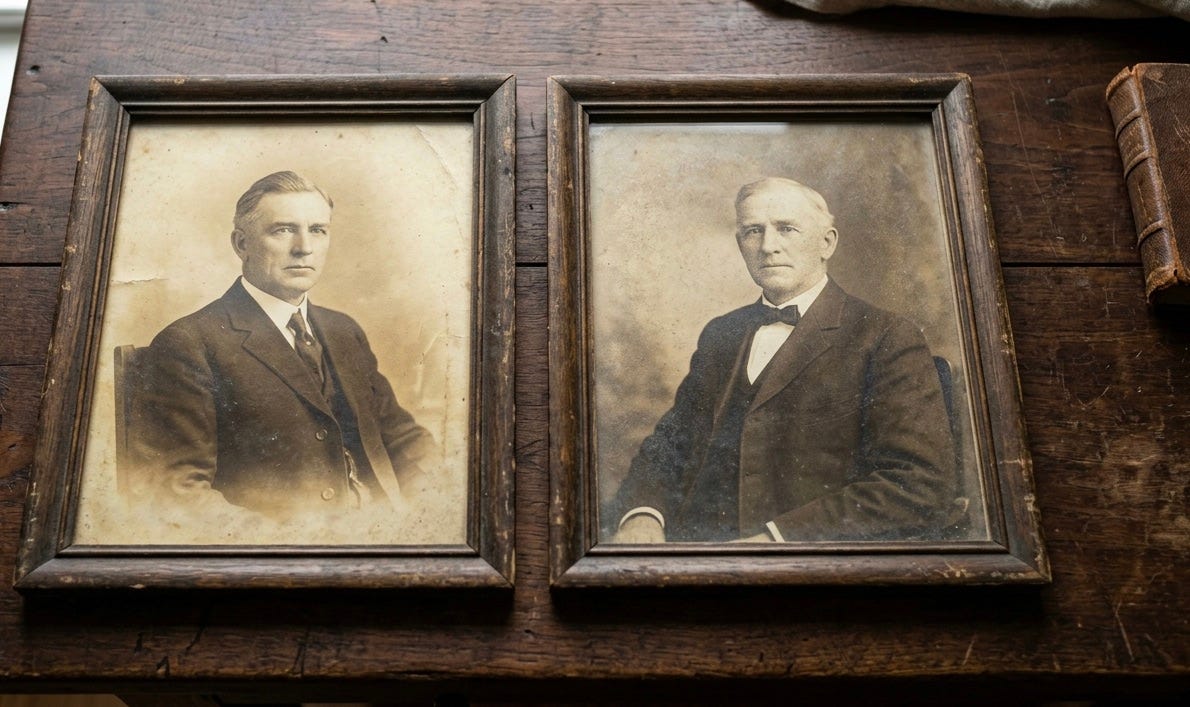
Ten months separated them. The same underground killed both.
Two ministers, ten months apart
Matthias Erzberger, a Centre Party politician and former Finance Minister, signed the armistice that ended the First World War for Germany in November 1918, a task that made him, permanently and unfairly, the personification of national humiliation in the eyes of the nationalist right, who branded him a “November criminal” and preferred to blame the peace on the men who signed it rather than the war that had already been lost. On 26 August 1921, hiking in the Black Forest, Erzberger was shot dead by two former Freikorps members, Heinrich Tillessen and Heinrich Schulz, acting for Organisation Consul. Both men escaped to Hungary with what the historical record describes as sympathetic assistance, a detail worth sitting with, since it means the deniability wasn’t just organisational, it extended to actual logistical help getting the killers out of the country once the act was done.
Walther Rathenau was Weimar’s Foreign Minister, a Jewish industrialist who had negotiated the Rapallo Treaty re-establishing relations with Soviet Russia, a diplomatic achievement that made him, to the same nationalist current that hated Erzberger, doubly suspect: a Jew and an internationalist, negotiating with Bolsheviks, representing exactly the kind of Republic Organisation Consul existed to destroy. On 24 June 1922, ten months after Erzberger’s killing, Erwin Kern and Hermann Fischer shot Rathenau in his open car and threw a grenade in after him, with Ernst Werner Techow driving the getaway vehicle. All three were affiliated with the same Organisation Consul network. Rathenau’s Jewish identity was not incidental to his selection as a target, it sat directly inside the organisation’s own stated purpose.
The founding of the SA came before the killings stopped
The single most direct link between Organisation Consul and the Nazi movement predates even the Rathenau assassination. In August 1921, ten months before Rathenau was killed, Organisation Consul’s leader, Hermann Ehrhardt, reached an agreement with Adolf Hitler under which the organisation would provide military training for the Nazi Party’s “Gymnastics and Sports Division.” That division, founded on 3 August 1921 under the command of Organisation Consul officer Hans-Ulrich Klintzsch, became the Sturmabteilung, the SA, the Nazi Party’s paramilitary wing and the direct institutional ancestor of the SS. This was not a case of former assassins quietly finding new employment after their organisation’s later dissolution. Organisation Consul’s own officer corps built the Nazi movement’s first paramilitary force while the assassination campaign was still actively running.
The pipeline that mattered more than the killings
What makes Organisation Consul more than a historical curiosity is where its personnel went next. The organisation was formally banned in July 1922, in the immediate aftermath of Rathenau’s murder; a successor group, the Bund Wiking (Viking League), formed to carry the network forward under a new name. Individual members were later folded directly into the Schutzstaffel once the Nazis held power. The organisational habit didn’t need to be relearned at each step: political violence conducted through a deniable paramilitary network, with the broader nationalist movement able to disclaim formal responsibility while quietly benefiting from the outcome, funded where necessary by elements of the state apparatus itself. The architecture Organisation Consul pioneered, elite intent, expressed through operators who can be sacrificed or disowned if caught, while the intent itself survives untouched and the state’s own military and diplomatic institutions willing to fund the arrangement, is the same architecture visible decades later in Operation Condor’s cross-border assassination network and in apartheid South Africa’s external hit squads. The specific killers changed. The organisational logic that gave the killers cover, and the money that kept the network running, did not.
The organisation was banned. The people who ran it were not disarmed of what they’d learned.
Part of the What If AI Investigated series. Sources: historical record of Organisation Consul’s formation from the disbanded Marine Brigade Ehrhardt; documentation of the assassinations of Matthias Erzberger (26 August 1921, killed by Heinrich Tillessen and Heinrich Schulz) and Walther Rathenau (24 June 1922, killed by Erwin Kern and Hermann Fischer, driven by Ernst Werner Techow); Organisation Consul’s founding statutes naming Jewry, social democracy, and left-radical parties as its targets; documentation of Reichswehr and Foreign Office funding of the organisation; the August 1921 Ehrhardt-Hitler agreement establishing the Nazi Party’s Gymnastics and Sports Division under Hans-Ulrich Klintzsch, which became the Sturmabteilung; the organisation’s July 1922 ban and the formation of its successor, the Bund Wiking.
메타데이터
- post_id
- c8da7a252dbc
- slug
- deniable-murder-organisation-consul-and-the-birth-of-the-death-squad-model-c8da7a252dbc
- url
- https://medium.com/what-if-ai-investigated/deniable-murder-organisation-consul-and-the-birth-of-the-death-squad-model-c8da7a252dbc
- canonical_url
- https://medium.com/what-if-ai-investigated/deniable-murder-organisation-consul-and-the-birth-of-the-death-squad-model-c8da7a252dbc
- author_url
- https://medium.com/@jamie_gray027
- status
- ok
- fetched_at
- 2026-07-17 02:44:42