The Hindu Sun List: A Chronological History of Solar Management
This article traces the evolution of Hindu Sun culture, identifying how the deity’s role shifted from a natural observer of time to a…
The Hindu Sun List: A Chronological History of Solar Management
This article traces the evolution of Hindu Sun culture, identifying how the deity’s role shifted from a natural observer of time to a replaceable engine of imperial wealth and cyclic renewal.
Disclaimer: This research is considered controversial and contested. It is based on interpretations of 18th-century remnants and “footnote” deity placements that may not be fully accurate or universally accepted. It is presented here as a speculative framework for identifying the phases of solar evolution in Hindu counterparts based on incomplete historical evidence.
I. The Natural Clock: Surya-Savitr
Scriptural Reference: The Rig Veda (Mandala 1)
In the earliest layer of solar culture, as recorded in the oldest hymns of the Rig Veda, the Sun was an external force of nature. Under the management of the Shrauta cults, the Sun was worshipped as a duality: Surya (the physical disk) and Savitr (the vivifying power behind the light). This was a “Passive” stage; the cult focused on synchronizing human life with the solar clock through the Agnihotra (fire sacrifice). The theology was minimalist, viewing the sun as a biological trigger that woke the world, requiring nothing but observation and ritual acknowledgment of the natural cycle.
II. The Witness of the Contract: Mitra-Varuna
Scriptural Reference: The Brahmanas (e.g., Shatapatha Brahmana)
As Vedic society transitioned into a structured social order, the focus moved from oral hymns to the ritual prose of the Brahmanas. The cult of Dharma-Shastra transformed the Sun into the “Eye of Varuna” and the radiance of Mitra. This iteration established the Sun as the cosmic witness to social and legal contracts. These texts codified a shift toward institutional oversight, ensuring that human “Truth” (Satya) mirrored the “Cosmic Law” (Rta). The Sun was no longer just a physical clock, but a judicial authority overseeing the “Contract” between the divine and human realms.
III. The Design Power: Brahma-Gayatri
Scriptural Reference: The Aranyakas & Early Upanishads
With the birth of high-level engineering, the Sun was reimagined through the “Forest Treatises” (Aranyakas) and early Upanishads, which began to interiorize the ritual into philosophical principles. The Saura (Brahma-Vidya) cults viewed the Sun as the Brahma-Gayatri — the solar word or sacred sound that organizes matter. The Sun became a mathematical constant, providing the “measure” by which the Architect (Brahma) laid out the foundations of the kingdom. The deity was no longer just an “eye” witnessing events; it was the “ruler” defining the structural blueprint for a stable civilization.
IV. The Resource Manager: Shri-Lakshmi
Scriptural Reference: The Sri Sukta (Rig Veda Khilani)
This stage represents the most “Contested” era of the 18th-century remnants, marking a transition toward the tangible management of assets described in the Sri Sukta (an early appendix to the Veda). In the Lakshmi-Sovereignty phase, the Goddess became the Sole Manager of the solar output, converting “Heat” into “Wealth” (Shri). This transition was controversial because it utilized the Sun as a furnace for economic bounty, subordinating the old “Architectural” principle (Brahma) to a secondary, framing role. This reflects a period where the state claimed the Sun’s radiance as a direct agricultural and financial resource.
V. The Procreative Synthesis: Lakshmi-Narayana
Scriptural Reference: The Vishnu Purana
To domesticate the intense solar heat of the previous stage, the cult of Sri Vaishnavism introduced a cooling lunar element, grounded in the narratives of the Vishnu Purana. By pairing the Sun with Narayana (the Preserver), it formed Lakshmi-Narayana, the “Procreated Sun.” This was a “Double-Barrel” management system where solar fire was balanced by lunar water-energy to prevent the state’s resources from being exhausted. The Sun was seen as the father of the biological cycle, working in harmony with the “Moon” to sustain a long-term imperial engine of preservation and growth.
VI. The Sovereign Lockdown: Martanda-Bhairava
Scriptural Reference: The Samba Purana & Agni Purana
The culture reached a peak of absolute authority under the Saura-Pashupata cult, drawing its “Lockdown” protocols from the Samba Purana and the Agni Purana. The Sun became Martanda-Bhairava, a fierce warrior-judge. This iteration moved away from procreative balance toward “Absolute Sanction,” reimagining the Sun as an impenetrable shield. As described in these Puranic texts, the Sun was the “Unconquered King” protecting the core of the empire, requiring total lockdown of all resources under a unified, fiercely guarded authority that brooked no opposition.
VII. The Replacement Engine: Mahakala & Krishna
Scriptural Reference: The Brahma Vaivarta Purana
The final evolution identifies the Sun as a part of a self-renewing machine. In the Brahma Vaivarta Purana, as old solar manifestations expire, they are replaced by a new Binary Engine (Sun and Moon) associated with the supreme presence of Krishna, who is the source from which these “Replacement” manifestations arise. The Sun becomes Mahakala (Great Time), paired with a “Replacement Moon” to manage the perpetual recycling of the universe. The Sun is no longer a static king but a roaring “Face of Glory” (Kirtimukha) that devours and regurgitatory time itself, ensuring the universe remains a functional, self-renewing engine of fire and seed.
Summary of the Textual Evolution
This progression illustrates a sun culture that moved from observing natural hymns (Vedas) to codifying ritual prose (Brahmanas), designing with philosophical principles (Upanishads), and eventually owning and replacing the solar power through imperial narratives (Puranas). The “Contested” nature of the middle rows remains a focal point, revealing the moment the state shifted from a “Plan” (Brahma) to a “Bounty” (Lakshmi), before concluding with the realization that the Sun is a functional, replaceable gear in a machine governed by a higher Source.
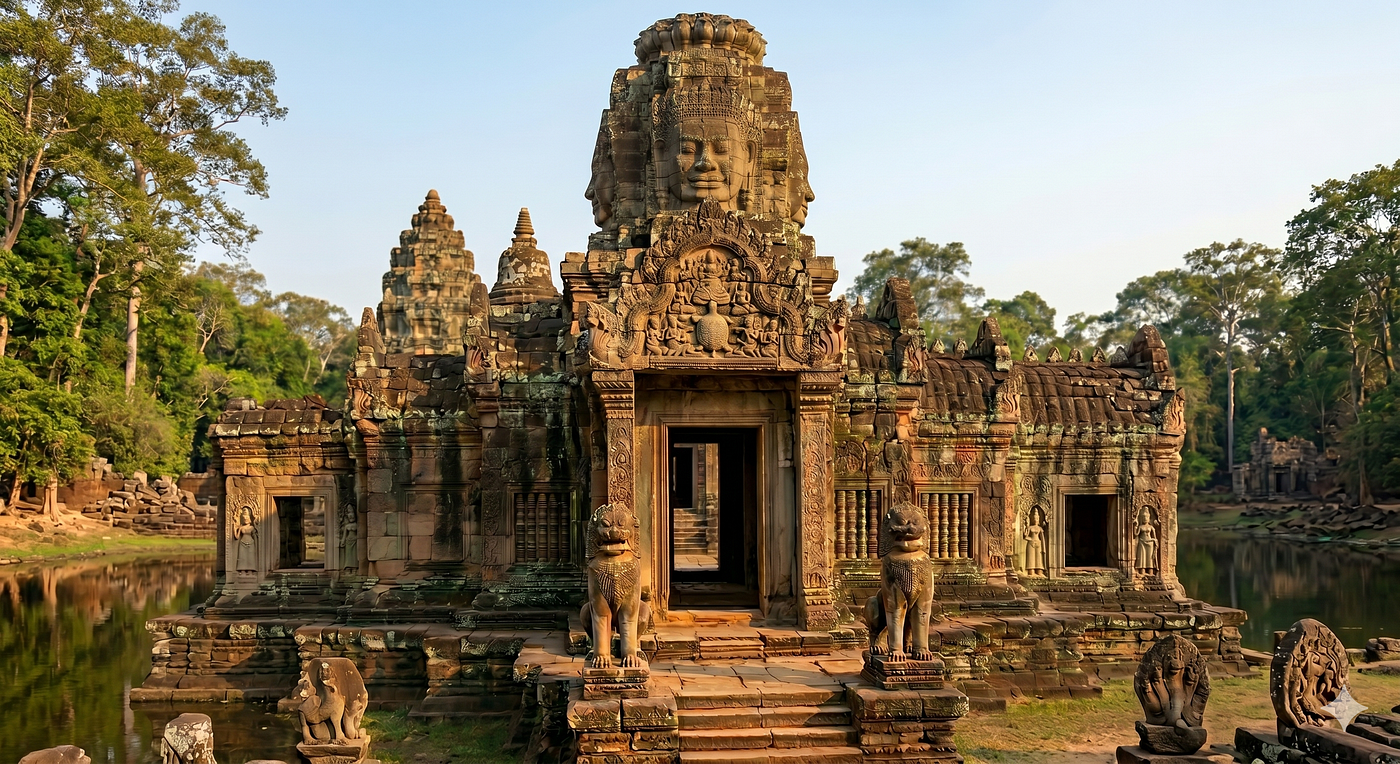
Lakshmi-Narayana (AI-generated architectural composite from key Angkorian temples: Preah Khan, Krol Ko, Neak Pean, Ta Som, East Mebon)
메타데이터
- post_id
- c8da83ae075c
- slug
- the-hindu-sun-list-a-chronological-history-of-solar-management-c8da83ae075c
- url
- https://medium.com/@gilesgaffney/the-hindu-sun-list-a-chronological-history-of-solar-management-c8da83ae075c
- canonical_url
- https://medium.com/@gilesgaffney/the-hindu-sun-list-a-chronological-history-of-solar-management-c8da83ae075c
- author_url
- https://medium.com/@gilesgaffney
- status
- ok
- fetched_at
- 2026-06-12 07:40:50