When Your Appetite Gets Quiet on GLP-1s, You Still Need a Rhythm
There is a strange moment that can happen on a GLP-1 journey.
When Your Appetite Gets Quiet on GLP-1s, You Still Need a Rhythm
There is a strange moment that can happen on a GLP-1 journey.
You realize food is not shouting at you the same way anymore.
The snack cupboard does not pull you in like it used to. You are not thinking about the next meal while eating the current one. Cravings feel quieter. Fullness comes faster.
For a lot of people, that quiet feels like relief.
Real relief.
Because if you have spent years feeling like food had a louder voice than you did, silence can feel almost emotional.
But after that first wave of relief, another question can show up.
If I am not hungry the same way anymore, how do I know I am still taking care of myself properly?
That is the part people do not talk about enough.
A quieter appetite can help you eat less.
But it does not automatically help you build a routine.
It does not automatically make sure you are getting protein.
It does not automatically keep your strength in the picture.
It does not automatically help you remember side effects, low-energy days, or the questions you wanted to ask at your next appointment.
That part still needs you.
Not in a stressful way.
In a simple, steady, “let me not lose track of myself” kind of way.
Quiet appetite can be helpful and confusing at the same time
At first, it may feel simple.
You eat less because you feel full sooner. You snack less because the urge is not as strong. You leave food on the plate and feel surprised by it. You stop thinking about food every hour.
That can feel amazing.
But then the days start getting a little blurry.
Maybe breakfast becomes just coffee. Maybe lunch becomes a few bites. Maybe dinner becomes whatever is easiest. Maybe protein becomes something you meant to get later. Maybe water slips your mind. Maybe movement feels harder because energy is lower.
And because you are not very hungry, it does not feel urgent.
That is the tricky part.
Hunger used to remind you to eat. Now it may not.
So your routine has to do some of the reminding.
Eating less is not the same as supporting your body
This is where a lot of people get stuck.
The goal is not simply to eat as little as possible.
The goal is to lose weight while still feeling steady, capable, and supported.
You still need fuel.
You still need protein.
You still need some kind of movement that keeps strength visible.
You still need to notice what your body is telling you.
You still need to remember what happened during the week so you are not guessing later.
That does not mean turning your life into a spreadsheet.
It just means you need a small rhythm.
Something simple enough to actually use.
Protein needs a little more intention now
When your appetite is lower, protein can become easy to miss.
Not because you are careless.
Because smaller meals can feel satisfying even when they are not giving you enough of what your body needs.
You might feel full after something light and think, “That’s enough.”
And maybe it is enough for hunger.
But is it enough for your body?
That is a different question.
You do not have to track every gram forever. You do not have to make food feel like math.
But it helps to ask one simple thing:
Where is the protein today?
That question is small, but it can change the day.
It can help you choose eggs instead of just toast. Greek yogurt instead of only coffee. Rotisserie chicken instead of a random snack plate. Turkey slices, cottage cheese, tuna, salmon, chicken breast, lean ground turkey, protein shakes, protein bars, or high-protein yogurt when a full meal feels like too much.
The exact food is personal.
The habit is the important part.
Do not let protein disappear just because hunger got quieter.
Strength can fade quietly if you only watch the scale
A lower number can feel like progress.
And it is progress.
But the scale does not tell you whether you feel strong.
It does not tell you whether stairs feel easier or harder.
It does not tell you whether your normal workout suddenly feels heavier.
It does not tell you whether you are skipping movement because you are tired.
It does not tell you whether you are losing confidence in your body while losing weight from your body.
That is why strength deserves a place in your week.
Not because everyone needs to become a gym person.
But because strength is part of feeling like yourself.
Even a small check-in helps:
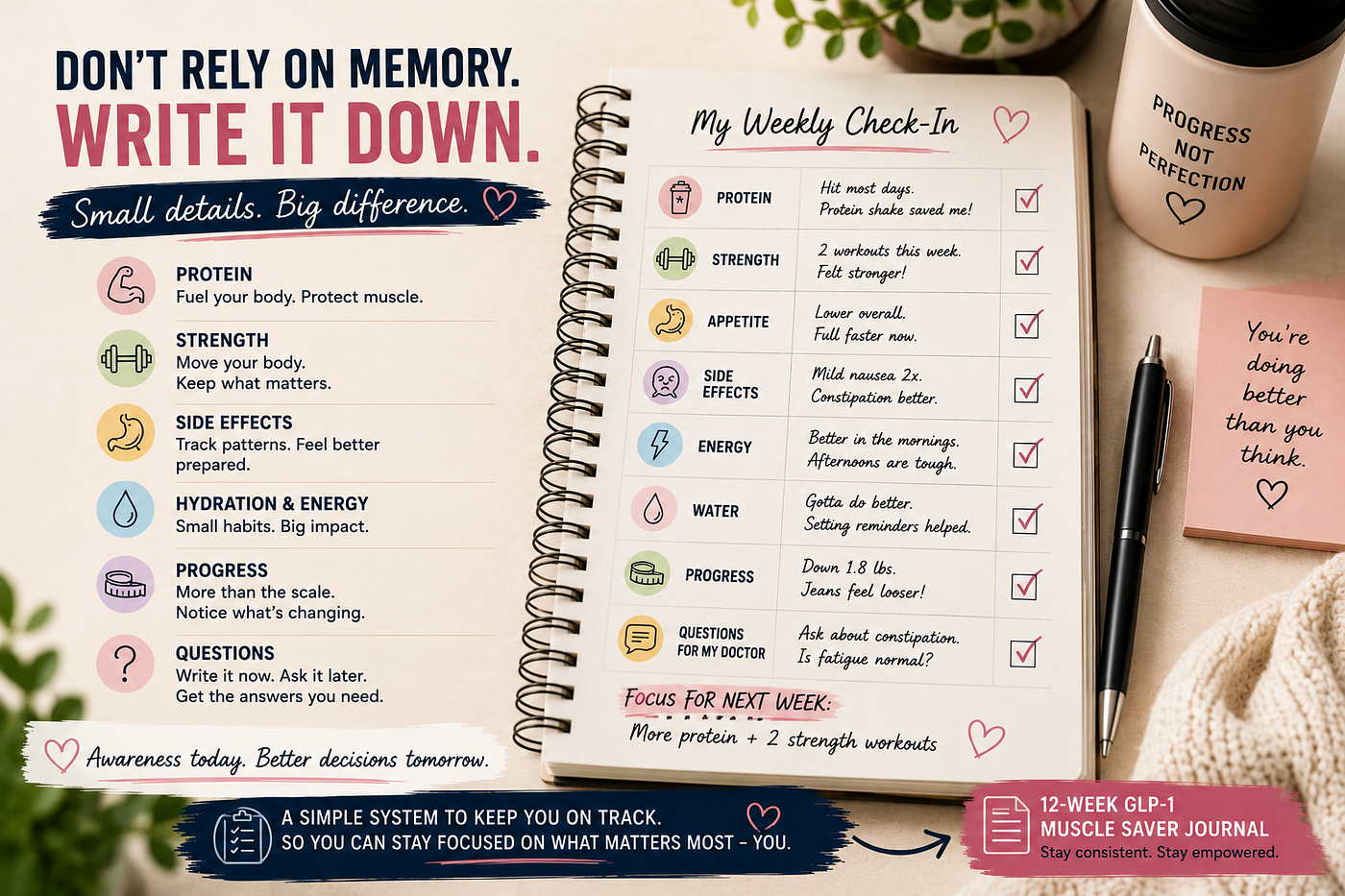
Did I move this week? Did I do any strength work? Did my body feel stronger, weaker, or the same? Did low energy stop me? What is one small movement I can repeat next week?
That is enough to keep strength from becoming invisible.
And honestly, invisible things are the easiest things to lose.
Side effects are obvious until you need to explain them
This happens all the time.
A side effect shows up and you think, “I’ll remember this.”
Then life moves on.
A few days later, you remember that something happened, but not exactly what.
Was nausea on Monday or Wednesday? Was constipation all week or just two days? Did fatigue happen after dose day or after a low-protein day? Was sleep bad before your energy crashed? Did anything help?
By the time you are sitting in an appointment, everything can feel vague.
That is why writing things down is not overthinking.
It is just helping your future self.
A note can be as simple as:
“Nausea twice this week.” “Low appetite in the morning.” “Constipation, ask about it.” “Energy low after lunch.” “Felt better after eating earlier.”
That is not a dramatic tracking system.
That is just not relying on memory for things that matter.
Your doctor questions should not live in your head
Doctor visits move fast.
You may wait weeks for one appointment, then suddenly you have a few minutes to explain everything that happened.
That is hard.
Especially when changes are small, scattered, and easy to forget.
So when a question comes up, write it down.
Right then.
Not later.
Later is where good questions go to disappear.
Maybe you want to ask about protein. Maybe side effects. Maybe energy. Maybe dose timing. Maybe digestion. Maybe strength training. Maybe what to watch for before the next visit.
You do not need to answer the question yourself.
You just need to keep it safe until you can ask the right person.
A simple weekly rhythm can make the whole thing feel less messy
You do not need to track every day if that feels like too much.
A weekly check-in is enough for many people.
Ten minutes.
That is it.
Ask yourself:
Main cover image Opening Quiet appetite section Protein section Strength section Side effects section Doctor questions section A simple weekly rhythm section
Checklist questions GLP-1 Muscle Saver Journal Structure is not the enemy Final thought Disclaimer
How was my appetite this week?
Did I get enough protein most days?
Did I move my body or do any strength work?
Did side effects show up?
How was my energy?
Did my clothes, measurements, or body feel different?
What questions do I need to remember?
What is one small focus for next week?
That kind of check-in can make the journey feel less random.
You start seeing patterns.
You notice what helps.
You catch what keeps repeating.
You stop judging the whole week based on one weigh-in or one bad day.
That matters.
Because this journey can already feel emotional enough.
You do not need more pressure.
You need a clearer picture.
Structure is not the enemy
Some people hear “tracking” and immediately think of restriction.
I get that.
A lot of people have had bad experiences with food logs, calorie apps, strict plans, and routines that made them feel like they were failing every day.
That is not what this is.
This kind of tracking is not about punishment.
It is about not abandoning yourself in the middle of change.
It is about saying:
“I want to know what is happening.” “I want to support my body.” “I want better notes.” “I want to notice patterns before they become problems.” “I want to stop guessing.”
That is a very different energy.
A good routine should make you feel more supported, not more watched.
If you need a simple place to keep it together
You can write all of this in any notebook.
You can use your phone notes.
You can use a planner.
The tool does not matter as much as the habit.
But if you know you will not build the structure from scratch, using a ready-made printable can make it easier to begin.
There is a simple 12-week GLP-1 tracking journal here:
It is built around the things that are easy to lose track of: protein, strength, side effects, measurements, doctor notes, and weekly progress.
No magic promise.
Just one place to keep the details you may want later.
The quiet is not the finish line
A quieter appetite can be powerful.
It can give you space.
It can make food feel less overwhelming.
It can help you feel like change is finally possible.
But the quiet itself is not the finish line.
The deeper work is learning how to support yourself while things are changing.
How to eat with intention when hunger is not loud.
How to keep protein visible.
How to keep strength in the picture.
How to write down side effects before they blur.
How to show up to appointments with better notes.
How to build habits that still make sense later.
Because the goal is not just to eat less.
The goal is to feel better in your body.
More steady. More aware. More prepared. More in control of the next step.
Final thought
When your appetite gets quiet, it can feel like the hard part is over.
But that is exactly when a simple rhythm matters.
Not a strict rhythm.
Not a perfect one.
A kind one.
A weekly habit that helps you check in with your body instead of drifting through the changes and trying to remember everything later.
So this week, do not only ask:
Did I eat less?
Ask:
Did I support myself well?
That question is quieter than the scale.
But it may be the one that helps you the most.
If you want a printable weekly place to keep those notes together, you can find it here:
Important note
This article is for educational and personal tracking purposes only. It is not medical advice. The journal linked above is an independent wellness journal and is not affiliated with, endorsed by, or sponsored by any pharmaceutical company. Always consult a licensed healthcare provider before making changes to medication, diet, supplements, or exercise.
메타데이터
- post_id
- c8db1dcf72fc
- slug
- when-your-appetite-gets-quiet-on-glp-1s-you-still-need-a-rhythm-c8db1dcf72fc
- url
- https://medium.com/@simpliqstore/when-your-appetite-gets-quiet-on-glp-1s-you-still-need-a-rhythm-c8db1dcf72fc
- canonical_url
- https://medium.com/@simpliqstore/when-your-appetite-gets-quiet-on-glp-1s-you-still-need-a-rhythm-c8db1dcf72fc
- author_url
- https://medium.com/@simpliqstore
- status
- ok
- fetched_at
- 2026-06-09 15:37:30