India’s most expensive convenience
— What the footnotes of India’s quick commerce story actually say*
India’s most expensive convenience
— What the footnotes of India’s quick commerce story actually say*
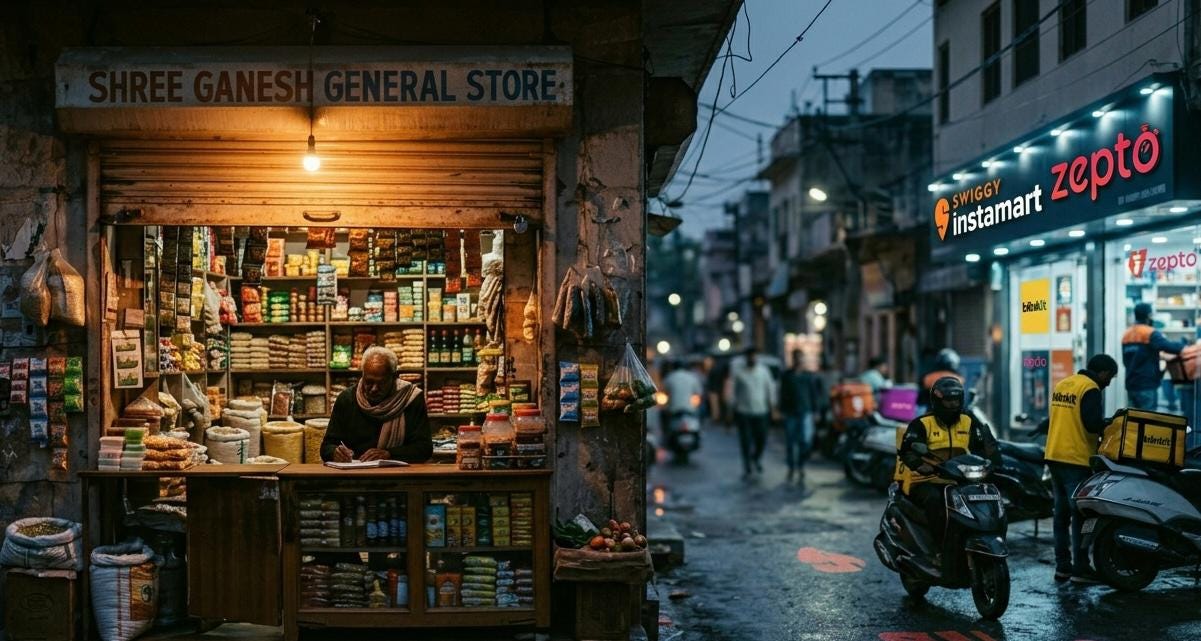
In January, Blinkit announced what the sector had been promising for a decade: an adjusted EBITDA profit. ₹4 crore, on a quarterly net order value of ₹13,300 crore.
In April, the sequel: ₹37 crore for Q4 FY26, on NOV of ₹14,386 crore. A nine-fold improvement in a single quarter, and the headlines treated the turning point as confirmed.
Those two quarters are, to date, the entire demonstrated profit of the entire Indian quick commerce. One company. Two quarters. ₹41 crore : on the sector’s most charitable metric, against a decade of building and more than ₹10,000 crore of losses in the last year alone.
I spent some years of my life reading the parts of financial statements that headlines are built to summarize away, so I did what old habits demand. I divided the profits by the order values.
Three basis points in January. Twenty-six in April.
The direction is real. The magnitude is the story.
This is not a criticism of Blinkit : reaching the positive side of zero in this sector, against this competitive intensity, is a genuine operational achievement, and the company has been admirably restrained about it.
It is a criticism of how we read numbers. Because if ₹37 crore is the good news, the rest of the ledger deserves a look.
The word doing all the work
First, a definitional precision the sector’s critics usually skip, and credit where it is due. Eternal publishes its formula in every shareholder letter: Adjusted EBITDA equals EBITDA, plus share-based payment expense, minus actual rent paid on Ind AS 116 leases. That last deduction matters. Under Ind AS 116, dark-store rent would normally bypass EBITDA altogether, reappearing below the line as right-of-use depreciation and lease interest.
Eternal chose, back in FY23, to put the cash rent back in “to more appropriately reflect our cash loss/profit,” in its own words. So Blinkit’s ₹37 crore is post-rent, pre-ESOP. The rent on 2,243 dark stores is inside the number. That is a more honest metric than most of this industry’s vocabulary, and it deserves acknowledgment.
Now, what remains outside it: ESOP expense, which is real compensation paid in real dilution; taxes; finance costs; and depreciation : the annual consumption of the capitalized build-out, the fit-outs, cold chains and equipment across some 17 million square feet, with over four lakh delivery partners attached to the network.
The build-out itself is correctly capitalized; no one books a store’s construction as a revenue expense. But depreciation is how that construction reaches the profit and loss account, year by year, as the asset is used up : and in a model that added 216 stores in a single quarter and intends to reach 3,000, depreciation is not an accounting formality. It is a close proxy for the real, recurring capex of keeping the machine alive and growing. The rent is counted; the wearing-out of the stores is not.
A steel company announcing profitability after paying the land lease but before charging the furnace’s depreciation would still invite questions. We should ask the same ones here, gently.
There is also an accounting weather pattern worth noting. Blinkit’s reported revenue jumped to ₹13,232 crore in Q4 from ₹1,709 crore a year earlier : a figure that owes most of its drama to the shift to an inventory-led model, where revenue now records the full value of goods sold rather than commissions.
On a like-for-like basis, growth was 126%: extraordinary, but a different number. The company’s own CEO, to his credit, flagged the uplift as one-time. Same oranges. Bigger-looking crate.
Now the full-year picture, which the quarterly celebration quietly eclipsed : and which settles every definitional debate, because statutory accounts have no adjusted layer.
Eternal’s FY26 net profit fell 31%, to ₹366 crore from ₹527 crore.
Total expenses for the year, at ₹55,145 crore, exceeded operating revenue of ₹54,364 crore.
Even with the rent counted, even with the most conservative adjusted metric in the sector, the group in its best year of growth spent more than it earned from operations.
And one line deserves a permanent glance. Eternal sits on a cash pile of roughly ₹18,000 crore, whose treasury yield ran at approximately ₹350 crore a quarter through the year against quarterly net profits of ₹102 crore in Q3 and ₹174 crore in Q4.
There is nothing improper here; cash earns interest. But the attribution matters: the parent’s entire net profit remains smaller than the interest on shareholders’ undeployed money. The operating businesses beneath, after real depreciation and real costs, still do not cover the cost of their own story.
A fairness note, because the footnotes cut both ways: the cash balance actually rose this quarter, to ₹17,972 crore from ₹17,820 crore. Read the reason before celebrating : the increase came from the working-capital release of the inventory transition, not from operations generating cash. The same accounting shift that inflated the revenue line refilled the till.
The treasury still subsidizes the story; this quarter, the story found a way to refund the treasury with bookkeeping.
The trajectory argument
The bulls now have their best chart yet, and honesty requires engaging it. Blinkit’s adjusted EBITDA margin has marched from −17.8% of NOV in FY23 to −3.7% in FY24, −1.3% in FY25, −0.6% in FY26, and +0.3% in the March quarter. Delhi NCR, the most mature market, is reportedly approaching the company’s guided steady-state of 5–6% of NOV. Management has guided 60%+ NOV CAGR for three years and 3,000 dark stores by March 2027.
This is a real trajectory, and Blinkit may genuinely walk it. Two observations, though, before extrapolating the line to the moon.
First, the blended margin will stay pinned near zero for years by choice : every cohort of new cities dilutes the mature ones, and the expansion is accelerating, not slowing. The 5–6% promised land keeps receding precisely because the company keeps moving the frontier. That is a legitimate growth strategy. It is also a decade-long subscription to “adjusted” profitability.
Second, the steady-state figure is itself an adjusted-EBITDA number, measured against NOV. It includes the rent, but not the depreciation. When the annual consumption of 3,000 stores’ capitalized build-out, plus ESOPs and taxes, is charged against that 5–6%, the genuinely net margin of this business at maturity remains an estimate nobody has published.
There is a difference between a company surviving and a thesis surviving. Blinkit is increasingly likely to survive. Whether ten-minute delivery is a standalone profitable industry, rather than a feature bolted onto a giant balance sheet , is a separate question, and the chart does not answer it.
The arithmetic next door
Swiggy’s full-year FY26 numbers are now final, and they sharpen rather than soften the picture. The quick-commerce segment earned ₹3,859 crore in revenue for the year against roughly ₹3,185 crore in Instamart EBITDA losses. For every ₹100 earned, about ₹82 burned : now an annual figure, not a partial one.
At the consolidated level, Swiggy’s FY26 loss came to ₹4,154 crore, while advertising and promotion spend rose 55% to ₹4,207 crore. Those two numbers sitting side by side tell a complete story: the entire annual deficit is, functionally, the cost of renting customer behavior. Rented behavior must be re-rented every quarter.
The Q4 trend lines are improving : net loss narrowed to ₹800 crore, Instamart’s adjusted EBITDA margin moved to −10.9% from −11.4%, and the monthly contribution margin touched −1.1% in March. Credit where due.
But the most telling number in Swiggy’s Q4 disclosure is not a margin. It is a count: the company added seven dark stores in the quarter, for a total of 1,143.
Seven. While Flipkart Minutes opens roughly a hundred a month and Amazon Now opens two a day. Swiggy calls this calibrated expansion. There is another name for a combatant conserving ammunition mid-war, and it appears later in this article.
The company’s stated answer remains scale : a medium-term vision of Instamart as a ₹1 lakh crore NOV platform at 4–5% margins, roughly a five-fold expansion from the current run-rate, to be executed while losing over ₹3,000 crore a year at the segment level. It may work. But it is worth naming what it is: a bet that the future will forgive the present.
The confession booth
IPO documents are where adjectives go to die. Zepto’s updated DRHP, filed this month after SEBI’s observation letter cleared the way on May 8, is eloquent in the way only mandatory disclosure can be.
FY26 revenue: ₹22,624 crore : genuinely impressive, more than double the prior year.
FY26 net loss: ₹5,905 crore, up from a restated ₹4,700 crore.
Cumulative losses across three years: roughly ₹11,850 crore. The trajectory is not narrowing; it is accelerating in absolute terms.
And one number that deserves to be famous: in Q4 FY26, Zepto lost ₹59.4 on every order, on an adjusted EBITDA basis. Five years in, the company loses ₹59 each time a customer does exactly what the company hopes customers will do.
The per-order loss is improving meaningfully : it was ₹142.7 a year earlier, but improvement toward zero is not the same as arrival, and the DRHP states plainly that fresh-issue proceeds will fund dark store expansion and the rental expenses of existing dark stores.
Public money, to pay the rent.
The listing is now targeted for the July–September quarter, raising around ₹10000 crore, with the contemplated valuation reportedly trimmed 15–20% from the $7 billion private round. The market has read the document.
The variable nobody priced
The war is no longer decided by operating efficiency. It is decided by geology : the depth of reserves.
The original consolidation thesis assumed the players would exhaust one another and one or two survivors would inherit pricing power.
That thesis had a flaw: it assumed all combatants could be exhausted.
Then Flipkart Minutes crossed 800 dark stores, opening roughly a hundred a month toward 1,100–1,200 by July, with a planned doubling by year-end.
Amazon Now began opening two dark stores a day.
These are arms of two of the deepest balance sheets on earth, and the discount data shows what that means: sector-wide discounting climbed back to 55% by January 2026, with Amazon’s own discounting more than doubling within months of entry.
Margin discipline that took the incumbents three years to build is being repriced by entrants for whom this entire war is a rounding error.
Sector-wide monthly burn had already crossed ₹1,300–1,500 crore by mid-2025, before this latest escalation.
The current annual incineration, by any reasonable extrapolation, runs well north of ₹15,000 crore.
To deliver atta in ten minutes.
Consider what that number means to Amazon specifically. AWS ; eighteen percent of Amazon’s revenue, generated roughly $45 billion of operating income in 2025, well over half the company’s entire profit, at a 35% operating margin.
India’s total quick commerce burn of ₹15,000-odd crore is about $1.8 billion. AWS earns that back in roughly two weeks.
It took Amazon twelve years and over ₹30,000 crore of cumulative losses to bring its Indian marketplace to the doorstep of breakeven and at precisely that moment, it chose to reopen the burn with two dark stores a day. That is not a company that needs quick commerce to be a business. It is a company that can afford for quick commerce to be a moat.
And then there is the combatant who never needed a war chest at all, because he already owns the terrain.
Reliance’s Q4 FY26 disclosures show JioMart’s hyperlocal orders growing four-fold year-on-year and 29% sequentially, to roughly 2 million daily orders, with 5.8 million customers added in the quarter alone and a registered base now at 387 million. The fulfilment network is the threat, not the volume: hyperlocal delivery powered by 3,100+ existing Reliance Retail stores across 1,200+ cities and 5,100+ pin codes : geography the venture-funded players cannot reach without burning capital they don’t have.
In the same quarter, Reliance scaled Ajio Rush, its four-hour apparel delivery, from ten cities to six hundred. A sixty-fold expansion, in ninety days, as a side project.
Every startup in this sector pays rent on dark stores as a pure cost. Reliance’s “dark stores” are mostly already-profitable shops doing double duty. The startups built a parallel retail infrastructure at venture prices to compete with a man who already owned the retail infrastructure, the telecom pipe the orders travel on, and the balance sheet of an oil refinery.
For Blinkit and Zepto, every order must eventually justify its own existence. For Reliance, quick commerce is simply a new counter at the front of an existing store and for Amazon, a toll paid gladly to deny others a kingdom.
The deepest problem with the quick commerce thesis was never the unit economics.
It is that the two entities best positioned to win the category are the two for whom it doesn’t need to be profitable at all.
The third giant proves the rule by breaking it. Walmart paid $16 billion for control of Flipkart in 2018 and has fed it since : and this year, the parent blinked.
Walmart has reportedly asked Flipkart to pause its IPO and reach EBITDA breakeven by FY27; the board earlier directed management to halve monthly cash burn from $40 million to $20 million; and when Flipkart explored a $2–2.5 billion pre-IPO round, Walmart’s internal concern was that fresh capital might distract from profitability.
Sit with that for a moment: a parent refusing its child more ammunition, mid-war. Flipkart Minutes is sprinting precisely because traditional e-commerce growth has plateaued, yet it must now fund the sprint while de-prioritizing everything else, on a deadline, with the group still bleeding across its constellation of bets.
So the deep pockets are not one species but three, each on a different clock.
Amazon has no clock: the moat is the return.
Reliance has no clock: the terrain was already paid for.
Walmart-Flipkart has a ticking one: FY27, an IPO in waiting, a parent counting.
And from that taxonomy falls a forensic prediction this article will happily be judged by: when consolidation comes, the first deep-pocketed player to rationalize will not be the one that can least afford the war. It will be the one that has said aloud it wants its money back.
Swiggy’s seven dark stores in a quarter suggest the venture-funded tier has already begun its own quiet rationalization. The taxonomy is starting to sort itself.
The losses that appear in no DRHP
Everything above is what the companies lost. A full audit must also count what everyone else lost : the costs this model externalizes onto parties who file no investor presentations.
- **The kirana ledger.***
The All India Consumer Products Distributors Federation, representing four lakh FMCG distributors, attributes nearly 2,00,000 kirana store closures in a single year to quick commerce’s deep discounting, with 45% of closures in metros where the platforms are densest, and footfall at surviving stores down by almost half. I’ll be careful here, as the piece’s own standards demand: this is an industry body’s claim, contested, and the economic slowdown shares the blame.
But the direction is not seriously disputed : a Parliamentary Committee has asked the CCI to explain how small retailers are being protected from below-cost pricing, and analysts have warned that 25–30% of kiranas could be at risk.
Here is the forensic irony: the sector is spending thousands of crores a year in losses to displace a retail format that was already profitable.
The kirana delivers same-day, on credit, with relationships, at zero venture subsidy. Capital is being burned to replace something that worked with something that doesn’t, yet.
- **The rider’s ledger.***
In January 2026, Blinkit quietly retired its “delivered in 10 minutes” tagline after the Union Labour Ministry raised concerns that time-bound promises put undue pressure on gig workers’ safety. The ten-minute miracle was always financed twice : once by investors, and once by the man on the scooter jumping a signal in the rain, carrying the clock so the customer doesn’t have to. His subsidy appears in no adjusted EBITDA.
- **The brand’s ledger.***
The platforms’ real margin engine is advertising : an estimated ₹3,000–3,500 crore in annual ad revenue extracted from the very brands selling on them.
Add the platform commissions, brand-funded discounts, storage charges, and expiry provisions, and a pattern emerges that any brand operator on these platforms will recognize: companies celebrating dashboard GMV growth while their contribution margin per order is quietly negative.
In this model, the brand is not the platform’s partner. The brand is the platform’s customer, and increasingly, also its inventory.
- **And then, the quiet knife: private labels.***
Platforms are now building their own brands in categories where loyalty is weakest, named by every analyst as a 2026 growth driver.
Consider the full architecture: the platform charges the brand to be listed, charges it again for ads to be visible, studies its sales data in real time, and then launches a house alternative against it on the same shelf.
AICPDF has formally accused the players of using private labels and foreign capital to squeeze out both kiranas and brands.
This is the Amazon playbook, compressed from a decade into eighteen months, and it reveals the endgame: the platforms do not intend to remain neutral pipes. The pipe intends to own the water.
Two lakh shopfronts and the brands that stock every shelf in the country sit on the other side of this ledger.
Regulators and parliaments have noticed quieter things.
This is a big political and regulatory risk.
What the footnotes are saying
Add it up conservatively, mixing metrics the way the sector forces us to: Zepto’s ₹5,905 crore net loss, Swiggy’s ₹4,154 crore consolidated loss (cushioned, note, by profitable food delivery : Instamart alone lost ~₹3,185 crore at EBITDA level), and Blinkit’s string of loss-making quarters before its two profitable ones.
Conservatively, ₹10,000+ crore destroyed in a single year among the named players alone , before counting whatever Flipkart, Amazon, JioMart and BBNow are burning inside parent consolidations, where it never has to introduce itself.
Against this stands the sector’s combined demonstrated profit in its entire history: ₹41 crore. One company. Two quarters. Post-rent, pre-everything-else. The ledger is not close. It is not even a contest.
And that is only the visible ledger. It excludes the shuttered shopfronts, the riders carrying the clock, and the brands funding the discounts that undercut them. When the externalized costs are counted, the cheapest convenience in history turns out to be the most expensive convenience India has ever built. The price was simply paid by people who don’t appear in the cap table.
I don’t believe quick commerce disappears. Indians have voted with several million orders a day; the convenience is real and the operational achievement behind it is extraordinary.
Blinkit, with density, discipline, an improving margin staircase, and ₹18,000 crore of parent cash, may genuinely cross over.
But there is a difference between a company surviving and a thesis surviving.
The thesis : that ten-minute delivery is a standalone, profitable industry rather than a loss-leading feature bolted onto giant balance sheets : is being quietly disproven each quarter, in footnotes, politely.
An old training stays with you: when the narrative and the cash flow statement diverge for this long, believe the cash flow statement.
It has no investor relations department.
— — -
Sources & Notes
Statutory filings and company disclosures :
- Eternal Ltd, Q4 FY26 results and shareholder letter (28 April 2026): Blinkit adjusted EBITDA of ₹37 crore (vs ₹4 crore in Q3 FY26 and −₹178 crore in Q4 FY25); NOV ₹14,386 crore, +95.4% YoY; adjusted EBITDA margin 0.3% of NOV; 2,243 dark stores (216 added in the quarter), ~17 million sq ft, 4 lakh+ delivery partners; Blinkit revenue ₹13,232 crore (vs ₹1,709 crore YoY), with like-for-like growth of 126%; Blinkit MTUs 27.2 million; consolidated net profit ₹174 crore (+346% YoY); consolidated adjusted EBITDA ₹429 crore; cash balance ₹17,972 crore, up from ₹17,820 crore in Q3 on reduced net working capital from the inventory-led transition; FY26 consolidated profit ₹366 crore (−31% vs FY25’s ₹527 crore); FY26 operating revenue ₹54,364 crore against total expenses ₹55,145 crore. Margin staircase per shareholder letter: −17.8% (FY23), −3.7% (FY24), −1.3% (FY25), −0.6% (FY26), +0.3% (Q4 FY26); management guidance of 60%+ NOV CAGR over three years and 3,000 dark stores by March 2027; Delhi NCR approaching the guided 5–6% steady-state margin.
- Eternal Ltd, Q3 FY26 results (21 January 2026): Blinkit’s first adjusted EBITDA profit of ₹4 crore on NOV of ₹13,300 crore; other (non-operating) income of ~₹348 crore against consolidated net profit of ₹102 crore — the basis for the treasury-yield attribution, which Q4’s ₹174 crore profit still does not exceed.
- Eternal Ltd, Q2 FY26 earnings call (October 2025): Blinkit CEO Albinder Dhindsa’s remarks that the adjusted revenue jump reflected the shift to an inventory-led model and constituted a one-time uplift that will normalise.
- Eternal Ltd, Adjusted EBITDA definition: stated in each shareholder letter as EBITDA (+) share-based payment expense (−) rental paid for the period pertaining to Ind AS 116 leases; the inclusion of actual rent paid was adopted in the Q2 FY23 results disclosure, with the company stating the change was made to more appropriately reflect cash loss/profit.
- Swiggy Ltd, Q4 FY26 and FY26 results (8 May 2026): FY26 consolidated loss ₹4,154 crore (vs ₹3,116 crore FY25) on revenue of ₹23,053 crore; Q4 net loss ₹800 crore (vs ₹1,081 crore YoY); FY26 quick-commerce segment revenue ₹3,859 crore; Instamart Q4 adjusted EBITDA loss ₹858 crore (margin −10.9%, vs −11.4% in Q3), implying ~₹3,185 crore Instamart EBITDA loss for FY26 against segment revenue — ₹82 burned per ₹100 earned, full-year; monthly contribution margin −1.1% in March 2026; seven net dark stores added in Q4 (total 1,143 across 129 cities); AOV ₹700, +32.8% YoY; FY26 advertising and promotion spend ₹4,207 crore, +55% YoY; stated medium-term vision of ₹1 lakh crore Instamart NOV at 4–5% margin.
- Zepto (Kiranakart Technologies), Updated DRHP filed with SEBI (June 2026), following SEBI’s observation letter of 8 May 2026: FY26 net loss ₹5,905 crore on operating revenue ₹22,624 crore; FY25 restated loss ₹4,695 crore; adjusted EBITDA loss of ₹59.4 per order in Q4 FY26 (vs ₹142.7 in Q4 FY25); fresh-issue proceeds earmarked for dark store expansion and rental expenses of existing dark stores; targeted listing in Q2 FY27 (July–September 2026) raising ₹11,000–12,000 crore.
- Reliance Industries / Reliance Retail Ventures, Q4 FY26 results (24 April 2026): JioMart hyperlocal average daily orders +~300% YoY and +29% QoQ, to roughly 2 million; 5.8 million customers added in the quarter; registered customer base 387 million (+98% YoY); hyperlocal delivery powered by 3,100+ stores across 1,200+ cities and 5,100+ pin codes; Ajio Rush four-hour apparel delivery scaled from ten cities to 600+ in the quarter. (Note: Reliance Retail’s total store network is ~19,000–20,000 outlets; the hyperlocal fulfilment network specifically is the 3,100+ figure per company disclosure.)
Brokerage and institutional estimates :
- UBS (April 2026), via TechCrunch: Flipkart Minutes crossing 800 dark stores with plans to double by end-2026; ~100 dark stores/month toward 1,100–1,200 by July 2026.
- HDFC Securities institutional research (29 April 2026): Q4 FY26 Blinkit adjusted EBITDA margin improvement of 23bps QoQ to 0.3% of NOV; maintained 3,000-store guidance.
- Elara Securities: quick commerce platform advertising revenue estimated at ₹3,000–3,500 crore ARR, with Blinkit holding roughly 45% share.
- Morgan Stanley: India quick commerce market sizing ($8B in 2024, projected $57B by 2030).
- Industry/brokerage estimates (December 2025): private labels contributing an estimated 5–10% of quick commerce GMV, concentrated in low-loyalty categories.
Reported industry data and public records :
- The Economic Times (mid-2025): sector-wide monthly cash burn of ₹1,300–1,500 crore. The “well north of ₹15,000 crore” annual figure is an extrapolation from this baseline into the subsequently intensified competitive environment, and is labeled as such.
- Trade data reported February 2026: sector-wide discounting at ~55% in January 2026; Amazon Now’s discounting rising from ~26% to ~57% within months of launch.
- Reported January 2026: Blinkit’s retirement of its time-bound “10 minutes” tagline following Union Labour Ministry concerns regarding pressure on gig workers; Eternal’s clarification that delivery timers are not shown to delivery partners is also on record.
- Amazon Now expansion (April 2026 reporting): approximately two new dark stores opening daily since December 2025; 300,000–350,000 orders per day.
- Amazon.com Inc., 2025 Annual Report and Q4 2025 earnings (SEC filings, February 2026): AWS revenue ~$129–130B (+20%), ~18% of total revenue; AWS operating income ~$45.6B at ~35% operating margin, over half of total operating income of ~$80B.
- Amazon Seller Services FY25 RoC filings (via Tofler, September 2025): net loss narrowed 89% to ₹374.3 crore on revenue of ₹30,139 crore; cumulative India losses across entities exceed ₹30,000 crore over ~12 years.
- Walmart–Flipkart reporting (Moneycontrol, ET, May–June 2026): Walmart’s reported direction to Flipkart to pause IPO plans and target EBITDA breakeven by FY27; prior board directive to halve monthly cash burn from ~$40M to ~$20M; reported reluctance toward a $2–2.5B pre-IPO raise. RoC filings (FY25): Flipkart Internet loss ₹1,494 crore on revenue ₹20,493 crore; Flipkart India (B2B) loss ₹5,189 crore.
- Zepto valuation reporting (May–June 2026): contemplated IPO valuation reportedly trimmed 15–20% from the $7 billion October 2025 private round (CalPERS-led, $450 million).
Advocacy claims :
- All India Consumer Products Distributors Federation (AICPDF), October 2024 study and subsequent statements: approximately 2,00,000 kirana store closures attributed to quick commerce expansion (45% metros, 30% Tier-1, 25% Tier-2/3); footfall at kirana stores down nearly 50%; formal accusations regarding private labels and foreign funding. These are the federation’s claims, not independently audited census data, and the concurrent economic slowdown shares causal responsibility — the article treats them accordingly.
- Parliamentary Standing Committee (2025): referral asking the Competition Commission of India to detail protections for small retailers against deep discounting; analyst warnings that 25–30% of kiranas could be at risk.
Definitions and disclosures. “Adjusted EBITDA” is as defined by each company and the definitions differ materially. Eternal’s (per its shareholder letters, and per its Q2 FY23 disclosure adopting the change) is EBITDA plus share-based payment expense minus actual rent paid on Ind AS 116 leases — i.e., post-rent, pre-ESOP, and before depreciation on owned assets, taxes and finance costs. Swiggy’s and Zepto’s definitions are their own and are not strictly comparable to Eternal’s or to each other. GOV/NOV definitions differ across platforms. Where the article aggregates loss figures across companies, it mixes net-loss and segment-EBITDA metrics conservatively and says so.
메타데이터
- post_id
- c8e562b5b3a5
- slug
- indias-most-expensive-convenience-c8e562b5b3a5
- url
- https://medium.com/@abhisheksinha_13336/indias-most-expensive-convenience-c8e562b5b3a5
- canonical_url
- https://medium.com/@abhisheksinha_13336/indias-most-expensive-convenience-c8e562b5b3a5
- author_url
- https://medium.com/@abhisheksinha_13336
- status
- ok
- fetched_at
- 2026-07-07 20:29:25


