When a Transformative Practice Works — But the Name Gets in the Way
On teaching Social Presencing Theater and finding doorways that meet people where they are
When a Transformative Practice Works — But the Name Gets in the Way
On teaching Social Presencing Theater and finding doorways that meet people where they are
I’ve been teaching and facilitating Social Presencing Theater (SPT) for several years now, and there’s a paradox that continues to frustrate me.
On the one hand, SPT is one of the most beautiful and powerful practices I know for working with groups, teams, and social systems. When people experience it, the impact is often immediate and profound. Systems become visible. Relationships shift. New possibilities emerge — not through analysis, but through embodied awareness.
On the other hand, it is surprisingly difficult to explain what SPT actually is.
And even more difficult to invite people into it.
A large part of the problem, I’ve come to believe, is the name.
What is Social Presencing Theater?
(Skip this section if you’re already familiar with SPT)
Before going further, let me offer a brief introduction for those unfamiliar with this work.
Social Presencing Theater (SPT) is a body-based methodology developed by Arawana Hayashi in collaboration with Otto Scharmer at the Presencing Institute. It’s part of what’s known as “social arts” — practices that apply collective creative processes to uncover new possibilities for transforming individuals, groups, and systems.
This is not “theater” in the conventional sense. SPT uses simple body postures, movements, and spatial awareness to dissolve limiting concepts, communicate directly beyond words, access intuition, and make visible both current realities and the deeper — often invisible — leverage points for creating profound change.
When a group steps into this practice together, something remarkable happens: the system begins to see and sense itself. Stuck patterns become visible. Relationships shift. The future that wants to emerge can be sensed and embodied.
It’s simultaneously simple and profound — requiring no performance skills, no prior experience, just a willingness to be present with what is.
For those wanting to learn more, the u-school website offers comprehensive resources on the practice and its applications, including this video on the impact of SPT.
[embed]The impact of SPT
The challenge: a name that closes doors before opening them
Let’s be honest and say what few people in the field are willing to say out loud: “Social Presencing Theater” is not an easy name in terms of branding.
Whenever I announce a workshop or training, one of two things sometimes tends to happen:
Some people don’t come because they think it’s theater — and they don’t want to “perform.”
Others do come expecting theater, and then feel confused or disappointed when they realize it’s not that either.
In both cases, the name creates expectations that pull people away from the very quality the practice requires: presence, openness, and embodied sensing.
I remember a colleague in Greece who organized a three-hour SPT event in a large space that could hold nearly a hundred people. Just over twenty showed up.
Frustrated, he asked me: “How do I explain this to others? How do I sell it? How do I put this in a radio ad, in a Facebook post, on Instagram?”
I didn’t have a good answer.
The truth is, many people discover SPT indirectly — embedded in another program where they stumble upon it and think, “Wow, this practice is incredible! What is this?” Or they come because they trust the facilitator, not because they understand the practice.
The name itself rarely brings people in.
And yet, paradoxically, there’s a part of me that appreciates the name.
What the name gets right (at a deeper level)
At its core, the name actually points quite precisely to the essence of the practice.
Social — because the work is not about the individual alone, but about the relational field. It moves from ego to eco, from “me” to “we,” from isolated experience to co-creation. We are co-creating the current reality together. And we have the possibility to make it better together.
Presencing — rooted in Theory U and the work of the Presencing Institute: the capacity to sense and embody the future as it emerges, rather than reproducing patterns from the past.
Theater — not in the modern Western sense of performance, but in its original meaning. From the Greek thea, the same root as theoria: to make something visible. Social Presencing Theater makes social systems visible so they can sense themselves — and, through that awareness, transform.
Together, these three elements capture the essence: making visible the structures, relationships, blockages, and the innate basic wisdom and potentials within a social field.
The challenge is simple: very few people have the time, patience, or context to receive this explanation.
By the time I finish it, half the room has already tuned out.
Explaining in 30 seconds what is meant to be lived
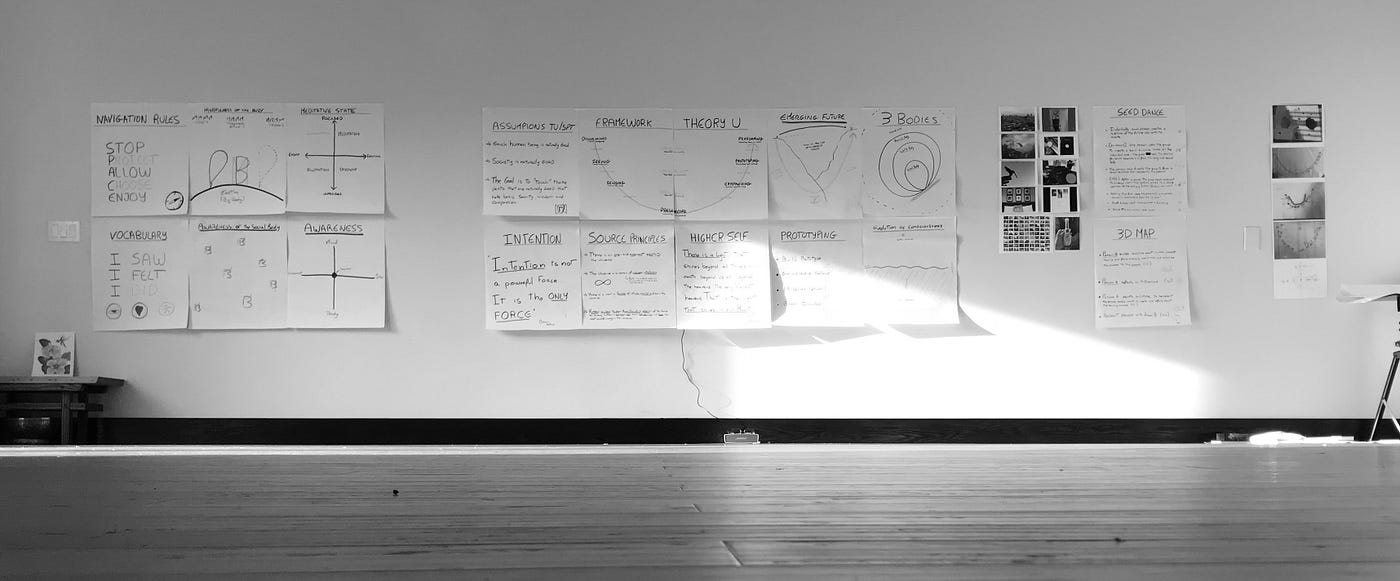
SPT is not something that truly lands through concepts alone. It’s something people understand through direct, embodied experience.
But we live in a world of short invitations, program descriptions, and social media blurbs. In that world, SPT often struggles.
Over time, I’ve experimented with different ways of communicating what this work is.
In Greece, after that frustrating workshop with low attendance, I offered my colleague a simple metaphor:
“I believe that mindfulness is to an individual what Social Presencing Theater is to a system.”
Something clicked in him and he answered:
“Ah — so this is mindfulness for systems! Now I get it.”
I know it’s not a perfect definition and it can also be applied to other approaches like Bohm’s Dialogue. But it opened a door in him in that moment. And sometimes that’s enough.
The Stockholm moment: When changing the language changed the whole field
A few months ago, after the IDG Summit in Stockholm, I facilitated a workshop for leaders from NGOs, foundations, and international organizations — CEOs, UN representatives, senior practitioners. I wanted to explore what Peter Senge had referred to during the Summit as ethical space — what many of us in the Presencing field would recognize as the social field.
Naturally, I chose Social Presencing Theater as the main approach, offering them a lived and tangible experience, rather than entering into conceptual discussions.
I started the workshop: “We’re going to explore Peter Senge’s concept of ethical space using practices from Social Presencing Theater…”
But as soon as I said “Theater,” I felt it in the room.
Subtle tension. Bodies tightening. A slight apprehension in people’s eyes. As a psychologist, I’m trained to read these micro-shifts in body language. The word theater seemed to evoke performance or being exposed — pulling people out of their bodies and into their heads, out of presence and into anticipation.
In that split second, something unexpected came to mind.
Some time earlier, ChatGPT had accidentally “hallucinated” and translated SPT as “Somatic Practices for Transformation” instead of Social Presencing Theater. At the time, I had laughed it off as a funny mistake. But in that moment, it felt like exactly the right doorway.
So I adapted, spontaneously:
“You can also hear SPT as Somatic Practices for Transformation — or, even better, as Somatic Presencing for Transformation. You might think of it as the somatic branch of the Presencing Institute and the u-school for Transformation.”
The shift was immediate and palpable.
People relaxed. Understanding became intuitive. The conceptual resistance dissolved. The field opened.
I even joked: “If my colleagues at the Presencing Institute knew I was using another name, they’d probably roast me over a fire.”
The room laughed — and the last traces of tension dissolved.
The practice that followed unfolded beautifully.
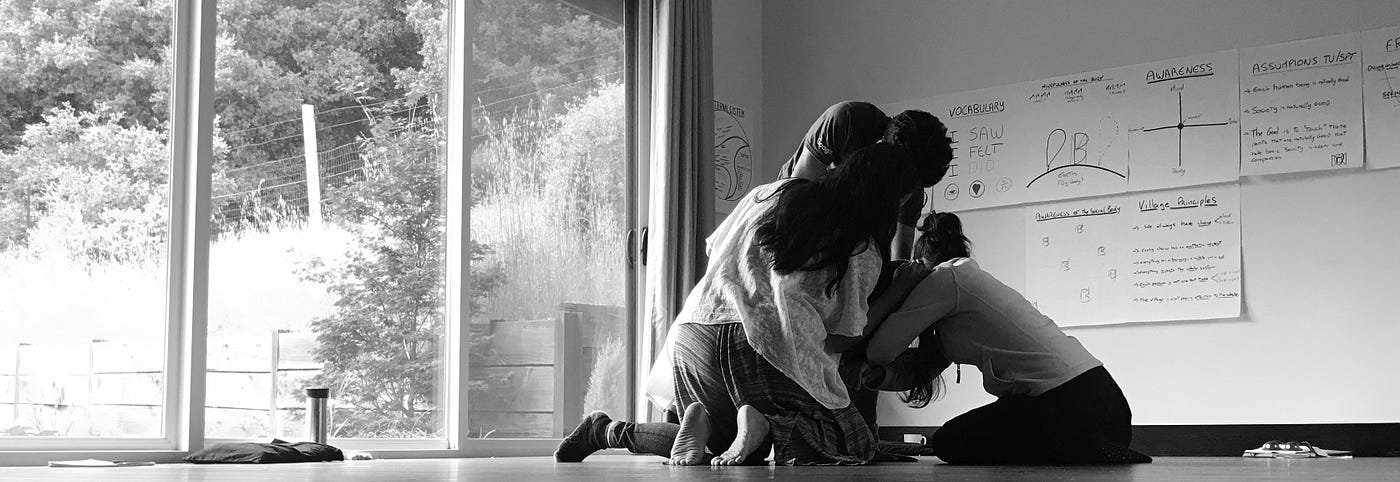
Stuck practice
Why this other name worked in that context?
After that experience, I started understanding why this alternative framing landed so differently:
Somatic — anchored the work in the body, which is increasingly recognized and credible in transformation work. It removed the performance anxiety that “theater” triggered while honoring the embodied nature of the practice.
Presencing — maintained complete fidelity to the source, honoring the Presencing Institute and Theory U.
**For Transformation** — connected naturally to the u-school for Transformation, making the purpose clear without abstraction. It named the intent explicitly. (other option for the T would be Togetherness, aligned with the social dimension of SPT and the u-school project Crafting Pedagogies of Togetherness).
Together, these words created a doorway that felt accessible, credible, and aligned — without triggering the “I’m not doing theater” kind of resistance.
It’s similar to how Internal Family Systems (IFS) exists as a therapeutic approach, and Somatic IFS exists as a body-oriented branch of the same work. Both are legitimate. Both serve different entry points. Why couldn’t the same be true here?
Sharing with the field
After the Stockholm workshop, I felt compelled to share this experience with colleagues at the Presencing Institute and the SPT teacher community.
The response has been consistently: “Interesting!”
That encouragement gave me permission to explore this more openly and bring it to a wider conversation.
Maybe the practice isn’t the problem
Experiences like this have led me to a simple question:
What if the challenge of Social Presencing Theater is not the practice itself — but how we talk about it?
Please note that I’m not suggesting we change the name.
I am wondering whether we need more contextual, adaptable ways of inviting people into the field — so this beautiful movement can reach more people who need it, and expand into spaces where it can make the greatest difference.
In my own work, I’ve noticed I already do this instinctively. When creating the enrollment page for my SPT Basics program in Portugal, I found myself leading with: “There are forms of intelligence that don’t live in the mind. They live in the body, in relationships, in the systems we’re part of.”
Throughout the description, the word “somatic” appears repeatedly — somatic presence, somatic techniques, somatic approaches. The word ‘theater’ surfaces only later — when explaining the official name and its origins.
I wasn’t consciously trying to hide anything. I was simply describing the work in a way that would actually land with people who normally come to my workshops — people more aligned with “somatics” than “theater.”
Different cultures, professional backgrounds, and embodied vocabularies resonate with different doorways. The name we use already shapes the field — before a single movement is made.
Perhaps the simplest solution is already happening organically: many of us already use SPT as the primary name — a neutral acronym that creates space rather than assumptions — and then expand it contextually depending on who we’re speaking with.
This is hardly revolutionary. It’s how many established practices already work. People say “IFS” far more often than “Internal Family Systems.” Business professionals talk about getting an “MBA” without constantly unpacking “Master of Business Administration.” The acronym becomes the identity, and the full name expands when context requires it.
For SPT, something similar might already be happening organically — each facilitator finding the language that opens the door for their particular audience, while the acronym and the practice remain consistent. The doorway changes. The destination doesn’t.
Perhaps this is less about branding, and more about care.
Care for the field we are trying to open.
Care for meeting people where they are, so they can experience what wants to emerge.
In Buddhism, the word upaya points to skillful means — finding the right way to meet people where they are. Since SPT has deep roots in the Tibetan Buddhist tradition of Shambhala, this adaptive approach might actually honor those origins. Arawana Hayashi and the founders of SPT created something profound; perhaps part of honoring that work is helping more people find their way into it. 🙏

Stuck practice
An open invitation
So I’ll leave this as an open question — especially for those working with SPT and related practices:
How do you introduce this work?
What metaphors, names, or framings have helped people enter more easily?
How do we stay true to the essence, while meeting people where they are?
Because when people finally step into the practice, one thing becomes very clear:
It works.
The impact is real. The transformation is palpable. Systems see themselves. Fields open. Futures emerge.
And that, ultimately, is what matters.
Vasco Gaspar facilitates awareness-based human flourishing — supporting individuals and groups to reconnect with their essence and transform the systems they’re part of. He integrates approaches rarely found together: Internal Family Systems (IFS), Compassionate Inquiry, Social Presencing Theater, and Heartfulness meditation. Through inner dive sessions, workshops, and retreats, he creates spaces where transformation happens not through conceptual understanding alone, but through embodied presence and lived experience. Based in Portugal and working internationally, his practice is grounded in a simple belief: at our essence we are deeply wise and compassionate, and sometimes we just need the right conditions to re:member that. Learn more at vascogaspar.com
메타데이터
- post_id
- c8eca1f3fa2d
- slug
- when-a-practice-works-but-the-name-gets-in-the-way-c8eca1f3fa2d
- url
- https://medium.com/presencing-institute-blog/when-a-practice-works-but-the-name-gets-in-the-way-c8eca1f3fa2d
- canonical_url
- https://medium.com/presencing-institute-blog/when-a-practice-works-but-the-name-gets-in-the-way-c8eca1f3fa2d
- author_url
- https://medium.com/@human-flourishing
- status
- ok
- fetched_at
- 2026-06-15 20:49:13