Synchronous vs Asynchronous Banking Transactions: How Core Banking Really Works
How core banking systems balance strong consistency and background processing using real-world
Synchronous vs Asynchronous Banking Transactions: How Core Banking Really Works
How core banking systems balance strong consistency and background processing using real-world

We use banking systems almost every day — checking balances, withdrawing cash, paying through UPI , as a user we won’t much bothered about how those transactions actually work. Everything feels instant, almost effortless.
It wasn’t until I got the opportunity to work in the banking domain that I started looking at these transactions more closely. That’s when an interesting pattern emerged. Not all banking operations behave the same way. Some demand immediate, strongly consistent outcomes, while others can safely happen in the background without the customer ever noticing.
This led me to a deeper questions which banking operations truly require strong consistency, and why does eventual consistency often fail in few core banking scenarios? And if core banking cannot be fully distributed, where does microservices architecture actually add value in a banking ecosystem?
On the surface, modern banking systems look real-time and simple. Behind the scenes, they are a carefully engineered mix of synchronous and asynchronous operations — each used deliberately, and never by accident. Getting this balance wrong can lead to serious financial and regulatory risks.
In this article, I’ll break this down using real, everyday banking examples. We’ll look at:
- Which banking operations must be synchronous
- Which operations can safely run asynchronously
- A realistic ATM withdrawal flow to show how both models work together
By the end, the goal is not to promote a specific architecture pattern, but to build an intuitive understanding of how banks protect money while still operating at massive scale.
Why Banking Can’t Be Fully Asynchronous
Banks deal with one thing that software systems fear most money that cannot be duplicated, lost, or delayed incorrectly.
If a user withdraws ₹10,000 from an ATM, the system cannot respond with:
“We’ll process it later.”
At the same time, banks also run thousands of background processes that do not need an immediate response. This is why real banking systems use a hybrid execution model.
What Synchronous Means in Banking
A synchronous operation is one where:
- The customer or merchant is waiting for a response
- The decision must be made immediately
- The result must be strongly consistent
If the operation fails, it must fail now, not later.
Banking Operations That Must Be Synchronous
These operations are short-lived, atomic, and directly impact money or access to money.
1. Login and Authentication
- Internet banking login
- ATM PIN verification
- UPI PIN validation
If authentication is delayed or inconsistent, the entire system becomes insecure.
2. Debit Authorization
Examples:
- ATM cash withdrawal
- Card swipe at a POS machine
- UPI debit approval
These operations:
- Lock the account
- Check available balance
- Debit money
- Create a ledger entry
All of this happens inside one ACID database transaction.
There is no retry-based compensation here. Either the debit succeeds, or it does not happen at all.
3. Limits and Compliance Checks
- Daily withdrawal limit
- Account freeze check
- KYC compliance validation
These checks must complete before money moves.
Why Strong Consistency Is Non‑Negotiable
In core banking:
- Double debit is unacceptable
- Eventual consistency is risky
- Compensation logic is dangerous
This is why banks still rely on single-writer ledgers backed by highly reliable relational databases.
What Asynchronous Means in Banking
An asynchronous operation is one where:
- The user does not need to wait
- The task may take time
- The system can retry safely
These operations improve scalability without risking financial correctness.
1. Notifications
- SMS alerts
- Email confirmations
- Push notifications
If an SMS is delayed, the money is still safe.
2. Ledger Reconciliation
- End-of-day balance matching
- Inter-bank settlement
- NPCI / RBI clearing processes
These run in batch or near‑real‑time modes.
3. Fraud Detection
- Pattern analysis
- Risk scoring
- Regulatory reporting
These systems consume transaction events and work independently of the debit path.
4. Statement Generation
- Monthly statements
- Passbook print updates
- Downloadable transaction history
5. Interest and Charges Calculation- Time-Based, Not User-Driven
Another major category of banking operations that runs asynchronously is interest and charges calculation. These processes are driven by time and rules — not by a customer clicking a button.
- Savings account interest
- Loan interest accrual
- Penalties and service charges
These are time-based processes, not user-driven.
Savings Account Interest
Savings account interest is usually calculated daily and credited monthly or quarterly. Millions of accounts may be involved, but no customer is waiting online for this to complete. Banks run scheduled jobs that:
- Identify eligible accounts
- Calculate accrued interest
- Generate posting instructions
These jobs often run during off-peak hours to reduce system load.
Loan Interest Accrual
Loan systems accrue interest daily, even though customers may only see the impact at the end of the month. The calculation itself is repetitive and deterministic, making it ideal for background processing.
If a batch fails, it can be rerun without risking financial inconsistency.
Penalties and Service Charges
Minimum balance penalties, late payment fees, and service charges follow predefined rules and dates. These charges are applied by scanning accounts, evaluating conditions, and posting fees asynchronously.
Again, no customer interaction is required at the moment these calculations run.
All of these processes share common traits:
- They are time-based
- They are repeatable
- They are safe to retry
Which is why banks design them as asynchronous workflows.
6. Downloadable Transaction History -A Perfect Asynchronous Use Case
When a customer downloads their transaction history — say the last six months of account activity — they are not triggering a financial decision. No money is being moved. No balance is being altered.
Behind the scenes, the bank typically:
- Fetches transaction data from reporting or read-only databases
- Aggregates and formats the data (PDF, CSV, or Excel)
- Applies masking or compliance rules
- Generates the file and makes it available for download
This process can take a few seconds without causing any concern. If it fails, it can be retried safely. The customer is not blocked from using their account in the meantime.
That makes downloadable transaction history a naturally asynchronous operation, often implemented using background jobs or dedicated microservices
A Real Example: ATM Withdrawal Flow
Now let’s contrast those background processes with one of the most sensitive operations in banking: an ATM withdrawal.
Synchronous Path: While the Customer Is Waiting
This is the part of the transaction that must complete before cash can be dispensed.
- ATM reads the card Card details are captured and validated.
- PIN is validated The customer’s PIN is verified using secure authentication systems.
- Account balance is checked The system confirms that sufficient funds are available.
- Debit transaction is executed The account is locked, funds are debited, and a ledger entry is created in a single atomic operation.
- Cash is dispensed Only after the debit is successfully confirmed.
This entire flow completes in a few hundred milliseconds. It is synchronous, strongly consistent, and designed to prevent any possibility of double debit.
Asynchronous Path: After Cash Is Dispensed
Once the customer has received their cash, the system moves into background processing mode.
- SMS notification is sent A confirmation message is triggered for the customer.
- Transaction is analyzed for fraud Risk and behavior analysis systems evaluate the transaction.
- Audit logs are written Compliance and regulatory records are stored.
- End-of-day reconciliation is scheduled Transactions are matched and settled during batch processing.
The customer never waits for these steps. Even if one of them is delayed, the correctness of the withdrawal is not affected.
The Design Principle Behind All of This
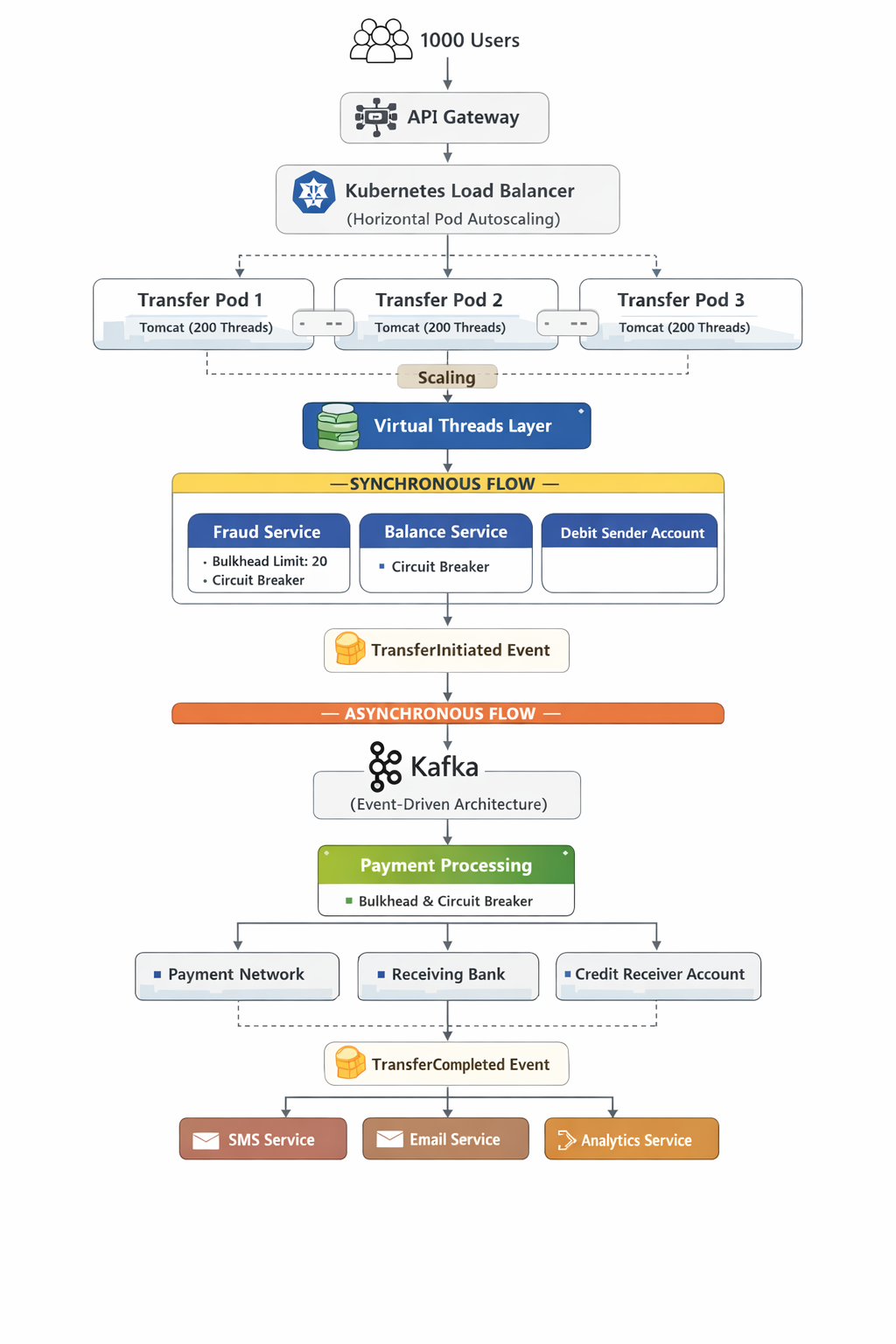
Banks deliberately separate:
- Customer-facing decisions, which must be synchronous
- Operational and analytical work, which can safely be asynchronous
This separation allows banks to scale, remain compliant, and still protect the integrity of money.
Conclusion
Not everything in banking needs to be fast. Some things need to be right.
By running time-based and non-critical operations asynchronously, and reserving synchronous execution for real-time money movement, banks strike the balance that keeps systems both reliable and scalable.
If you found this helpful, don’t forget to give this article a clap 👏 and **follow **me for more tips and insights! Your support means a lot.
메타데이터
- post_id
- c8fc683bebc9
- slug
- synchronous-vs-asynchronous-banking-transactions-how-core-banking-really-works-c8fc683bebc9
- url
- https://levelup.gitconnected.com/synchronous-vs-asynchronous-banking-transactions-how-core-banking-really-works-c8fc683bebc9
- canonical_url
- https://levelup.gitconnected.com/synchronous-vs-asynchronous-banking-transactions-how-core-banking-really-works-c8fc683bebc9
- author_url
- https://medium.com/@sudhass
- status
- ok
- fetched_at
- 2026-06-24 13:29:15