The Organisational Data Twin
A practitioner’s guide to building systems that reflect operational reality — not just its history.
The Organisational Data Twin
A practitioner’s guide to building systems that reflect operational reality — not just its history.
Introduction
At Winter(Peerislands) , I worked with two customers who, despite operating in very different domains, shared a remarkably common aspiration. The first managed millions of artwork jobs for marketing purposes. They wanted a data lake that served as a faithful mirror of their entire data infrastructure — queryable at speed — so they could run both operational and predictive workloads seamlessly. Their core need was clarity: understand what the data looks like, govern master data for every job in flight, and verify that what was committed in the workflow tracker actually got done. The second was processing millions of messages per second — live telemetry from their teams and equipment. They needed to observe how data moved through their system, trace how a single message fanned out into multiple status events, and aggregate those propagation graphs to assess the health of their operations in real time. At their core, both customers were asking for the same thing: a digital twin of their organisation’s data — one that lets someone in the operations room ask the system, “What is happening in the business, and who is affected?”— and from that answer, reason forward to “What comes next? What should we do?” This is the fundamental shift enterprise organisations are now demanding from their data engineering teams: from pipelines that move data to systems that reflect operational reality. As it turns out, this demand has a name. Gartner introduced the concept of the Digital Twin of an Organisation (DTO) in 2017, defining it as “a dynamic software model of any organisation that relies on operational and contextual data to understand how an organisation operationalises its business model, connects with its current state, responds to changes, deploys resources, and delivers expected customer value.” What neither of my customers called it by that name — they described it in the language of their own operational pain — is precisely what makes the concept so powerful. The DTO is not a vendor product or a platform category. It is an architectural pattern that data engineering teams can, and must, build. This article is a practitioner’s guide to doing exactly that.

Two different domains and same underlying needs
Pipelines move data. Business needs a living model.
Traditional data engineering is built around movement: extract, transform, load, report. That works well for historical analysis. But as Marc Andreessen observed, every company is now also a software company. Digitalisation raises the stakes for decision speed — and most data platforms answer the wrong question.
Traditional platforms answer: what happened last week? Business operators need: what is blocked right now, who is affected, and what is at risk?

The Structural gap
Enterprise data engineering must evolve beyond data movement. It must model business state and connect it to the structural architecture of the organisation — so decision-makers understand consequences, not just conditions.
What is a Digital Twin of an Organisation?
A DTO is a live, queryable reflection of how the business is operating. It combines what the organisation is — its capabilities, systems, teams, processes — with what is happening right now — events, state changes, delays, failures. That combination creates something no prior data platform could: a feedback loop between organisational structure and live operational reality.

Digital Twin of an Organisation
Gartner identifies twelve use cases — from enterprise performance management and risk to M&A and programme portfolio management. The DTO is not a vertical solution for one industry. It is a horizontal capability every enterprise needs.
Every DTO expresses the same three-part pattern.
The two customer examples look different on the surface. But architecturally, they were solving the same problem with the same structure — one that repeats across every DTO implementation regardless of industry.

DTO Pattern
Different domains. Same principle. The DTO is built by combining operational state, propagation graphs, and wellness signals — layered onto the structural architecture of the organisation.
Three questions, each harder than the last.
A DTO must be useful in the operations room and the boardroom. That means it must answer three practical questions — each requiring a more sophisticated engineering foundation than the one before.

Three levels of DTO Capability
Without Level 1, every decision is made on stale data. Without Level 2, teams cannot understand the blast radius of a change. Level 3 — where the DTO helps leaders understand the consequences of their options before they act — is where it becomes genuinely actionable.
Five building blocks — each with real trade-offs.
A DTO requires a different architectural mindset from traditional reporting. The following five building blocks are essential. Each carries implementation trade-offs that practitioners must navigate.

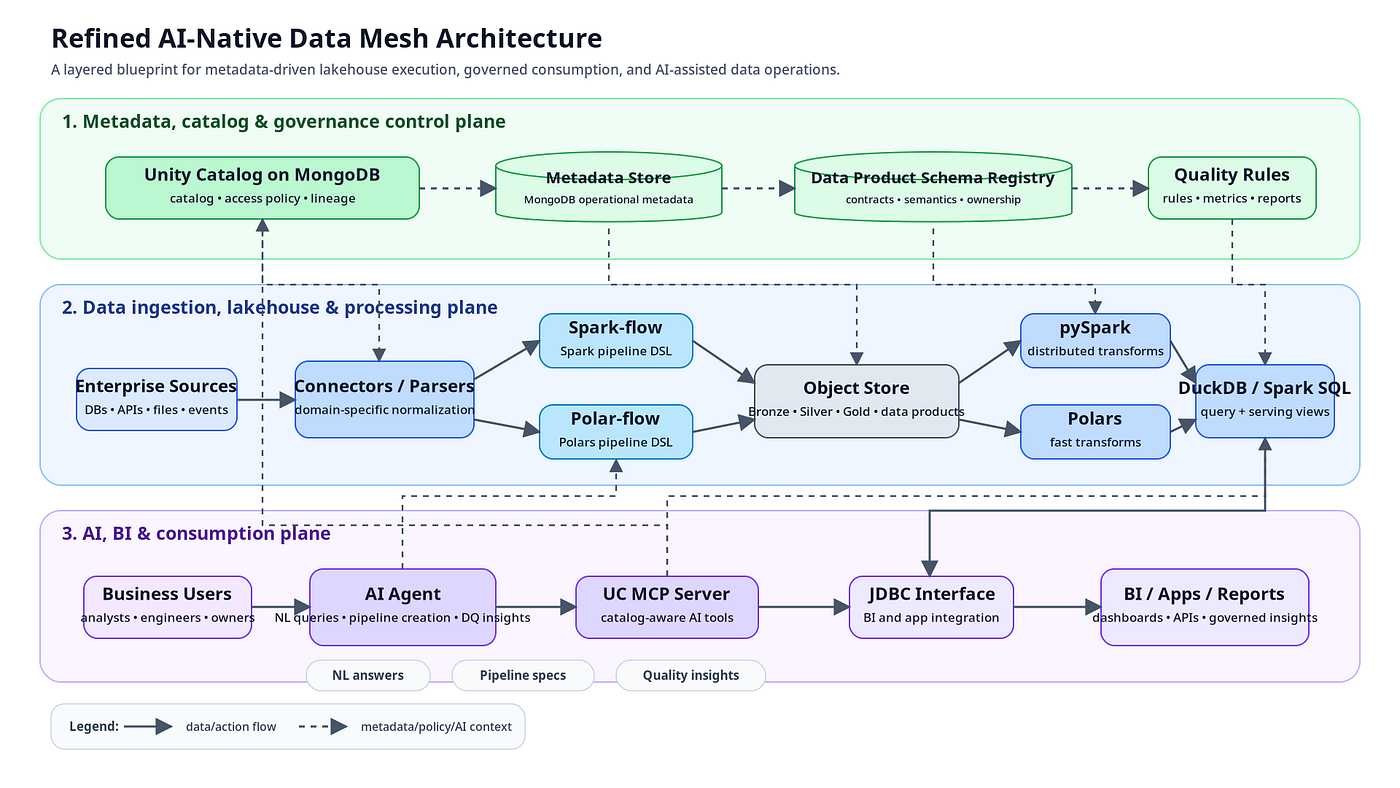
DTO Architecture stack
The goal is not one database for everything. It is the right query layer for the right operational question. AI agents fail not because the models are weak but because the data underneath them is fragmented, stale, or ungoverned. The DTO fixes that foundation.
The new charter for data engineering teams.
Building a DTO changes the role of enterprise data engineering — not just the stack, but the team’s relationship with the business and with Enterprise Architecture. The DTO lives at the intersection of two layers that have never worked together: the operational layer owned by data engineers, and the structural layer maintained by enterprise architects.

Old vs New
The old responsibilities still matter — pipelines and curated tables are not going away. But they are no longer sufficient. Success should be measured differently: did we reduce operational blind spots? Did we help decision-makers understand consequences faster? Did we enable safe automation?
The future of enterprise data engineering is not better pipelines. It is systems that understand the business — and help the business understand itself.
Read part 2 : The Storage War Underneath Your Data Twin
References
- Gartner, “Top 10 Strategic Technology Trends for 2017: Digital Twin” (2017) — gartner.com/en/documents/3647717
- Gartner, “Market Guide for Technologies Supporting a Digital Twin of an Organisation” — gartner.com/en/documents/4003512
- Ardoq, “Evolution of EA: Digital Twin of an Organization” (2024) — ardoq.com/blog/digital-twin-of-an-organization
- Palantir, “Architecting Operational Truth: An End-to-End Guide” — linkedin.com/pulse/architecting-operational-truth…
- Marc Andreessen, “Why Software Is Eating the World”, a16z (2011) — a16z.com/2011/08/20/why-software-is-eating-the-world/
메타데이터
- post_id
- c8ffd828b7ae
- slug
- the-organisational-data-twin-c8ffd828b7ae
- url
- https://tech.ganesh.ky/the-organisational-data-twin-c8ffd828b7ae
- canonical_url
- https://tech.ganesh.ky/the-organisational-data-twin-c8ffd828b7ae
- author_url
- https://medium.com/@ganeshparasuraman
- status
- ok
- fetched_at
- 2026-08-27 06:56:12