Outdoor vs Indoor Tiles: 2026 Export Guide
Morbi Tile Industry Analyst | Factory Intelligence | Export Trends
Outdoor vs Indoor Tiles: 2026 Export Guide
Morbi Tile Industry Analyst | Factory Intelligence | Export Trends
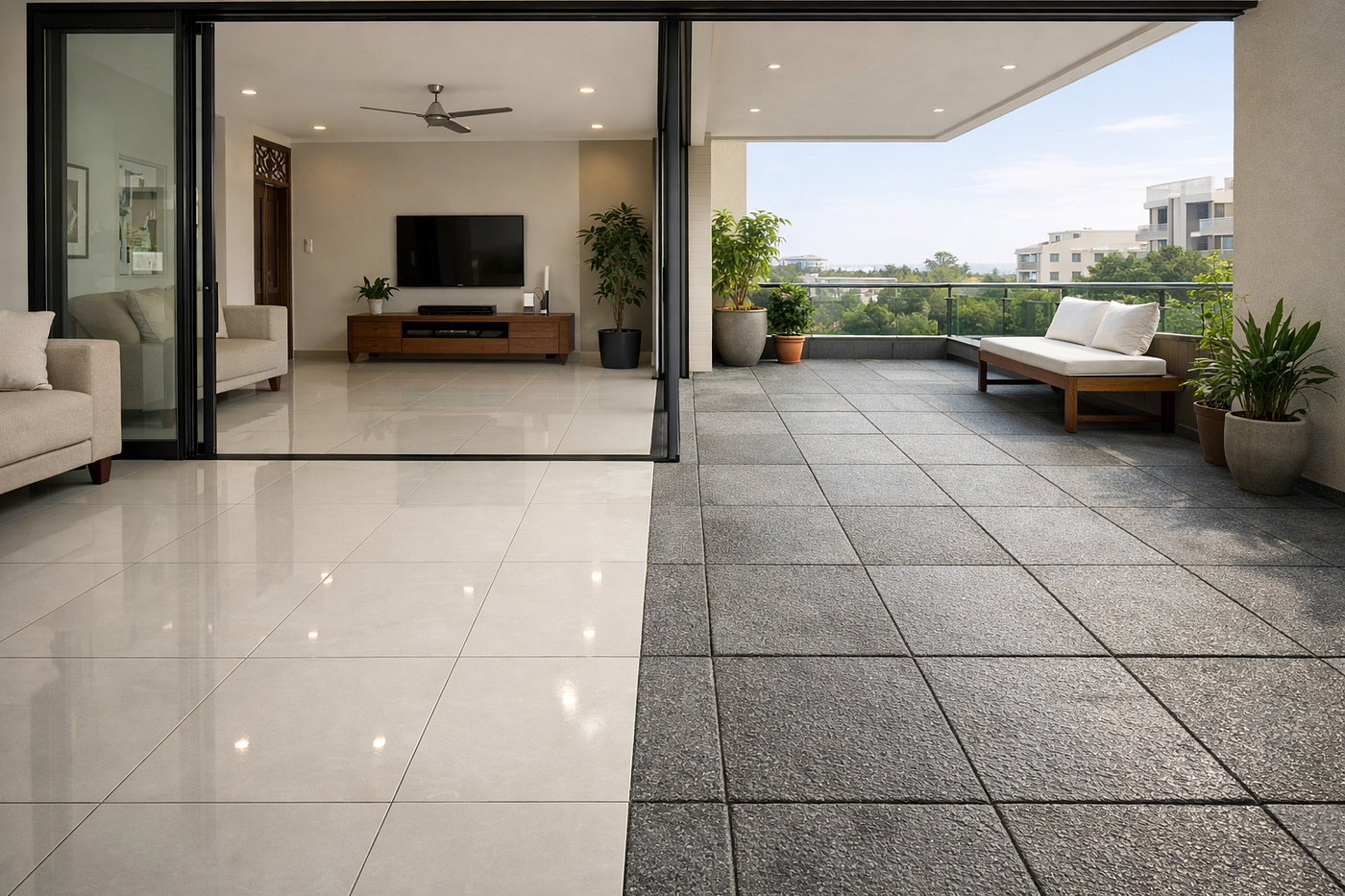
India’s tile exports are no longer just about design — they’re about performance engineering. In 2026, global buyers are demanding specification-driven sourcing, especially when it comes to indoor vs outdoor tile selection.
**From Morbi factory floors to container yards, one mistake importers still make is treating all [vitrified tiles](https://www.morbitilehub.com/vitrified-tiles)** as interchangeable. They are not.
**Outdoor tiles** today are engineered products — built for structural load, water resistance, and climate durability. Indoor tiles, on the other hand, are optimized for aesthetics and controlled environments. Misjudging this difference directly impacts claims, replacements, and long-term margins.
Market Reality Check
The global tile trade is shifting toward performance-certified sourcing, and Morbi manufacturers are adapting fast.
1. Export Pricing Is Thickness-Driven Outdoor tiles — especially 20mm **parking slabs** — are priced significantly higher due to increased raw material usage and firing cycles. While standard indoor tiles operate in a thinner range, outdoor SKUs demand higher kiln energy and longer production time. This directly impacts FOB pricing.
2. Manufacturing Costs Are Rising Fuel costs, clay quality variation, and **polishing technology upgrades are pushing production costs upward. [Anti-skid textures](https://www.morbitilehub.com/tiles/anti-skid-tiles)** (R11/R12) require additional surface processing, increasing per sq.ft manufacturing expense.
3. Specification Compliance Is Now Mandatory Importers in Europe, the Middle East, and North America are increasingly requesting COF ≥ 0.60 and water absorption <0.5%. Suppliers unable to provide lab-tested data are losing export orders.

The takeaway is clear — tile selection is no longer aesthetic-first. It’s specification-first.
Importer Decision Framework
To protect margins and avoid post-installation failures, importers must adopt a structured sourcing strategy.
1. Validate Technical Specifications Always verify thickness, slip rating (R11/R12), and water absorption before confirming orders. Outdoor tiles must meet **porcelain-grade** density standards.
2. Match Application to Product Type Balconies, terraces, and parking zones require **different tile strengths**. A 10–12mm tile may work for covered areas, but open-to-sky applications demand 20mm+ thickness.
3. Check Supplier Manufacturing Capability Not all Morbi factories produce true **outdoor-grade vitrified tiles**. Visit factories or request production videos to confirm pressing capacity and kiln infrastructure.
4. Factor True Landing Cost Ex-factory price is only part of the equation. Add GST, freight, breakage allowance (typically 5%), and port handling charges to calculate real margins.
5. Insist on Batch Consistency Outdoor tiles require **consistent texture** and finish to maintain safety standards. Mixed batches can create slip-risk variations in projects.
At this stage, serious buyers should move beyond catalogue-level decisions.
Complete factory-sourced analysis: **Outdoor vs Indoor Tile Specifications Breakdown**
This level of technical validation is what separates high-margin importers from high-risk buyers.

The Missing Factory Data
What most importers still overlook is the gap between declared specs and actual production output.
Many suppliers quote <0.5% water absorption, but without third-party testing, this claim remains unverified. Similarly, slip ratings are often assumed rather than tested under DIN standards.
The real advantage comes from sourcing directly from factories with proven export documentation and repeat order history.
For deeper factory intelligence and validated sourcing benchmarks, refer to: Morbi Outdoor Tile Buying Insights for Importers → https://morbitaa.blogspot.com/2026/04/outdoor-vs-indoor-tiles-comparison-guide-2026.html?utm_source=medium&utm_medium=guestpost
This is where data-backed sourcing replaces assumption-based buying.

Conclusion
As we move through 2026, the tile export market will continue shifting toward performance-led procurement. Indoor vs outdoor classification is no longer basic knowledge — it’s a strategic sourcing decision.
Importers who prioritize technical validation, supplier capability, and real landing cost analysis will outperform competitors relying on price alone.
Morbi remains the global hub — but only informed buyers will extract its full value.
Publishing Specifications
Tags:
MorbiTiles
CeramicTilesExport
VitrifiedTiles
ConstructionBusiness
InteriorDesign
메타데이터
- post_id
- c8ffdeed6507
- slug
- outdoor-vs-indoor-tiles-2026-export-guide-c8ffdeed6507
- url
- https://medium.com/@morbitaa/outdoor-vs-indoor-tiles-2026-export-guide-c8ffdeed6507
- canonical_url
- https://medium.com/@morbitaa/outdoor-vs-indoor-tiles-2026-export-guide-c8ffdeed6507
- author_url
- https://medium.com/@morbitaa
- status
- ok
- fetched_at
- 2026-07-16 09:36:51