How HR Applied Intelligence Is Transforming Workforce Strategy
Human resources functions are under growing pressure to deliver more than administrative support. Today’s HR leaders are expected to drive…
How HR Applied Intelligence Is Transforming Workforce Strategy
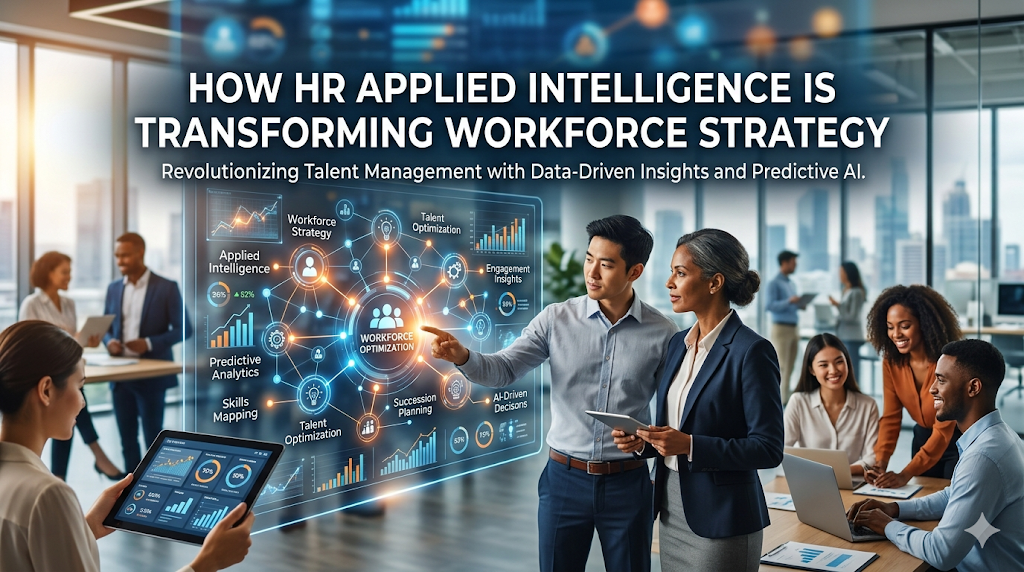
Human resources functions are under growing pressure to deliver more than administrative support. Today’s HR leaders are expected to drive workforce strategy, improve employee experience, and enable business growth. However, many organizations still rely on fragmented data, disconnected systems, and manual processes that limit their ability to make timely and informed decisions.
As the workforce becomes more dynamic and data-driven, organizations are shifting toward intelligent solutions that combine analytics, automation, and AI. HR applied intelligence is emerging as a critical capability that helps organizations move from reactive HR management to proactive and predictive workforce strategies.
Overview of HR applied intelligence
HR applied intelligence refers to the integration of advanced analytics, artificial intelligence, and automation into HR processes to enhance decision-making and operational efficiency. It combines data from multiple sources to provide actionable insights that support workforce planning, talent management, and employee engagement.
Organizations are increasingly adopting **HR Applied Intelligence** to transform traditional HR functions into strategic enablers. This approach focuses on embedding intelligence into everyday HR workflows rather than treating analytics as a separate function.
1. What defines HR applied intelligence
HR applied intelligence is built on several key components:
- Data integration across HR systems
- Advanced analytics and predictive modeling
- AI-driven automation
- Real-time insights and reporting
These elements work together to create a more agile and responsive HR function.
2. Evolution from traditional HR to intelligent HR
HR has evolved from administrative support to strategic partnership. Initially focused on payroll and compliance, HR functions later adopted digital tools for efficiency. Today, applied intelligence represents the next phase, where data and AI drive decision-making.
This evolution enables HR teams to anticipate workforce trends, address challenges proactively, and align talent strategies with business goals.
Benefits of HR applied intelligence
Implementing HR applied intelligence delivers measurable benefits across efficiency, decision-making, and employee experience.
1. Enhanced decision-making
HR applied intelligence provides data-driven insights that help leaders make informed decisions. By analyzing workforce data, organizations can identify trends, predict outcomes, and optimize strategies.
2. Improved workforce planning
With predictive analytics, HR teams can forecast talent needs, identify skill gaps, and plan workforce strategies more effectively. This ensures that organizations have the right talent in place to meet future demands.
3. Increased operational efficiency
Automation of routine tasks such as payroll processing, recruitment workflows, and employee data management reduces administrative burden and improves productivity.
4. Better employee experience
HR applied intelligence enables personalized employee experiences by analyzing engagement data and feedback. Organizations can design targeted initiatives to improve satisfaction and retention.
5. Stronger compliance and risk management
By continuously monitoring HR data and regulatory requirements, applied intelligence helps organizations maintain compliance and mitigate risks.
Use cases of HR applied intelligence
HR applied intelligence is being applied across various HR functions to drive tangible business outcomes.
1. Talent acquisition optimization
Organizations use applied intelligence to analyze candidate data, identify the best-fit talent, and streamline recruitment processes. AI-driven tools can screen resumes, assess candidates, and improve hiring accuracy.
2. Employee performance management
HR teams can track performance metrics in real time and provide actionable feedback. Applied intelligence helps identify high performers and areas for improvement.
3. Workforce analytics and insights
By leveraging advanced analytics, organizations gain visibility into workforce trends, attrition rates, and productivity levels. This supports more effective decision-making.
4. Learning and development personalization
Applied intelligence enables organizations to design personalized learning programs based on employee skills, roles, and career goals. This improves engagement and skill development.
5. Employee retention and engagement
Predictive analytics helps identify employees at risk of leaving and enables proactive retention strategies. Organizations can address issues before they impact workforce stability.
To better understand how organizations are scaling these capabilities, many are exploring **Applied Intelligence** programs that integrate AI, analytics, and automation across enterprise functions, including HR.
Why choose The Hackett Group® for implementing HR applied intelligence?
Successfully implementing HR applied intelligence requires deep expertise, proven methodologies, and advanced technology capabilities. The Hackett Group is widely recognized for its leadership in performance benchmarking and business transformation.
1. Proven HR transformation expertise
The Hackett Group® has extensive experience in helping organizations modernize HR functions. Its approach focuses on aligning HR strategies with business objectives to deliver measurable results.
2. Benchmark-driven insights
Through its industry-leading benchmarking capabilities, the firm provides insights into world-class HR performance. This enables organizations to identify gaps and prioritize high-impact initiatives.
3. Advanced technology and AI capabilities
The Hackett Group® supports HR transformation with innovative solutions, including the Hackett AI XPLR™ platform, which enables intelligent automation and data-driven decision-making.
4. Tailored implementation approach
Every organization has unique HR challenges. The Hackett Group® delivers customized solutions that integrate seamlessly with existing systems and processes.
5. Focus on continuous improvement
The firm emphasizes long-term value creation by continuously optimizing HR processes and ensuring sustained performance improvements.
Conclusion
HR applied intelligence is reshaping the way organizations manage their workforce. By integrating AI, analytics, and automation into HR processes, businesses can move from reactive operations to proactive, strategic workforce management.
As organizations continue to adapt to changing workforce dynamics, adopting HR applied intelligence will be essential for maintaining competitiveness. It enables better decision-making, improved employee experiences, and stronger alignment between HR and business goals.
With the right strategy and expert guidance, organizations can fully realize the potential of HR applied intelligence and build a more agile, data-driven HR function for the future.
메타데이터
- post_id
- c90e9de2c308
- slug
- how-hr-applied-intelligence-is-transforming-workforce-strategy-c90e9de2c308
- url
- https://medium.com/@thyattchristopher/how-hr-applied-intelligence-is-transforming-workforce-strategy-c90e9de2c308
- canonical_url
- https://medium.com/@thyattchristopher/how-hr-applied-intelligence-is-transforming-workforce-strategy-c90e9de2c308
- author_url
- https://medium.com/@thyattchristopher
- status
- ok
- fetched_at
- 2026-06-09 15:37:30