Is 86 47 Violent? Try 63 68
By Janet Dagley
Is 86 47 Violent? Try 63 68
By Janet Dagley
Please note: Political violence is never appropriate. I condemn not only such violence, but threats of, and calls for any kind of violence.
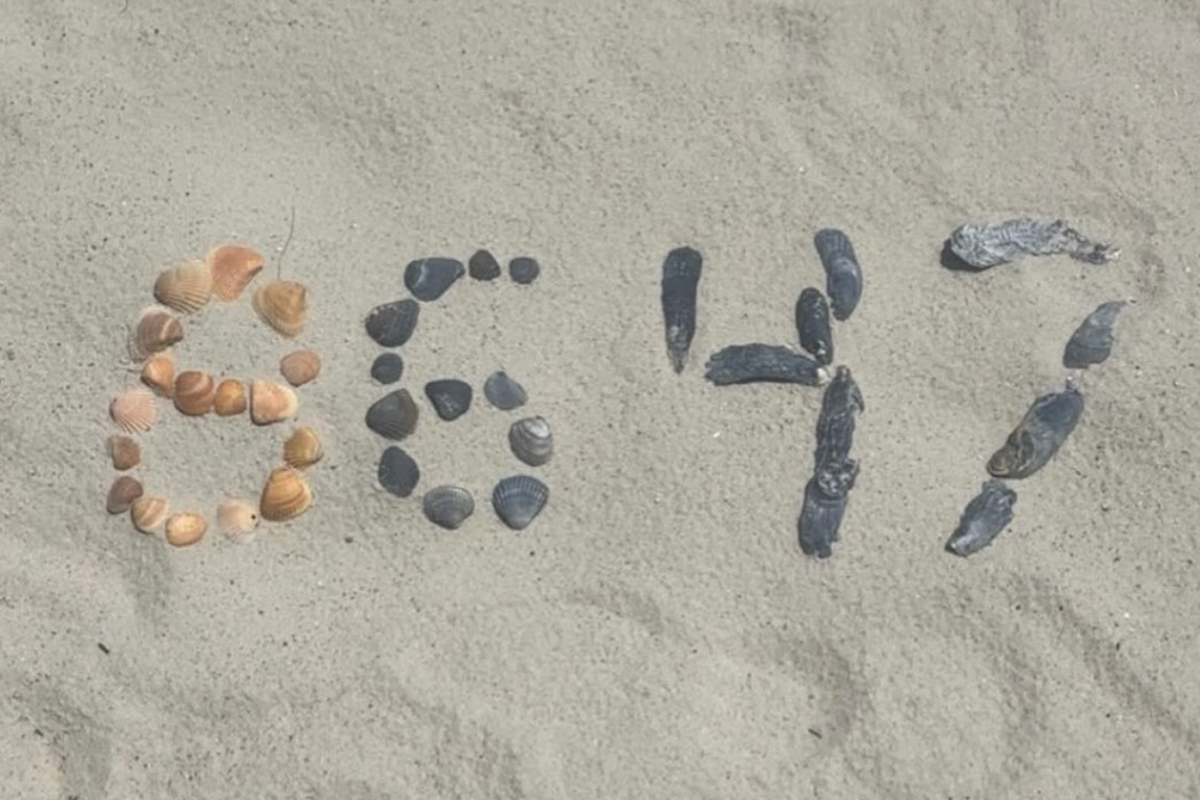
The U.S. Justice Department has charged that four digits — 8647 — in themselves constitute a death threat, and they have charged the former director of the Federal Bureau of Investigation with threatening to kill the President for posting a photo of those numbers spelled out in seashells and rocks on a beach.
The number 86, prosecutors charged, meant “kill.” And they claimed “47” meant Donald Trump. The President himself later stated that “86” was a Mob term that meant “kill.” Never having been in the Mob myself, I wouldn’t know. To many, 86 simply means “throw out,” as one would toss spoiled food in a restaurant kitchen.
In the wake of yet another unsuccessful assassination attempt on the President of the United States (but strangely, without reference to the successful assassinations of a Minnesota legislator, her husband and even the killings of their dogs, or the arson attack on the Pennsylvania governor’s mansion), pundits decades my junior are declaring that we are in an unprecedented era of political violence.
Unprecedented?
When a shaken reporter covering the incident at the White House Correspondents Association dinner made that claim, my husband yelled at the TV: “When were you born?”
To the Justice Department as well as political pontificators, I offer two more numbers, numbers associated with violent turning points in my childhood, not to mention the history of our nation: 63 and 68.
63:
I was a 10-year-old sixth-grader when one afternoon in November, 1963, our class was studying our nation’s 16th president, Abraham Lincoln. We were working our way through time to April, 1865. One of our classmates, Lila, was attending school from home, since she was bedridden in a full body cast. The school district had set up a closed-circuit speaker system, with one end on her bedside table, and the other on our teacher’s desk. At the time, it was state-of-the-art communications technology.
Suddenly Lila interrupted the lesson, shouting, “The President’s been shot!” At first, we thought she and our teacher were performing a re-enactment of the Lincoln assassination. But our teacher’s shocked reaction showed us instantly that it was not.
Lila had a transistor radio, as most of us kids did then, and her mother placed it on the nightstand facing the speaker, volume up to the max. The class listened for more than an hour as the news of President John Kennedy’s assassination unfolded, and soon other classes, teachers, and even the principal crowded into our classroom to listen, too. Eventually school was dismissed, and students wandered home.
My contemporaries and I have remembered, all this time, exactly where we were when Kennedy was shot. (Even dementia patients remember the distant past better than what happened yesterday.) Even though we knew there had been other presidential assassinations in our history, we were stunned.
Two days later, as we watched the nonstop TV coverage of the aftermath of Kennedy’s death, the nation saw its first live televised murder, as accused presidential assassin Lee Harvey Oswald was shot at point blank range while being transferred from one jail to another. My generation grew up with the image of his face, contorted in agony, burned into our brains.
The schools adjusted their curriculum to include recent events. “Assassination” became one of our spelling words. We learned about the assassinations not only of Lincoln, but of Presidents James A. Garfield and William McKinley. We learned the song “White House Blues,” about the McKinley killing, in which Mrs. McKinley allegedly said,
“Look here, you rascal, see what you’ve done
You shot my husband and I’ve got your gun
I’m carrying you back to Washington…”
(It was only after McKinley’s death in 1901 that the U.S. Secret Service was ordered to provide protection for the President).
We learned about the legendary “Curse of Tippecanoe,” associated with Presidents elected in years divisible by 20, beginning with 1840’s William Henry Harrison, who died barely a month into his presidency, allegedly from an illness he caught by not wearing a hat at his chilly inauguration.
President Warren G. Harding (elected in 1920), died in office of a heart attack. President Franklin D. Roosevelt (elected in 1932, 1936, 1940, and 1944) died of a cerebral hemorrhage. And President Kennedy (elected in 1960) was shot to death.
68
Five years after the Kennedy assassination, I was in high school when the news broke one April evening that the Rev. Dr. Martin Luther King had been gunned down by an assassin in Memphis. Again, the nation was shocked and fearful of what might happen next.
It didn’t take long for us to find out what was next. Weeks later, I was on summer break, visiting my aunt and uncle on their farm, where there was no TV or phone. We were already in bed that night when a neighbor came running down the lane, shouting, “Robert Kennedy’s been shot!” We woke up in disbelief: Another Kennedy shot? How could it have happened again?
Those too young to recall 1963 or 1968 may remember September, 1975, when, days apart, two female would-be assassins took aim at President Gerald Ford. Secret Service agents wrested the gun away from the first attacker before she could fire. The second attacker managed two shots that went wild as a bystander grabbed her arm. Ford was uninjured, but he began wearing a bulletproof coat at later events.
Or they might remember March 30, 1981, when, outside the same Washington Hilton Hotel where the most recent incident occurred, President Ronald Reagan was shot and seriously wounded. “All in all, I’d rather be in Philadelphia,” he joked before being put under for surgery. Reagan’s survival and full recovery was said to have broken the 140-year-old Curse of Tippecanoe.
For years I studied the JFK assassination, trying to solve an insoluble mystery. During my research I learned that in the days before he was shot, posters with his photo and the words “Wanted for Treason” were being distributed in Ft. Worth and Dallas. Kennedy knew that, and he went anyway, despite warnings from, among others, the Rev. Billy Graham, who told him not to go because “something bad” might happen.
Kennedy did not call for those who distributed those hateful messages to be criminally charged. Nor did he sic the Justice Department on those who placed a full-page ad criticizing him in the local newspapers there. As it turned out, those notices were never connected to the assassination. Ironically, the Kennedys, along with Vice President Lyndon Johnson and Mrs. Johnson, Texas Governor John Connally and Mrs. Connally, were enjoying a warm welcome from the local crowds just before the fatal shots were fired.
Threats of violence, and calls for it, are also not unprecedented. What is unprecedented are the many such threats and calls made by President Donald Trump, during his campaigns and presidencies. Over the years he has made various calls for those who disagree with him to be beaten, shot, locked up, hanged, or otherwise executed.
A few examples:
1989: Trump took out a full-page newspaper ad calling for the executions of the Central Park Five, now known as the Exonerated Five after DNA proved they were not guilty.
2015: (Re: protestors) “Just knock the crap out of them, would you? Seriously, OK, knock the hell. I promise you, I will pay for the legal fees.”
2016: “I would bring back waterboarding. And I’d bring back a helluva lot worse than waterboarding.”
“I’d like to punch him in the face.”
2017: To New York police officers: “Please don’t be too nice.”
2018: “Any guy who can do a body slam, he’s my kind of guy.”
2019: He recommended a trench filled with snakes and alligators to catch migrants, and suggested “shooting them in the legs.”
2020: “Can’t you just shoot them?” about those protesting the killing of George Floyd in Minneapolis.
2024: “If you had one really violent day…one rough hour, and I mean really rough, the word will get out and it will end immediately.”
Over the years he has also called those who disagree with him sick, evil, enemies, thugs, traitors, and more.
I’m old enough to remember the phrase “the loyal opposition.” Those words have never come from Trump’s mouth, or his social-media spewing fingers.
As I noted at the beginning, political violence is never appropriate. I condemn all violence, as well as threats of, and calls for violence. That includes such calls — unprecedented — from the President of the United States.
And the numbers 8647 are not a call to violence.
메타데이터
- post_id
- c97cd881e129
- slug
- is-86-47-violent-try-63-68-c97cd881e129
- url
- https://medium.com/@chair.rcdp/is-86-47-violent-try-63-68-c97cd881e129
- canonical_url
- https://medium.com/@chair.rcdp/is-86-47-violent-try-63-68-c97cd881e129
- author_url
- https://medium.com/@chair.rcdp
- status
- ok
- fetched_at
- 2026-06-22 07:15:07