Beyond 2025: Homagama 2030 — Sri Lanka’s Future Knowledge and Innovation City
The future competitiveness of nations will depend on their ability to build innovation ecosystems. With expanding higher education…
Beyond 2025: Homagama 2030 — Sri Lanka’s Future Knowledge and Innovation City
The future competitiveness of nations will depend on their ability to build innovation ecosystems. With expanding higher education infrastructure, a new generation of healthcare facilities, internationally connected research laboratories, and strategic global partnerships, Homagama is positioning itself as one of Sri Lanka’s most promising innovation destinations for the decade ahead.
The future of Homagama is extending far beyond the boundaries of a traditional university town. As Sri Lanka moves toward a knowledge-driven economy, Homagama is emerging as a strategic future city powered by education, healthcare, science, technology, and global innovation partnerships. With the continuous expansion of the NSBM Green University ecosystem through its upcoming Phase 2 and Phase 3 developments, the growth of advanced healthcare infrastructure, and the establishment of Sri Lanka’s first Biotechnology Innovation Park in Pitipana through a collaboration between SLIBTEC and USAID. By housing high-end manufacturing firms and providing a centralized multidisciplinary research facility focused on biopharma, biofuel, and agro-biotech, this landmark hub is designed to attract international investments, foster entrepreneurship, and increase the country’s hi-tech exports by at least 1%.
By 2030, this transformation has the potential to create a globally connected ecosystem where universities, healthcare institutions, research organizations, entrepreneurs, investors, and technology companies converge to develop solutions for Sri Lanka and the world.
NSBM Green University Phase 2: Building the Foundation of a Knowledge City
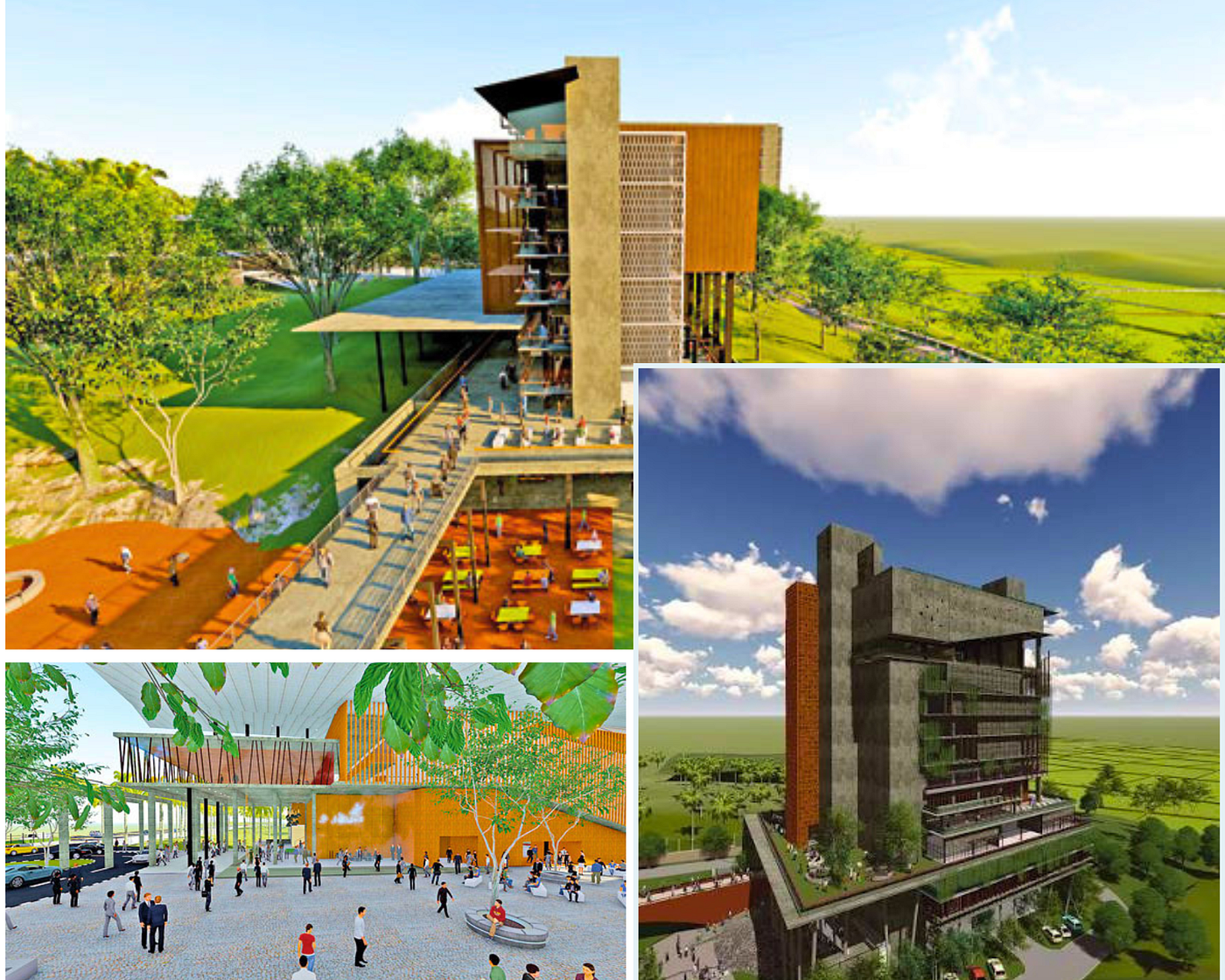
Image : NSBM Green University’s proposed 15-storey Phase 2 faculty building in Homagama.
A major milestone in Homagama’s future development is the expansion of NSBM Green University through its Phase 2 development project. The project introduces a new multi-storey faculty building complex, including a proposed 15-storey facility designed to expand advanced education capabilities.
The new faculty complex will strengthen NSBM’s role as a leading higher education hub by introducing facilities for:
- Faculty of Medicine
- Faculty of Law
- Faculty of Health Sciences
The development will include modern academic infrastructure such as advanced lecture halls, computer laboratories, tutorial rooms, student collaboration spaces, and other educational facilities.
The complex will feature:
- One 500-seat capacity lecture hall
- One 250-seat capacity lecture hall
- Seven 100-seat capacity lecture halls
- Computer laboratories
- Tutorial rooms
- Student gathering spaces
- Outdoor student activity terraces
These facilities represent more than physical expansion. They represent the creation of an environment where future doctors, lawyers, healthcare professionals, researchers, and technology leaders can collaborate within a single innovation ecosystem.
The expansion also creates opportunities for greater interdisciplinary collaboration. Bringing together students, academics, researchers, healthcare professionals, legal experts, and industry partners within one campus can encourage new ideas, research initiatives, and practical solutions to complex national and global challenges.
As academic capacity grows, the surrounding ecosystem may also evolve. Demand for student accommodation, healthcare services, commercial facilities, hospitality, transport, technology businesses, and professional services could increase, supporting broader economic activity in the Homagama region.
Multi-functional Hall: Creating a Social and Innovation Hub

Image: Proposed NSBM Multi-functional Hall in Homagama.
Another landmark component of NSBM’s future development is the proposed state-of-the-art Multi-functional Hall, designed as a large-scale venue for learning, collaboration, conferences, exhibitions, and community engagement.
The facility will consist of five floors with a total floor area of approximately 13,500 square metres, providing modern infrastructure capable of hosting events at both national and international standards. With a seating capacity of approximately 2,000 people, it is set to become one of the largest purpose-built event facilities within the Homagama region.
The development will include:
- Large-scale event and conference facilities
- VIP lounge facilities
- Mini conference rooms
- Cafeteria facilities
- Student activity areas
- Workshop spaces
- Banking and ATM facilities
- Post office services
- Outdoor gathering areas
- Parking facilities for approximately 100 vehicles
Beyond its architectural significance, the Multi-functional Hall represents an important milestone in Homagama’s urban transformation. Rather than serving only the university community, the facility has the potential to become a shared destination for the wider public, supporting national and international conferences, scientific symposiums, technology exhibitions, innovation showcases, entrepreneurship programmes, cultural performances, sporting events, graduations, and community activities.
As Homagama continues to develop as a knowledge and innovation ecosystem, infrastructure of this scale can help attract researchers, academics, technology companies, investors, entrepreneurs, policymakers, and international visitors. Such gatherings encourage collaboration, knowledge exchange, networking, and investment opportunities that extend beyond the university campus.
The development also reflects Homagama’s gradual evolution into a more self-sustaining urban centre within the Colombo metropolitan region. As new educational, healthcare, research, and commercial infrastructure continues to emerge, the city is steadily building the amenities needed to support a growing population, attract high-value industries, and host major national and international events closer to its own innovation ecosystem.
Looking towards 2030, the NSBM Multi-functional Hall has the potential to become one of Homagama’s defining landmarks, complementing Sri Lanka’s existing conference and event infrastructure while establishing Homagama as a recognised destination for education, science, technology, innovation, and global collaboration.
Phase 3: Transforming Homagama into a Healthcare and Medical Innovation Hub

Image: Official NSBM Healthcare Limited multi-speciality hospital in Homagama.
Another transformative milestone in Homagama’s journey towards becoming a future knowledge city is the development of a state-of-the-art multi-speciality hospital by NSBM Healthcare Limited in Pitipana, Homagama.
Designed as one of the university’s most ambitious future developments, the project reflects NSBM’s long-standing commitment to environmentally conscious architecture by integrating modern healthcare infrastructure with the university’s signature green University philosophy. The development aligns with broader sustainability principles and contributes to several United Nations Sustainable Development Goals, particularly those related to quality education, good health and well-being, innovation, and sustainable communities.
Its distinctive green architectural design, combined with world-class healthcare facilities, has the potential to become another iconic landmark within Homagama’s expanding innovation landscape. As the surrounding education and research ecosystem continues to grow, the hospital could enhance the area’s attractiveness to international academics, medical specialists, researchers, students, and healthcare partners.
The proposed hospital represents a significant shift in Sri Lanka’s healthcare landscape by combining:
- Advanced medical services
- International healthcare standards
- Medical education
- Clinical research
- Innovation in healthcare technologies
The hospital is designed to serve both local and international patients while supporting the proposed Faculty of Medicine and allied health programs at NSBM.
More importantly, it will function as a teaching and research hospital, creating a direct connection between:
Education → Clinical Practice → Medical Research → Healthcare Innovation
This model is similar to globally recognised university healthcare ecosystems, where hospitals become centres for both patient care and scientific discovery.
SLIBTEC Biotechnology Innovation Park: Laying the Foundation for Sri Lanka’s Biotechnology Future

Image: Proposed SLIBTEC Biotechnology Innovation Park
Another transformative development shaping Homagama’s 2030 vision is the proposed SLIBTEC Biotechnology Innovation Park, planned as Sri Lanka’s first dedicated biotechnology innovation park. Located in Pitipana, Homagama, the project is designed to create a world-class ecosystem for biotechnology research, innovation, manufacturing, and commercialization.
Developed through collaboration between the Sri Lanka Institute of Biotechnology (SLIBTEC) and the United States Agency for International Development (USAID), the Biotechnology Innovation Park aims to become a national hub for high-value biotechnology industries, bringing together research institutions, startups, and private-sector companies.
The park is expected to accommodate high-end biotechnology companies while supporting multidisciplinary research in areas including:
- Biopharmaceuticals
- Agricultural Biotechnology
- Biofuels
- Industrial Biotechnology
- Emerging Life Science Technologies
Beyond strengthening Sri Lanka’s scientific capabilities, the project is intended to attract both local and international investment, encourage technology transfer, create high-skilled employment opportunities, and contribute to increasing the country’s high-tech exports.
Homagama 2030 — Building Sri Lanka’s Next Knowledge and Innovation City
Homagama is moving into an important phase in its evolution as the infusion of higher education by NSBM Green University combines with the upcoming multi-speciality teaching hospital, the cutting-edge Multi-functional Hall, accredited laboratories, and the proposed SLIBTEC Biotechnology Innovation Park to indicate much more than individual projects. In fact, all these developments could potentially provide a platform for an integrated ecosystem in which education, health, biotechnology, research, entrepreneurship, and industries come together. It’s possible that by 2030, Homagama will emerge as one of the most important knowledge-based urban centers where students will innovate, research will turn into commercialized technologies, and sustainable economic development will be driven by global partnerships. Such an integrated scheme corresponds to the features of successful innovation districts around the globe where universities, research centers, healthcare institutions, and business work together for the benefit of society.
As this ecosystem continues to mature, its impact is likely to extend well beyond the boundaries of Homagama itself. A growing concentration of knowledge institutions and modern infrastructure has the potential to attract researchers, multinational companies, technology startups, healthcare providers, venture capital, and international academic collaborations. Such growth could stimulate new employment opportunities, encourage the expansion of local businesses, strengthen the hospitality and service sectors, and support the development of a more dynamic regional economy. Increasing demand for residential, commercial, and mixed-use developments may also contribute to the long-term evolution of Homagama’s property market as the area becomes a more attractive destination to live, work, study, and invest. While future market performance depends on many economic factors, the scale of planned investment positions Homagama to benefit from sustained interest over the coming decade.
As we look beyond 2030, Homagama’s most significant opportunities arise not only from existing projects but also from the ecosystem they will foster for the future. For its investors, developers, entrepreneurs, research institutions, and international partners, Homagama has become more than just an emerging suburb; it is a possibility to engage in developing one of the most promising knowledge corridors in Sri Lanka. If the present ideas develop further with the help of strategic investments, collaboration with significant stakeholders, and reasonable planning, Homagama could become an important destination in such sectors as education, healthcare, biotechnology, research, innovation, and high-value business activities of the country, boosting the competitiveness of Sri Lanka in the global knowledge economy.
메타데이터
- post_id
- c9856e91b5fa
- slug
- beyond-2025-homagama-2030-building-sri-lankas-future-knowledge-and-innovation-capital-through-c9856e91b5fa
- url
- https://medium.com/@yasirumanujith/beyond-2025-homagama-2030-building-sri-lankas-future-knowledge-and-innovation-capital-through-c9856e91b5fa
- canonical_url
- https://medium.com/@yasirumanujith/beyond-2025-homagama-2030-building-sri-lankas-future-knowledge-and-innovation-capital-through-c9856e91b5fa
- author_url
- https://medium.com/@yasirumanujith
- status
- ok
- fetched_at
- 2026-08-01 19:37:17