Belief as Operating System
Introduction
Belief as Operating System

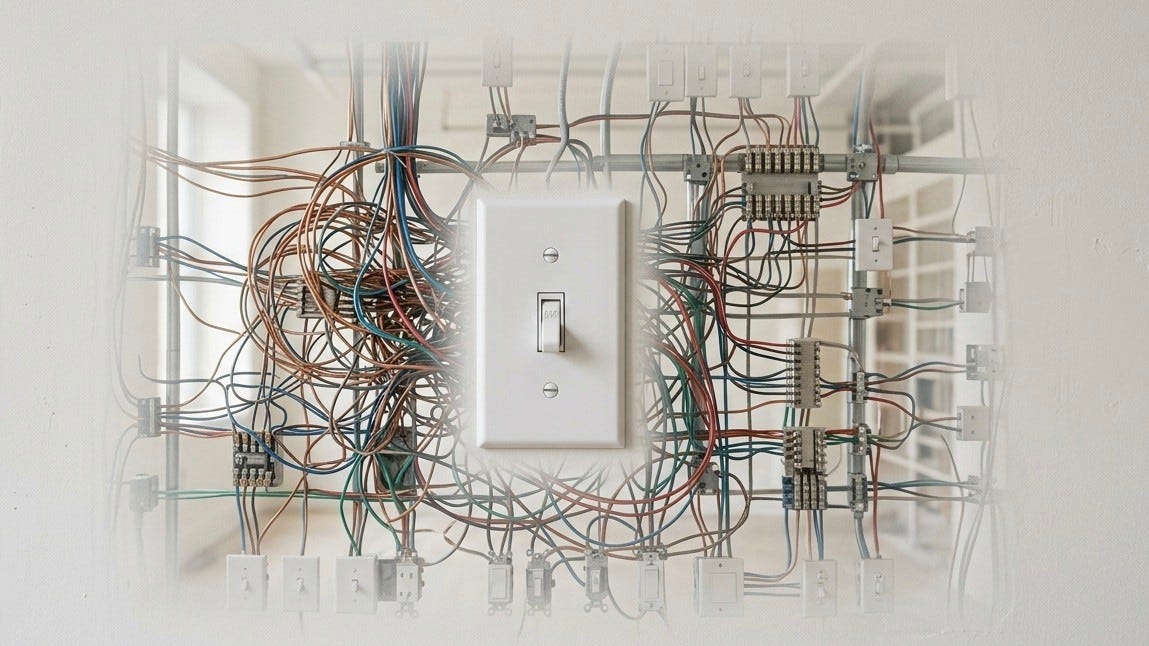
Same hardware. Same cable. Same words moving across it. Two entirely different programs running. All images generated by author unless stated
Introduction
In 1856, in the Eastern Cape of southern Africa, a teenage prophetess named Nongqawuse told the Xhosa people that if they killed their cattle and destroyed their grain, the ancestors would return, the dead would rise and the British would be swept into the sea. Over the following year, the Xhosa killed their cattle by the hundreds of thousands and burned their own food stores. Tens of thousands of people starved. The British colonial administrators watching it happen had every tool of Victorian statecraft available to them, economic incentive, legal deterrent, rational persuasion, and every one of those tools failed, because every one of them assumed the Xhosa were trying to solve the same problem the British thought they were facing.
They weren’t. Inside the framework the Xhosa were operating in, killing the cattle was not economic self-destruction. It was the single most rational act available, the necessary precondition for salvation. The behaviour was perfectly coherent. It was just coherent inside a different system.
This piece is about that gap. Not as history, as an active, operational, systems-level problem in the present. Because the same structural failure that left Victorian administrators unable to read the cattle-killing is currently leaving secular analysis unable to read actors who hold cabinet positions, military commands and policy authority in the most consequential conflict on Earth.
The Operating System, Not the App
The useful metaphor is not “belief as opinion.” Opinions are applications, content running on top of something deeper. A belief framework of the kind this piece is concerned with is the operating system: the layer that defines what counts as evidence, what counts as a win, what counts as catastrophe and what counts as rational in the first place.
Two actors running incompatible operating systems can exchange identical vocabulary, ceasefire, deterrence, escalation, acceptable risk, and be running entirely different programs underneath. The words compile differently. A ceasefire, on one operating system, is the shared off-ramp both parties are seeking. On another, it is an interlude inside a sequence whose ending is already written. The document is the same. The execution is not.
This is why the analytical failure is so persistent and so invisible. Nothing looks wrong at the interface level. The diplomatic language parses. The meetings happen. The signatures land on the page. The failure is beneath the interface, at the layer nobody is inspecting, and it only becomes visible when the outputs diverge from every prediction the secular model generated.

The interface layer is shared. Everything below it is not. All communication happens at the top. All behaviour is generated at the bottom.
Two Rationalities
The sociologist Max Weber gave this distinction its formal shape a century ago and secular analysis has been quietly ignoring it ever since. Weber distinguished instrumental rationality, selecting the most efficient means to achieve material ends, the calculus of costs and benefits, from value rationality: action taken because the actor believes it is intrinsically required, commanded, or sacred, regardless of consequence.
The critical point is that both are rationality. The value-rational actor is not confused, not stupid, not “brainwashed,” not failing to compute. They are computing flawlessly against a different objective function. The martyr weighing death against eternal significance is running a cost-benefit analysis. The inputs are simply drawn from a ledger the secular analyst does not believe exists.
This is where mainstream analysis makes its foundational error and it makes it in a specific and diagnosable way. Confronted with value-rational behaviour, the secular analyst has two available moves: treat the actor as irrational (and therefore unpredictable, and therefore un-analysable), or treat the stated beliefs as cynical cover for “real” material interests underneath (and therefore analyse the material interests instead). Both moves delete the actual operating system from the model. Both produce predictions that fail. And both feel rigorous while doing it, which is precisely why the error survives contact with its own track record.
Aum Shinrikyo assembled chemists, laboratories and a publicly available apocalyptic doctrine that described more or less exactly what it intended to do. Analysts had the data. What they lacked was the willingness to treat the doctrine as an operational variable rather than colourful background. In March 1995, the group released sarin on the Tokyo subway, killing thirteen people and injuring thousands. The information was never missing. The literacy was.
The Tools Encode the Assumption
Every instrument in the secular conflict-management toolkit carries a hidden dependency, an assumption about the counterparty’s operating system, compiled so deep into the tool that nobody remembers it’s there.
Deterrence, as formalised by Thomas Schelling and lived through the Cold War, assumes the adversary fears the threatened cost. It is a beautifully engineered instrument for exactly one class of actor: instrumentally rational, materially invested and catastrophe-averse. Point it at an actor whose framework processes suffering as confirmation and martyrdom as participation, and the mechanism doesn’t merely fail, it inverts. The threatened cost becomes an incentive gradient pointing the other way.
Sanctions assume material welfare sits near the top of the target’s objective function. Negotiation assumes catastrophe is a shared negative that both parties are paying to avoid. Ceasefires assume both signatories want the document to describe the future. Each tool works, genuinely, reliably works, against actors who share the analyst’s rationality. Which is why the toolkit’s long record of success is itself part of the trap: decades of positive results against instrumentally rational adversaries trained an entire analytical establishment to mistake a special case for a universal law.

The instruments are excellent. The machine they were calibrated for is not the machine that’s running.
Cognitive Gentrification in Reverse
I have written elsewhere about cognitive gentrification, the process by which AI removes the hard parts of thinking and human reasoning capacity quietly atrophies underneath the convenience. What this piece describes is the same structural process running in the opposite direction, on a longer clock.
Over roughly a century, secular analytical institutions, foreign ministries, intelligence agencies, academic international relations, financial risk modelling, outsourced and then deleted their religious literacy. Theology became a humanities elective, not an intelligence discipline. The confident secular assumption was that belief frameworks were residue: pre-modern software running on legacy hardware, destined for deprecation and safe to exclude from serious models. The module wasn’t just deprioritised. It was uninstalled.
The frameworks did not deprecate. They persisted, adapted, and, in specific, documentable cases, placed their adherents inside the command structures of major powers. The result is a precise inversion of the gentrification pattern: it is not the ancient frameworks that atrophied while modern analysis advanced. It is secular analytical capacity that atrophied, in one specific and now operationally critical dimension, while the frameworks it dismissed retained full fluency in both systems. The value-rational actor can read the secular analyst perfectly. The secular analyst cannot read them back. That asymmetry of literacy is itself a strategic asset, and it is currently held entirely by one side.
The Live Case
This is not an abstract argument. The war initiated against Iran on February 28 this year has, in four months, produced a ceasefire that collapsed and was reassembled repeatedly, a memorandum of understanding signed on June 17 with a 60-day window to negotiate final terms, and, as of this writing, contested straits, rejected frameworks and strikes traded inside what the documents describe as a cessation of hostilities. Every instrument applied has been drawn from the secular toolkit. Every instrument has behaved exactly as this piece would predict: functioning at the interface layer, failing at the layer beneath.
The full mapping of the belief architectures operating inside this conflict, on multiple sides of it, is the work of the Convergence/Sequence diptych, and I will not repeat it here. What this piece adds is the general claim those pieces implied but did not state: this is not a Middle East problem. It is a systems problem. Wherever value-rational actors hold operational authority inside institutions modelled by instrumentally rational analysis, any conflict, any market, any government, any era, the same structural blindness produces the same failed predictions. The current war is simply the largest live instance.

Both parties signed the same document. Only one of them signed the one on the table.
What Follows
Naming a blindness is not the same as correcting it. This piece has made one claim: that belief frameworks function as operating systems, that incompatible operating systems produce systematically misread behaviour and that the secular analytical toolkit encodes, invisibly, structurally, the assumption that no such incompatibility exists.
Two questions follow, and each is its own piece. First: what does the failure actually look like mechanically, what is the specific feedback structure that makes belief-driven escalation immune to the tools designed to interrupt it? That is the next piece, The Self-Fulfilling Architecture. Second, and harder: if you cannot convert the actors and cannot rely on the existing tools, what would governance built for this problem actually look like? That is the third piece, and it is the reason this trio exists.
The cattle are already being killed. The administrators are already drafting their incentives. The question is whether analysis learns to read the operating system before the program completes.
The author has no theological commitments to any tradition described. The analysis proceeds from observable behaviour, documented positions and published texts. Part of the Systems Thinking series; extends Convergence and Sequence, available on this publication.
메타데이터
- post_id
- c994272e9163
- slug
- belief-as-operating-system-c994272e9163
- url
- https://medium.com/what-if-ai-investigated/belief-as-operating-system-c994272e9163
- canonical_url
- https://medium.com/what-if-ai-investigated/belief-as-operating-system-c994272e9163
- author_url
- https://medium.com/@jamie_gray027
- status
- ok
- fetched_at
- 2026-07-08 21:20:17