George “Machine Gun” Kelly at Alcatraz: Myth vs Reality
When most people hear the name George “Machine Gun” Kelly, they picture one of America’s most dangerous gangsters — a gun-wielding outlaw…
George “Machine Gun” Kelly at Alcatraz: Myth vs Reality
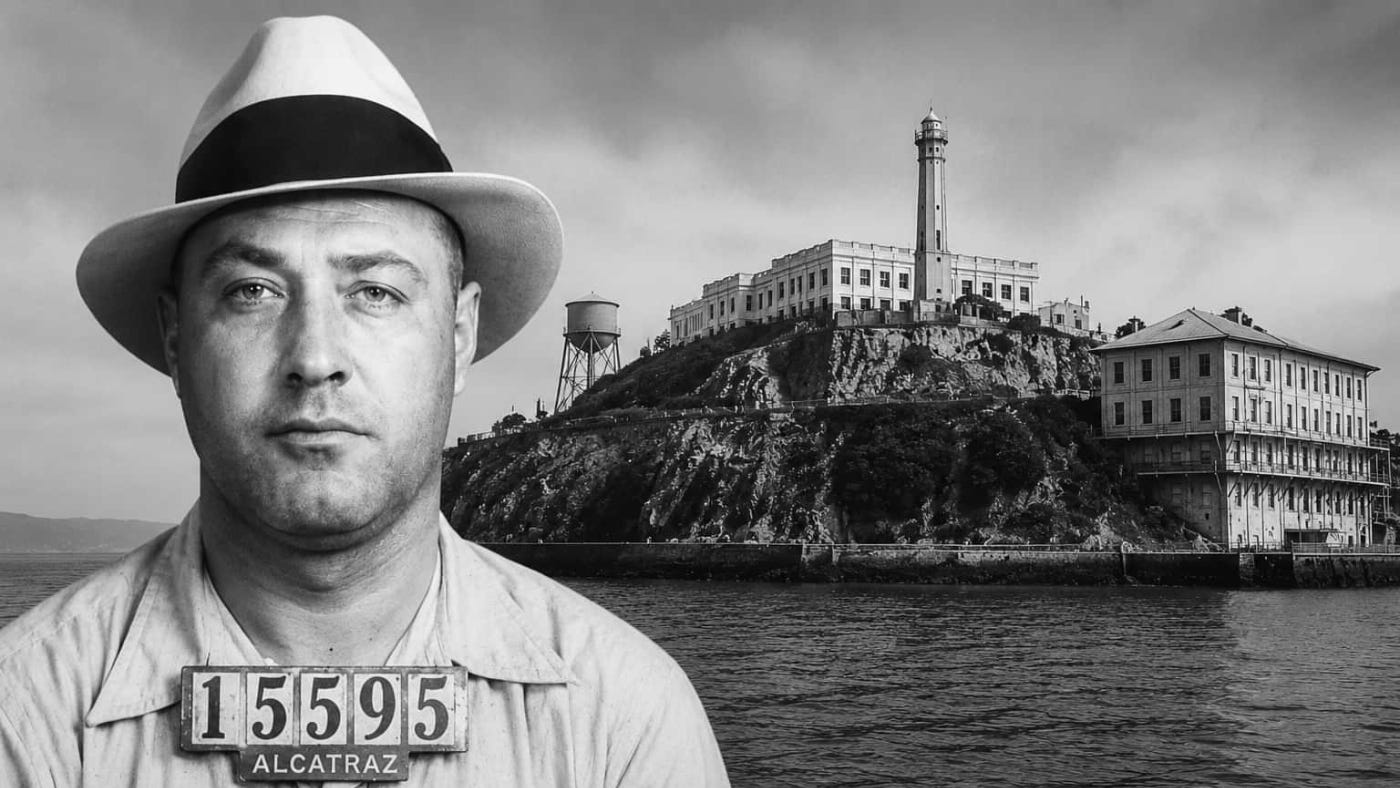
When most people hear the name George “Machine Gun” Kelly, they picture one of America’s most dangerous gangsters — a gun-wielding outlaw who terrorized the country during the Great Depression. Popular culture has reinforced that image for decades.
But the truth is far more interesting.
The story of George “Machine Gun” Kelly at Alcatraz is not about violence, prison riots, or daring escapes. Instead, it reveals how one of the most feared criminal brands of the 1930s gradually disappeared behind the walls of America’s most secure prison.
His time on Alcatraz exposes the gap between reputation and reality and offers a fascinating look into how the federal government used Alcatraz not just to imprison criminals, but to strip away the power their names carried.
Who Was George “Machine Gun” Kelly Before Alcatraz?
Long before becoming one of the FBI’s most famous targets, George Kelly Barnes lived a relatively ordinary life.
Born in Memphis, Tennessee, in 1895, Kelly did not fit the stereotype of a career criminal. His path into crime developed gradually through bootlegging operations during Prohibition. Thousands of Americans participated in similar illegal alcohol networks, but Kelly’s story took a different turn.
The turning point wasn’t necessarily his criminal activity — it was his image.
Many historians believe Kelly’s wife, Kathryn Thorne, played a major role in building the “Machine Gun Kelly” persona. Through carefully crafted stories and public perception, Kelly became associated with violence and intimidation, whether or not the reality matched the legend.
Today, visitors exploring resources from Alcatraz Cruises often discover that many famous Alcatraz inmates had reputations that differed significantly from their actual prison behavior.
The Kidnapping That Changed Everything
The Charles Urschel Case
In 1933, Kelly became nationally famous after participating in the kidnapping of wealthy oilman Charles Urschel.
The crime immediately drew federal attention and became one of the FBI’s highest-profile investigations.
Ironically, Kelly’s downfall came largely because of Urschel himself.
Despite being held captive, Urschel carefully observed his surroundings and memorized important details that later helped investigators identify the location where he was being held. Those observations allowed federal agents to dismantle the kidnapping operation and arrest those involved.
Kelly was captured in September 1933 and sentenced to life imprisonment.
The case became one of the early victories that helped establish the FBI’s national reputation during the J. Edgar Hoover era.
Why George “Machine Gun” Kelly at Alcatraz?
More Than a Prison Transfer
When Alcatraz Federal Penitentiary opened in 1934, it was designed to house inmates who presented unique challenges to the federal prison system.
These were not necessarily the most violent prisoners.
Instead, they were often inmates whose influence extended beyond prison walls.
This included:
- Organized crime leaders
- Escape risks
- High-profile public figures
- Inmates with powerful criminal networks
Kelly fit that profile perfectly.
His notoriety made him an ideal candidate for the new prison.
If you’re interested in understanding the prison’s original mission, the history of Alcatraz Island provides valuable context for why inmates like Kelly were transferred there.
Life Inside Alcatraz: Where Legends Disappeared
From Machine Gun Kelly to AZ-117
Upon arrival, Kelly lost something more valuable than freedom — his identity.
Inside Alcatraz, he became inmate AZ-117.
The prison’s strict structure left little room for personal influence.
Every inmate followed the same schedule:
- Fixed meal times
- Mandatory work assignments
- Regular inmate counts
- Controlled recreation
- Limited communication
The environment was specifically designed to eliminate status and reputation.
The same system that controlled notorious prisoners like Al Capone and Alvin Karpis also controlled Kelly.
Visitors taking an Alcatraz Day Tour often gain a better understanding of this system by walking through the cellhouse, dining hall, and exercise yard where inmates spent much of their daily lives.
The Surprising Reality: A Model Prisoner
The Myth vs Reality
Many people assume that a man known as “Machine Gun Kelly” would have been one of Alcatraz’s most difficult inmates.
The historical record suggests the exact opposite.
Prison staff consistently described Kelly as:
- Cooperative
- Respectful
- Well-behaved
- Reliable
There are no major records of disciplinary issues, violent incidents, or escape attempts involving Kelly during his years on the island.
For someone whose public image was built around intimidation and danger, his prison record was remarkably ordinary.
This is where the real story becomes fascinating.
It raises an important question:
Was the legend larger than the man?
What Alcatraz Revealed About Criminal Reputation
Why Kelly Adapted So Easily
One of the most overlooked aspects of George “Machine Gun” Kelly at Alcatraz is how quickly he adapted to prison life.
The answer may lie in how his reputation was originally created.
Outside prison, Kelly benefited from:
- Media attention
- Public fear
- Criminal associations
- A carefully crafted image
Inside Alcatraz, those factors disappeared.
The prison removed the environment that allowed the legend to exist.
Without an audience, there was little value in maintaining the persona.
This supports a broader theme that appears throughout many Alcatraz inmate stories. The psychological effect of Alcatraz often had a greater impact than physical confinement itself.
Seventeen Years on The Rock
Routine Replaced Reputation
Kelly spent approximately 17 years at Alcatraz, from 1934 until 1951.
Unlike many famous prison stories, his years there were largely uneventful.
His daily life revolved around routine:
- Work assignments
- Structured schedules
- Limited privileges
- Institutional rules
Over time, public attention shifted elsewhere.
The feared gangster who once dominated newspaper headlines gradually became another inmate living within Alcatraz’s rigid system.
That transformation may be the strongest evidence of the prison’s effectiveness.
Alcatraz wasn’t simply preventing escape.
It was removing influence.
Can You Still Experience Kelly’s Story Today?
Absolutely.
Although Alcatraz contains countless stories, Kelly’s experience is woven throughout the prison itself.
Visitors can better understand his transformation by exploring:
The Cellhouse
The rows of identical cells demonstrate how individuality was stripped away inside the institution.
The Dining Hall
One of the few places where inmates gathered, the dining hall highlights the controlled nature of daily life.
The Recreation Yard
Standing on the yard while looking toward San Francisco helps visitors appreciate the psychological challenge inmates faced every day.
Many travelers also choose the Behind the Scenes Tour for access to additional areas that reveal how prison operations extended beyond the standard visitor route.
Why Machine Gun Kelly’s Story Still Matters
The story of George “Machine Gun” Kelly at Alcatraz remains relevant because it challenges assumptions.
Most people expect a tale filled with violence, rebellion, and criminal masterminds.
Instead, they find something much more revealing.
Kelly entered Alcatraz carrying one of the most famous criminal reputations in America.
He left as a man largely defined by routine, compliance, and institutional control.
His story demonstrates that Alcatraz was designed to do more than lock people up. It was built to dismantle influence, remove status, and place every inmate under the same system regardless of who they were outside the prison walls.
For visitors exploring Alcatraz today, understanding Kelly’s transformation provides a deeper perspective on how the prison actually operated.
The myth may have made headlines, but the reality tells the more compelling story.
메타데이터
- post_id
- c99ebad62e81
- slug
- george-machine-gun-kelly-at-alcatraz-myth-vs-reality-c99ebad62e81
- url
- https://medium.com/@alcatrazcrusies/george-machine-gun-kelly-at-alcatraz-myth-vs-reality-c99ebad62e81
- canonical_url
- https://medium.com/@alcatrazcrusies/george-machine-gun-kelly-at-alcatraz-myth-vs-reality-c99ebad62e81
- author_url
- https://medium.com/@alcatrazcrusies
- status
- ok
- fetched_at
- 2026-06-24 16:30:55