Writing With Your Hand
It’s not the same as typing with your hand
Writing With Your Hand
It’s not the same as typing with your hand
Photo by Zhuo Cheng you on Unsplash
As I perform a nerd storm I prefer my pictures in word form
— Lupe Fiasco
Richard Feynman believed in experiments.
He knew that armchair analysis of ideas and intuition could always be misleading. Experiments neither have a brain nor biases. They would settle the argument.
One of the ways he would do this, naturally, when he was younger, was to develop his own symbols to represent certain mathematical ideas. As he would advance his learning, he would find evidence from other workers that converged with his analysis. In this way, he would independently test what he didn’t know, all of which was possible through pen or pencil and paper.
Feynman would never have found a version of the symbols he made if he didn’t have the mighty power of a pen. It often goes unsaid, but it deserves mention that using a pen packs dense information, a feature that AI presently cannot do.
Think about the letter “g” and the letter “a”. I grew up knowing the letter ‘a’ more closely resembles the “@” sign without its nearly circular cover than the one used on computers. As for the letter ‘g’, it wasn’t as dramatic as the one shown in online documents. Nevertheless, there are people who write with a pen on paper using these letters. Typing destroys this variety, but writing by hand preserves it.
That’s how dense a symbol can be. It can be extracted from a list of symbols on your Word document, but it’s not readily available; it lies hidden to the naive eye.
When I joined campus, I developed a note-taking style that I have long valued. I’d fold a page from my book into two halves, split vertically, then write from one half to the next, flip it “inside-out,” and then write some more. I had a structure to it, knowing which one half-page would lead to the next. Most importantly, I packed so much into half a page than most of my classmates. I can comfortably claim that I had the most dense information per page than anyone in my class.
It kind of looked like “Mwaks,” the version most students used to use when intending to sneak in pieces of paper to cheat in an exam. Despite understanding the incentive for cheating, I have never been a fan. Still, my note-taking style wasn’t that far away from Mwaks:
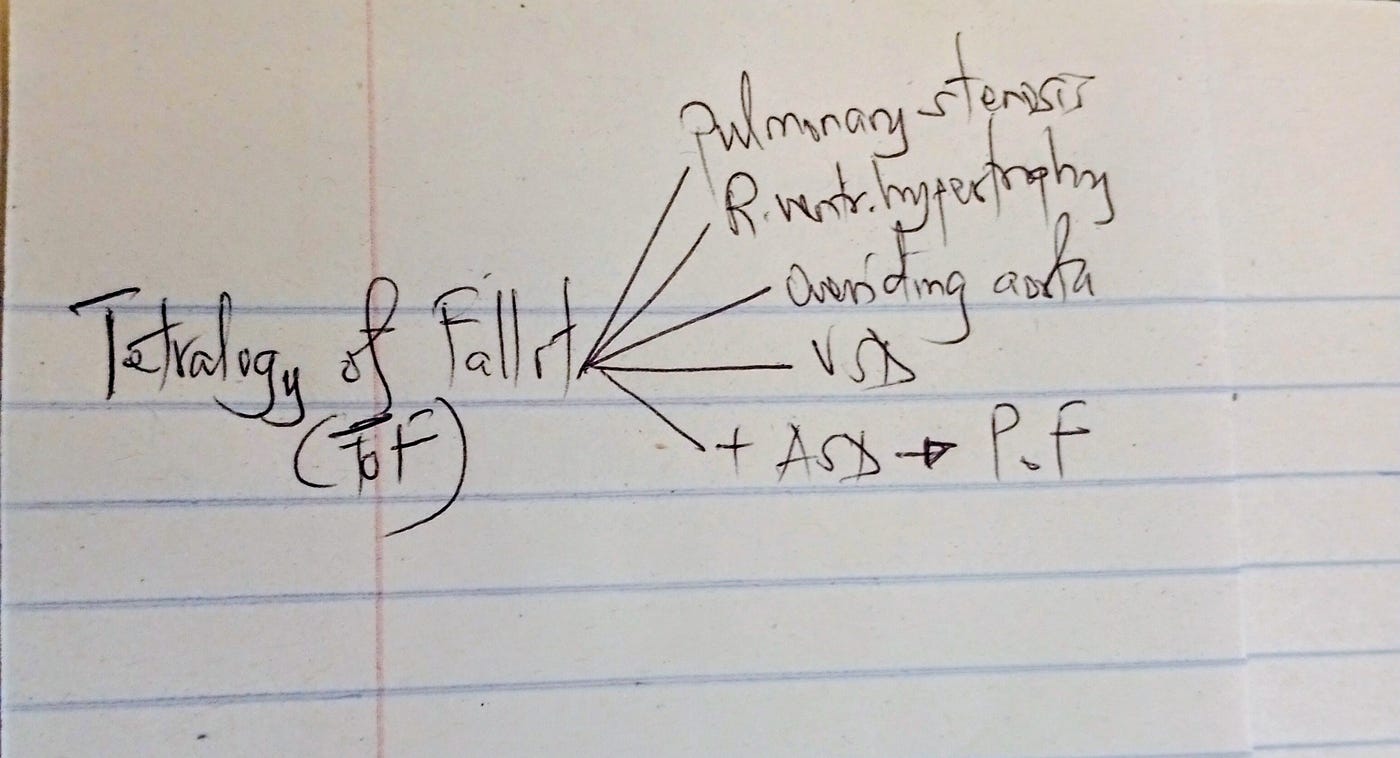
An example of how I would write my notes back in medical school. On the left was the condition Tetralogy of Fallot (ToF), and on the right end of the edges were the four features, and an addition sign (+), in case a patient had more than four features, to make a pentalogy (PoF). Source — Author.
I’d start by writing the main point in shorthand, then draw edges connecting it to the next most important elements, like in the image above. On the left, I’d have the condition — Tetralogy of Fallot (ToF)— and on the right, the components. An addition would be a symbol (+), and another edge showing how the condition could mutate from a tetralogy (with four components) to a pentalogy (with five). Such a dense structure reveals a feature that typing can never achieve — shorthand.
Shorthand is the ability to generate one’s unique style of summarizing information. Presently, AI summarizes material and presents it to us as the first search result. It may be appealing, in part because it is a condensed collection of websites and articles, a summary, and resembles what we have been doing when writing. As instantaneous and convenient as this option may be, it collapses information in uncreative ways.
Shorthand requires creativity. Feynman’s symbols were his. Not the ones shared on a typeface. Our teachers never told us, but shorthand is evidence of one’s understanding, processing, and making an output that only the processor (you) can adequately decipher. Shorthand was our way of conquering problems in our own unique way. Typing does not offer these options. Neither do AI summaries.
As for leaning words, those that follow the Tower of Pisa, italics, are just one way of leaning. The right side is not the only side one can bend their letters. I have a colleague who writes immaculately, but with words leaning to the left. This cannot be acquired through typing.
As much as we are keen on adopting new technology, we need to acknowledge what we are dropping along the way. Starting children on laptops and tablets may take away the benefits of writing using a pen or paper. And now, there’s evidence to show it.
Evidence
Photo by Iván Díaz on Unsplash
A word game back up plan that can dam lakes Backup the wordplay ain’t playing that the man’s states Means I can still be the man if the dam breaks And when demand brakes I’m reflectious, what they can’t face
— Lupe Fiasco
Pressing a pen or pencil on paper requires proprioceptive sensation and intervention. How much should one press onto the pencil for the desired shape to emerge and be legible enough for the teacher to perceive?
After making out the outlines of a letter, the first assessor is the writer. Several processes have gone into this outcome.
One must hold the pen in a way they are most comfortable. Lines drawn on the paper, if there are any, are a guide to how they should align and space their letters on the page. One should know the most appropriate space between letters and words to show, each of which will be different at any given time, unlike the evenly spaced text typed on online documents.
Next is tactile movement of the fingers to achieve the desired letters. It also requires that one suspend the need to remind oneself that the fingers are closely pressed on the pen or pencil, but preserve that the ulnar side of the hand is tracing its surface across paper.
In some parts of the world, the sentence moves from left to right; in others, it’s the opposite; and in several parts of the Asian continent, this movement is vertically guided. One needs to summon the stock of letters, characters, and words, and pour them on the paper, with minimal errors.
Typing, however, does not leave evidence of correction. I recall how my mother insisted that we erase our work with the clean side of the eraser. We would even cut small pieces from our slippers if we did not have the shop-bought erasers. She didn’t like dirty work. And even if you cleaned it nicely, there was still evidence of erasure, visible to the keen eye. There were dire consequences for handing in dirty work. Writing by hand has no backspace. Typing has eliminated this.
Today, typing is accompanied by a red underline, evidence of wrong spelling. Autocorrect or apps like Grammarly do the correction for you. There is no incentive to spell correctly as was the case in my final year in primary school. Our English teacher (she wasn’t from England, but hailed from the hills of Kisii) would ensure we never misspelled a word by making us write three to five columns of the correctly spelled version on a free A4-sized page. She was ruthless. In the age of autocorrect, she is deemed irrelevant. She shouldn’t.
Why?
Because intelligence is first seen in error correction. It gradually gets purified into what one desires. In this case, it’s accurate spelling. If large portions of the correction are not done by us, then who’s the intelligent one? Evidence of progressive increase in intelligence is seen when past records and present ones show improvements, identifiable by fewer errors. Writing with our hands can reveal that you spelt the word “immediately” wrongly yesterday, and you have learnt its correct spelling today. This is positively possible through writing using the hand. Yes, positively.
Largely underappreciated is how writing by hand created the wide latitude for reading every possible handwriting. Every single handwriting is unique to the writer. It means there was a time when the writing universe was as diverse as the number of literate individuals who could write on paper. This wealth of diversity trains the brain to know what to look for, synecdochically, and make sense of every other written work. Typing does not give us that added benefit. Your Times New Roman is the same as mine. By destroying diversity, we destroy the brain’s ability to decipher written work. Essentially, typing is dumbing down writing. To use Lupe’s words, it could be a poetic way of dodging rain but catching hail.
I recall reading some time last year concerns by a teacher who reported that her students could not read her writing on the chalkboard. This is a teacher who has been at it for years. The students’ inability to read her words is not because she has poor handwriting. The effects have already started to manifest.
Much more can be derived about an individual from their handwriting. I have noticed that on days I am happy, have little work, and a full stomach, I write pretty well. On a busy day, with families frustrating your efforts to take care of their patients, my writing is evidently different. In a word, worse. By typing it all, one cannot know much about the individual who typed it. Or as Dana Meadows liked to say, constants reveal little about the system.
For all I have prattled on about, typing is tepid in comparison to writing by hand. The only movement it largely evokes is that of lightly tapping a button. For laptop keyboards, the movement may need good coordination, but it doesn’t replace writing and its associated benefits. For phones, where the first four fingers support the device while the thumbs do the typing and scrolling, less coordination is needed. Typing makes us dumber.
And now, we have evidence:
Handwriting requires fine motor control over the fingers, and it forces students to pay attention to what they are doing. Typing, on the other hand, requires mechanical and repetitive movements that trade awareness for speed. Our results reveal that whenever handwriting movements are included as a learning strategy, more of the brain gets stimulated, resulting in the formation of more complex neural network connectivity. It appears that the movements related to typewriting do not activate these connectivity networks the same way that handwriting does. The concurrent spatiotemporal pattern from vision, motor commands, and proprioceptive feedback provided through fine hand and finger movements, is lacking in typewriting, where only a simple key press is required to produce the entire wanted form.
Writing using your hands, pen, and paper increases learning. But as more generations get less exposed to this skill, learning reduces. From the look of things, learning is taking a hit across multiple fronts. Social media is consuming every attention possible; online apps are distracting minds with all possible psychological tricks; AI is taking over the little that we could do ourselves, including reading and writing, although reading had already been affected long before AI walked into the scene; and now writing by hand is fading. It prompts Lupe Fiasco to ask:
Are we apps, or are we bodies filled with apparitions? Operating applications, stuck inside of Apple prison Chicken hackin’ download updates that lack religion Or are we more…
Our history shows that we are more than that.
Man easily forgets. And when we take away the writing by hand, we forget even faster, since writing, so the researchers have surmised, improves long-term and working memory.
Writing is the art of creating symbols, stringing them together to make a coherent meaning of a word. Place the word in a clause or sentence, and the semantics emerge. In this sense, writing is no different from drawing, but at a faster pace. The words are the pixels, and the full work is the Mural, like Lupe’s work. It’s why, like the rapper, I prefer my pictures in words.
A picture can be worth a thousand words, but a thousand words is not worth one picture.
While it might have taken researchers this long to find and share evidence for the benefits of writing by hand, even though it was intuited, some cultures have long supported the importance of hand art. Writing is hand art. The Chinese and Japanese have preserved these traditions because they know the power of calligraphy.
To a samurai, calligraphy is a powerful tool. The swordsman needs to hold the brush firmly but briskly, make characters without carelessly spilling the ink, create fine lines and spaces between them, requiring intense focus but also measured relaxation. A rigid hand does not create the best curves, nor does it move with grace on the blank sheet.
As with calligraphy, so it is with swordsmanship. You could tell a top-tier Samurai from their calligraphy. You could also now see how writing using the hand is related to drawing and the multiple connections it has in the brain. To wield a sword masterfully requires graceful movement in space, depth perception, and proprioception. That is what these studies have discovered. In this way, the pen yet again has proven to be mightier than the sword.
What I’m trying to say is…
The art of writing by hand is fading, but it need not. The researchers used a stylus pen on a tablet, showing that we can advance our technology without sacrificing the art of writing.
Placing more emphasis on using tablets and laptops early on in a child’s life could give the impression that you’re helping them, but evidence points otherwise. Old is the gold we’re leaving behind by forgetting the relevance of writing using our hands.
Let us not forget.
[embed]This song inspired some of the lines used in this article. Source — YouTube
메타데이터
- post_id
- c9a3d3eefd86
- slug
- writing-with-your-hand-c9a3d3eefd86
- url
- https://medium.com/@theonealternativeview/writing-with-your-hand-c9a3d3eefd86
- canonical_url
- https://medium.com/@theonealternativeview/writing-with-your-hand-c9a3d3eefd86
- author_url
- https://medium.com/@theonealternativeview
- status
- ok
- fetched_at
- 2026-07-15 04:06:43