How Tutors Prepare Students for Calorimetry Numericals
Calorimetry is a key area in thermodynamics, typically introduced in high school and early college-level physics and chemistry. For many…
How Tutors Prepare Students for Calorimetry Numericals

Calorimetry is a key area in thermodynamics, typically introduced in high school and early college-level physics and chemistry. For many students, numerical problems in calorimetry are among the toughest: they require a firm grasp of concepts, accurate unit handling, and careful algebraic manipulation. A good tutor can make all the difference. In this article we’ll explore how tutors prepare students for calorimetry numericals, breaking down the process into stages, techniques, common pitfalls, and how ongoing support helps build confidence.
1. Foundations First — Conceptual Clarity
Before jumping into numbers:
- Understanding Definitions: Tutors ensure students are crystal clear about what quantities like specific heat, latent heat, calorimeter constant, thermal equilibrium mean. They discuss units (J/kg·K, J/g·°C, etc.) to avoid confusion during calculations.
- Relation Between Heat, Temperature Change, Mass: The formula Q=mcΔTQ = mc\Delta TQ=mcΔT is central. Tutors walk students through how each factor influences the heat absorbed or released.
- Phase Changes: What does ‘latent heat’ mean when melting or boiling occurs? When a substance changes phase, temperature doesn’t change even though energy is absorbed or released. This must be clearly understood before tackling numericals.
- System vs Surroundings; Sign Conventions: When heat is lost vs gained: how to treat the sign of QQQ, and account for the calorimeter itself (if needed).
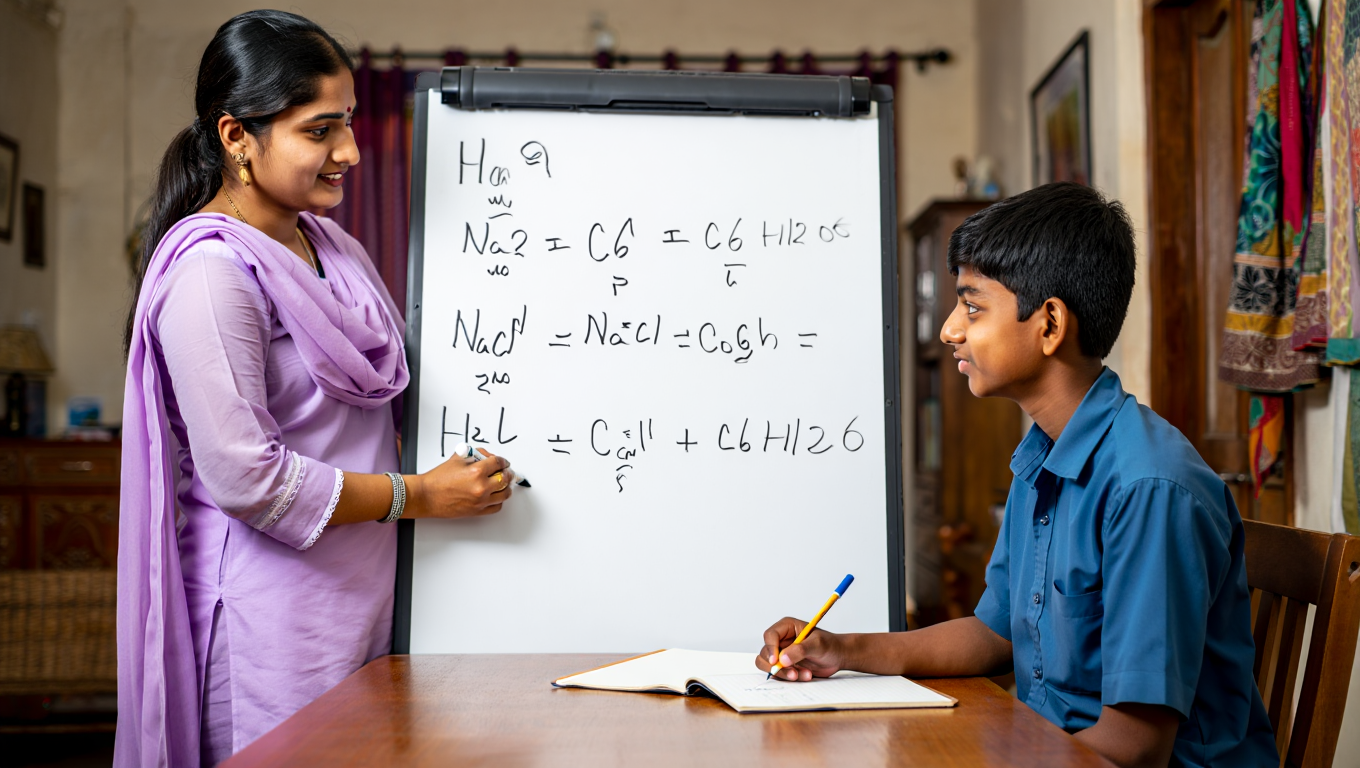
This groundwork is often covered in the initial sessions, where a tutor may use analogies, diagrams, and simple thought experiments to help students build intuition.
2. Progressive Difficulty in Problem Sets
Once conceptual foundations are strong, the tutor typically introduces numerical problems of increasing complexity:
- Simple “single-process” problems: e.g., heating water from one temperature to another, or cooling, using Q=mcΔTQ = mcΔTQ=mcΔT.
- Two-step problems: where one substance loses heat and another gains heat, possibly including calorimeter walls or vessel.
- Phase change problems: melting or boiling involved, using latent heat LLL: Q=mLQ = mLQ=mL.
- Mixed process problems: for example, heating, then melting, then heating again.
Each level adds new layers: more algebra, more terms, more care with units.
3. Emphasis on Units, Significant Figures, and Approximation
Errors in units are among the most common mistakes. Tutors:
- Check units at every step: mass in kg or g, specific heat in correct units, temperature in °C or K accordingly.
- Emphasize conversion when needed. For example, if specific heat is given in J/g·°C but mass in kg, then convert.
- Teach rules of significant figures — what to carry forward, how to round off final answers.
- Discuss approximations: when using specific heat values (often given approximate), when ignoring minor heat losses (if allowed), or when assuming calorimeter insulation is perfect.
4. Problem-Solving Strategies & Templates
To avoid repeated mistakes, tutors often provide students with structured strategies. A generic template might look like:
- Read carefully: What processes are happening? Heating? Melting? Boiling?
- List knowns: masses, initial and final temperatures, specific heats, latent heats, calorimeter constants.
- Convert units: to standard units (SI or as per convention in the problem).
- Decide on sign of heat: Knowing whether heat is gained or lost, and whether a component is the system or surroundings.
- Break into stages: If multiple steps, treat each separately.
- Set up equations: For example, sum of heat gained = sum of heat lost; or include calorimeter constant.
- Solve algebraically: Simplify, rearrange.
- Check answer: Units, magnitude (does the number make sense physically?), significant figures.
Using such a structured step-by-step plan helps reduce careless mistakes.
5. Worked Examples & Peer-Like Feedback
Tutors often go through multiple worked examples:
- They’ll pick examples that highlight typical tricky spots: e.g. when the calorimeter’s heat capacity matters, or when masses are large/small or specific heats differ widely.
- They encourage students to solve a problem on their own, then review the solution together: this helps them catch mistakes, understand alternate approaches, and build confidence.
Frequent quizzes or assignments let tutors gauge what kinds of numerical questions trip up the student most (e.g. arithmetic, algebra, conceptual misthinking) and adjust subsequent lessons accordingly.
6. Realistic Practice — Simulating Exam Conditions
Beyond guided examples, it’s essential to simulate exam-like conditions:
- Timed tests: so the student learns to manage time, avoid spending too long on one part.
- Mixed problem sets: so that heat-transfer, calorimeter constant, phase changes etc. are all mixed together. This avoids “pattern recognition” where student expects only one kind of problem.
- Error correction sessions: discussing past mistakes to help the student internalize what to avoid.
7. Use of Resources and Visual Tools
Visual and hands-on tools help cement understanding:
- Diagrams of calorimeters: showing where heat is being transferred.
- Table comparisons of specific heats or latent heats for different substances to appreciate relative magnitudes.
- Graphs: how temperature vs time behaves in different phases.
Also, tutors may recommend textbooks, online simulations, and worksheets. They might even suggest going through sample problems available at sites or coaching centres.
8. Tailored Support According to Weaknesses
Each student has different strengths. A tutor will often:
- Identify whether a student is weak in algebra or in conceptual thinking or simply in doing arithmetic under time pressure.
- Adapt approach: if the student is good with formulas but poor at unit management, then more work will be given to unit conversion exercises.
- Encourage mental checks: is the answer plausible? For example, if heating water from 20 °C to 100 °C yields millions of joules, is that reasonable, given the mass?
9. Mentoring Attitude, Encouraging Growth
A good tutor does more than teach: they motivate. For students struggling with calorimetry numericals:
- They reassure that making mistakes is part of learning.
- They show improvements over time, so students can look back at earlier work and see how much more confident they have become.
- They encourage questions: “Why did you assume calorimeter was perfect?” or “What if we included heat capacity of vessel? How would that change result?”
A Practical Case Study: How Home-Based Tutors Operate
To make this more concrete: consider a student in West Delhi preparing for their board exams. They have basic physics understanding, but they falter when calorimetry problems include multiple steps or hidden details.
A home tutor visits regularly (or via online video). In early sessions, the tutor uses simple problems:
- Heating water from 25 °C to 75 °C.
- Then, water cooling, or mixing of hot and cold water.
Once confidence builds, the tutor introduces calorimeter constant, latent heat, phase change etc. They give homework that includes questions from as many sources as possible so the student is exposed to different problem styles.
If the student is taking help through home tuition services in West Delhi, they benefit from a tutor who already understands the local exam patterns, textbook formats, and common numerical styles (which sometimes include calorimetry numericals quite similar across different boards). This context-sensitive teaching offers an edge.
Integration and Long-Term Retention
It’s not enough just to solve a batch of problems once. Tutors employ methods to ensure retention:
- Spaced repetition: revisiting calorimetry numericals after intervals of a week or two to reinforce memory.
- Cumulative problem sets: including calorimetry plus other topics (e.g. laws of thermodynamics, heat transfer by conduction etc.) to ensure calorimetry is not seen as an isolated topic.
- Encouraging teaching: asking the student to explain the concept (or the solution) to someone else, which reinforces understanding.
Where to Find Good Tutors and Supporting Systems
Students often seek out tutors or tuition services that specialize in concept-based teaching. When evaluating tutors, one may look for:
- Ones who balance conceptual clarity with rigorous practice.
- Tutors who offer home-visits or in-person sessions (where feasible), especially for topics like calorimetry that benefit from drawing out diagrams or working step-by-step on problems.
- Those who provide ongoing feedback and correct homework thoroughly.
For example, services like Concept Tutor have developed a reputation for focusing on clarity of physics and chemistry concepts, which helps when working through topics like calorimetry. They also offer home tuition in West Delhi, meaning students in that area can receive personalized explanations, problem drills, and guided practice in person. Such in-region services can help minimize delays and make scheduling easier, which contributes to consistent progress.
Common Pitfalls Tutors Help Students Avoid
While preparing for calorimetry numericals, students often make predictable mistakes. Tutors anticipate these and design strategies to avoid them:
- Forgetting calorimeter or vessel heat capacity: Some problems include calorimeter constant; forgetting this leads to underestimating heat lost/gained.
- Mixing up phases: Trying to apply Q=mcΔTQ = mcΔTQ=mcΔT through a phase change without latent heat.
- Neglecting sign of ΔT: If temperature decreases, ΔT is negative; heat lost is negative, etc.
- Wrong unit conversions: grams vs kilograms, Celsius vs Kelvin (though ΔT is same, sometimes context matters), J vs kJ.
- Arithmetic or algebra errors: Collecting like terms, distributing mass or specific heat properly.
- Rounded values too early: Losing precision by rounding intermediate steps improperly.
- Not checking plausibility: Getting answers that are too big/small relative to expected energy scales (e.g. for a small amount of water, energy in gigajoules would be nonsensical).
A tutor helps by pointing out each mistake, modeling checks, peer correction, and ensuring students self-check answers rigorously.
Conclusion
Numericals in calorimetry are a test of both conceptual understanding and precision. A student may know formulas, but unless they can apply them correctly — keeping track of units, rounding, phases, and thermal systems — they will falter under exam conditions. Tutors play a vital role in bridging that gap: building foundational understanding; gradually increasing problem complexity; providing realistic, timed, mixed examples; focusing on common pitfalls; and tailoring support to the student’s unique needs.
For students in places like West Delhi, where local exam boards often have characteristic styles of calorimetry questions, personalized help (for example via home tuition) can make a big difference. With consistent practice, feedback, and structured learning, students not only improve accuracy in answers, but gain confidence in their ability to tackle any calorimetry numerical thrown at them.
메타데이터
- post_id
- c9c5cdbec1df
- slug
- how-tutors-prepare-students-for-calorimetry-numericals-c9c5cdbec1df
- url
- https://medium.com/@edu.hub1180/how-tutors-prepare-students-for-calorimetry-numericals-c9c5cdbec1df
- canonical_url
- https://medium.com/@edu.hub1180/how-tutors-prepare-students-for-calorimetry-numericals-c9c5cdbec1df
- author_url
- https://medium.com/@edu.hub1180
- status
- ok
- fetched_at
- 2026-09-02 19:00:23