Best AI Tools for Local SEO and Google Maps Rankings
As a local business owner, I used to think Google Maps rankings were mostly about having a decent Google Business Profile, collecting a few…
Best AI Tools for Local SEO and Google Maps Rankings
As a local business owner, I used to think Google Maps rankings were mostly about having a decent Google Business Profile, collecting a few reviews, and hoping customers found me when they searched nearby.
That mindset worked for a while but then my local market became more competitive.
New competitors started showing up in the map pack. Some had more reviews, better photos, stronger service pages and posting more consistently.
Others seemed to understand local SEO in a way I did not, and my local growth strategy was too reactive.
- I was checking rankings after they dropped.
- I was responding to reviews when I remembered.
- I was updating my Google Business Profile only when something changed.
- I was creating content when business slowed down.
- I was guessing which locations, services, and keywords mattered most.
The problem was that I did not have a system and in this article, I will write about how I leverage the existing tooling to improve my competitive position.
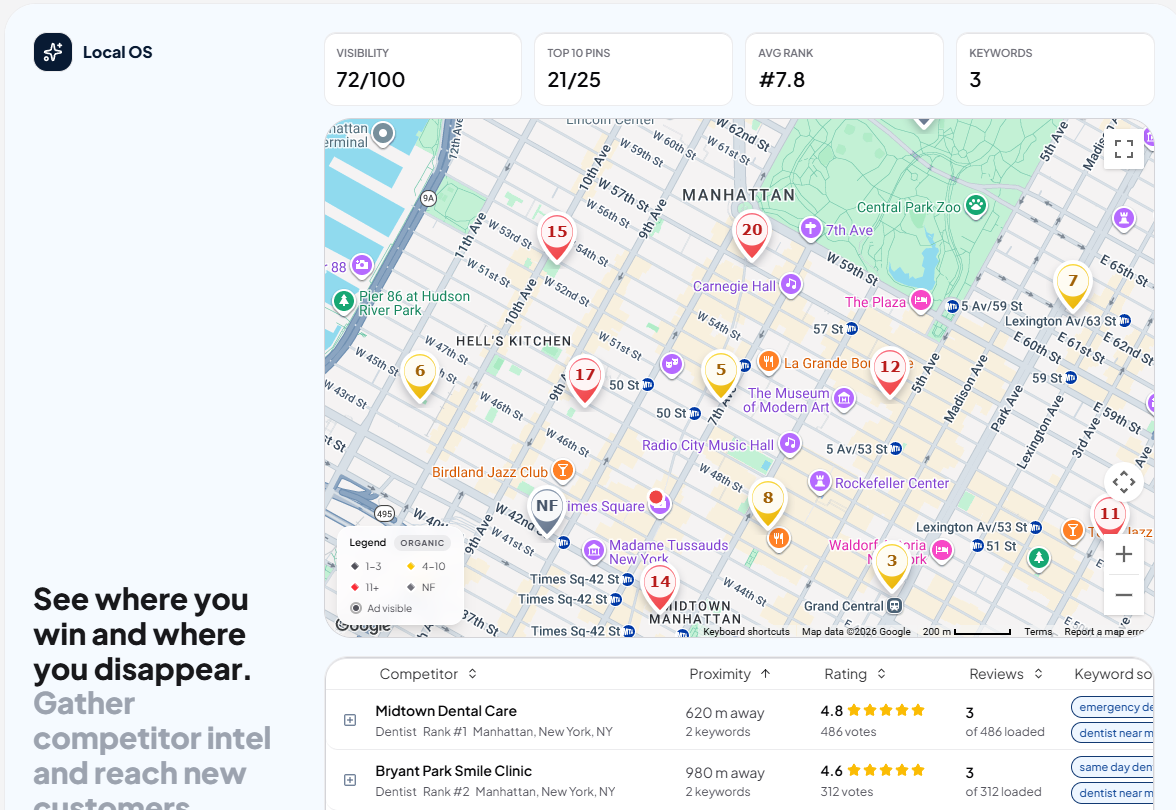
Local OS: Local Rankings and Recommendations
Why I Started Taking Google Maps Rankings More Seriously
Calls, direction requests, bookings, website visits, and walk-ins often start with a Google Business Profile result.
Many customers never scroll through traditional organic search results but they search, compare nearby businesses, read reviews, check photos, and make a decision quickly.
That means my Google Maps presence became one of the most important parts of my customer acquisition system.
My biggest weaknesses were:
- I did not know which services I was ranking for
- My review response process was inconsistent
- My local content was too generic
- I was not tracking competitors closely enough
- I had no clear system for refreshing my Google Business Profile
- My website and local landing pages were not supporting my map visibility as well as they should
- I was making decisions from scattered data instead of one clear operating view
Once I saw those gaps, I stopped looking for “hacks” and started looking for tools that could help me operate better.
What I Learned About Local SEO
Google Maps visibility depends on a mix of signals, including relevance, distance, prominence, profile completeness, reputation, website strength, customer engagement, and competitive density.
In practical terms, that means I had to pay attention to things like:
- Profile Completeness: My categories, services, business description, photos, hours, attributes, products, and updates all mattered. Even small gaps could make my business look less relevant than a competitor.
- Reviews and Reputation: It was not enough to collect reviews occasionally. I needed review momentum, thoughtful responses, and a better understanding of what customers were actually saying about my business.
- Local Content: My website had to explain where I did it, who I served, what problems I solved, and why my business was relevant in each local market.
- Competitor Movement: I realized I was paying too much attention to my own profile and not enough attention to the businesses outranking me. Competitors were changing categories, earning reviews, improving pages, and adding content while I was only checking my own dashboard.
- Operational Consistency: This was the biggest lesson. Google Maps growth is not a one-time project. It is an operating rhythm.
1. Local OS
I previously had Google Business Profile data in one place, reviews in another, ranking checks somewhere else, content notes in documents, and competitor observations living mostly in my head.
I was slow because my process was fragmented.
Local OS helped me bring the important parts of local visibility into one working system:
- Listings
- Reviews
- Local visibility
- Content opportunities
- Location-level performance
- Optimization tasks
- Competitive insights
- Next actions

Local OS: Competitor Watch
The biggest benefit was clarity, I could ask better questions:
- Which locations are improving or slipping?
- Where are reviews slowing down?
- Which listings need attention?
- Which services are under-optimized?
- Which competitors are gaining visibility?
- What should I work on first?
That helped me refocus.

Local OS: Competitor Review Intelligence
I started treating it like an operating system for growth.
It is easy to get pulled into daily fires. Staff issues, customer service, operations, scheduling, inventory, calls, and admin work all compete for attention.
Local SEO can become something you only think about when leads slow down, which was also my pattern, and Local OS helped me break it by turning local growth into a repeatable workflow.
I can now see what needs attention, prioritize or monitor the signals that influence performance earlier.
That helped me recalibrate my growth strategy around execution, not hope.
2. Semrush Local
Semrush Local helped me connect local visibility with the broader SEO picture, it can be helpful for:
- Listing management
- Review monitoring
- Local visibility tracking
- Connecting local SEO with broader keyword strategy
- Understanding how website performance supports map visibility
- Reporting across SEO and local channels
The biggest benefit was perspective.
It can help you understand whether local pages support my target services, are my website keywords aligned with my Google Business Profile categories, are competitors beating me only in Maps, or also in organic search, are my local landing pages strong enough to support conversion, and are there gaps between what customers search and what my pages actually explain?
That also changed how I planned content.

It is really about building a complete local search presence.
That includes:
- Google Business Profile strength
- Website authority
- Local landing page quality
- Reviews
- Listings
- Competitive positioning
- Keyword relevance
- Customer conversion paths
This helped me to build a stronger local search footprint, which is a more durable goal.
For my workflow, I still see Local OS as the more focused local operating layer, but Semrush Local is useful when I want to connect Maps performance with the bigger SEO picture.
3. ChatGPT
ChatGPT became one of my most practical tools, but not in the way many people think.
I use it as a thinking, drafting, and organizing assistant.
ChatGPT does not manage my listings or track my rankings by itself.
It also doesn’t know my customers unless I give it real customer language, or understand my local market unless I provide context, but when I use it correctly, it saves a lot of time.
I use ChatGPT to help with:
- Google Business Profile post drafts
- Review response templates
- Local landing page outlines
- Service-area page ideas
- FAQ sections
- Customer review summaries
- Competitor positioning notes
- Content briefs
- Internal SOPs
- Email and SMS review request drafts
The biggest benefit is speed because before, I would delay content because starting from a blank page took too much energy and ChatGPT helped remove that friction.
For example, instead of sitting down and thinking, “What should I post this week?” I can give ChatGPT a service, a local event, a promotion, or a seasonal trend and ask for ten Google Business Profile post ideas, then I edit the best ones.
When you run a local business, you also make hundreds of small decisions. By the time you sit down to write a service page, respond to reviews, or create a post, your mental energy may already be gone.
ChatGPT helped me get unstuck and it gave me first drafts, outlines, angles, and options, which helped me keep momentum without lowering quality.
It also helped me turn customer language into better content. For example, I could paste anonymized review themes and ask ChatGPT to identify recurring pain points, service benefits, and FAQ opportunities.
That helped me write content that sounded closer to what customers actually cared about.
For me, ChatGPT helped turn local SEO from something I avoided into something I could execute more consistently.
4. Surfer SEO or a Similar AI-Assisted Content Optimization Platform
The fourth tool is less about Google Business Profile management and more about the website side of local SEO.
Because some pages were too thin, too generic. or did not explain the service clearly, so even if my Google Business Profile was improving, my website was not always reinforcing the same local relevance.
AI-assisted content optimization tools like Surfer SEO helped me improve that.
Similar content optimization platforms typically help with:
- Building stronger service pages
- Improving local landing page structure
- Identifying missing topics
- Organizing headings
- Adding FAQs
- Covering important subtopics
- Making pages more complete
- Scaling content across multiple locations

For local SEO, this is especially useful when you serve multiple cities, neighborhoods, or service areas because they help you to explain:
- What emergency plumbing services you provide
- Which areas you serve
- Common problems customers face
- Why response time matters
- What customers should do before calling
- What makes your business trustworthy
- Related services
- Frequently asked questions
- Clear calls to action
That kind of page gives customers more confidence and gives search engines more context.
How I Choose the Right Tool for the Right Problem
I use a local-first platform like Local OS, that helps me centralize the operational side of local SEO.
Then I use Semrush Local or a similar SEO suite, which helps me see how Maps visibility, website rankings, and keyword strategy fit together.
If I need to create content faster, I use ChatGPT.
I see this all as very strategic, now my system finally has a rhythm with visibility, reviews, competitors intelligence, listings, pages, content, customers and similar.
The biggest benefit of using these AI tools was not just more content or better reporting but it’s focus.
They helped me move from:
“We need more leads.”
to:
“We need stronger review momentum, better service-area pages, more consistent profile updates, and clearer visibility tracking for our highest-value services.”
That is a much better growth conversation and that is how I recalibrated my local growth strategy.
I hope this was useful, I’d love to hear what worked for you in the comments!
메타데이터
- post_id
- c9c8447b2bc4
- slug
- best-ai-tools-for-local-seo-and-google-maps-rankings-c9c8447b2bc4
- url
- https://medium.com/@emma_collins/best-ai-tools-for-local-seo-and-google-maps-rankings-c9c8447b2bc4
- canonical_url
- https://medium.com/@emma_collins/best-ai-tools-for-local-seo-and-google-maps-rankings-c9c8447b2bc4
- author_url
- https://medium.com/@emma_collins
- status
- ok
- fetched_at
- 2026-06-09 15:37:30