Blurring the Lines: How the Supreme Court’s Latest UAPA Ruling Erases the ‘Middle Circle’
(Author’s Note: A condensed version of this argument was published as a Letter to the Editor in The Indian Express on January 7, 2026…
Blurring the Lines: How the Supreme Court’s Latest UAPA Ruling Erases the ‘Middle Circle’
(Author’s Note: A condensed version of this argument was published as a Letter to the Editor in The Indian Express on January 7, 2026. Below is the in-depth analysis.)
On January 5, 2026, the Supreme Court denied bail to Umar Khalid and Sharjeel Imam. While the denial itself made headlines, the reasoning used by the Court has widened the definition of a “terrorist act.”
This post analyzes one specific aspect of the judgment: the expansion of Section 15 of the UAPA and how it contradicts settled legal doctrine.
The “Any Other Means” Trap
Section 15 of the UAPA defines a terrorist act. It includes acts done with intent to threaten the unity, integrity, security, economic security, or sovereignty of India. The controversy lies in the catch-all phrase: “by any other means of whatever nature.”
The defense argued that democratic protests — even disruptive ones like a “chakka jam” — cannot fall within this definition. The Court disagreed, holding:
“Apart from death or destruction of property, the provision expressly encompasses acts which disrupt supplies or services essential to the life of the community… threats to sovereignty and security may arise through conduct that destabilizes civic life… even in the absence of immediate physical violence.” (Para 88)
The Erasure of the “Middle Circle”
This reasoning is legally precarious because it treats a problem of “Public Order” as if it were a threat to the “Security of the State.” This distinction is not just semantic; it is the foundation of Indian civil liberties law, most famously established in Ram Manohar Lohia v. State of Bihar (1966).
In that case, the Supreme Court visualized three concentric circles:
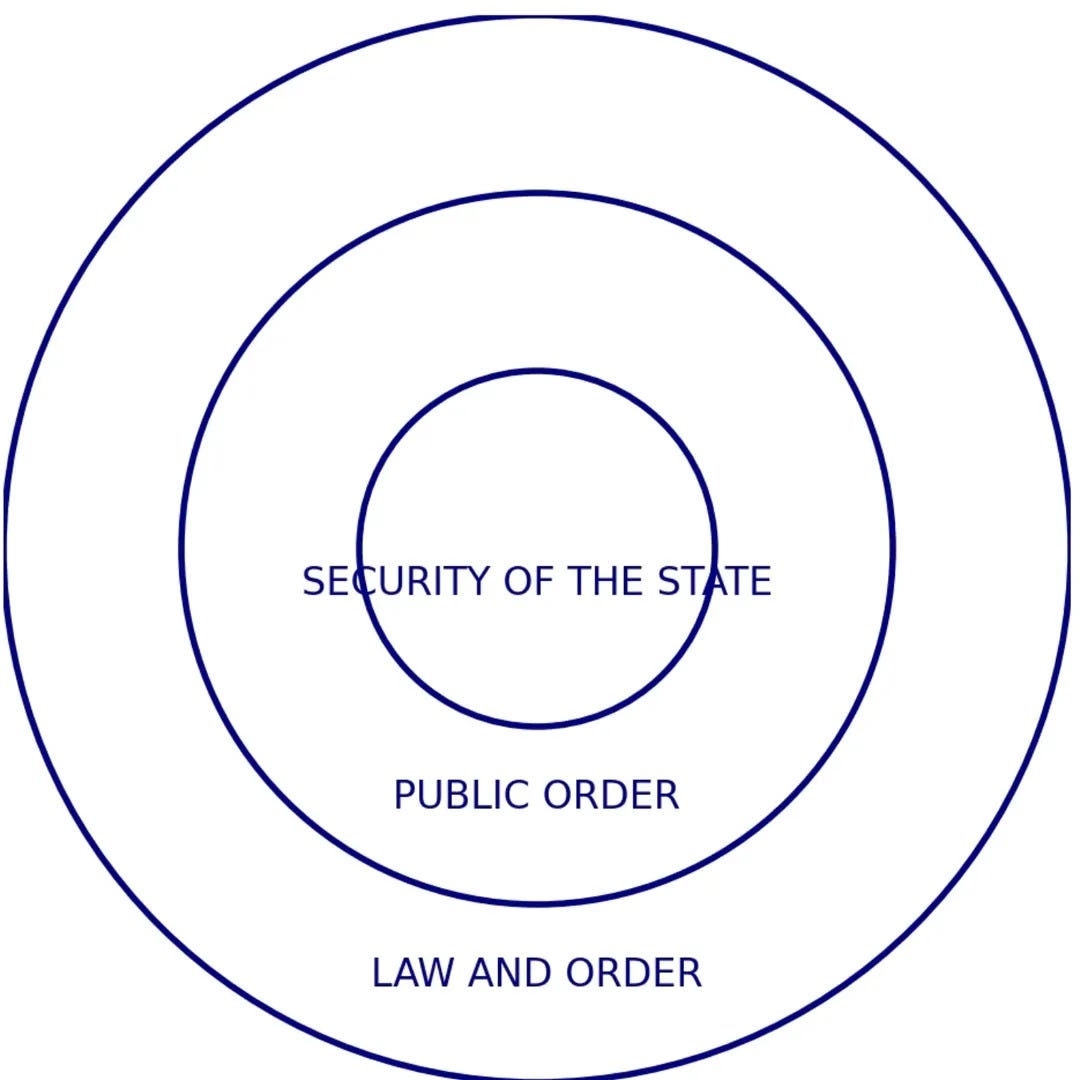
- Law and Order: The widest circle (e.g., ordinary crimes like theft).
- Public Order: A smaller circle (e.g., riots or major disruptions affecting the community).
- Security of State: The smallest, innermost circle (e.g., war, terrorism, or acts threatening the nation’s existence).
By ruling that “destabilizing civic life” (a Public Order issue) equates to a threat to sovereignty, the Supreme Court has effectively erased the middle circle. It allows the state to prosecute road blockades as acts of terror.
Ignoring Precedent
This new interpretation also contradicts Hitendra Vishnu Thakur v. State of Maharashtra (1994). That judgment clarified that a crime, no matter how heinous or brutal, is not necessarily a “terrorist act” unless the specific object of the crime is to strike terror.
Furthermore, it walks back the Delhi High Court’s 2021 observation in Asif Iqbal Tanha, which famously noted:
“The foundations of our nation stand on surer footing than to be likely to be shaken by a protest, however vicious, organized by a tribe of college students.”
The “Economic Security” Fallacy
Finally, the Court’s reliance on “economic security” is misplaced. When read with Clause (iiia) of Section 15, economic security specifically refers to “damage to the monetary stability of India” via counterfeit currency.
Stretching this clause to cover general disruptions to societal functioning creates a weapon that can effectively silence dissent under the guise of national security.
메타데이터
- post_id
- c9cde97cfa77
- slug
- blurring-the-lines-how-the-supreme-courts-latest-uapa-ruling-erases-the-middle-circle-c9cde97cfa77
- url
- https://medium.com/@prajanayvyas/blurring-the-lines-how-the-supreme-courts-latest-uapa-ruling-erases-the-middle-circle-c9cde97cfa77
- canonical_url
- https://medium.com/@prajanayvyas/blurring-the-lines-how-the-supreme-courts-latest-uapa-ruling-erases-the-middle-circle-c9cde97cfa77
- author_url
- https://medium.com/@prajanayvyas
- status
- ok
- fetched_at
- 2026-08-15 19:48:24