Seven and a Half Decades
Reflections on the times past at age 75
Seven and a Half Decades
Reflections on the times past at age 75
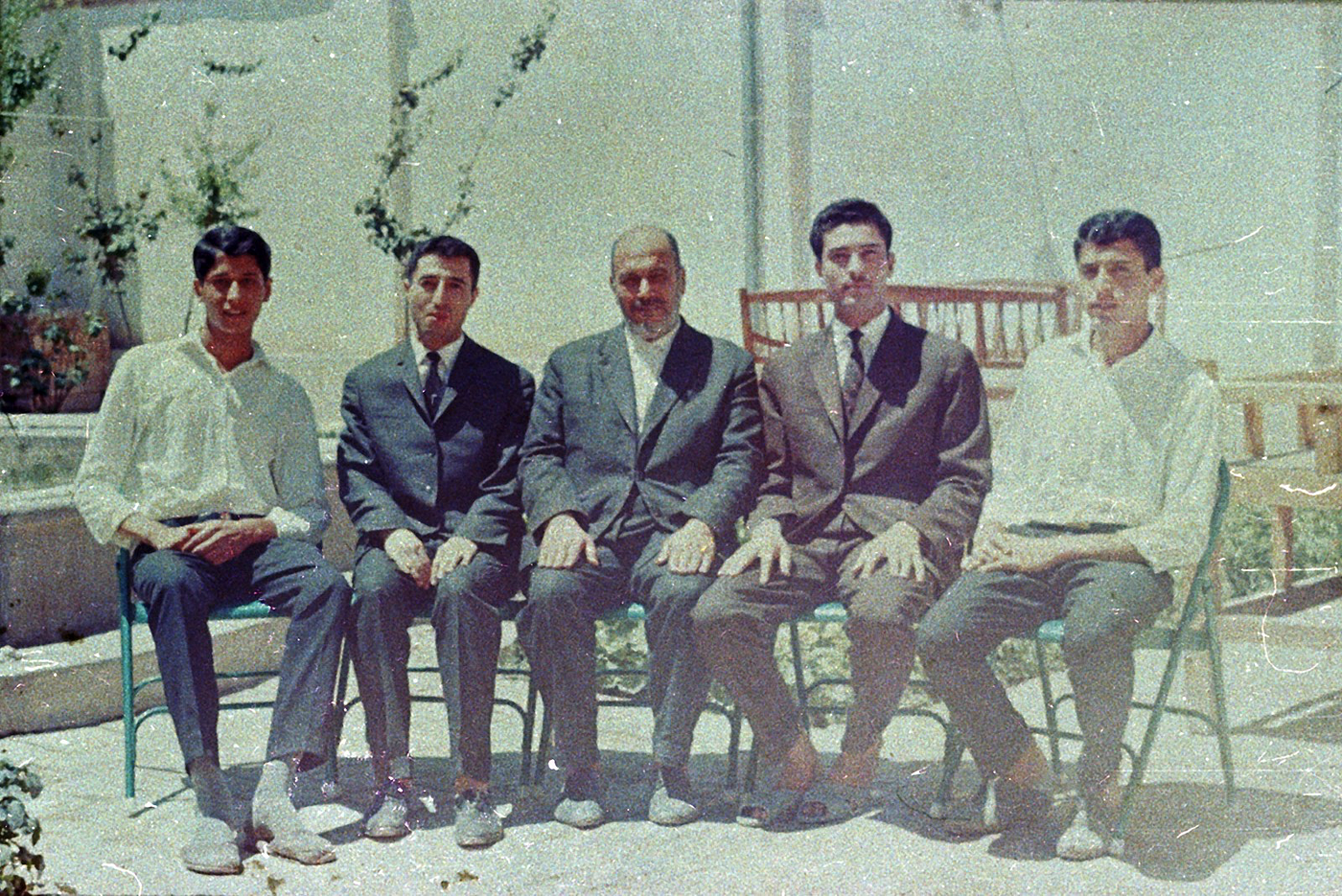
This is the picture of my father and his four sons. I’m the one on the right. I was 17 years old then. I also have three sisters, so my mother spent many years being pregnant. My three brothers, my father and mother have all passed away. My three sisters and I are the ones left and I’m 75 years old now. At 75 I’m an old man. But 75 years is just seven and half decades. That’s really not that long, since decades pass so quickly. Decades are like chapters of your life, and before you know it you are at the end of the book.
I took this picture in 1963. My oldest brother, second from the left, had just finished medical school and gotten an SLR camera as a gift. It had all kinds of manual controls and was complicated to use, so everyone shied away from it except me; I loved it. I read the manual from cover to cover and learnt the function of every button. I even learnt that 1.4, the first f-stop on the lens, is the square root of 2, and every f-stop, going from 16 to 1.4, is twice larger than the previous one. This picture was overexposed anyway, because I was a rookie.
I spent the first two decades of my life in Esfahan, Iran, where I was born. When I was six years old my father moved us to a new house, so my memories of the old house must be from when I was a small boy.
I remember one day the neighbor’s boy, who was about my age of 4 or 5, started screaming as though he was in severe pain. When I asked my parents what was happening they explained he was being circumcised. It took a long delicate conversation to make me understand that good Moslem boys had to be circumcised. Scared and crying I asked if they were going to do that to me. They told me I was circumcised when I was an infant, something our neighbors should’ve done for their boy, so he wouldn’t have had to suffer like this.
When I saw the neighbor’s boy the next day, he had a sheet wrapped around his legs, instead of wearing pants. He looked embarrassed for being in that predicament. When I saw blood spots on the sheet I got scared and looked down to see how much of mine was cut away. I wondered if God, in his rush to put us all together, had made a small mistake, and the grown ups in their wisdom were helping God by cutting away that mistake.
Many years later I learnt that circumcision was not only for good Moslem boys, it was also a prevailing tradition in the Jewish community. Early Christians also followed this practice until Saint Paul, in his evangelical zeal to convert the macho Romans to Christianity, realized circumcision was not a good marketing tool, so he dropped that requirement. In the 7th Century CE Moslems went back to requiring it for the good Moslem boys. So decisions made thousands of years ago, by people in distant places who spoke different languages, made the neighbor’s boy scream in pain, and scared me about the injuries done to my manhood.
In 1951 the Prime Minister of Iran Dr. Mossadegh nationalized the Anglo Iranian Oil Company, a popular move that brought masses of people to the streets to celebrate. I remember sitting on my uncle’s shoulders watching the noisy crowd.
The English were very possessive of the Iranian oil resources. At the turn of the Century the English had secured the rights for oil exploration in Iran for a paltry sum of £20,000, plus a small percentage of the profit. Over the next four decades the Iranian oil production had helped the English economy and fueled her navy over two World Wars. In 1953 the English, with help from the CIA, orchestrated a coup that overthrew the government of Dr. Mossadegh. This coup, that ended a budding democracy in Iran, created a political turmoil, with lasting domestic and international consequences that can be felt all the way to the present time.
After finishing high school in 1965 I passed the entrance exam to attend Tehran Polytechnic. When I told my family I wanted to go to America instead, they thought I was crazy. In those days passing the entrance exam to the university was a major achievement for a high school graduate. It was reasonable for them to think I was unreasonable, but I was adamant about leaving Iran. I promised my father that if he paid for my ticket to America I would work and put myself through school.
In the summer of 1966, at age of 20, I arrived in Monterey, a city in Northern California. Many rich people lived their retirement years there, enjoying its beautiful Pacific coastlines. Natural beauty aside, I had to work and put myself through school. I got a job as a busboy in a restaurant, and found myself a room in exchange for cleaning the house once a week. This beautiful house was located in Carmel By The Sea, a city that years later became well known because of its famous mayor Clint Eastwood.
The owner of the house was a talkative old man who often bragged about his wealthy Southern family who were plantation owners. In 1966 he was 91 years old, and proudly spoke of his father who had fought in the Confederate Army. The Civil War had happened a long time ago in another century, but here I was talking to someone whose father had participated in it. It felt strange to be so close to something so ancient.
What intrigued me about this old man was his naked racism. He mourned the Confederate loss and spoke about Blacks in the same manner that his father may have spoken about his slaves. He thought I was a young naive foreigner whose head was not yet polluted by the Liberal Media, so he lectured me often to indoctrinate me. Actually I had listened to the passionate speeches of Martin Luther King and Malcom X, and this old man’s racist views only proved the correctness of their struggle and the importance of the Civil Rights movement.
Before I came to the US my understanding of the Civil War and race relations in America was from a picture in the library of the American Consulate in Esfahan. This was before the Iranian Revolution, when there still was an American Consulate in Esfahan. My high school buddies and I visited this library often, not for its books but for a beautiful young librarian, whose desk faced the entrance and greeted everyone with a friendly smile. We all fought to be the first in the door, since we all felt possessive of her. On the wall above her desk was a picture of Abraham Lincoln with his hands over the shoulders of two boys, one Black and one White. For us this picture summarized the Civil War: the North had won, Abraham Lincoln had freed the slaves, and everyone lived together happily ever after. This was our naive view of race relations in America, until the old man taught me otherwise.
When I left Iran I had told my father I was going to study architecture, but I really wanted to study cinema. I couldn’t tell him that because people of his generation thought anything related to entertainment was for lowly people. When he found out I was taking theater classes he wrote me a letter saying if he knew I wanted to take theater classes he would’ve put me in the local clown school. In those days making overseas phone calls was very difficult, so we wrote letters that took about two weeks to reach its destination. In my rebellious manner I wrote back that I was putting myself through school and I could take any classes I wanted. Naturally, my father and I stopped communicating until many years later when I went back to Iran.
In a Spring day in 1968, when I arrived at school I saw everyone standing in silence around the flag poll, with the flag half raised. Martin Luther King had been assassinated.
In 1969 I moved to Los Angeles to continue my education at California State University in Los Angeles. Not having a place to stay, I slept in my car for a few nights and later found a room in an old lady’s house in East Los Angeles. Her name was Mrs. Joseph and she was the only Jewish lady in an all Mexican neighborhood. At the turn of the century this neighborhood was populated with Eastern European Jews, and by the 1950’s it had become an all Mexican neighborhood. Her house was a small two bedroom house. In one of the rooms she had two beds that she rented to two foreign students. I paid $35 per month and shared the room with a student from South Vietnam. His father was an officer in the South Vietnam Army. My roommate was very careful expressing his views about the war or politics, since any sign of dissent from him would have jeopardized the safety of his father.
Mrs. Joseph was a petit old woman in her 80’s who loved watching the Laker games. Whenever there was a game she unplugged the phone and watched the game with passion. I’ve been a Laker’s fan ever since.
In 1971 I started graduate school at UCLA and also got a job as a photographer to document the educational growth of migrant children, whose families followed the harvest from state to state. The writer and director of this project was August Coppola, a brilliant educator and writer, and the older brother of Francis Ford Coppola. We travelled through many of the Southern States and went all the way up the East Coast to Upstate New York. This was an amazing experience of seeing the country up-close and learning about the locals who lived there. Above all this was a chance to get to know August and develop a close friendship with him that lasted until his death in 2009. You can read more about this trip in another Medium article I wrote here.
In 1974 I went back to Iran to visit my family. I was greeted warmly by everyone, especially by my father, who had stopped communicating with me ever since I had sent him that rebellious letter. Now he treated me as an adult who had survived eight years on his own in a foreign country. He opened up to me and told me about his youth. He had lost his father when he was 14 and had worked hard to support his family in the small town where he lived. Being the eldest male in the family, he had to choose a surname when birth certificates first became mandatory in Iran. In our family tree he is the first Rezvani, the surname he chose for us. I enjoyed listening to my father and felt very close to him.
The day I was leaving to come back to America we had a long hug. I could see in his eyes that he was saying goodbye to me for the last time. I was in America a year later when he passed away at the age of 75.
One day in January 1982 August and I planned to go out fishing on an excursion boat in Santa Monica Bay. The same day I got a call from a friend who was inviting me to dinner to introduce me to someone he thought I would like to meet. I had recently broken up with a girlfriend and friends were trying to fix me up with someone. That day I caught the biggest halibut on the excursion. August said it was my lucky day and that I’ll be meeting someone special at the dinner that night. He was right, I met my wife that night. As a wedding gift August designed a beautiful neon light for us. It shows the second letter of my wife’s name in Persian.

Wedding gift designed by August Coppola
In 1985 I was on a job in Atlanta when I got a call from my nephew informing me of my mother’s passing in Iran. Although I had not seen her for more than ten years, at that moment I really felt her absence and wished I had been with her.
In 1991 our two daughters were 6 and 8 years old and my wife and I had a dilemma of how to introduce them to the subject of religion. Although my parents were devot Moslems, as a teenager I had come to the conclusion that religions were inherited rituals, and there was no reason to believe one was more correct or better than another. So my wife and I didn’t want to indoctrinate our daughters in any religion. We also did not want to leave them uninformed so that they’ll be susceptible to indoctrination by others. So we decided to take them to various religious institutions, and have someone explain their practices to them. A few of their friends also joined them. We made a documentary about it that was shown on the local PBS channel in Los Angeles. You can see the documentary here.
Some years later our younger daughter in a college assignment had written about her positive experience doing that project. I felt very proud of our family for having done that.
In 2009 “Tetro”, the latest movie by Francis Ford Coppola, opened in theaters. A few days after the opening I got a call from August. He was very upset so I went over to his house. I had seen August in rocky relationships with women, and had heard him complain about various people, but this time he was angry with his brother Francis. To August “Tetro” was an autobiographical movie where Francis was getting back at his older brother. “Tetro” is about the artistic rivalries of two Italian immigrant brothers. Although it is fictionalized and the setting is in Argentina, August’s conclusion was not farfetched. Knowing August and his family I actually felt Francis was trying to reach out to his brother in “Tetro”, but August took it differently. To prove his point August referred to a number of Francis’s movies where the main character kills the older brother, like in the “Godfather”. Even in “Rumble Fish”, which was dedicated to August, the older brother gets killed. I couldn’t say anything to please him, so I listened. When he paused to finish his drink I asked: “August, do you know why the Germans refer to their country as Fatherland and the Russians refer to theirs as Motherland?” He said he didn’t know. I said “I don’t know either, but do you think that’s why they’ve been screwing each other for so many years?” He laughed and said that was a good one. At least I had changed the subject and his mood for a short period of time.
August passed away on October 27, 2009. He was 75 years old.
I’m 75 years old now. There maybe a few more pages left in this book, or if I’m lucky perhaps a couple of more chapters. Whatever it is it will be a bonus to a life well-lived.
메타데이터
- post_id
- c9d326fea2a9
- slug
- seven-and-a-half-decades-c9d326fea2a9
- url
- https://medium.com/@mort.rezvani/seven-and-a-half-decades-c9d326fea2a9
- canonical_url
- https://medium.com/@mort.rezvani/seven-and-a-half-decades-c9d326fea2a9
- author_url
- https://medium.com/@mort.rezvani
- status
- ok
- fetched_at
- 2026-07-17 05:19:11