The BRRRR Strategy Pivot: Using Bridge-to-DSCR Financing in a Cautious Market
Let’s be honest: the “good old days” of BRRRR (Buy, Rehab, Rent, Refinance, Repeat) where you could throw a dart at a map, buy a shack for…
The BRRRR Strategy Pivot: Using Bridge-to-DSCR Financing in a Cautious Market

Let’s be honest: the “good old days” of BRRRR (Buy, Rehab, Rent, Refinance, Repeat) where you could throw a dart at a map, buy a shack for $50k, and get a cash-out refinance at 3% are long gone. If you’re still trying to use a 2020 playbook in 2026, you aren’t just nostalgic: you’re likely bleeding cash.
The market has shifted. We’re in a “cautious” phase where lenders are pickier, appraisal gaps are real, and interest rates aren’t doing us any favors. But the BRRRR strategy isn’t dead; it has just evolved. The smart money has pivoted away from traditional bank financing and high-interest, short-term hard money and moved toward a more integrated approach: Bridge-to-DSCR financing.
If you want to keep growing your portfolio without getting stuck with a property you can’t refinance, you need to understand how this pivot works.
The Problem with the Traditional BRRRR Model Today
In a low-interest, high-appreciation environment, you could survive a lot of mistakes. You could overpay for the “Buy” phase because the “Refinance” phase would bail you out with a massive valuation hike.
Today, that cushion is gone. According to the Sinai Capital Q1 2026 Rate Trends report, while rates have stabilized, the volatility in secondary markets means lenders are tightening their debt-service coverage ratio (DSCR) requirements. If your property doesn’t cash flow at today’s rates, the bank isn’t going to give you your money back. Period.
This is where the pivot happens. Instead of treating the rehab and the long-term loan as two separate battles, successful investors are now looking at them as one continuous mission.
Step 1: The Buy and Rehab with Modern Bridge Loans
The “Buy” and “Rehab” phases are the most capital-intensive. Most people default to hard money here, but in a cautious market, you should be looking at bridge loans for real estate.
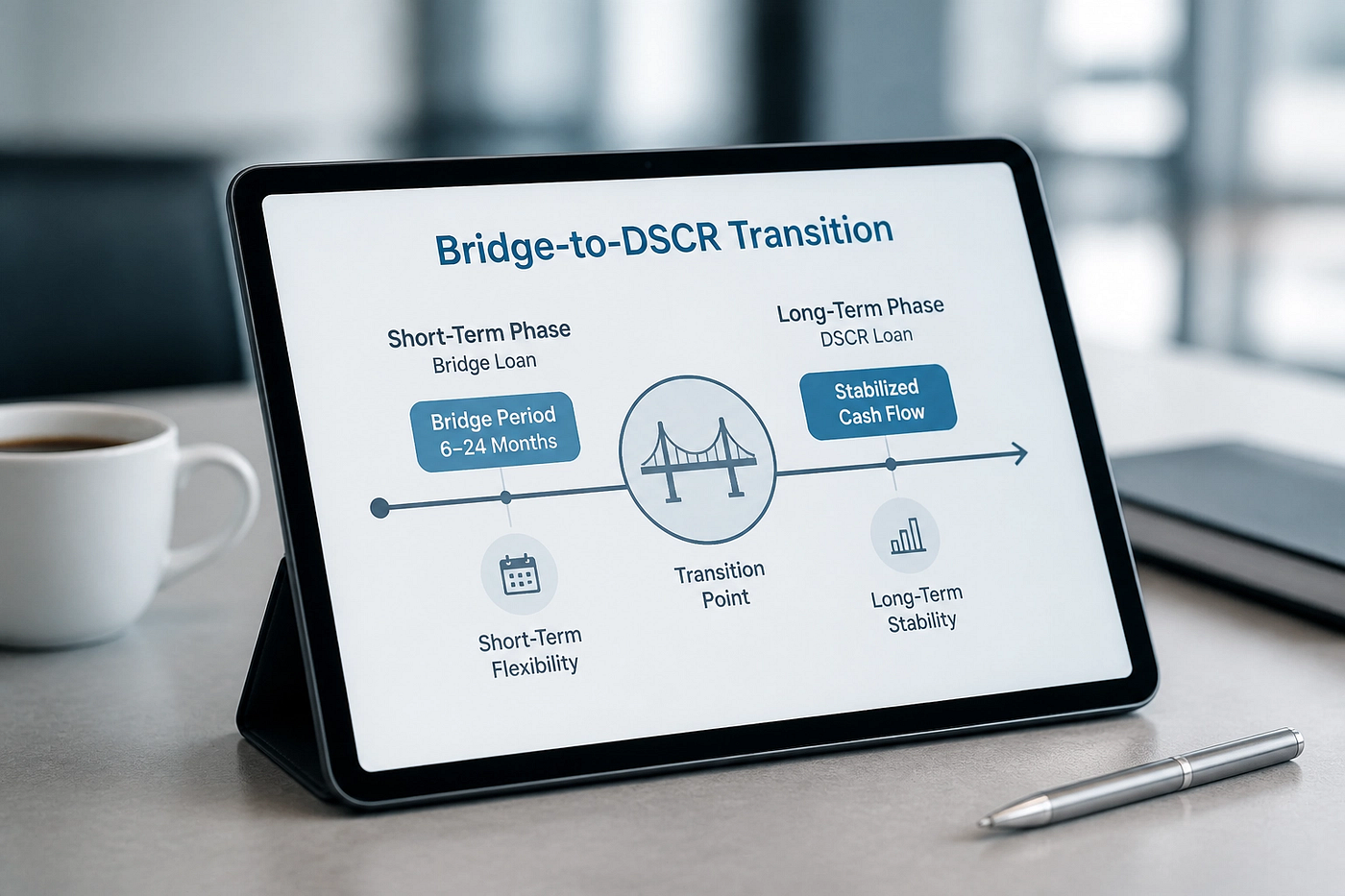
Why? Because traditional hard money often comes with “gotchas”: punitive interest rates if you take an extra month on the kitchen remodel, or rigid terms that don’t allow for an easy exit. Modern bridge loans are designed to be the “bridge” to your long-term debt. They offer the speed of hard money but often come with more flexible terms that anticipate you moving into a DSCR loan.
In 2026, the NPLA Private Lending Market Report highlighted a significant trend: bridge lenders are now focusing more on “as-completed” value (ARV) rather than just the purchase price. This is crucial for BRRRR investors. If you can secure a bridge loan that covers 100% of the rehab costs, you preserve your liquid capital for the next deal.
But don’t bullshit yourself on the ARV. In a cautious market, assume the appraiser is going to be conservative. If your deal only works if the house appraises at the absolute top of the market, it’s not a deal: it’s a gamble.
Step 2: The Pivot to DSCR Refinancing
The magic (and the risk) of BRRRR is the “Refinance.” This is where you pull your initial investment back out to go buy property number two. In the current landscape, DSCR loans for BRRRR investors are the ultimate tool.
DSCR loans are unique because they don’t care about your personal income. They don’t care if you’re self-employed or if you have ten other mortgages. They care about one thing: Does the property’s rent cover the mortgage payment?
If your property has a DSCR of 1.20 or higher, you’re in the gold zone. Even in a high-rate environment, if you’ve picked a strong market with high rental demand, the DSCR model allows you to scale much faster than traditional Fannie Mae loans, which often cap you at 10 properties.
Why Integrated “Bridge-to-DSCR” is the Move
One of the biggest mistakes investors make is using one lender for the bridge and then hunting for another for the DSCR. This is a massive waste of time and money.
Lightning Docs 2026 Trends shows that the most successful private lenders are now offering “single-closing” or “integrated” products. These allow you to transition from the bridge phase to the permanent DSCR phase with minimal paperwork and reduced closing costs.

Think about it: the lender already has your title work, your appraisal (updated for ARV), and your entity docs from the bridge phase. Transitioning to a long-term loan should be a button-click, not a two-month nightmare. This speed is what allows you to “Repeat” the BRRRR process while your competitors are still stuck in underwriting.
Comparing the Stack: Bridge vs. Hard Money vs. DSCR
It’s easy to get lost in the terminology. When you’re comparing DSCR and hard money, you’re really comparing a sprint to a marathon.
- Hard Money: High interest, short term (6–12 months). Great for fix-and-flips, but dangerous for BRRRR if you can’t exit quickly.
- Bridge Loans: The middle ground. Often slightly lower interest than hard money, designed specifically for that 12–24 month window where you are stabilizing the asset.
- DSCR Loans: Long-term (30-year) fixed rates. This is your “forever” debt that protects you from future rate hikes.
In 2026, the winning strategy is using the Bridge to survive the renovation and the DSCR to secure the cash flow. Trying to “bridge” with your own cash is a recipe for a stalled portfolio. Trying to “refinance” with a traditional bank is a recipe for a headache.
Real-World Market Data: What the 2026 Research Says
Let’s look at the numbers. The Sinai Capital Q1 2026 report indicates that while the Federal Reserve has stopped the aggressive hiking cycle, they aren’t exactly rushing to cut rates back to zero. We are in a “higher for longer” environment.
This means your margins are thinner. In 2020, you might have had a 300-basis-point spread between your mortgage and your cap rate. Today, it might be 100 points.
Does that mean you stop buying? No. It means you stop buying junk.
The NPLA 2026 Report found that properties in “landlord-friendly” states (think Texas, Florida, the Carolinas) are seeing much higher LTV (Loan-to-Value) approvals from DSCR lenders compared to states with strict rent controls. If you’re BRRRR-ing in a market where you can’t raise rents to match inflation, your DSCR is going to fail, and your capital will stay locked in the deal.
Execution Over Theory
The BRRRR strategy pivot is about being a professional, not a hobbyist. A hobbyist hopes for appreciation. A professional secures financing that works even if the market stays flat for three years.
By using an integrated Bridge-to-DSCR approach, you mitigate the “refinance risk.” You know exactly what the exit looks like before you even swing a hammer. You aren’t praying for a low interest rate in six months; you are underwriting the deal based on the DSCR reality of today.
That’s not just “investing”: it’s smart business.
Don’t overthink it. Find a market where the rents make sense, get your bridge financing in order, and have your DSCR exit strategy ready before you close. In a cautious market, the person with the most flexible financing wins. Everything else is just noise.
Sources:
- Sinai Capital Q1 2026 Rate Trends: Analysis of secondary market liquidity and private lending rate stabilization.
- NPLA (National Private Lenders Association) Private Lending Market Report 2026: Trends in LTV discipline and geographic lending preferences.
- Lightning Docs 2026 Trends: The rise of integrated loan documents and standardized Bridge-to-DSCR products in the US market.
메타데이터
- post_id
- c9dbc8a5596b
- slug
- the-brrrr-strategy-pivot-using-bridge-to-dscr-financing-in-a-cautious-market-c9dbc8a5596b
- url
- https://medium.com/@sydneydaniels_45393/the-brrrr-strategy-pivot-using-bridge-to-dscr-financing-in-a-cautious-market-c9dbc8a5596b
- canonical_url
- https://medium.com/@sydneydaniels_45393/the-brrrr-strategy-pivot-using-bridge-to-dscr-financing-in-a-cautious-market-c9dbc8a5596b
- author_url
- https://medium.com/@sydneydaniels_45393
- status
- ok
- fetched_at
- 2026-06-09 15:37:30



